


Text and photos by Patty Huston-Holm
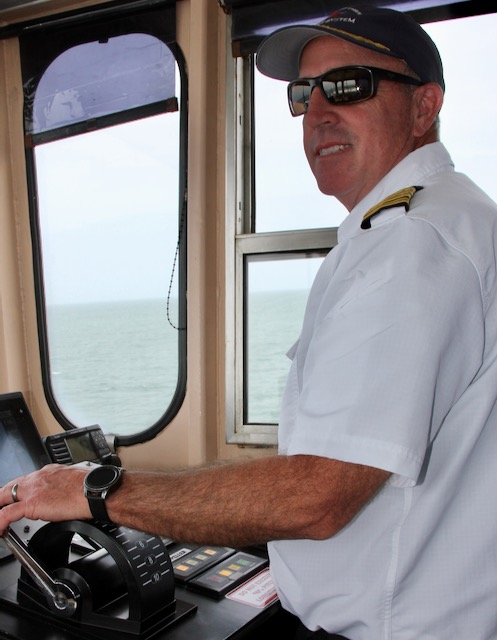
Hatteras Ferry Captain Anthony Gavetti ruined my vacation last year. This year, after meeting him and learning about his work, I’m glad he did.
As a captain of the ferry traveling Hatteras-to-Ocracoke and back, Gavetti is one of 45 captains in the North Carolina Ferry Division.
We’re not 100% sure he was calling the shots in March 2024 as my husband, Mike, and I tried desperately but unsuccessfully to get from Hatteras Island to Ocracoke Island for our off-the-social-media dream trip with our granddaughter. But if he didn’t, he would have.
In the name of safety, Gavetti calls the “go” or “no-go” shots for all the ferries traveling from Hatteras to the NC Highway 12 connection on the north end of Ocracoke Island.
Sometimes, the boats are suspended due to mechanical problems.
But usually, it’s inclement weather, including high wind. Gusts of 35 to 40 mph and shifting sand can make water unsafe for all boats.
Sand, wind and unpredictable water levels within the Pamlico Sound, Hatteras Inlet and Atlantic Ocean were issues during the unseasonably cold temperatures in that last week of March in 2024.
“Don’t get me wrong; I care about tourists,” Gavetti said. “But my focus is more on the people who live on the island and need to get home and the delivery trucks with food or maybe somebody’s prescription medicine. I need for it to be safe for everybody.”
Gavetti is a captain of the 22-year-old M/V Croatoan, named after a small Native American group living on what is now Hatteras Island back in the 1500s when Europeans first landed there.
I knew the Hatteras-to-Ocracoke route is the busiest of the seven routes. I have been among the estimated 1 million passengers per year using the ferry there. More than once, I was an impatient, cranky one.
I also knew the North Carolina ferry system to be the second largest in the country behind Washington state.
I shadowed Captain Gavetti, 50, on April 4. For six hours that day I posed incessant questions to him and his older and semi-retired captain back-up partner, Ricky Jones.
The average ferry passenger wants to know how long the trip will take and if the boat is going in the right direction. The average passenger hears the horn upon takeoff, absent-mindedly taking in the message to do what the captain tells you “in case of emergency.”
I wanted to know more. Gavetti patiently complied, sharing his background, credentials, stories and why the banana I ate was bad luck.

Ferry service began across the Hatteras Inlet to Ocracoke 72 years ago, in 1953. This is Gavetti’s 28th year.
Most of my conversation with Gavetti was in the wheelhouse up two flights of stairs where often it’s only the radiator and music that break the quiet.
Shortly after 8 a.m. the Croatoan pulled away from South Dock (as the north end dock is called) into the Hatteras Inlet and then into the Pamlico Sound. A sound is a body of water, typically a long, wide inlet or channel, connecting two larger bodies of water, in this case the Atlantic Ocean.
The two share in “guiding,” or directing a 275-ton, 150-feet-long, 42-feet-wide vessel between buoys and around often-changing piles of sand making up a shoal or sandbar.
The water needs to be deep enough. The depth a ferry sits in the water, also known as its “draft,” varies greatly, depending on the size and type of ferry, but generally ranges from around 3 to 15 feet (1 to 4.5 meters).
Alongside Jones, his teammate of 16 years, Gavetti works 12-hour shifts, 7 a.m. to 7 p.m., seven days a week (Tuesday to Monday) with seven days off after that.
Under the captain are chief engineer, oiler/assistant to engineer, senior AB (able body), AB and ordinary seaman. Two people must be in the captain quarters at all times.
To be captain, a minimum requirement is at least 360 days working on a vessel of 100 tons or greater.
“Able-bodied is probably the most important qualification for all of us,” Gavetti, a native of Carteret County, said. “I had to take a test to do this job, but my physical condition is what is monitored.”
The captain has the job of steering the boat and directing vehicle placement based on boat weight balance. The rest of the crew maintains order, safety and cleanliness with backup for each role.
“Sometimes, they fix me breakfast,” Gavetti. As I finished my banana, he added, “But no bananas.”
He then relayed legends of African ships disappearing under the Atlantic Ocean with “only bananas floating on top” and of deadly spiders hitching a banana ride. Thus, the yellow fruit has taken the blame for death and destruction.
“It’s just a tale, I suppose, but we all know about it,” he said. “Nobody in the crew eats bananas on the boat.”
To passengers who on this day made the boat less than half of its 30-to-40 vehicle capacity, the work of the captain might seem seamless.

Passengers exit their cars, trucks and vans to use the bathroom, feel the ocean air on their faces, get a closer view of the gulls gliding above the rear wake and peel their eyes for dolphins.
On this day, a half dozen dolphins were diving in and out, “getting food that we stir up,” Jones said.
Research revealed that the Roanoke Sound, which includes Hatteras Inlet, is home to an estimated 400 to 800 dolphins.
“It might seem very monotonous, and it is,” Gavetti said, noting that on a ferry sometimes the front (bow) becomes the back (stern) and vice versa. “But you need to be ready. You have to be able to detect something different.”
Brewing storms are always on a captain’s radar.
The worst of them, hurricanes, suspend water travel, with the last one having been Isaias in 2020, though that storm went well to the west of the Outer Banks.
What most passengers don’t know about – but all Hatteras ferry crew members do – are the problems the last two years with Sloop Channel, which the ferries encounter about a third of the way into the run from the Ocracoke side.
This channel had bulged out to skirt shoals but could not accommodate two ferries, causing time delays while one ferry waited for the other to pass through. Last year, Hyde County and the Ferry Division received an emergency permit to cut off that bulge, shortening the run time.
“This was the section that aged us all by 10 years,” Gavetti said of that bulge. “We were always struggling to get through that without incident.”
Creation of the channel that is used today required research by archeologists to determine that dredging wouldn’t destroy something (an old, buried ship, etc.) as well as engineering study.
“We called this ‘the gauntlet,’” he said of that route “that kept getting further and further out” before the emergency cut was dredged. “There were so many agencies involved in making that better that when it was finally opened as a big slough, we saluted it.”
From the Hatteras dock, Gavetti can see his house. He has a wife who teaches kindergarten and four children, ages 25, 17 (twins) and 15.
Gavetti and Jones, who hails from Frisco, go home at night while other crew members from farther away stay in dormitories.
Gavetti’s father was a fisherman and a ferry boat captain. Also, once a commercial fisherman, Gavetti gravitates to the water even when on vacation. Marathon City in the Florida Keys is a favorite spot.
Gavetti’s first ride on a ferry was in seventh grade when his basketball team was coming over to compete against the Ocracoke Dolphins. He recalls always being fascinated with boats – tugboats, dredging spider barges, cruise ships and, of course, ferries.
“Village councils and businesses are talking about us – the ferries – all the time,” the captain said. “Businesses get ticked off because the tourists can’t get over, and then they’re not making money. But when they realize it’s about safety, they calm down.”
