

This story won third place for feature writing in the 2025 N.C. Press Association contest, Online division.
By Connie Leinbach
Does anyone ever get over their first great love?
If you are Asa Jonathan Zoesman, that’s a no.
Zoesman, 72, has been on a quest to come to terms with the tragedies that befell him 53 years ago when he lost his baby and later his wife, Maggie Goldberg, who drowned in the wilds of Canada’s Northwest Territories. He visited Ocracoke recently in his tricked-out Tesla, complete with a Starlink antenna on top. Emblazoned on the front in letters made with colored electrical tape are the words “Arctic Tesla Film.” It causes double takes wherever he goes.
As an attention magnet, it’s supposed to engender discussions with people – and possible film producers and collaborators – to help get the word out.
“I just park the car and people come up to me,” he said about his transportation that has a passenger-seat film studio.
Zoesman applied those words to the car’s hood after having driven the car two years ago in the dead of winter to Tuktoyaktuk at the edge of the Arctic Ocean in the Northwest Territories. He was the first to do that in a Tesla.
But the vehicle is less important than the story.

“To be on that river that she disappeared in,” he said about his quest. “To go back to the river where she was never found.”
The film is a documentary about the couple’s love story and their experiences living in northern Canada in the early 1970s.
“I got married when I was 17 in 1969,” Zoesman recalled, noting that they’d known each other since the second grade. “We were madly in love, and we went to Canada because the Vietnam War was happening and (Maggie) didn’t want me to die in the war or go to jail. We wanted to be free.”
Canada was open to Americans and because the couple wanted to homestead and live off the land they took off into the woods – first to Quebec and later farther northwest.
“It’s about cutting all the ropes and burning all the bridges,” he said about the film. “We wanted to get away from people.”
The film doesn’t have a title yet, and it’s not a total documentary. It has some live action, Zoesman said, but in the last two years he has traveled way up north in his electric car to rediscover the places where he and Maggie had lived and experienced tragedy.
The first one was the death of his one-day-old son, Aurora, so named as he was born under the northern lights in a cabin 252 miles north of Whitehorse.
After the baby died and since the birth wasn’t in a hospital, Canadian authorities held an inquest. An autopsy revealed that Aurora died of Hyaline membrane disease (HMD), also called respiratory distress syndrome (RDS), a condition that causes babies to need extra oxygen and help breathing.
They were exonerated but after that, the couple received chilly receptions from locals, some of whom had previously been friendly.
So, he and Maggie decamped to the Northwest Territories near Fort Liard where they had just homesteaded five acres of land for $5. They had a campsite along the Flett Creek and one day they needed to travel 70 miles away to the nearest town for vegetable seeds.

After trekking along the creek, they found some flotsam with which they quickly fashioned a raft and floated into the Liard River. A passing motorboat offered them a ride, though they lost their raft.
During the return trip, as the boat captain refilled the gas tank he spilled oil onto the boat floorboards.
And just as their campsite came into view, the captain threw a lit cigarette onto the bottom of the boat igniting a fire.
“It’s time to hit the drink” the captain yelled to the couple.
They did and swam to a mud flat in the middle of the river. Their campsite was 1,200 feet on the other side of the river, but the river current was fast.
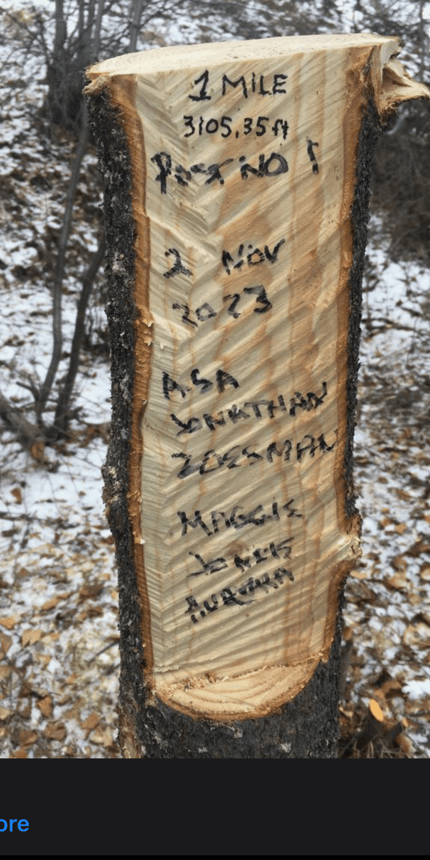
Knowing they could not last overnight outside in the wet, the couple knew they had to swim across to the shore.
So, they jumped again, and after Zoesman fought the current and clambered to the shore, he was alone.
Maggie, didn’t make it. She was swept away.
“We searched in a helicopter 50 miles downstream,” Zoesman said, but Maggie was never found. “We were so in love and then, poof. Just like that it was taken.”
But never forgotten.
Since 2018, he has worked on telling this story. First it was as readings, but after a while it morphed into a film and Zoesman created a film studio in his home.
“My intention from the beginning was to make a movie that has never been made before; completely out-of-the box,” he said. “Not Hollywood, but a real thing, and it requires a lot of different input.”
For the last two years, to get scenes for his film, Zoesman has been driving his Tesla from his Petersburgh, New York, home to the Yukon, the Northwest Territories and the Arctic Ocean and getting press along the way.
As the spirit moves him, he’s made side trips, such as a recent foray to Plains, Georgia, where he witnessed the funeral for the late president Jimmy Carter, and then to the Ocracoke.
On one of the trips into Canada, he traveled to his son’s gravesite for the first time since that event. There he said a Jewish prayer and placed two stones his mother had collected from the shore of the Liard River after Goldberg went missing.
And he’s also learning things that are different from his experiences in the 1970s, especially gaining new understanding of the native people, their lands and their historic struggles with white settlers.
“I had no real concept of this when Maggie and I went there,” he said. “We just wanted to go out in the woods.”
So, in gathering film footage, he has included perspectives of First Nation chiefs.

“It’s going to be fascinating,” he said about the film. “People are going to learn from this. It’s going to be educational.”
An electrical contractor by trade, Zoesman, with the help of Jeanne Marie, his second wife of 45 years, outfitted the self-driving Tesla as a traveling film studio and home on wheels in which he can camp and park at charging stations.
“I don’t think I can separate what I’m doing from the vehicle that is carrying me forward, nor from the moment in time in which we live, nor would I want to,” he said.
He shares his progress with a 200-person mailing list.
A number of people in the film industry are working with him on the film, such as cinematographer Mike Rintoul, who has worked with director J.J. Abrams.
“There are hundreds of hours of footage, and it needs editing,” Zoesman said. “I’m in the film. I’m making the film. I’m working with all of these people trying to pull all of these things together.”
Zoesman will use AI to help complete the film, which he expects to be done by the end of this year.
The project has been a healing experience from the decades-old trauma.
Sometimes he leans back in the driver’s seat and lets the Tesla go where he has commanded it. It’s an adventure that has become reminiscent of his life with Maggie: floating down the river of life in a vehicle not unlike that long-ago raft.
“This craft is driving me,” he said about riding in the Tesla. “I am witness to the mountains sliding by. I lean back in my seat, down pillow cradling my head.
“Freedom. It might be borrowed; it might be quite temporal. That doesn’t matter. Such is life. Everyone wants to be free.”
Asa Jonathan Zoesman’s website arctictesla.org. Below is the full story titled “1000 Days: The Story of Maggie and Jonnie,” as told to Dalena Frost Storm, granddaughter of Robert Frost.


1000 Days
The True Story of Maggie and Jonnie
By Asa Jonathan Zoesman With Dalena Frost Storm
It is 1969, and I wake up with you at my side. The best thousand days of my life are about to begin. There are thirty-two of us in the loft on the second floor of an old barn that serves as the setting for a utopian experiment: a commune I founded where anyone can live so long as they are willing to work. We are working on a house, a barn, and a water system. Most of us come from Boston, some are local, and others come from far away. The rules here are simple: No drugs. No meat. Have a peaceful attitude. Work every day. It’s the weekend, and you must be interested to find out what’s going on here, and what we’re offering—an alternative way of thinking, and living.
I met you much earlier, and in my mind, the truth is that we are destined for each other.
We grew up in Mystic Side, Massachusetts, and when I was in the fourth grade, Dr. Michael Kramer predicted that I would marry you, for he had “never met two souls so much alike.” I don’t believe that Michael Kramer was psychic, and I saw you only a few times between fourth grade and now. But I can recall every moment like it is etched on my soul, and now that you are here next to me, I feel like I am coming into focus. Every glance we share makes me feel more real. This is where we are meant to be—together.
Each Friday and Saturday, cars arrive at the farm carrying visitors from Boston and New York. Hundreds of people come to spend a weekend here, but only a few become regular weekend residents. While they are here, everyone on the commune shares this single room, a twenty-four by twenty-four-foot space with a short knee wall and a peaked, twelve over twelve ceiling. It’s kind of pretty, all wood, with mattresses lying all around next to each other. A wild place, where people float from one bed to another or else bed down as couples. Yesterday, when I saw you, I was sure that you had come with a fellow. I recall my surprise when, late in the evening, when most everybody had gone to bed, you showed up at my bedside and said, in a quiet but knowing voice, “Is there room for me?”
Your hair is long and silky, halfway down your back. With your glasses off, you stare at me, assessing me. You seem to decide I pass the test.
Now you wrap yourself around me again, and the heat of it pulses through me like a recognition, like within you is my own heartbeat. I am not psychic, but even I can feel it like a premonition: I am destined for this and only this. There is no other way.
*
By the end of the summer, the commune has evaporated. On the Woodstock weekend, two of us stay behind to work on the commune instead of going to hear Jimmy Hendrix. But then, everyone goes back to school, including you. And you are the only one who really matters.
I know that you are at Antioch College in Yellow Springs, Ohio, pursuing your program in Urban Studies. You want to redesign urban landscapes, make them more habitable. I want to redesign everything—the whole universe—and the only person I want to do it with is you.
At the first early frost when there is nothing much left to eat in the garden, I load the few things I have into my dad’s 1952 Willy’s Jeep pickup and drive home to my parents in Mystic Side. My parents are Lillian and Max. They both have troubled pasts, thick with trauma.
“I’m going to see Maggie in Ohio,” I tell them.
They know you, and like you, but they are worried about my future. My eighteenth birthday is approaching, and if I don’t come up with some kind of plan, I’ll be drafted, but we’re all against the war in Vietnam, and none of us want me to go fight.
“How are you going to get there?” asks Lillian. “Hitchhike. Or walk.”
“You should get a job,” Max tells me.
“I still think you should go back to school,” says Lillian.
But both of them know they can’t stop me once I’ve made up my mind, so they don’t try very hard. The most they can do to signal their disapproval is tell me that they’re not going to help me get there, but I wasn’t anticipating any help. I know I’ll find a way.
When the day of my departure comes, Lillian stops me at the door. She has that look in her eyes, like she’s getting a glimpse of my future. She sees it, and she can’t stop it, so she chooses to accept it. “Wait just a minute,” she tells me gently. “Let me give you a ride to the highway.”
We get in the car and she keeps going until there is no traffic on the Turnpike and we’re far into Western Massachusetts, where she finally pulls over to the side. She puts ten dollars into my pocket like a stolen kiss.
“Don’t tell Max I did this,” she says, leaning in and embracing me.
I get out and watch as she drives away, then I turn around and stick out my thumb. But the first car that comes past is a blue and gray Massachusetts Police State cruiser. I jerk my thumb back in, too late. The car pulls over directly in front of me and a police officer steps out.
“Am I under arrest?” I ask.
He opens the door of the car and forces me into the backseat without an explanation; typical gruff police man. Not a great start to my trip.
We come to a large white building on the village green of Stockbridge, Massachusetts, where a black and white sign announces, “Police.” I am escorted inside. I’m dressed in a pair of
Levi’s, a red and black checkered flannel shirt, thick leather moccasins with big brass rings, a Daniel Boone style brown leather jacket with fringe, and a large white Stetson hat like Hoss Cartwright used to wear and which belongs to Max. My hair is long and stringy, and my beard is mostly under my chin and scruffy on my face.
I am told to come and have my picture taken, which I do, though they still won’t tell me the charge. Then they fingerprint me, and a man I am told is the judge arrives. He is stout and tall, with a white shirt that is unbuttoned at the collar, no tie, and no jacket. He doesn’t look too mean, so I hope I’ll get off easy.
“Were you hitchhiking?” he asks.
“I was hoping to. You had to arrest me for that?”
“On the turnpike, we do that. I see you have ten dollars,” he says, for they made me turn out my pockets, “so the fine today is ten dollars.”
“But that’s not fair!” I cry. First, they arrest me for no real offense, then they take every cent my mother gave me?
“Well, look, I can’t fine you less than ten dollars. But here’s what we’ll do: I’ll take your ten and we’ll give you a dollar back if you’ll just behave like a gentleman. Okay?” He turns to the officers in the room like he’s being a big man, and calls out, “Hey, boys, any of you got some loose change so we can give ol’ Daniel Boone here a dollar?”
I feel like I must be some kind of joke to them, and I end up with a pocket full of nickels and dimes and mostly pennies. Then the judge announces he’s going to give me a ride to the edge of town. He motions me to go.
We head out in the afternoon sunshine and get into his white Jeep station wagon. Before we leave, he turns to me. “You know, if you get picked up now in West Stockbridge, it’ll just
give me a bad name, so I think I’ll take you all the way to the New York state line, if that’s all right with you.”
“Fine.”
“Where are you headed, anyway?” “Ohio.”
I keep my answers short and to the point. I’m still peeved about the fine, even though I know he really is doing me a favor. Still we drive the seven or eight miles in uncomfortable silence. Finally, he asks, “Why are you going to Ohio?”
“I’m going to see Maggie.”
He exhales. “Ahhh.” Like that explains everything.
*
I am pulled to Yellow Springs like a salmon making its way upstream to return to its spawning ground. I have no idea what I’m doing, but I’m following an urge, something necessary to survive. I walk and walk. I walk most of the way to Albany, where I spend a short, fitful night in the bus station. When things begin to open for the day, I phone Max, who agrees to wire me twenty dollars—just enough for a bus ticket to Buffalo. I don’t mention anything about the ten dollars from Lillian or getting picked up by the police. Once I get the money, I take a local bus towards Erie, and when I get off, I start to walk along a tiny highway that runs along the Lake, through grape country. I have a few slices of bread and half a pack of Camels with me. I’m very thirsty, but surrounded by miles of vineyards, so I step a few feet off the highway and fill my bag with Concord grapes.
The skins are a little tough, but it’s easy to squeeze the flesh out of them and into my mouth. The luscious juice drips down my throat, and I am perfectly content, making my way to see you. The sky is beautiful. It feels like everything in the universe is in perfect alignment.
After midnight, I get to Erie, where I find my way to a mission that lets me stay for the night. In the morning someone tells me I can stay in a bed and work in the kitchen for my keep. Instead, I ask to call my father, who finally relents and agrees to send more money to help me complete my trip, since it’s clear I’m not turning back.
With the money from Max, I take the Greyhound to Cleveland, a train to the airport, a flight to Dayton, and a city bus to Xenia, from where there is supposed to be a bus to Yellow Springs. Instead of a bus, however, it is a Volkswagen Beetle that stops to pick me up. It’s covered with decals of flowers and filled with long-haired kids who happily take me to Antioch campus, where I ask everyone who walks past if they know your name. Finally, I meet someone who does.
“Yeah, I know her,” the girl tells me. She looks a little like you—long brown hair, but no freckles. “I think she’s in class right now. It’s called ‘The Global Condition.’”
I get directions to the building—it looks like someone’s house, modern, with gray painted walls. I walk right in and take a seat in the back of the room. The classroom is large, and slides are being shown so the light is dim and I don’t see you right away. Then I recognize your silky curtain of hair. It hangs like no other. My heart starts pounding in my chest.
At five o’clock the lecture ends, and I wait outside on the path by the door for you to emerge. The sun is reddish gold and low in the sky. The air is crisp. I am aware of the fact that my hair is greasy and my jeans are stiff. I haven’t showered for days.
I watch you walk out the door. At first, you don’t see me. Somehow you make it to almost within a foot of me before you notice and look up.
“Jonnie? I can’t believe it! I just can’t believe it!”
Your face transforms instantly from bored to elated, and as your eyes meet mine I watch your pupils dilate and I feel myself starting to fall in. Your freckles go dark, your cheeks flush, and the whole world starts spinning. You pull me into you, your tongue is down my throat, then all at once you pull away and I’m breathless.
“Wait here!” you instruct me, then you disappear across the yard. A few minutes later you reappear, holding something in each of your hands. When you get closer, I see what they are: a key to a private room, and two candles.
It’s nearly sunset. We run together to the room, excited as children, then close the door and light the candles. I can hear rumbling in the distance. As darkness falls, there are flashes of lightning and deafening thunder. It rains so hard, the water roars by in the street just like a river. We fall into each other. We are magnetic, elemental. Gravity pulls us into each other where we crash together and ignite.
*
“We are loving each other so much,” you write to your friends back home, confessing page after page of ardor. But at the same time, you are conflicted—a problem has arisen. You have to make a choice that will affect the course of your life: either you can throw yourself into school, or me. I don’t mean to make you choose. I want you to be happy, to have everything you could ever desire. But at the same time, I know that I can’t live without you.
When it’s clear that I am getting in the way of your studying, and that you are unsure of what you want, I make a difficult decision. I decide to go abroad, to Israel, to give you space. It will also give me some time to figure things out. Perhaps I can avoid the war by becoming an Israeli. That might be better than whatever I can do at home.
I am only here for a few weeks, however, when out of the blue, a letter arrives. Some young man brings it to me, having apparently followed the directions of a string of people. “Are you Jonnie?” he asks me. When I nod, he sticks an envelope in my hands that has your handwriting on it. My name is written on the first line, followed by the vague address: “Jerusalem, Israel.”
This feels like a miracle. How did this letter find me? Why wasn’t it simply thrown away? By some inexplicable divine providence, it is here, in my hands, from you. I tear it open and devour your words, written in your slanting, passionate handwriting, and my entire world shifts.
“Dear Jonnie,” you write. “I cannot stop thinking about you. My world is empty without you. I hope this letter gets through. Please take care of yourself. I cannot live without you.”
I start weeping out of control, and at the first plane, at the break of dawn, I leave. When I get to the Antioch airport, I am so overcome with emotion that I am shivering uncontrollably, and your friends keep putting blankets on me in an attempt to get me warm. Nevertheless, it is days before I stop shivering; I am just so grateful that you found me. I feel that you saved me, Maggie. From what, I don’t know, but it feels like the most precious gift imaginable.
From the moment your letter was put into my hands, our fate is sealed. It is clear that we are tied to each other, one to the other, like two strings that form an inseparable knot. Your words could not have found me if our hearts were not already bound together.
*
You and I live in Dayton together for a while, in a funny one-room apartment in a yellow tenement building. Then, one day, after your boss tries to force himself on you during what should have been an innocent drive home in his car, you say to me with complete earnestness, “Why don’t we get married and move to Canada?”
Recently, I was counseled that one option to avoid the draft would be to leave the country and register in a foreign embassy before my eighteenth birthday. If I do, I will be registered in Draft Board 100 in Washington, D.C., from which no one has ever been drafted; I believe this law exists in order to help the children of diplomats. Max is in favor of my doing this, since he wants everything I do to be legal, and I think that’s why you suggest Canada.
We pack a loaf of bread, a half jar of peanut butter, a banana, and two mushy apples. We put on our jackets and scarves, and walk the five long blocks to the highway on-ramp. It is just starting to snow.
We hitch rides together as far as New York, and in the rest area at the border we learn that the highway is closed—it’s officially a blizzard. So we get ourselves to Syracuse campus for the night where we stay in the dorm of a mutual friend. She has a color organ I built by hand and gifted her during my junior year of high school, and we play Grace Slick’s “Piece of My Heart” and project the colors on her dorm ceiling—mostly purples. Watching the light show, I have the sense that we are glimpsing through a portal in time. There is no end and no beginning. We hang suspended in the moment.
The next day we hitchhike north again through the snow, but when we reach Watertown, the highway remains closed. We are right next to the airport, which should have a payphone and be a warm place to wait, so we go inside and you wait while I call Max.
“Where are you?” Max asks as soon as he answers.
I tell him how you and I are going to get married, and we want to emigrate to Canada to be farmers. Right now, I explain, we’re headed to Ottawa, but the highway is closed and we’re stuck.
“Listen to me, Jonnie,” Max tells me sternly. “You have to stop hitchhiking. If you promise me you will stop, then I’ll help you.”
He tells me to go to the counter and tell them a ticket is coming for me, and to ask them to tell me when it arrives.
“Go. Figure out your plan. And then, come home to Mystic Side for the wedding.” As Max says this, I can hear how important is to him—to have both of us back home when we begin our new life.
“I love you,” I tell him. Maybe I don’t say this enough. Every second with Max in my life feels like an unexpected gift, since the doctors predicted he would die years earlier from cancer. He miraculously recovered, to the bewilderment of the experts. His presence is evidence of the inexplicable. And now he gifts this to us: two tickets to Ottawa, and two hundred dollars in cash.
When we are led outside to the plane, you exclaim over its beauty.
“It’s so pretty. Almost like a toy.” You are like a young girl on Christmas morning.
The tiny Lear Jet has only eight seats. The stewardess brings us forward and tells us the best seat is the one over the leading edge of the right wing. The windows look to me like tiny
magical portholes, and the seats are plush and covered in soft, light brown leather. We are the only passengers.
I hold you in my arms as the plane lifts off. I can smell the leather, and you. We are on our way.
*
When we arrive in Ottawa, we go straight away to the headquarters of the Canada Department of Agriculture. You always like to consult experts before we do anything. It’s Christmas Eve and the whole campus is snowy and deserted. The building is modern, with silver and glass front doors. When we go inside, we find there is no one in the secretary’s seat, but we see the door to an inner office a little farther in. It’s cracked open, so we walk inside.
Sitting in a comfortable leather chair behind a big desk is a man I take to be the director.
He is in the middle of doing paperwork. When Maggie and I walk in he looks up in surprise. “Who are you?”
I stand back while you explain. I tend to let you do the talking, because you have this way about you—no matter who you’re talking to, you persuade people to help you. I can’t do that.
Maybe I do have some persuasive power, but half the time people want to help me while the other half they seem adamantly against me. Maybe people are drawn to you because you live so vibrantly. Your essence is vibrating with this desire to transform the world around you, and as people get this vision of the possibilities, they want to help make your world a reality.
So you explain to him that you and I want to be farmers, and that we’ve looked at encyclopedias and atlases and are thinking of going to Hudson Bay.
The director, whose name is Grant Carman, listens intently. “You can just go into the province of Quebec. It’s only about fifty miles from here, and they’re having a bit of a political disturbance so the land values are very, very low. You can buy a farm there for a small amount of money. The people are exceptionally nice. Why don’t you have a look in Shawville?”
Shawville turns out to be an Anglophile town in a French Province where people have been farming since at least the early 1800s. We go there the very next day. As soon as you see the newspaper office, you decide to walk in.
The publisher of the Shawville Equity is a gentleman named David Dickson, who is incredibly warm and welcoming and listens to everything we have to say. He invites us to meet his wife, then tells us he knows a man named Sid Wyman who can find a farm for us.
Sid comes the next day and shows us to a place called Weirstead in Bristol, nine miles from Shawville. There we see one hundred acres of pretty bad land. But it has field and forest, and there is one treasure that really entices us—what people call “the best spring in the country.” The water is simply delicious. It seeps up out of the ground, and it tastes like purity.
You and I are striving for something, a kind of perfection we can’t find in our rotten and polluted world. Suffering surrounds us. When my mother was five years old, she was at home with her mother and little sister when her mother hurt herself and bled to death on the floor in front of her—a trauma she has spent her whole life continuing to live through. And my father was caught up in one of the worst battles of World War II. You and I want to escape all the bloodshed, the pain, the suffering. We want to begin together anew.
“This is where we’ll live,” I say.
*
On February 10, 1970, we are married. You are wearing a beautiful confection of a dress with nothing underneath. The dress was my mother’s, originally made in the ’30s, and it has been modified into a wedding dress befitting 1969—the hem has come way up, though the gorgeous translucent lace remains.
After the ceremony, there is a wonderful reception and many of our friends are there. We tell them about our plan to be farmers in Weirstead. Most of them are supportive, but a few look at us with an expression we will come to know well: a mixture of fear and doubt. “You won’t survive,” they tell us, but you and I share a look. We are determined to pursue freedom—we are willing to take the chance.
Returning to Canada, we go first to Shawville, where the Dicksons have invited us to stay in a little apartment above their printshop. It is February and we are in the thick of winter, and we spend our time there in the apartment thinking about building houses. We pick up a few basic tools: a hammer, a saw, a tape measure. Working in the parking lot, we build a door, imagining it might be the door to our new home.
In early May, we arrive at the farm. Our spring is here, and we fill ourselves with its sweet, pure water. We are trying to make life. As we toil to produce an acre of garden, we are also trying for a baby. And we want to provide something special for our child; we don’t want them to be inculcated with the wrong ideas, stripped of their individuality. You and I believe that everything we experience from the moment we are born, or even before we are born, colors our understanding and our thought. We don’t want our child to become a cog in an unjust machine. More than anything, we want our child to be free.
Seven miles away from our farm, the largest mining operation in Canada is taking place. There is a huge open pit mine, and these enormous trucks called Euclids carry huge loads back and forth from the site.
When we visited our land earlier, I underestimated the effect this mining operation would have on me. And not just on me, but the whole soundscape. All night long, the mine is running, every day of the year—even Christmas.
As I lie in our bed trying to sleep, the sound troubles me—that it can reach us this far away. You are sleeping in my arms, and the feeling of the gentle rise and fall of your body should be comforting, but all I can think about is how, if there is a new life growing inside of you, I don’t want our baby to be born to this. The animals don’t like it. They rely on sound more than we do. How selfish humans are! Self-centered and inconsiderate. The earth is our mother, and we pillage her like this. We have no thought of how our actions affect other creatures.
Instead, all we care about is money and personal gain. It makes me sick.
I try to ignore it and bear it for your sake. So we stay another month, and then a whole season. We learn to grow things, expanding our garden until we have two and a half acres. We build ourselves a shed to live in, and it has no calendar but we keep track of the days with a pencil on a string, making marks on the framing of the shed. You track your periods this way, and we watch time gradually tick away the days of our life in the province, which in many ways is blissful. In our quest for freedom, I can tell that we are closer. But I still feel like we need to break away further, because even here, it seems, we remain caught in society’s net.
We stay in our home one more year, loving each other and working the land. Then, one morning in July, you stand longer than usual, staring at the pencil marks on the wall. For a second, I wonder what it is you are looking at, and then I leap out of bed.
“Did it happen?”
Your hand is on your belly. I place my hand on top of yours. You turn to me, your eyes shining.
“I’m pregnant.”
This is the first real miracle of our time on the farm. For over a year we’ve been trying, and I was starting to think it might never happen. Now that it has, I can’t find words to express my joy. I dote over you more than ever. Within you is the key to a private paradise: a new life of possibility. Where will our baby be born?
Not here. The thought takes root in me. I can’t shake it. This place isn’t right. The mining operation is too close. We have the spring here with its pure water, and we have our natural garden full of vegetables and rye, but we are not yet somewhere truly pristine.
But you shake your head. “We can be happy here,” you say, and so I try again.
Gradually, my reservations start to wear away. The joy of your pregnancy is so strong, it illuminates every day. I fall asleep happy, and I wake up happy—until the day our neighbor sprays our crops.
Our neighbor is not exceptional is his farming practices. We know that everyone uses toxic chemicals these days; everyone but us. But when he sprays them onto our land and, to my mind, defiles it, hot rage surges within me, magnified because you are pregnant. It’s not just that those crops are food for us—they are food for our baby, who as of yet is untouched by the toxicity of the world. Our infant is not even born yet, and I should be able to protect them, to keep them safe for at least a little longer before disillusionment settles in.
I feel like a wild bear. You and I are vegan. We abstain from wearing leather. We are trying to get closer to God. And I am not about to let our neighbor strip that possibility from us. If we cannot attain purity here, we will find it somewhere else.
We go back to Ottawa, where we speak once more to Grant Carman, director of the Department of Agriculture.
“We went to Shawville, and we bought a farm, but then…” you tell him, catching him up on the whole story of what we experienced. Once again, he listens intently, and once again I have the impression that he very much wants to help us accomplish our goals.
“Have you thought about Northern Australia?” he asks. “There aren’t very many people there. You could grow pineapples.”
The idea has a fantastical quality to it. We can’t really entertain it. So we talk instead about the Northwest Territories and the Yukon.
“Farming there is limited, but possible. I know of a valley that hasn’t been developed, and it’s at least as fertile as the Peace River Valley. Think about it. Go home, and think on it for a bit.”
It doesn’t take us long to reach our decision. We’ll head West in Max’s funky old ’52 Jeep as soon as we’re packed and ready.
This summer, the engine failed on it completely, but a guy in Shawville invited us to use his garage where we spent ten days learning to rebuild the engine. It wasn’t too hard, as engines go—we did the whole thing without taking the engine out of the vehicle. But we didn’t do a perfect job, and it leaks. A kind of horrendous oil leak, actually; a big of an ecological disaster. Every thirty or forty miles I have to put in another quart of the cheapest oil I can find. But we have to get moving, so we can find somewhere to make paradise. Our baby is on the way.
*
Before we go, we build a camper on the back, as big as can possibly be: an eight-by- eight-foot cube. Inside, we build a bed platform, and alongside that we cram all the things we want to bring—which isn’t much, really. The inside is comfortable, and loaded up with an enormous crop of winter rye in burlap sacks. We’re planning to make loads of rye bread, and in the meantime, we can munch on the kernels while driving. They’re hard, but if we let them sit in our mouths for long enough, they get saturated until they’re chewable and surprisingly tasty, even if they do make our jaws ache after a while.
In the mornings, we wake up in the wooden camper, our limbs threaded together, surrounded by rye. We are in no hurry to get up. Every second together is precious and complete. Before you, I was incomplete, but now I am whole. If only I could take this wholeness and spread it outward until it encompassed our entire world. If only our love could save it all.
We drive six or seven hours a day, camping wherever we find ourselves. Sometimes we cook the carrots and onions we harvested from the garden before we left.
Past Lake Nipissing, we find a strange sight. In place of the usual verdant greenery are a bunch of dead sticks. The air seems hazy, almost orange, and I feel on guard against some unknown threat. As we approach the town of Sudbury, I pull the Jeep over to the side of the road where a man and a woman are talking.
“What are we looking at here? Did something happen?” I call to them.
They give me knowing, wry smiles. “It’s the smelter,” the man tells me. “Sudbury’s home to the largest smelting industry in the region.”
“I can hardly breathe.”
“You get used to it,” says the woman.
But it strikes me that this is yet another abuse of nature. For fifty miles around the city, everything is dead. You and I drive out of there as fast as we can; it’s no place for the kind of life we want to lead.
We make it to just outside Saul Ste. Marie in southern Ontario, right on the line against Michigan, when the Jeep breaks down in the middle of the road. It’s a clear, breezy day, and we both get out and open the hood to take a look at the problem.
We are standing there, puzzling, when a blue Toyota slows down and a man with a short- trimmed beard leans out. Next to him sits a woman with a kindly face.
“Need any help?” the man asks. “I can tow you into town.”
It turns out to be a problem with the condenser or the points in the distributor. The little screw that holds the points in the right setting is worn out, and the points keep closing, so there’s no spark and the engine won’t run. But now that I know what it is, I can correct for it, though I have to adjust it almost every day. As long as I do that, the Jeep keeps running.
We drive through Manitoba, which is strikingly beautiful. It’s sunflower season, and the fields are full of towering sunflowers with large, cheerful heads of seeds hanging on them. They are just ready for harvest, and this, for us, is a shining place. A piece of us wants to linger here. But soon enough, we are past it.
When we’re coming in to Winnipeg, we’re on a high plateau that gradually rolls down toward the city. It’s a two-lane road, but we’re the only traffic in sight, and there’s not a cloud in the sky—it’s blue and mild. The Jeep could only go thirty-two or thirty-three miles an hour, or up to a max of thirty-eight but then it starts shaking. As we’re going down this long, beautiful
hill I catch sight of something out of the corner of my eye. It’s coming up behind us in the other lane, and slowly gaining on us until it’s rolling even with the Jeep.
We look at each other. There’s a humorous twinkle in your eye. “Maybe we’d better slow down. That looks an awful lot like our rear wheel.”
So I very gradually step on the brakes, and our wheel passes us, heading downhill without us to Winnipeg.
In fits of laughter, I pull the Jeep over to the breakdown lane. It feels like we just drove through a scene in the funny pages. The Jeep makes a load groaning noise as it stops and then clunks down on the rear left side, where the wheel came off, and that jolts us into another bout of laughter, so strong we are crying.
Some nice people pick us up before long and drive us into Winnipeg, and I take the drum off the rear wheel to a machine shop to get it fixed. We stop by a health food store and buy a gallon of Hanes Apple Cider. Everything tastes so good when I’m with you—the air, the food, the water. It’s such a joy to be alive.
On a little road in Northern Manitoba, we reach a river where we find a little two-car ferry that will take us to the next province. For $3, a kind ferryman drives the Jeep onto the ferry and takes us across the river.
Being in the Great Plains is thrilling. One morning, when we start driving, you spot a little grain elevator in the distance, but all morning we drive without seeming to get any closer. It takes us three hours before we reach the grain elevator, and that’s when we realize we can see for literally a hundred miles in every direction. Along the way, we pass ghost towns with nobody in them; just grain elevators and a couple of stores, but no cars and no people. It’s creepy, but also beautiful. A new experience for both of us.
September has ended and October is just beginning when we catch our first view of the Rocky Mountains. After all that flatland, the huge range of mountain peaks jutting up into the sky is a breathtakingly beautiful bit of creation. It makes us feel like we are on the edge of something. The place we have been seeking is now within sight—and somehow, I feel connected to these mountains. From one plane of existence, we are crossing into another; a new territory to call our own.
*
At the office of the Department of Agriculture, we were shown a lovely aerial photograph of a valley in the Northwest territories. The picture was taken from the top of Mount Flett. It has virgin soil, we’ve been told, which is what I want to farm. The picture of this valley remains in my mind as we make our way toward the Yukon.
At the Liard River we stop for a day. This place is miraculous—a series of natural hot springs boil out of the ground, so hot that a person wouldn’t be able to get in if people hadn’t engineered cool ponds and a cool stream that mixes into the hot spring water.
The Alaska highway crosses the woods here, and there’s a steel suspension bridge that you and I stand on for a long time, gazing down at the rushing green water as if waiting for a sign. It’s beautiful, both powerful and calm where we are, but we know that a little downstream from here is the Canyon of the Damned, and beyond that, the Rapids of the Drowned. This kind of wild is uncultivated. We can feel it approaching the farther we head into the mountains. It makes us feel invigorated and alive.
Some young people in a beat-up and very noisy white car come driving along from the north, and start to pull into the driveway of the establishment on the other side of the bridge. But they must notice us standing here, staring down at the river, because the car awkwardly changes direction and veers back toward us. When they are parallel with us, the people inside roll down their windows and call out, “Hey! Where are you headed?”
“To the Yukon,” we say, smiling at the group’s enthusiasm.
“Not so fast!” says the driver, grinning. “Aren’t you going to the hot springs first? Come join us for a swim. This is one of the most amazing places on earth. You won’t want to miss it.”
There are two developed pools. The closest one to the road has boardwalks and a little changing booth. Beyond that is a rough trail that leads a quarter of a mile to a natural pool that is about thirty feet across with sulfurous steam rising from the surface. Our new friends disrobe and get in, and we follow suit. The warmth seeps into me, and I can feel it entering my bones. It seems purifying and nourishing, and as I relax into the water I feel as if my consciousness is heightened. I am more connected now to nature and the earth. It feels like I will never be cold again.
The next day, we resume our journey, and toward nightfall we enter the Yukon. Snow is gently falling, and the day is gray but peaceful. The dusting of powder clings to the evergreen boughs, and in this idyllic scene I feel that everything is good.
We sleep soundly, parked at a roadside pull off. The night gets brisk—colder than I anticipated. In the morning, the Jeep refuses to start. The gas isn’t reaching the engine. We’ve never had a frozen gas line before, and we have no antifreeze. After a while, fortunately, someone comes along and gives us a bottle of the stuff. Later, once it penetrates the ice, we are able to start up and move on.
The snow is heavier now, building up on the road to perhaps four inches, but this is no problem for us. It makes things more pleasant, actually, as the noisy Jeep is now nicely quieted by a blanket of snow.
After a while, we reach a cluster of low white buildings and a gas pump. The gas is twice as expensive as I’ve ever seen it, but we fill up our tank and go in to get some more dry gas and pay. The proprietor, however, is nowhere to be found. We look around the aisles and I locate the dry gas.
“I’ll just leave some money and a note at the register.” “But we don’t know how much to leave,” you protest.
We have a short disagreement. I think it would be fine to just leave the money, but you think we should find out how much it costs first. Finally, I open a closed door and behind it we find the proprietor fast asleep in a chair behind a desk. He doesn’t wake when I speak to him, so I reluctantly shake him on the shoulder. He startles awake and is immediately cross.
“Who are you? What do you want?” he barks.
“We’d like to buy this dry gas. And we filled up our tank outside.”
He glances at the container in my hands and then at my face. “Five dollars.”
This amount seems utterly outrageous. Even with the doubled gas prices I saw outside, the dry gas is grossly overpriced. I should have just left the money on the table. I look at you to see if you share my disbelief.
“Just give him the money, Jonnie,” you say, wanting to avoid a fight. “Fine. I’ll give it to him. But it’s roadside robbery.”
I throw the money at him, not too nicely, and we head back out to the car. My mood is spoiled. It had been such a beautiful day.
After a few more days of driving, we come to the first real town in the Yukon: Watson Lake, where the road is paved for a few miles. There isn’t much here except gas, but one thing I notice is how acute my sense of smell has become. Every time we come near a village, sawmill, or gas plant, I can predict what is coming by the odors that carry on the air, distinguishing between petroleum odors and identifying the shared septic odor shared by all villages and which is faintly nauseating. But at Watson Lake we encounter something different: ice fog, or perhaps, more accurately, exhaust fog.
In this freezing weather, the truck and auto emissions cling to the ground. Even in a small village in the wilderness, noxious particles hang in the air immediately over and around the vehicles. I am eager to get away from it, and as we make our way past this town and through others, a pattern begins to assert itself: inhabited areas have little appeal to me, but unpeopled places hold great attraction.
When we get to Whitehorse, the capital city of 8,000 people, we decide to spend the day looking around. We find a health food store with a kind proprietor named Ellen, and we buy some rice and apple juice. We talk to the local historian, a man named Richard, throughout the afternoon. He tells in some detail about the one farm in the Yukon Territory he knows of, where the Pelly River meets the Yukon. Two brothers have been successfully farming there for twenty- five years.
“They’re friendly,” he says, quite sure of himself. “If you go out there and see them, I’m sure they’ll try to help you in any way they can.”
A few days later, we arrive at Pelly River Lodge, which is on the Dawson Trail, about forty miles from the Pelly River Ranch. From there, a road follows the north bank of the Pelly River to the Yukon. At the lodge, we are told that the brothers at the Pelly River Ranch are
friendly and welcome visitors, but that we need to steer clear of another pair of brothers who are staying about twelve miles away in a white ranch. Those brothers came from the states to get away from things and don’t care for people much. We don’t want anything to do with them. The best thing is to stay away.
Back in the Jeep, we drive about twenty miles, and at sunset we find a place to stop. We sleep in the back, and when morning comes, we try to start the truck, but the battery must have gotten too cold in the night. We take out the battery and try to warm it up in our camper for several hours, but even then, it won’t start. We’re going to need a jump.
We end up spending another night at the same spot, and I can’t help thinking of the two brothers in the white ranch we were told to avoid. I know we were warned to keep our distance, but how bad can they be? They must be the closest people out here. I decide to pay them a visit.
The next morning, you stay at the camp to tend to our produce and make sure it doesn’t freeze. You have built a fire in the clearing from which you take coals to put in our cast iron Dutch oven, which you bring into the camper to make it nice and warm. Meanwhile, I set off on foot to find the two unfriendly brothers. After many miles of hiking down the road, a white ranch comes into view in the distance. There are fences put up surrounding it to ward off visitors, and I think about turning back, but I’ve already come this far. Even if they are unfriendly, I’m sure they’ll be willing to give us a jump once I explain our situation.
As I walk up the lane to the front door of the ranch, I feel a prickling on the back of my neck like I have to be careful. I rehearse my words in my head. Sorry to bother you, I’ll begin. Sorry to bother you, but my wife and I could use a jump.
The sound of my footsteps on the wooden stairs is loud in my ears, a dull thudding with a hollow echo underneath. The paint on the white door is flaking and the whole building exudes an aura of neglect.
I step onto the porch and take a breath, raising my hand to knock, but before I can do so the door swings open and I find myself staring down the barrel of a shotgun.
“I’m going to kill you,” the man growls. I can’t see his face; only the gun. “I am going to kill you right now.” I feel that this gun is his face; he has two hollow eyes that lead straight to a barrel of explosive killing power.
It is now that I realize these brothers are not “unfriendly.” They are outright deranged. I should have listened and kept my distance.
The gun-man is mad, a fact confirmed by the way that he mutters to himself, “I oughtta kill you, I oughtta kill you,” almost like he is trying to convince himself of the rightness of this choice. I realize there will be no reasoning with him whatsoever, so I turn tail and run before he can blow my brains out, a possibility that seems imminent.
Back on the road, once I am out of firing range, I keep walking at a brisk pace, heading now all the way back to Pelly River Lodge, another twelve miles. I just keep thinking of you back at the Jeep waiting for me, worrying. I want to get back as fast as possible. But I can’t return until I find help.
Finally, I make it back to the lodge, which should be a place of safety, but outside waiting for me is a man all dressed in leather. No one else is about, and the scene is eerily quiet. This man makes for me like I am a pest to be eliminated, and I realize this must be the older brother of the man at the white ranch.
There is no time to think; the man grabs me and hurls me to the ground like a sack of flour, then proceeds to literally kick the shit out of me, attacking my balls and kicking them repeatedly until I feel sure I am going to die. It is only at the point that I see death that he decides to let up, and he hops carelessly back into a truck and drives away, leaving me groaning and begging for my life on the ground.
After the truck is gone, the door of the lodge opens, and a man approaches. Once he is sure that I’m not dead, he helps me to my feet. I’m limping badly. He supports me on the short walk to his cabin, where he brings me inside for a while to recover. I am fed hot stew, then the man harnesses up a sled that is pulled by twelve beautiful white and silver huskies. There, piled up amidst blankets, I ride back to you and the Jeep, about twenty-five miles down the road. You leap to your feet as soon as I appear, though I can tell that you’re worried.
We both thank the man with the sled for helping me, and he promises to send someone to give us a jump the next morning.
The whole experience was bewildering. Humans are the strangest creatures, full of such kindness and such hatred. Those men wanted to kill me without even knowing who I was, without a single reason. They were like rabid dogs who can only see red. How do people get into such a state? I can’t explain it. There’s a kind of poison behind it, but I don’t know where it comes from. We spend the night nursing my wounds, and the next day we are back on the road.
The rest of the drive is easy, and as we approach Pelly River Ranch we pass a lodge that has some gas pumps out front, so we make a stop for gas and go inside to get cups of hot water. There, a group of local residents are hanging out. It’s immediately clear to everyone that we are new to town, and one of them—a man with leathery skin, long black hair, and an authoritative
bearing—greets us with perceptive eyes and a friendly smile. His warmth, like the man with the sled’s, is incredibly reassuring after my encounters with the two deranged brothers.
“Where from?” he asks in a deep voice.
I let you do the talking, and hang back a little, watching as the man, whose name is Harry McGinty, is joined by his wife and a few of their other friends. You talk and they listen, and the magical effect takes place that I have witnessed many other times: they fall in love with you. It’s a beautiful thing to watch, like lambs being born or the sun rising. I know it sounds sentimental, but it’s true. Warmth spreads over them and light enters their eyes, and I know exactly how they feel. It makes me both jealous and protective. I have to watch the men carefully, to make sure they won’t make any moves. I am your protector; your defender; but I would also be lost without you.
After an hour of talking to both of us, but mostly to you, Harry McGinty invites us to come home with him and his wife. He is so insistent and enthusiastic that it doesn’t take long before we relent, and he shows us to their place. Out back is a tiny little trailer that is maybe six by eight feet.
“You live caboose,” he tells us, pointing at it. It feels like he’s giving us a command, but a good-natured one.
We smile at each other. There is something tempting about it—to just let ourselves be taken in; to settle down and be cared for. It would be a relief after the recent suffering I’ve just endured. But we are envisioning something different for ourselves. We want to make a go of it in the wild. Create our own paradise.
Harry gets the gist without us having to say much of anything.
“Okay. No live here. Live my cabin. McQuesten River, Seven Mile. Very beautiful.”
We drive there across seven miles of what turns out to be partially muskeg, but the ground is getting cold and hard so it’s not too bad—things aren’t fully frozen, but they’re solid enough for the wheels of our Jeep to make the journey. The cabin turns out to be more than beautiful. It’s absolutely glorious—built during the gold rush, it’s made of thick logs that are more than two feet in diameter, and the roof is truly a sight to behold. Two and a half feet of earth sits directly on top of the cabin, and growing out of it are lichens and mosses and grass and flowers and little fir trees. It sits right on the bank of the McQuesten. The whole thing exudes an aura of peaceful coexistence with nature, like the earth has lifted up a part of herself and made a hole to welcome us into.
We step inside and take a look around, inhaling the scent of pine. The space is maybe twelve by fourteen feet. From inside, we see that the roof is built of tightly-laid trees, perfectly straight and each about six inches in diameter, with a big ridge beam. Above that sits the layer of earth. There is a single perfectly square glass window with a wood shutter like a picture frame for the moon and the sun. The only other inhabitant of the cabin is a red squirrel who has made a large pile of dried mushrooms in one corner. Taking up a large portion of the space is a barrel stove with a fifty-gallon drum that is almost forty inches long and which we will need to fill with firewood. Luckily, there are a few logs still in it, so we can start chopping wood starting tomorrow.
The first thing we do is fetch water from the river and start up the stove, then we set up our bed area and get settled in. Already the days here are shortening, but this cabin has a warmth and coziness to it like nothing I’ve ever felt. The room itself hasn’t warmed up yet, but within these walls we feel protected. We’ve arrived at one of the coldest places on earth, but in each other’s arms, it seems no cold can ever reach us.
*
When we wake up the next morning, the river has frozen over, and we have to chop through a thin layer of ice using an axe we found hanging in the cabin before we hit water. I have never lived by a river before, and it holds some kind of magic for us. It is broad, perhaps two or three-hundred feet across, and dark green, which looks very pretty against the new snow.
Looking across, there is an escarpment, which rises to the left and goes up immediately about five-hundred feet before trailing off as far upstream as I can see. There is also a forest on the other side, full of thick fir trees and groves of white paper Birch. Some years earlier there was a forest fire in this area, and all the fir trees were burned, but some of the dead trees are still standing. Every ten or fifteen feet there is a charred tree that has no branches left on it. These trees are all small, perhaps up to seven inches in diameter, and we decide that we will cut them down and saw them into long lengths to go into the stove. In order to accomplish this, we will need some provisions, so we make a trip to town to pick up some basic items. When we return, we fashion a sled out of plywood and rope which we pull out with us to the forest, then we load up the sled with our firewood and bring it back to the cabin.
It takes almost a week for the logs in the stove to finally get warm enough to really heat up the cabin, and by that time we’ve developed a routine. The first thing, virtually every day, is love. We wake up and fall into each other. It’s a chemical reaction; there is no deciding to do it, it just happens. We are an item, a thing, we are literally one being, and as soon as consciousness enters us we need to experience the pleasure of being together. The darkness holds us in our warm cocoon, but eventually, morning dawns with a lazy glimmer across the landscape and we rise.
Outside, we gather firewood. We chop through the icy river to get water. We cook: carrots and onions and rye, and organic brown Lindbergh rice from a big bag we purchased in town. In the evening, we go inside and read each other stories by candlelight. Thoreau, Mark Twain, and Jack London’s tales take on a new life alongside our own in the wilderness. And we watch the fire. We love watching the fire we have made; the logs burning in the stove, transforming into light and warmth. It holds some special significance for us, some proof of being alive. As long as those flames are dancing, we are safe here, together.
*
As autumn turns into winter, the river continues to freeze, though we can still hear water flowing under the ice. The first thing we want to do when the ice is thick enough is cross it and explore the forest on the other side. After three very cold days, we go and test the ice with an axe. At the edge, it is about ten inches thick, but farther in it gets thinner, so we decide to wait.
Five days later, we try again, and this time we find that the ice stays very thick, and there is about three inches snow on the river, perfectly flat and smooth. We carefully go all the way across. As we begin to trust the ice, we discover that we can run and slide for long stretches, and we do so, shouting and laughing all the way, until we get to the other side.
When most people think of the Northwest Territories, I imagine they picture landscapes that are either rough and harsh or majestic and overpowering. But you and I are beginning to discover many gentle and serene places with majestic backgrounds, including a sand beach that we find this day.
The sand beach leads up gradually to a meadow that is open and has a few Birch trees with their branches all stretched out. About a hundred feet back, a forest of nicely spaced fir trees begins, and behind that the escarpment rises with only a few small trees and some shrubs nestled among them. There, we find a tiny log cabin that is mostly yellow, and barely large enough to hold the cot and stove that are in it. The roof has fallen in, and the inside is covered with snow.
Quite near to the cabin, we find an immense golden tree standing so far above the other trees it’s hard to figure out how tall it is. It has no back on it and looks solid as a rock.
“It must have been hit by lightning,” you muse, “to have died in such perfect condition.”
Together, we marvel at the tree. It would create a huge pile of wood for us if we could possibly get it home.
In addition, we find many old shrubs and high cranberry bushes, and frozen red berries that look like rubies. We thaw them in our mouths, and although they are very tart we eat them until we are full, all the while looking all around for a promising spot to make our garden. Then, when the day is growing late, we slide back across the river to our new home.
*
Around Christmas time a care package arrives for us, driven to our cabin by one of our closest neighbors who we sometimes visit for tea, though he and his wife live twenty miles away. It’s a big box wrapped up in brown paper that my mom sent. Inside, we find dried fruit, socks, big white mittens, and a pair of brilliant green parkas that come down to our knees. That night, when it gets dark, we put them on and go outside in the snow so that we can watch the northern lights. We make a kind of couch out of snow and lay down with our arms around each other, our heads together, and I sing: “Come to my bedside, my darling.”
After a while, there is a faint glow on the horizon. In time, it grows stronger and we see bursts of bright bluish white; rays that rise and fall and multiply and diminish. In time they spread on the horizon toward the east and west. We see clusters of these bundles of rays form and undulate as they spread. Gradually they rise overhead and as they do, they change to the same emerald green that your eyes turned when we came north. The rays pulse and rise, climbing overhead and beyond, and then all of a sudden they open up and spread out like the most finely crafted curtain I can imagine and cover us completely, dancing and shimmering.
We never tire of this show, and it becomes our habit to watch it nightly as your belly swells bigger. One night, watching the sky, you tell me, “That’s our child.”
“What is?”
Your eyes never leave the light. “Aurora.”
As Aurora’s kicking grows stronger, we begin to make preparations. We drive into town and pick up something special from a woman in Whitehorse who runs a little health food shop. She sells the most amazing blackberry juice that comes in bottles from someone named Dr.
Fogel in Switzerland. It’s terribly expensive, but we buy four bottles. This will be our champagne for when Aurora arrives. And we request a bag of rice that she has specially shipped for us.
As always, you want to consult an expert, so we go to a hospital in Mayo, Yukon to talk to a doctor about how to best equip ourselves for the birth.
When the physician sees us, we tell him about our situation and what we want. You are planning to give birth in the cabin, and want to be as prepared as you can.
“Young people like you shouldn’t give birth in the woods all alone. Come and stay with me and my wife, just until you’ve delivered the baby. That way you’ll have the care you need.”
When you tell him no, his warm demeanor vanishes. “If you want to do this, you just do it. You’re invited to come here, and that’s the sensible thing to do.”
He refuses to equip us in any way, insisting that doing this on our own is foolhardy.
Probably he is right, but his stubbornness will not change our minds, not when we have already abandoned home and country in the pursuit of our freedom. This child is the crowning pinnacle of our union, and you and I share something never seen before in this universe. Each union is special, and ours has its own character and its own destiny. Nothing can get in the way of its fulfillment.
We return to our cabin and continue preparations. It feels like we are expecting royal company. We want everything to be as comfortable and perfect as it can possibly be.
Both of us continue to think about the beautiful golden tree on the far side of the McQuesten. This is going to be what we burn when the baby comes and thereafter, so that we won’t have to go out and cut firewood. So you and I take our giant two-man saw and begin sawing the tree, moving it painstakingly in one direction and then the other until slowly, gradually, the massive four-foot diameter base is cleaved in two. We have half a dozen steel wedges which we drive into the cut as we continue sawing, working slowly. You are bent with difficulty over your large belly, and this feels like a true labor of love, a sacred ritual for our child.
All at once, there is a cracking noise, and the tree falls from a great height and crashes down onto the river, where it doesn’t even break the ice. You and I are both sweating, and we feel this tremendous sense of accomplishment, of having felled this beautiful giant of a tree.
It takes us a week to cut the trunk into logs, which we roll across the river and back to our cabin. It’s so cold, somewhere around forty or fifty below, that it makes it much easier to split wood. I can split the enormous logs with an axe, which makes me feel like Paul Bunyan; it’s so improbable. We have taken to calling the wood “our Baby Wood.”
Just when we have nearly finished collecting all our precious firewood, the physician from the Mayo clinic arrives at our door. He’s here for some reason with the RCMP, the Royal Canadian Mounted Police, who take a look around our cabin as if we might be doing something suspicious. But it turns out all that happens is the physician give us a little kit he has put together for the delivery—a package with some scissors and thread and curved needles. He tells us how to perform an episiotomy, since he’s concerned that you could tear and bleed to death. Then he wishes us luck, and leaves. We put the kit on a table in the corner of the room along with the blackberry juice. We’re as ready as we’re going to be.
Two weeks after that, we are watching the northern lights, which seem to have been getting stronger every night. The curtain of emerald has just fallen across the sky when I hear a peculiar sound coming from right overhead. It’s getting louder. As it approaches, the green shimmering light fills up the entire space between us and the heavens until we are bathing in it. Tiny particles of blindingly bright green fill the air all around us. And then you cry out:
“Jonnie! Jonnie! Our baby is coming!” I turn to you. You cling to my hand. “My water just burst.”
We get back into the cabin and your legs are drenched. The whole experience is surreal— it happens fairly quickly. Nothing about it is gradual or prolonged, and there was hardly any warning, like you have been taken over by a force you have absolutely no control over and who has chosen this to be the moment of arrival. You have entered very suddenly into active labor, and the strong contractions shake your whole body and make you scream. In between them, though, you are as euphoric as I’ve ever seen you. You crouch and sweat and shudder with the effort of birth.
By daybreak, the baby is crowning. Through our picture-frame window I can see light just warming the horizon, and you push Aurora out. You do not tear, and I do not perform an episiotomy. You just push and he is with us—earlier than we expected, but there is no doubt that he has come to us at his own chosen time.
Aurora is born with his eyes open, smiling and looking all around… And singing.
Every breath he exhales is accompanied by a melodic whistle, and his expression is delirious with happiness, wonder, and joy. It infects all of us. We are full of it, beaming. The glory of life, the miracle of existence. Aurora rode to us on the northern lights and in this perfect little cabin he gets to experience the light of day. And he has a presence, our child, like we are being visited by a spirit, like he is wiser than you or I, like he knows things we will never know. And as he is here with us, I have the feeling he is teaching us something. Each musical phrase is an expression of wisdom straight from God. I try to take it in, to receive every moment of it, though it is inexpressible, ungraspable, yet it permeates every corner of this room. For this one perfect day I know the meaning of paradise. There is nothing to be wished for or desired but what we have right now, right here. The love I feel is overwhelming—so intense it is almost impossible not to dissolve into pieces.
The sun rose that morning around nine thirty, and by four o’clock it sets.
As it is darkening, Aurora’s song softens and mellows. It’s still thrilled, but in a gentler, slower way. He seems to be falling asleep. And so do I.
Perhaps I dream of the Garden of Eden. A brief dream of rapture. And then you wake me up.
Tears are falling from your eyes like a river, so you don’t have to tell me what has happened—I know. And perhaps it is not a surprise, really, because the whole thing was too miraculous. Such miracles can’t last long on earth. They belong to another realm, beyond time. And Aurora had to return to that realm—whatever heaven he had visited us from had called him back.
Of course, we cry. We grieve. We hold each other. Throughout the night, we stay on the bed next to Aurora’s still form, while outside, the emerald green once again floods the sky, but there is a sadness to it, now, removed as it is from our arms.
There is really no loss like the loss of a child, because children teach us love we cannot know without them. And this teaching from Aurora is so brief and intense… it’s all we can do to cling to each other and try to find our way forward through it.
The next morning, Aurora’s body is stiff and lifeless. Later that day, we carry him up the river about a mile to a lovely spot on the bank, where we leave him under a tree at the end of the day before we return home. That night, exhaustion makes us sleep deeply, and the next day we decide to make the eighteen-mile walk to our neighbor’s house to call home and deliver the news.
Everything is surreal, with a strange glimmer to it. Aurora’s sudden arrival and departure is hard to process. The phone is an old, black Bakelite dial phone, and I ring Max and manage to say a few words. When he gets the picture of what happened and what we did about it, he tells us we need to call the authorities and tell them. When there’s a death and it doesn’t happen under medical care, it raises questions for people, so Max advices us to tell them right away to minimize any complications for us.
The next day, the RCMP descends on us and takes Aurora’s remains away in order to conduct a formal investigation and autopsy. They tell us we are not to leave the area. But I call Max again, and he speaks to the commander, and they agree that it will be okay for us to come home to Boston for a short visit, since my father assures them he will see to it that we return. We can only stay for nine and a half days, since after ten days the law is that you need to register at the nearest draft board.
For the first time in our relationship, we are inconsolable. When we finally reach home all my mother wants is to hold and grieve with us. Rather than sitting still in our grief, we go on a trip to Maine with her, where we fantasize about how wonderful it would be to just live in the country all together in Northern Maine. We drive to Moose Head Lake, where we stay overnight, and my mom says, “This is pretty wild, isn’t it? You could be happy here.”
Maybe we could, in a different world, with no war going on. But our fantasy lives only as long as our visit. We have to go back to Canada, to avoid the draft and face the inquest.
Before we fly back to the Yukon, my mother takes us shopping at a place called Hilton’s Tent City—an outdoor store with five stories of camping gear. We get a Coleman sleeping bag that has an emblem on it of a woodsman dressed in a Holmesy hat and curved pipe, with a couple of hounds at his feet. It’s flannel lined, and very comfortable. Then we have a tearful parting, and fly back north.
I know little about inquests and how they work, but I feel the palpable shift in people’s behavior toward us. Before, they saw us as eccentric, harmless kids, but now they suspect us of infanticide or negligence. They seem to resent our presence, and condescend to us, perhaps because we went ahead and did what so many people told us would be a mistake. They judge us for our failure to listen. And we can feel the tension in the air as they evaluate the evidence, prepared to deliver a verdict of guilty or not guilty based on the results of the autopsy and investigation.
People who were friendly to us before now refuse to look us in the eyes. Their judgment is non-verbal, but extremely profound. We feel estranged from society, which in some ways is what we wanted, but we didn’t want this judgment. We wanted to still be able to enjoy occasional human contact, to make trips into the city for food and provisions. Yet as we have continually struggled for our freedom, we have come now to a turning point: either our freedom will be taken from us completely and we will be locked up as a potential harm to society, or we will be exiled from it simply by being shunned and shamed. So where does freedom lie, and how can we attain it?
The thing that saves us from a guilty verdict is the autopsy, which reveals that nothing could have been done to save Aurora. Even if he had been airlifted out to Edmonton, the best hospital a thousand miles away, he still wouldn’t have survived.
Yet the feeling of judgment still hangs in the air, refusing to be swept away so easily.
From the perspective of the town, we have burned our bridge of connection, and I am furious—enraged—at their condescension. How dare they think to judge us! We are just two vegan kids struggling to be happy; to do no harm.
As we are dismissed from the inquest, it’s afternoon, and we begin walking down the road out of town. If we can get to Pelley before eight, there will be a bus going through that will bring us to the McQuesten trail.
Once we are about a mile away, I turn back and start shouting at the village and aiming my wrath at the people in the government building, screaming, “Sons of bitches! Ignorant sons of bitches!” I just don’t think people like that should exist. You are calmer than I am, and you help me simmer down. But this is the moment when I turn my sights on the Northwest Territories, farther away from human habitation. The solution, I think, is to go deeper into the wilderness. We are still too close to people, and I am done with them. I want to live as a prehistoric man, and the only way to do that is in total isolation. I want to be part of a different time than the one I’m in, and I want to bring you with me—you alone.
Slowly, the day grows later, and finally a taxi stops for us. It is full of half a dozen drunken men and women from the local reservation who are on their way to Whitehorse to spend their monthly checks. The inside smells of smoke and the smell of stomachs soured by too much beer and not enough food. They offer us beer, and we accept, putting the bottles to our lips, though by the time we get to Pelley the bottles are still full.
In Pelley, we have to wait three hours for the bus, so we go into the lodge to wait in the warmth, but we can tell they don’t want us in there unless we order something. So we order some food, but neither of us can eat. We feel too upset. And people are watching us, waiting for us to finish our meals, and we can’t. We just wait for the time to pass.
There’s an old Joan Baez song on the jukebox and we want to play it, but when we put in our money and enter our request, the broken machine starts playing some other song instead. We hate it. If we had the energy we might laugh, but we are both just too tired and can only feel miserable.
Finally, the bus comes and takes us the thirty miles to the path toward our cabin. We leave our bags under some bushes, a few hundred feet from the road, and start to walk. We’ll come back for them later.
It’s been several weeks since we’ve been on this path and it looks like no one else has been this way, either. The snow comes nearly to the top of our tall boots, and the walk is slow going, but we’re not too cold.
When we get to the cabin, it’s very dark. I kick the snow away from the door and undo the outside latch. The door squeaks on the wood floor, and I light a match, then a candle. From that candle, I light two more candles and we start to get the barrel stove ready for a fire. Soon, it’s roaring with dry fir twigs and warm smoke fills the room. We can stand by the side of the stove to get warm. It’s late and we’re exhausted but neither of us want to stay in this place a minute longer than we have to. So we put a pot of rice on to cook and begin to sort through what we want to bring with us when we leave. Throughout all our travels, we have been carting two nice old cherry wood trunks from Holland, but this time we’re only going to bring whatever we can fit on the little wooden sled—our trusty plywood sled that looks rather like a toboggan, and which the two of us can pull through the snow with the help of some scratchy manila rope.
We take the heavy green woolen blankets. They’re so bulky they almost fill the entire sled themselves. Then we take the clothes that are in the best condition—lots of stockings and mittens; two axes; a shovel. We decide to take the cast iron rice cauldron, but leave the frying
pan behind. We know that anything left behind will be scavenged, and we are so angry at the people here that we don’t want them to have it. Anything that can burn, we take outside and burn rather than leave to the locals.
Finally, the sled is full and the cabin is empty. You and I get between the sled and the rope and loop it over our chests, hold it with our hands, and pull; we are the mule team. As we pull, I sing to you in a deep baritone imitation of Al Jolson, “How deep is the ocean? How high is the sky?” My dad sent us the lyrics to this song, along with the transliteration of the cottage prayer. He assured me it wasn’t necessary to have a minion recite the prayer, and that if I said it, I would be heard.
There is a full moon out, and it’s around thirty or forty below zero. The bus to Whitehorse is due to come around daybreak, and we have seven miles to walk, so we want to leave with plenty of time. We have left behind candles, having decided that firelight will be sufficient, and nights are meant for sleeping, anyway. We even sold the Jeep, which we’d left at Harry McGinty’s cabin. We sold it to two brothers who owned a garage in town and knew all about our Jeep and exactly where it was. They paid us $350 in cash, which will help us on our journey, and I signed the registration over to them and left it in the glove compartment for them to collect.
We get to the bus stop early. The snow is very dry, and it’s so cold it doesn’t melt, so we lay down in the snow in order to get a little protection from the wind. We sleep a little, and then I hear a man shouting at me, “Are you alright?”
“Yes. We’ve been waiting for you,” I tell him. He gives me an odd look, and we get up and start to pack our stuff on board.
It’s an ancient bus, the sort they stopped making in the states after the early sixties, with a round silhouette. We are the only passengers, and we put our sled with all its supplies in the storage compartment under the bus, then we step on and slide into a seat a little behind the driver. He starts up the engine and immediately I feel relieved to be leaving this place behind. I wonder what the driver thinks of us. Does he know about the inquest? Or does he just see two kids, not suspecting what we’ve been through and what we’re capable of? We look like two hippies, I suppose, though our look has probably gotten a little wilder thanks to our life of isolation.
The driver has a bald head with scars running across it. I wonder how he got them—from some kind of fall? I look out the front window down the narrow road that is illuminated by the bus headlights, then I notice a long-legged spider crawl from the driver’s jacket up onto the back of his head, like it’s doing a delicate dance. In a reflexive movement, the driver reaches up and whacks it so it crumples up, crushed and dead.
This makes me feel sick to my stomach. How can people just do that? Kill beautiful creatures without a second thought for their worth?
Somehow this encapsulates once again everything that is wrong with society; everything you and I want to get away from. And yet the people in the town looked at us and thought somehow that we were guilty of doing this kind of thing—that we could commit such evil. It makes me want to scream.
“Let’s go to the back,” I tell you.
You look at me, confused and exhausted from everything that has happened, but you don’t question me. Together we get up and walk to the back of the bus, where a single long seat stretches all the way across. Here, we curl up, seeking safety in each other’s bodies. If only you and I could create our own world, we would do it right. We would be kind and gentle and respect all of creation. This thought and hope gnaws at me as we cushion each other from the jolts and bumps of the road.
*
Seven hours later, we arrive in Whitehorse. The bus driver seems like he’s in a big hurry to get us off the bus, and it’s not like there’s a line of people waiting, so I feel it must be personal.
We get our sled and our supplies and take a look around. There’s hardly anything here— just the bus station and some kind of café. We’re surrounded by an ice fog that makes it hard to breathe since it’s trapped fumes like exhaust.
Sputtering and choking, we pull our sled across the street and park it outside of the café, then step inside hoping for something nourishing to drink, maybe some hot herbal tea. We are greeted by the thick smell of cigarette smoke and the news that all they have to offer is coffee and hot water. Hot water is better than nothing, so we get two Styrofoam cups of it, but as soon as I bring it to my lips I can smell that the Styrofoam cup has absorbed the cigarette smoke.
Taking a sip, that’s all I can taste. So, both the water and the air here is toxic. I think briefly of our fresh water spring back in Weirstead. No matter where we go, there’s something wrong with the place. Or if not the place, then the people. We have to go farther and farther away.
We go to the Whitehorse airport, which has two flights a day—one to Edmonton and one to Vancouver. We get on the one that’s headed to Edmonton, which stops at Watson Lake Yukon and then Fort Nelson, British Columbia, which is our jumping off point to go to the Northwest territory.
Fort Liard is the place we want to go, which is about two hundred miles from Fort Nelson into territory where there are no roads whatsoever. At Fort Nelson, we discover that there won’t be a plane leaving for five and a half days, so we find a place to sleep in the upstairs of a restaurant where there’s a signboard out front that says “Cabaret.”
That afternoon, we go to the Hudson’s Bay department store where they sell outdoor gear and sleeping bags. Here, we find a few friendly faces—people who are interested in what we are doing. When we tell them about our adventure and our plan to live in the wild, excitement gleams in people’s eyes.
“Just the two of you? On your own?” one of the older men who is working there asks us. When I say yes, he smiles knowingly. “You should go talk to Preacher Bob. He might be able to help you get to Fort Liard. He has a little plane he takes out sometimes. You know, when I was young, I walked more than four hundred miles on the ice one winter, all the way from Fort Nelson to Fort Simpson.”
We thank him for the information, and then he sells us a house-shaped white canvas cabin tent, and a little wood stove. As we are checking out, the manager comes out to explain how we can use the stove in the tent. We just have to take two aluminum pie plates a cut a little hole in the roof and tie our pie plates into the roof, which will function as a chimney cover for the stove pipe so the tent doesn’t burn down.
The two of them are so friendly, I decide to ask if we can store our blankets at the store for a while. We’ll want them eventually, but not until we’re settled. The man who sold us the tent nods at the manager.
“No problem,” he says. “I’ll keep them in the back room for you. What are your names?”
I tell him we are Maggie and Jonnie, and he attaches a tag to the blankets, which are stored in plastic to keep them dry, and then carts them away.
From here, we go to a government building in order to try to talk with someone about our plan to live on a farm in the territories. We are introduced to Keith the forest ranger, the representative of the federal government bureau of lands, who tells us about Homesteading.
Basically, the federal government thinks it’s their place to manage the land, and since it’s not privately owned, we can pick anywhere in the territories that we want to live so long as we fill out the right paperwork. This seems very exciting, and like we are on the verge of finding the life we want to live. We will have our pick of virgin, unexplored land. We can finally be wild and free.
It doesn’t make sense for us to joint point to a spot on the map, but we decide to go out in the region of Mount Flat and look for a place to settle. First, though, we want to talk to Preacher Bob.
We ask around, and find Preacher Bob’s house, where his wife welcomes us inside, telling us he’ll be home in a little bit. She invites us to sit in the living room and asks if we’d like some herbal tea, which we accept, gratefully. She doesn’t ask many questions, but bustles around the home and kitchen, cleaning things and doing some cooking, and we don’t have to wait long until Preacher Bob arrives.
We sit down together for dinner and tell Preacher Bob our story. He and his wife eat meat while you and I stick to the potatoes and carrots. I can tell that Preacher Bob’s wife thinks we’re a little odd, but Preacher Bob doesn’t seem to be paying any attention to what we do or don’t eat.
Instead, he talks to us intently about living in the wild. He seems supportive of our plan, but he wants to make us a deal.
“The deal is this,” he says. “I’ll help you two out in any way you want. I’ll give you an aerial tour of the area, and I’ll loan you my Autoboggan to do some exploring so you two don’t have to pull that sled all by yourselves. But in return, I want you to do something for me.” He wipes his mouth and gets up from the table while his wife clears the plates away. You and I look at each other. What could he want us to do? Whatever it is, chances are, we’ll do it. When he comes back a minute later, he’s holding a copy of the King James Bible. “I want you two to read every single word in this book. You can borrow my copy. Doesn’t even matter if you return it, just so long as you promise to read it cover to cover. I killed a man once,” he says, lowering his voice into a whisper. “And I’ll be damned if this book wasn’t the only thing that saved me. I’d be a dead man and a damned one if I hadn’t read this book while I was doing time. The Lord has forgiven me and brought me a brand-new life. With the Lord on your side, anything is possible.”
He passes us the book in a solemn manner, and I hardly hesitate before taking it. “We like to read,” you tell him, giving him one of your winning smiles. “Out in the Yukon, Jonnie and I read to each other every night. Henry Thoreau and Jack London and Huckleberry Finn. But we didn’t bring any books with us. So we’ll be happy to read this one.”
“Glad to hear it.” Preacher Bob smiles and there’s a twinkle in his eye. “Then we’ve got ourselves a deal. I’ll get the Autoboggan up and running. You can come and collect it in a couple of days.”
In the meantime, we decide to camp just outside the city in our new tent, but during the day we come into town and get to know some of the residents. We meet some ladies who want to show us their curling league, so we go and watch them do their sport. Watching them, we feel once again the pull of society, how people want us to settle down and take part in the routines of “normal life.” But it is not for us.
When it’s time, we borrow Preacher Bob’s Autoboggan, which goes maybe four miles an hour, tops, and load it up with all our stuff, heading out into the wilderness at a rate of ten or fifteen miles a day.
All alone together, we experience how gorgeous nature is. The Rocky Mountains rise up out of the great plains, capped in snow and ice. We practice making the frame for our new tent, finding sticks and making a ridge beam out of a dried dead tree, feeling like real explorers. Once our campsite is established, we investigate the area by foot, then when it starts to get dark, we cook dinner, and read to each other from the King James Bible.
We discuss this just as we have discussed everything else we have read together. We debate the book’s believability, and talk about the characters who appear in its pages. We are not convinced of its reality, per se, but we find it interesting, and we are keeping our word to Preacher Bob to read the whole thing.
For a few days, we make progress through the landscape at a steady rate, but then, in one of the most beautiful places I’ve ever seen, the Autoboggan breaks down. It doesn’t trouble me. There’s no way that I could feel lost when I’m with you. Every step we take on earth together feels like home, and I just want to live in a place where we can continue that feeling uninterrupted.
For two and a half days, we camp out here, cooking rice and beans and eating dried apples from our store. We have enough to last for a while, so I’m not worried. We can always trek back to town if we need to.
Then, while I am in the middle of starting a fire in the stove, I hear you shouting from outside the tent.
“Jonnie, a plane! It’s a plane!”
I hurry out and see Preacher Bob’s single-engine plane flying past overhead. Looking closely, I see Preacher Bob himself waving excitedly out the window. He signals something with his hand, kind of a stopping motion, like “wait.” Then the plane turns and zooms back away again.
“He’ll be back,” I say.
Four hours later, with the sun low in the sky, Preacher Bob’s plane appears again. It circles lower and lower, and then I see him holding a canvas duffel bag out through an opening in the side of the plane. You and I stand back as he releases the bag and it soars to the ground, landing with a clattering sound on the snow.
We hurry to unzip it and inside we find an assortment of tools. Preacher Bob must have known the chain in the Autoboggan was going to come off the sprockets, I think, since he has just given us everything we will need to fix the problem. I wonder briefly why he didn’t mention this before we left town, but decide he might not have wanted to spoil our fun by having us worry about breaking down. Or maybe he’s just disorganized. Whatever it is, I don’t mind it.
Part of having an adventure is experiencing some difficulties along the way.
Once the Autoboggan is fixed, we make it to the river crossing, where we again set up camp. Shortly after setting up, we hear a sound in the woods of cutting and slashing, accompanied by two male voices. They seem to be heading our general direction, so we wait by the campsite until they emerge from a path that has been cut into the trees.
Both of them look to be in their mid-thirties, in matching puffy jackets and trapper hats.
They are breathing heavily and look like they’ve been working hard, but hail us with good humor.
Because they strike us immediately as friendly and good-natured, we invite them to join us for our humble dinner, and when it turns out they don’t even have a tent to sleep under, we tell them to bring their sleeping bags into our tent for the night.
“You two are really going to live out here?” says one, the older of the two and the most talkative. He has a look of wonder in his eyes. “This is the most beautiful place I’ve ever seen. If it weren’t for the wife and kids back home, I’d never go back. The lights at night—man, I’ve never seen anything like it.” He pauses, looking at me intently. “Someday, this here will be the town of Goldberg. No doubt about it. You two are regular pioneers.”
Somehow, as he says it, I feel that he is right. This is the place you and I had been thinking of, and now, when I look around us, I just can’t imagine us living anywhere else. We have a clear view of Mount Flett. From the cut bank where the men have been working, we can see three or four feet of dark, rich soil. It’s near Flett Creek, but not so close we’re likely to flood.
So after the two forest workers leave, we make our decision, for the third time in our Canada adventure. This is where we will live.
*
We return the Autoboggan to Preacher Bob, and then he flies the two of us and our stuff back out to Flett Creek, where we can see Mount Flett—or, as I have been calling it, “Mount Fluffy.” It’s a pet name for you. Everything we can see, I feel, belongs to us. We are at one with the land and we are also its overseers. Once we go back and sign the papers, our homestead will be officially ours.
The spot we pick is at the tip of the horseshoe bend in Flett Creek, which looks like a perfect garden site. There’s a Southern exposure. The soil looks deep and rich. There will always be water. And most importantly, it has a natural clearing with only some bushes and many rose plants. So we will not have to disturb the natural order of things in order to plant our garden.
Preacher Bob wants to make sure we are still reading the Bible, and we continue to do so, night after night, making our way through the books of Matthew, Luke, Mark, Paul, and the Corinthians. We place our tent between some big cottonwoods to the side of the garden, and begin living here. During the days we spend hours clearing the brush and small dead trees off the garden. It’s not easy with just the axe, but we pick a spot where most of the trees are dead, so we can break them off rather easily and then chop them up, making a pile of firewood next to the tent.
By the time the snow melts, we have cleared about a quarter acre. This seems like enough for our first garden in the wilderness. We are dreaming of peas and carrots, learning to live with the rhythm of the days. At night, just like when we were in the Yukon, we watch the Northern Lights, and they still give us this feeling of looking out into the universe. Watching the distant stars, we can feel the earth turning and when the moon is full, we can see it rotating around the earth and we can feel how the earth is moving through the galaxy, one tiny planet in a universe of other worlds. I believe we can see right back to the beginning of time, and it’s thrilling—just existing, perceiving all of being from our particular point right here.
It’s a very pretty garden with the creek running a semicircle around one side. The green poplars at the back are so tall that their tops reflect in the water of the creek on the side where we have placed the tent. At the far end of the garden is a magnificent Alder tree whose gnarled and curling branches greatly resemble my favorite Elm tree in Quebec.
We are making plans to build a house next winter. Not anything large. The most important thing is the garden. So long as we have food to eat, and fire, we can survive. As soon as possible, we want to dispense with the metal stove. It seems irreverent to lock fire away in a metal box. Instead, we want to build a house that serves primarily as an enclosure for the fire, some sort of wooden or earth teepee with an opening at the top and an open fire in the center of the room. We want to fashion this house out of materials at hand.
Every morning, we wake up to birdsong, and we come to intimately know the songs of our friends. When their familiar melody begins, we know dawn is breaking, and they are beckoning us to awaken and enjoy life. Looking into your eyes is like watching the sunrise, and as the birds begin their morning dance of joy, so do we.
You and I are bird lovers. There are canaries of every color imaginable, and cranes with such long legs they look almost human and who seem to enjoy a certain sense of humor about life. Some run right up to us as if to get a better look before running away again, to tell their friends about what strange creatures they glimpsed in the woods. And there are thousands of richly blue and green Canadian geese. When we watch them flying overhead, we try to assess by their flight which birds are the most in love, and we speculate about which birds we would like to be in another life, if given the chance.
Most of our thoughts are directed toward the garden. We are able to work up the soil in a few spots, but for the most part, the ground is still frozen. So while we wait for it to thaw, we go for lovely walks in the forest. Not far from our home is a grove of trees with giant trunks. We feel closer here to nature than we have anywhere else. For us, this is wilderness. Land that has been untouched by humans, in which the balance of power tips toward the plants and the earth rather than toward the people who would wish to harness her. The biggest concession we have to make to our ideals is that we are going to garden rather than gather, because it seems to us that the land won’t support our presence otherwise. If possible, we would like to live with exquisite lightness, not drilling into the earth or hacking pieces of her apart, but taking just what is freely offered. This, to us, would be heaven, and a form of real coexistence that would be our way of making up for the pillaging of other men. But this land holds a secret—at least, we are unaware of it. Without our knowing it, we have settled on a place I will later call “the holy of holies,” an ancient sacred fishing ground. Later, I will find the totems to the spirits of which, at present, we are blissfully unaware.
When the garden is prepared sufficiently, the ice in the river is just beginning to thaw and break, and the sound is like that of cannons being fired. You are in the tent, and I am standing just outside the door, looking at Mount Fluffy. A great sense of power comes over me, that I am lord and master of all I see.
I let this sense of power fill me and inflate me, and as I fill up with it, my lungs expand, and all at once I am crying out in a deep, musical voice that hardly sounds like my own:
“I am Lord of Lords, King of Kings, and Master of all I see and survey!”
I project this sense of dominion over all the land around me and I feel it—it is mine.
Ours. We are finally the masters of our lives.
We decide it is time to make the journey to the village to buy some seeds. We have ordered seed potatoes that should have arrived by now, and while it still gets cold at night, the weather is getting warm enough that we should be able to make it. I’m not afraid of anything. I have a great sense of power—that everything will be okay. And you are even pregnant again. I feel as if nothing can stop us. There is no force in the world that can prevent us now.
On a bright and sunny morning in May we set out from our tent on a big adventure. We pack a bag that includes a jar with matches and $500 inside, along with our IDs. We put this into a red waterproof bag that my mother gave us, along with some raisins and dried apples and a map of the river area, and dry socks. We have seventy miles to walk, and this seems like all we can carry without being slowed down by weight.
Before we go, I pause outside the tent next to you. This feels like a significant moment: the beginning of the next phase of our lives. I feel inspired to declare my love to you.
“Maggie,” I tell you, “I will never, ever leave you. I will love you to the very ends of time. I will follow you even to the gates of Hell.”
“Jonnie.” You pause, as if you want to say more, but instead you kiss me, grabbing my face and pulling me into you so you can feel the roughness of my beard. I feel inundated by you, like you are all that surrounds me, like all I want is to be swallowed up in your warmth.
We walk up the creek and stop for a while to marvel at a huge Cottonwood tree that a beaver has chewed almost all the way through. Somehow it is still standing, defying comprehension. I feel in tune with the power of the beaver, able to accomplish what seems like a miracle.
We reach the seismic line we intend to follow, and the next thing we have to do is cross the creek. It looks fairly deep, so we take off our clothes and hold them over our heads as we walk across. Once on the other side, we dry off and get dressed.
Our idea is to follow the cutline for sixteen miles to where it crosses the river, and then follow along the river bank until we reach the Indian cabins that are across the river from the village. From there, we can get a ride across.
So we start walking along the line, and after a short visit to the tent site where we’d lived a month before, the walking becomes much more difficult than we anticipated. It’s very muddy. We have to walk on the sides of the bank to keep from sinking beyond our ankles. After a little while, we find that we are spending more time walking off the line than on it. Finally, we get to a point where all the land around it goes through a large slough. We talk about it and decide we should head for the river bank.
We get to the river without trouble. The walking isn’t too bad, even though there is no trail. It’s nice to be able to see the water. The only real problem we encounter is mosquitoes.
We stop, build a little fire, and eat a few dried apples, feeling proud of ourselves for being able to travel like this, but we are also getting tired. It’s starting to rain, which chases away most of the mosquitoes, and means we need to find shelter, so we look for a place to spend the night. There are three huge Cottonwood trees, close together, at the side of the river and some large pieces of Cottonwood bark out of which we fashion a makeshift roof.
We spend the night here, and in what I judge to be the middle of the night, I wake up to the sound of someone on a motor boat. I stand up and call out to them, hoping that they might give us a ride the rest of the way to town, but they don’t hear us.
Right now, we’re in this beautiful time of year when the sun never really sets, it just goes down low and you get a gorgeous orange yellow sunset, which at some point turns into the sunrise, and there’s this amazing moment where the sunset and sunrise meet. I feel like I could float forever in that warm, deep glow, where there is no beginning and no ending. The person in the motor boat passes on by, and that’s okay. From right here, everything is just fine.
Our minds are preoccupied with the books of Matthew, Luke, Mark, Paul, and the Corinthians, which we have just finished reading to satisfy our promise to Preacher Bob. We are drawn to the story of Nadab and Abihu, who offer a sacrifice with foreign fire before the Lord and are then consumed by a holy fire. They didn’t know better, and they didn’t survive. What is the secret name of the lord? How can we possibly know?
When the rain lets up, we keep walking, discussing the words of the Bible as we go. As we reach the crest of a small hill, I say the secret name is secret because no one can say it.
“I can say it,” you assert. “I know the secret name.”
Your eyes are glowing, shining, and a part of me thinks maybe I believe you. Maybe no one has ever spoken the name until now, but you, Maggie, will find a way to speak it.
“Look, here’s what we’ll do,” you go on. “We’ll just find out. We’ll find out whether I know the secret name or not. We’ll find out whether there is a secret name or if it’s all just bullshit. We’ll put it to the test.” You turn your face to the sky and cry out with great emotion, “God, who calls himself Almighty! If you’re so big and strong, why don’t you just swallow us up right now!”
The great, yawning sky is silent, and I feel a sense of jittery exhilaration. Nothing has stepped in to challenge our authority. We are walking on air, with the great combined power of our two minds.
And, full of this sense of the power of our own ability to create the universe without the help of any deities, we walk along to the river landing, where together we spy a pile of junk—some kind of leftovers from an oil expedition some years earlier. But before our eyes, this pile of junk transforms into something else.
“Looks just like a raft,” I say, swatting ineffectively at the hundreds of mosquitoes. Soon, we’ll be able to escape them. All we have to do is imagine it.
“Yeah,” you say, smiling at me, “That’s a raft.”
It’s just some big planks, sixteen-foot four-by-eights, and some pallets, but there are some big nails stuck in one of the boards and we are able to pry them out and use another board as a hammer, and about twenty minutes later we have managed to fashion a raft. It uses two sixteen-foot pontoons as the flotation, and three four-by-six wood pallets laid on top of that for the cabin. We made a rudder out of the blank, and lash it to the pallet with baling twine, feeling very much as if we are living the pages of Huckleberry Finn, out on an adventure in the wild world, unafraid and capable of anything. Our plan is to float downriver for about 230 miles until we get to the McKenzie River, then we’ll go to the town there and catch a flight back to Ford Liard, which is seventy miles upstream from where we are, and then we can pick up our seeds. It doesn’t matter if it takes a while. We can survive for as long as it takes.
As soon as we push out into the river, we are free of the mosquitoes. It’s a perfect day, with little puffy white clouds that I almost want to give names to; they remind me of all kinds of things. The sky is blue and the sunshine is warm and comforting, so we take off our clothes and just let ourselves enter this state of complete ecstasy and rapture. Together, we have everything anyone could ever want. There is nothing greater than us, than this moment, than our life together, free and naked on the river.
This is heaven, I think. It’s not in some book. It hasn’t been taken from us. All we have to do is imagine it.
Floating through forests of giant Cottonwood Fir trees, I close my eyes and fall into an easy, untroubled sleep.
When you wake me, there’s a note of concern in your voice. “Jonnie,” you whisper, “I hear a motor.”
I sit up. As the sound gets nearer, we both put our clothes on, and eventually, around a bend, a little motorboat appears, making its way upstream. On it are half a dozen Eskimos, dressed in the full-body covering they wear even at this time of year, which must keep the mosquitoes away. They stare at us as if we are visitors from another planet.
One of the men on board is enormous—so fat I am astounded the boat can support his weight. His belly seems to be four feet across, and as soon as we are within hailing distance, he shouts at us, “Where do you think you’re going?”
I don’t like the way he says it, like he owns the river or something, and I think maybe I should tell him it’s none of his business. But I choose to be polite. “Fort Liard.”
“That’s the other way?” he says, raising an eyebrow. “Yeah. We know.”
The motorboat hesitates in the water next to us, and the people on board have a short conversation that occasionally includes questions to us. There is a woman on board who seems to be the fat man’s wife, and finally, perhaps with her help, they come to the conclusion to offer us a ride.
“Come with us. It’ll be faster. But you have to leave your raft,” says the man, whose name is Don Kissinger. He glances at our construction with obvious disgust.
You look at me, and there’s hesitation in your gaze, but I can tell you’re being persuaded by what he says.
“It would make sense,” you whisper. “It’ll be more efficient. They’re going up that way anyway. Why not go with them?”
Common sense wins out, and we decide to take the ride. It’s noisy on the boat, which his maybe twenty feet long and made of plywood. It’s kind of like a scow, with a small outboard motor of something like five or seven horsepower. The river itself is probably seven miles an hour, so we make maybe two or three miles an hour headway against the current. On the boat, we learn the names of only two of the other passengers: Donald and Francine, who is so pregnant she is almost as big as Don is.
Donald is the captain, and he’s steering the outboard motor while another man stands at the prow of the boat, staring into the water to watch out for shallows or snags or other hazards, telling Don which way to go.
After a while, he and a few of the others see something, and tell Donald to stop. They take out this big, fancy leather equipment case that has shiny silver latches, and when they open it, I start to understand. It’s a weapon.
Together, they assemble an enormous rifle with a telephoto lens that is fifteen inches long and three inches in diameter. Donald takes charge, like a trained militant. He knows exactly what to do.
As peaceful vegetarians, it is jarring to be next to this incredibly lethal device. You and I want to be as far away from such things as we possibly can, and here we are, trapped on a boat with a weapon of death that is primed to be used.
At some point during the assembly, I become aware of the target. About a thousand feet away, on the west bank of the river, is an enormous moose with a head rack so extreme it makes
me wonder how any living creature could support such a crown. And to me, this moose inspires the same awe and respect as royalty. For Donald and the others, he is nothing but a prize.
We are all staring at the moose now, and it seems to me that he must be able to sense us.
Why don’t you just run?
The moose is completely unafraid. Donald pulls the trigger, and there is a deafening boom, but…
He misses.
Now, the moose must certainly run. I watch, waiting for the moose to make his escape. Still, he stands his ground while Donald reloads, and I wonder if this moose knows something that I don’t. Certainly, life must be preserved at all cost. It is sacred; divine—our one true gift.
Run! I wish for him, while Donald is taking aim, adjusting for the wind. Donald fires, and this time when we hear the boom, the moose crumples to the ground—first his front legs buckle, then his entire body collapses.
Tears are streaming from both of our eyes. The poor moose. He didn’t stand a chance against such a large, obscene weapon. This was not a fair fight. Once again, mankind has raped nature, which is the mother of us all. The self-destruction of it is heartbreaking. What Donald and the others do not realize is that every such act of violence reflects back on them, on us. For we are not actually separate from mother nature; we are all her children, and she contains us all. The moose understood this much better than we did. He knew there was no point in trying to run, because it wouldn’t make any difference. We are the ones who have to stop the cycle of violence. We are the ones who have to wake up, to see that when we hurt others—when we hurt the world—we are only hurting ourselves.
This whole time, the motor has been going while Francine holds the boat steady in the water. Once the moose is felled, she brings the boat in to the shore, and everybody springs into action. The group of Eskimos, who up until now have been largely still and quiet, become very animated. In about fifteen or twenty minutes, a fire is blazing. They remove the moose’s heart and tongue, and cut some portion of moose flesh into long, thin strips. As they are doing this, Donald says to me in a commanding voice, “Why don’t you help them?”
“I’m not helping them.” My voice is still choked with emotion. “I’m not helping you do this.”
Francine is standing next to Donald, watching, as he says, “Well, I think we should leave you here.”
I look at you. If they leave us here, we’ll be stranded without our raft. And we’re in the middle of nowhere. But Francine intervenes. “Donald,” she says softly, touching him on the arm, and he turns away from us. That’s all.
Everyone except for us has a cookout. The Eskimos have whittled sticks into points and stuck them in the ground around the fire, and they’re enjoying the food. In addition to what they eat now, they cut twenty or thirty pounds of flesh off the moose and wrap it in some fabric to store in the boat. The rest of the moose—1200 pounds or so—is left to return to the earth.
We get back on the boat. It occurs to both of us that perhaps these people might just kill us. They have seemingly so little respect for life.
But they take us the rest of the way to Fort Liard. Yet it seems that some current of destiny or fate has turned. We can’t find any seeds to buy for our garden, and people who were previously friendly with us will no longer speak to us or look us in the eyes. All the doors are closed—even the door to Preacher Bob’s house. His wife, who was previously hospitable, says, “He’s away right now and he won’t be coming back,” then she slams the door in our faces.
What happened? What went wrong? Maybe they got word of what happened with Aurora. Once again, we are just as ostracized as we felt after the inquest.
There is still one person in the village who will speak to us—Keith, the forest ranger.
He’s a funny little guy who looks a bit like a fish; short and skinny, with round dark glasses and a comb-over. But he’s a decent guy, and he grants us the lease for our five acres of land on which to homestead. The terms are that we will build a cabin and an outhouse and plant a garden, and if we do those things, the lease will renew.
We pay him $5.00 and sign a document with the government of Canada to take possession of the acreage, and as we do so, we are aware of making history. You and I are the first people to ever be granted a lease on this land, and it’s kind of a big deal. We have the sense that the Eskimos aren’t too happy about it. No one tells us this directly, but we can feel it in the air. We are not welcome here. But we are determined to make a go at it. This land has everything we have been looking for, if we can just get ourselves set up.
“I noticed that you have canoes out back,” I say to Keith. “Is there any chance you could loan us one, to get back to the homestead? We’ll bring it back next time we come up.”
Keith looks at me from behind his large glasses. “When will you need it?” “Maybe in a week or two? I’m not sure. After we pick up our seeds.” Keith hesitates but then gives a little nod. “That would be fine.”
Our celebratory mood is greatly tempered by the mosquitoes, who are vicious. I never really thought of mosquitoes as predators until now. I remember an insect repellant film from the sixties where a guy stuck his arm in a cage full of mosquitoes and his arm became covered as if he were Wolfman Jack; they covered every centimeter of exposed skin. It’s like that, outside. They’re making us crazy. After we get enough mosquito bites, we start to have an intense reaction; our necks get stiff and everything starts to seize up and we can no longer think clearly. It’s like we are being slowly devoured. Maybe we can catch a flight out of here and go visit our folks, or go down to Vancouver to find some seeds. But no plane is coming until the next morning, and in the meantime, we have to find shelter.
Finally, Rob, the Junior RCMP in town, takes pity on us. It is late, and he is the only one working. After glancing around to make sure he won’t be overheard, he says, “Look, I’ll probably get in trouble for this, but you can sleep on the porch here if you want. But you have to lock the door, and if you leave, you won’t get to come back in.”
You are the one to thank him, since I figure he doesn’t give a crap about me, and Rob shows us out to the porch, unlocking the door and letting us in.
There’s no soft furniture, just a hard picnic table with wooden blanks. No blankets or anything. But at least we are safe from the mosquitoes.
I am pretty angry about the situation, but I don’t complain. What good will griping do? It seems that our life always gets worse when we get close to where people are. If we could just get ourselves set up to be self-sustaining in the wilderness, we won’t keep having these problems.
And the land is now officially ours.
There is a plane due the next morning at 8:25. It lands on a little strip of land inland from the river, and only lands for a few minutes while it discharges passengers and mail, then picks up anyone who needs a ride.
It has been a long time since you and I have been around clocks, and the sun seems to always be up, so it’s hard to tell what time of morning it is. We don’t want to go off the porch too early because we know we won’t be let back in, so we put it off for as long as we can, until I’m sure the time must be getting close.
“Let’s go wait for the plane,” I say. “Are you sure it’s not too early?”
“We don’t want to miss it. It won’t come back again for a week, and these people don’t want us here. We have to get away.”
We grab our belongings, and head outside. Immediately, the mosquitoes are on us, and we hurry to the airstrip. But it must be too early, still—there’s no sign of any plane in the sky. Our tolerance for the mosquitoes is less, today. Yesterday they were really getting to us, and now our skin is quick to react with itchy irritation that seems to spread through our whole bodies.
“Let’s try and outrun them!” I say, so we try running together. I think we just have to go faster, and we end up going quite a distance, but it turns out to be impossible to outrun a swarm of mosquitoes. All we do is end up getting exhausted. Then, we both hear something at the same time. The distant roar of an engine.
“The plane!” you cry, and we both run fill-tilt for the airstrip. We know we have to hurry, that the plane will only be on the ground for a few minutes. Did we really run this far in our attempt to get away from the mosquitoes? We seem to be running even faster this time, like our lives depend on it. We have to get there in time. It’s such a narrow window, but we have to make it. We will make it.
We don’t make it. The plane roars up into the sky, and though we wave and signal from right next to the airstrip, the plane will not be turning back.
We have missed our chance. You look devastated, and I want to cheer you up, to find some plausible alternative.
“We’ll just get the canoe from Keith now,” I say. “We’ll go back to the homestead. We can pick up seeds later.”
You seem to cheer up somewhat at this. Life on the homestead is idyllic. We need the seeds, but we can survive without them for a little longer, if we have to.
But when we go to see Keith, there’s a problem. The ice in the river has just gone out.
This happens every spring when the thaw comes; the mile-wide piece of ice that covers the river along its hundreds of miles length starts to break up, and the sound is like explosions or cannon fire. First it rumbles, and then these deep, throaty, explosive noises sound out, and then the water starts to rush out of the river like into a vacuum, like the sluice gate has been opened or the dam just broke.
“The river just dropped fourteen feet,” Keith tells us. “I can’t let you take the canoe. It’s just too dangerous. There’s no telling what the river will do next. There’ll be snags. Rapids.
There’s no way you kids could make it.” He pauses, then says, “Why don’t you go ask Donald if he’ll take you home? They’re having breakfast upstairs right now, and they’re going back in your direction.”
Keith points at a long wooden staircase in the corner, on the opposite side of the building from the porch where we spent the night. You and I look at each other, wishing there were some other option. The last thing we want to do is ride with Donald again. The ride he gave us yesterday was traumatic. We never should have even got on board his boat. My dad made a deal with me—I promised never to hitchhike again. And yet we did, and look what happened. That terrible business with the moose.
But we have nowhere to sleep in town, and we can feel that everyone wants us to leave. Staying isn’t an option, and Keith won’t loan us a canoe. Preacher Bob is out of town, and no one else here is remotely friendly. Like it or not, fat Donald is our only choice.
So we go up the staircase and from outside the door we can hear they are having an animated discussion. We can’t hear every word, but we can hear just enough to tell that they are talking about us. We are news in town. We are strange and foreign. We are not to be trusted.
We open the door and a hush falls across the table. There are sixteen people, all staring at us guiltily. Donald is among them, but he doesn’t look guilty; just annoyed.
“What do you want?”
I meet his gaze, and Francine’s. She looks abashed, almost sorrowful. “Can you give us a lift?” I say, more to her than him.
Donald snorts and just gives me a disgusted look, but Francine elbows him or pats him.
He shakes her off, and then says in a begrudging voice, “I guess. But we leave at ten o’clock, and you better be on time, because we’re not gonna wait.”
We say thank you, and go downstairs. We have more than an hour to wait, and in the meantime, you decide that we should go and pick up the blankets your parents gave us, the ones they saved from the Holocaust in Holland and which we stored at the Hudson Bay Company.
The blankets are half-inch-thick Belgian wool with sea green silk bindings. We retrieve them, wrapped up in plastic, and this seems like one good thing—to be bringing these back to our new home. Then we sit in the downstairs of the RCMP building and wait. When they leave, we follow them. It feels like we are filling out some sentence, like we are prisoners being escorted to our prison cell. It’s eerie, and I try to shake the feeling. I wish there were some escape, but there is none.
I squeeze your hand. As awful as this is, at least we are in it together. At least we have each other.
Back out on the river, we know we have seventy miles to go. Seventy miles, and then we will be back home. Seventy miles to suffer this company, this feeling of being unwanted, and then we will be free to live our lives together alone, and in love.
The journey takes all day, and the smell of oil is heady in our brains. There is a leak under the floorboards, a toxic smell that doesn’t dissipate despite the fresh air. We are silent, counting our breaths until we can reach freedom, enduring their stares, their silence, their thoughts, their judgment. The land will love us, and her love is all we need. Let these people hate us if they want to. We will find refuge in the earth.
Finally, we get to within view of our place. There is “Mount Fluffy,” waiting to receive us. Just out of sight but hidden in a place we recognize is the camp where our tent is, with the dry tinder in the Hudson Bay stove that you have prepared, with the firewood piled up next to it and the dry matches, the rice and beans and dried apples and warm bedding. Our paradise. And it is officially ours.
We have just rounded the final bend in the river when the steady sound of the motor abruptly putters out, and we are left, drifting so close, in silence.
“Out of gas,” Donald announces in a lazy, tired voice. I can feel my heart pounding at this final interruption. The agony of this trip is so close to over—I wish he’d hurry and fill it up.
The fuel is in these red containers that are stacked up in the middle of the boat in a pyramid. Many of them are already empty or mostly empty, but Donald finds a full one and unscrews the cap. An unfiltered cigarette is dangling from his lips, adding to the unappealing figure he makes. I know I shouldn’t judge him, but I find him so grotesque. He pours the oil sloppily into the outboard motor, not taking any care not to spill, and this adds to the inch of oil under the floorboards. I am staring at him, hating him and everything he stands for, wishing he would get this over with, when he takes the cigarette from his lips and flicks it…
For a moment time stands still. The cigarette is in the air. The oil is under the floorboards. We are paused in the river, so close to home. We should be able to escape. We should be able to get out of here. We should be able to go a different way, a different direction. We should be on a plane, or in a canoe. We should be at Preacher Bob’s house. We should be back home with my parents.
But we are not any of those places. We are right here in the life we have chosen, or maybe it has chosen us.
The cigarette is in the air, and then it is in the oil, and the flames leap into existence— three or four feet tall. The heat is instant, and the fire crackles. All I can think about is those empty gas kegs, which could explode any second. Somehow you and I find ourselves at one end of the boat with Donald, while everyone else on the boat has shuffled onto the bow, out of the flames. Francine is with them. She meets my eyes for a second, then Donald captures my attention with his strangely beautiful eyes. They are blue with rings of color radiating outward.
“It’s time to hit the drink,” he says.
I hold your hand tight in mine, and together we step off the side into the water. The icy cold engulfs us and we swim toward the closest shoreline we can see, which is a mudflat in the middle of the river.
I assume Donald and the others are jumping off now, too, but when we look back, they are all still on the boat. Incredibly, they are baling bucket after bucket of water onto the fire, which of course isn’t working, since it’s a gasoline fire. Despite everything they have done to us, we don’t want them to die, and we are filled with apprehension about the explosion that we know is about to happen.
Then we remember the blankets—the beautiful Belgian blankets.
“The blankets! Use the blankets!” we cry, but they don’t seem to hear us or understand what we’re saying. Finally, Francine catches my eye, and she seems to understand. Like you, she is pregnant, though much farther along. She retrieves the blankets from their plastic bags, and we watch as everyone uses the blankets to effectively smother the flames. For a moment we are relieved; even joyous. Now they are safe. Now they will come back.
But as we watch, they drift further away with the current, and I realize that the fire must have damaged something, so that now the motor won’t start. A sense of doom sets in worse than anything I’ve ever felt. I don’t want to say it, but I know I have to tell you.
“They’re not coming back for us.”
“What?” You look deep into my eyes, begging. “They have to come back.” “They’re not. They can’t.”
“They have to!” you cry. And there should be some way out of this. Some way to save you. It’s time to figure it out. What options do we have?
First, we take off our wet clothes and try ringing the water out of them. As soon as they are off, we experience a little relief. There are chunks of ice floating in the water, and the temperature is falling as the day grows later. As soon as we put our clothes back on, however, our shivering gets worse.
We are stranded on the mud flat. It is perhaps 1,200 feet to our side of the river, but there’s a seven-mile-per-hour current that will pull us under if we try to swim.
“Let’s run,” I suggest, and while this didn’t work with the mosquitoes, I still think that maybe it will work now. I have to think of something.
So we try running, but the mud is so soft that our feet sink in every step we take, up to the ankle bone, so we have to pull our feet back our forcefully with a sucking noise. This is no kind of running I’ve ever seen, but still we do it. We have to try.
We go a distance downstream, until we are almost a quarter mile away from the mouth of the creek we live on, but I realize that the other side of the mudflat is just even with the creek.
“Maggie, we have to go down to the other side, and try to swim. It’s not as far down there. I think we can make it.”
“It’s closer down there, but the current is stronger.”
“I know the current is stronger, but the distance is less.”
You are still reluctant, so we try to come up with other options. We take our clothes back off—our Levis and flannel shirts, our wool socks and Converse sneakers, until we are completely naked. We drape our clothes over some water-logged shrubs, and then we try running again, and jumping. When this fails, I look again at the water.
“Let’s make love,” you beg me, reaching for me, but our hands, arms, and legs are icy, and I’m shriveled. We try to breathe into each other, to rub each other to life. “Come on,” you beg me, but my body just can’t do it. It is fighting to survive, and I know that it’s failing.
Hypothermia is setting in. Soon we won’t even feel the cold.
“Let’s rub sticks together,” you say, in a desperate attempt to do anything but try to swim. I feel that the river is our only way, but instead we go and gather sticks with trembling fingers. Everything is wet, but we rub them together as hard as we can, as if just by believing perhaps we can make a spark. But we rub and we rub, and we aren’t able to warm the sticks. Even if we did create a spark, there wouldn’t be anything on which it could catch.
Time passes, the sky darkens, and our situation becomes more desperate. Opportunities are closing off gradually, winking out, and I become hyper-focused on the river, on the chance to swim. If we keep waiting, we’ll lose our chance, but if we swim, we might make it. We have to try. I can’t let us both vanish without even trying to survive. I know that we could stay here. We could freeze, holding each other until numbness takes over us both and our breathing stops and our hearts stop. We could die, frozen into each other’s arms like beautiful statues. But I don’t want that to happen when there’s still a chance to live.
“We have to swim!” “I can’t!”
You look so fragile, so frail, with the tiny new life inside of you I desperately want to protect. Our bodies are giving out on us. They can’t survive much more of this. And some vital force propels me to step into the water. I am almost as cold as the river. I am numb almost to my bones.
You are standing with your feet right at the edge of the water, and I wade in up to my knees, hoping to pull you with me; to save you. The water is swirling and looks treacherous. “We have to!” I scream. I am half-crazed, too. I know this is our only chance.
“Stop! Let’s go back.”
I can hardly see you, but I can feel you. The thread connecting us is stronger than ever.
There is only one way forward. Can you feel it, Maggie? Can you follow me there?
There is a pause, and then I hear you speak in a voice that sounds like it comes from the depth of your soul, from the depth of your being, as if you are being cracked open and the entire universe is spilling out.
“Let’s go,” you say, and you take a step forward into the water. With that, I step forward, too, and am immediately sucked under.
I take my first breath of water, which floods my lungs with icy fluid. I try to swim, but my frozen limbs can barely tread water, and all around me the mud and sticks swirl against me through chunks of ice. I am sucked under again, and inhale a second gulp of freezing water.
From somewhere it comes to me that if I inhale one more gulp of water, I will die. There is almost no air left in my lungs. I can feel death’s closeness. One more, and it’s over.
So instead of giving in to my need for air, I hold my breath, refusing to cough out the water and take more in, existing on whatever tiny pocket of air I still have. After a while, I realize my body has formed a particular shape, like a C, with my arms and legs pushed back as far as they can go so that the bit of air still in my lungs functions as a flotation device on the surface, keeping me just barely afloat. When the water around me is calm enough, and when I am certain my lips are above water, I let myself cough and sputter and gasp in a tiny bit of air, and then I hold my breath again, clinging to life with every ounce of strength I have.
This becomes my only focus—to remain afloat and gulp in air whenever I get the chance. After a while, everything turns white and I don’t feel cold any longer. I seem almost to not exist, though somehow I also do not sink. Finally, I get the feeling that I am not even floating in water anymore, but I am actually suspended in space itself. The illusion of reality crumbles away like a dream, and out of the vast emptiness surrounding me comes a sound—loud—like the blades of a helicopter chopping through the air. It is familiar but also alien. What entity has come to me?
Whatever it is, I am taken inside the vehicle and laid out, and then the most excruciating experience of my life comes to pass:
Without a moment’s warning, the skin at the base of my neck is split open, and my entire body is sliced, all the way down to my pelvis. Through this pain, with careful movements, something is extracted from me whole—the thing I love most in the entire world:
You.
And once you are taken out, I am sewn back up, newly hollow. They say that birth is the other side of death. If so, then Maggie, I felt you die, and I hope that the spirits who took you to the other side have been caring for you as much as I always will.
After a while, I realize I am in a place of softness, like a womb. The feeling is sweet and beautiful; comforting and light. The sun is out, and I have drifted into the mud on our side of the river. The mud is a few degrees warmer than the water, and it feels like life. In its soft, good embrace, I am reborn to mother earth, like a child waking up for the first time.
This goes on, and then my sense of ecstasy starts to fade. There is a breeze on my buttocks, which is sticking out of the water, and it dawns on me that there was a fire on the boat and now I am in the mud on the riverbank. I remember the world I was just in, the one where we were together. Our paradise. Our universe. The world of Maggie and Jonnie.
I sit up and look all around me—at the river, the mudflat. “Maggie!”
I scream your name for as long as my breath lasts, like an infant crying for its mother. In my heart, I know that you are gone, but right now I can’t accept it. I have to believe, at least for the moment, that maybe you have washed up somewhere farther down the river, because if I can’t allow myself that small hope, I am certain I will die. I am certain that I cannot withstand this pain and I will explode. It seems impossible that I can be here and you can be gone.
Maggie, I promised to follow you even to the gates of Hell, but I never thought you would follow me even through death. Why did you do it? Why did you go with me? Why did you agree and say, “Let’s go,” when I alone would survive?
All around me, I beg the world to return you to me by some miracle. Let time run backwards. Let the universe take another course. Let me do it all again and create a world in which you stay. Let everything vanish completely if it means you will come back to me again.
And somewhere, in the distance, I feel you reach out and take my hand. You write a letter, and send it to find me in Israel with nothing guiding it but love.
Dear Jonnie, you are writing, I cannot live without you.
Across time, you hold me. And the truth is that even as I am losing you, you are finding me. This is our story, Maggie, and though it ends, it also begins, again and again, forever.
Throughout it all, I am in your arms, and you hold me and kiss me until my shivering finally stops—because in this universe, your warmth always surrounds me. Your light will remain in the sky, where Aurora also glimmers every night. There is no darkness, finally, because both of you can never die; you survive forever, in everything.
You save me, Maggie. I live because of you. I will love you to the very ends of time.
And thus have I received in my life the greatest gift I can even imagine. Love. True Love. Sing Praise to G-D.
Jonnie
Acknowledgments
Nobody has helped me more than Jeanne Marie Ferland, who came to my side, as if in a dream, forty and more years ago, and though it has often been difficult, we have sustained each other
And arrived at this season. I call it Love. True Love.
There are so very many people I would like to thank for their help in bringing the story of Maggie and Jonnie to the world. There are, however, very few to whom I feel as indebted as Ms. Dalena Frost Storm, my developmental editor. You breathed life into our story and got the words onto the page. I cannot even begin to say how thoroughly I appreciate You. My Dear Ghost.
My Dear Frost. My Dear Storm. i thank you


Great story!!
Comments are closed.