
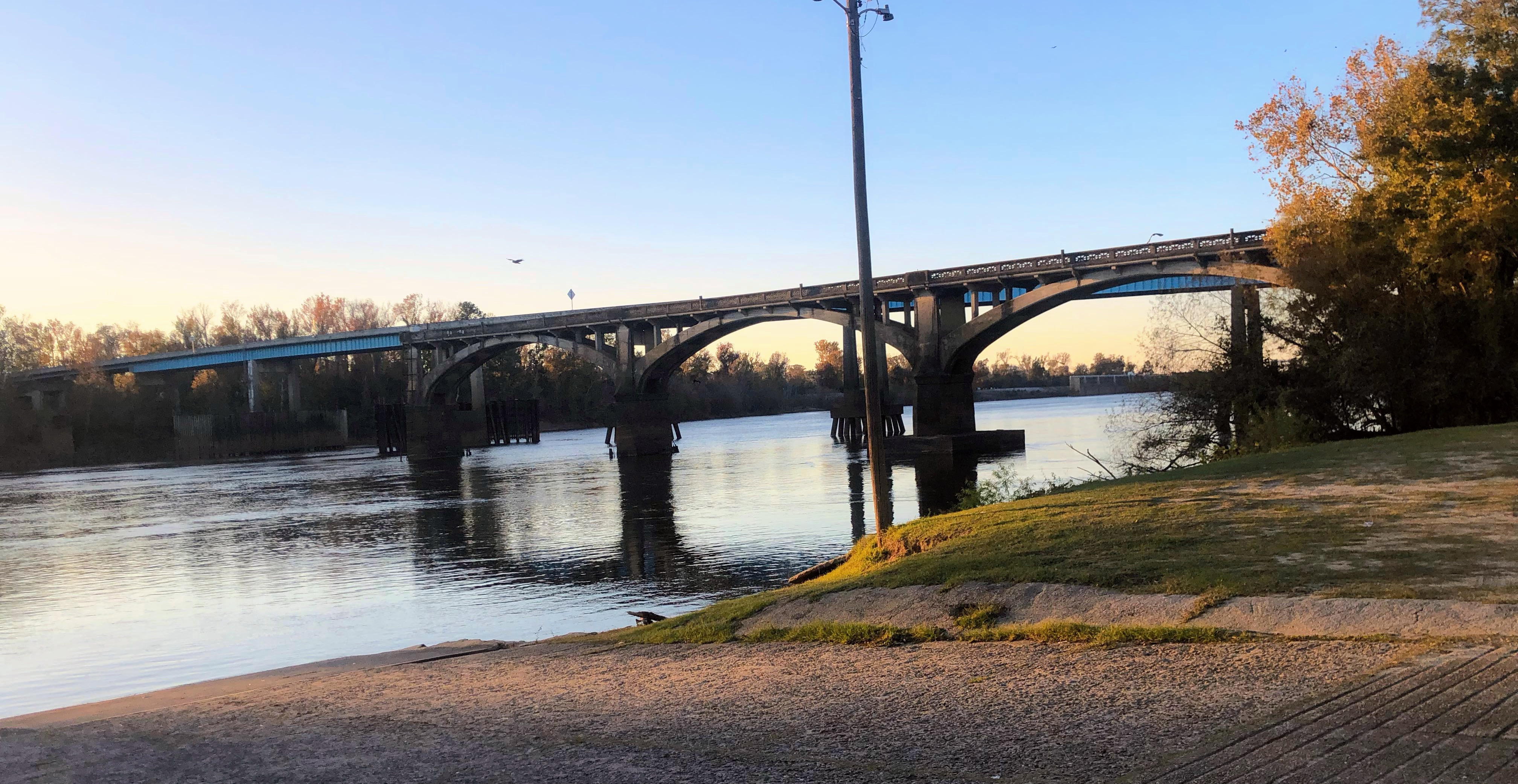
Editor’s note: Ocracoke Islanders Tom and Carol Pahl are on a trek around the United States (following 70-degree weather) and will report back from time to time their reflections. This is their second dispatch.
By Tom Pahl
As we have traveled from place to place over the last month (we just passed our one-month anniversary of departing our beloved Ocracoke), we find ourselves digging into bits and pieces of local history. The more local the better, it seems.
Recently, we spent almost two weeks camped just over the border in a campground on Lake Seminole in Georgia, but it was nearby Chattahoochee, Florida, that grabbed my interest.
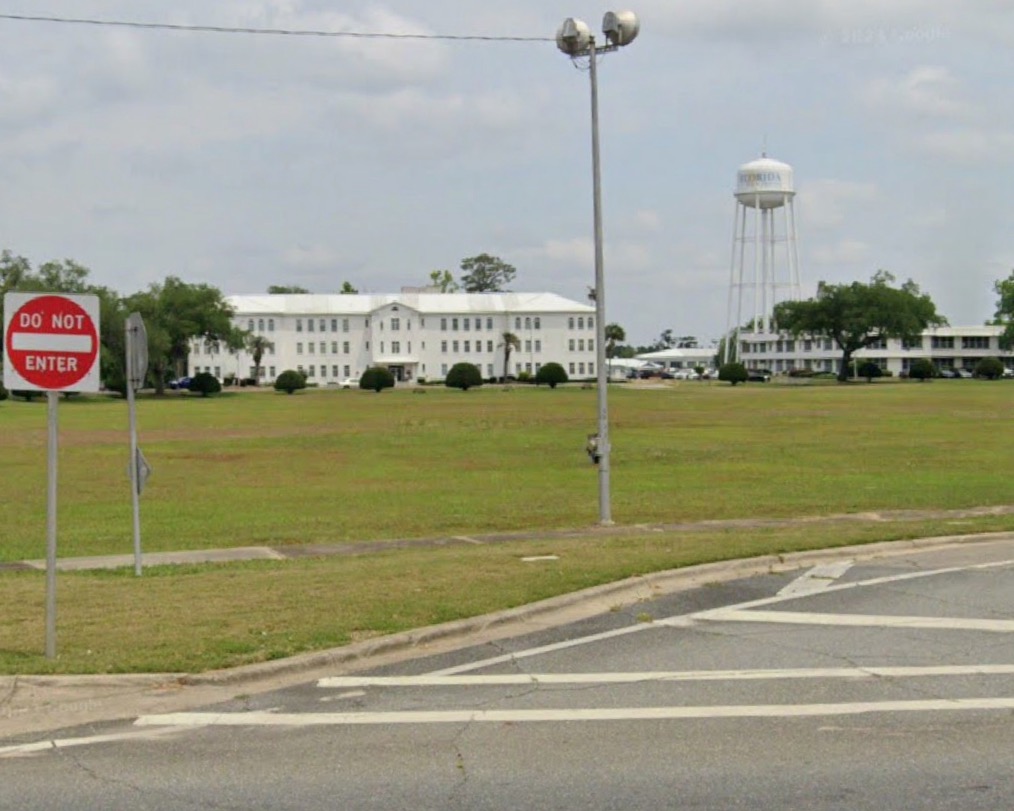
Driving down Main Street Chattahoochee, you can’t miss the Florida State Hospital, a facility for the treatment and incarceration of the criminally insane. It’s the only such facility in Florida. Also, one town over, in nearby Sneads, is the Apalachee Correctional Institution.
Between the state hospital, known colloquially as just “Chattahoochee,” and the correctional institute, more than 3,000 people were incarcerated within just a few miles of our campground. One might think that the State of Florida was putting its most problematic citizens as close to the Georgia border as possible, but at least in the case of The Florida State Hospital, history would belie that claim, as the story of the place precedes, by more than 1,000 years, the establishment of the Florida-Georgia line.
As a settlement, Chattahoochee is well chosen, but it was chosen by indigenous natives long before Europeans came to the area. It is the confluence of three rivers, known today as the Flint River, Spring Creek and the Chattahoochee River. They converge within yards of our camp site and form the Apalachicola River which flows from there to the Gulf of Mexico.
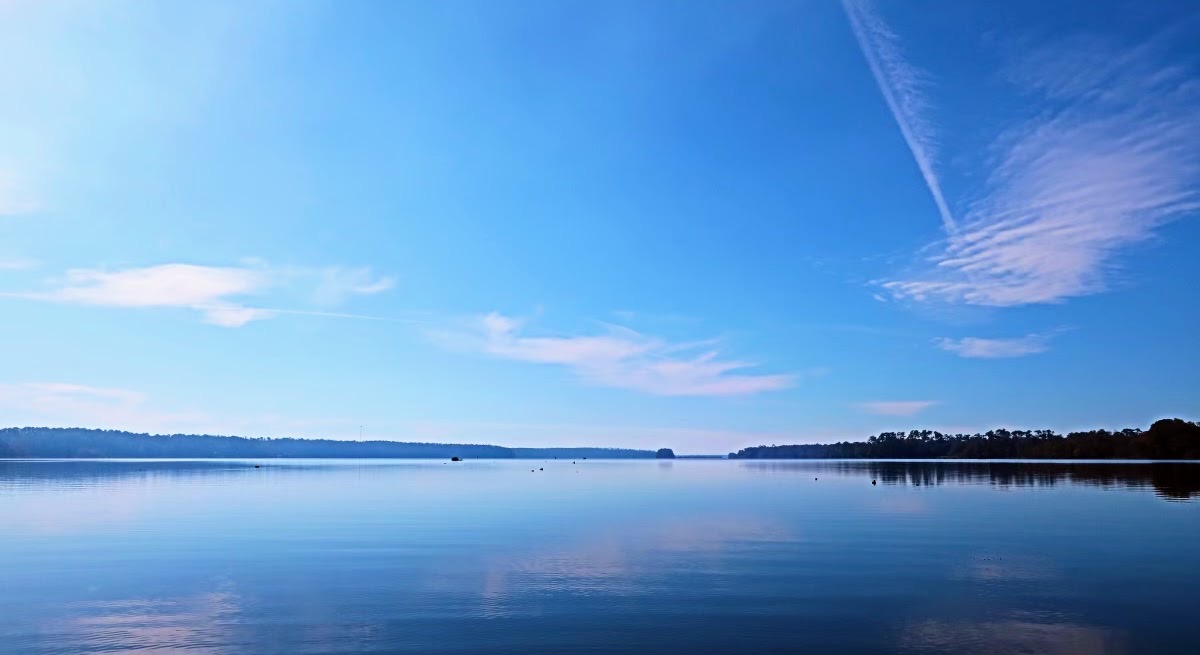
But that great convergence is now invisible, hidden by the very lake we are camped beside. Lake Seminole is a man-made reservoir formed by the construction of the Jim Woodruff Dam in 1952. There the waters of the three rivers mix and spread out over more than 37,000 acres until they spill over the dam generating electrical power for Florida residents. And there, almost 2,000 years ago, is where the story of Chattahoochee begins.
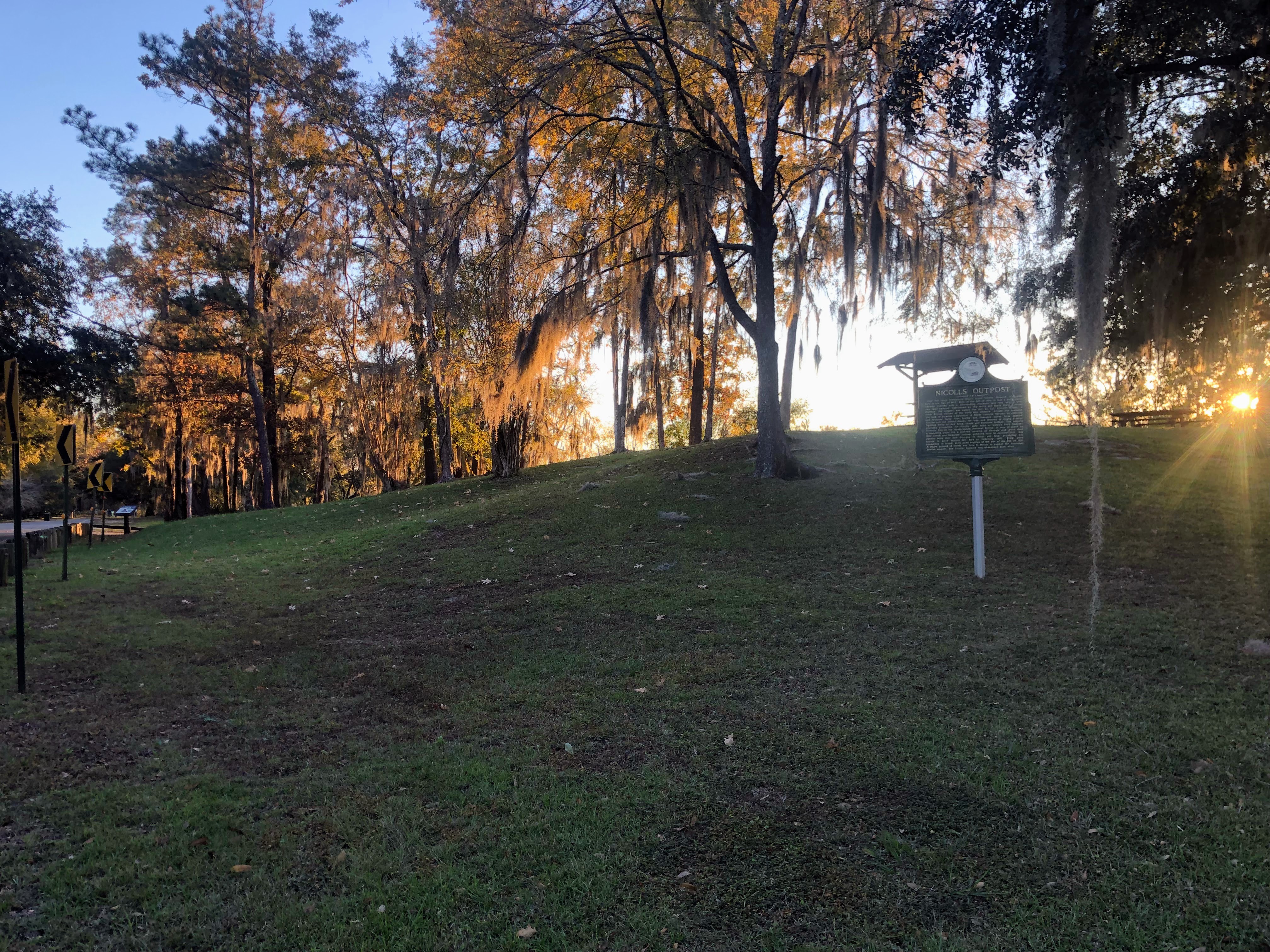
“Archaeologists are unsure,” pretty much sums up what we know about the early history of this site. What we do know is that there are earthen “mounds” still in existence at the headwaters of the Apalachicola River. There were apparently as many as seven of these structures, which were most likely pyramidal in shape, except the tops were flattened. They were formed in a semi-circle which seems to line up with the position of the sun at solstice. Some researchers say this was a sacred site, others seem to think it was “residential” without a spiritual component. Without resolution, we are allowed to walk all over the extant mounds at the risk of offending a higher power.
Carbon dating sets the earliest human activity at the site almost 2,000 years ago, and the construction of the pyramids at about 1,500 years ago. The site is assumed to have been important for its easy access to river transportation in four directions—an ancient Grand Central Station.
Historians know that the site was in common use by native tribes until the arrival of the Spanish in the late 1600s. Imagine the natives’ reaction on first encountering these strange beings: their skin was oddly pale, they wore heavy clothes and carried steel swords and guns. They spoke an odd language and most likely would have benefitted from a bath. Apparently, their arrival did not bode well. So, the natives vacated their thousands-year old home and sought safety in the forest. These were the Creeks and the Seminoles and they weren’t happy.
The Spanish took over the site, building a fort and making it an important way point along the “Spanish Trail,” which connected Florida with points westward for trade, exploration and in their mission to bring civilized religion and morality to the savages.
I suppose you know how the story unfolds. The Creeks and Seminoles attempted to reach accommodations with the invaders and were repeatedly cheated and lied to and massacred, bringing to mind that cynically twisted phrase “Indian givers.”
Meanwhile, Europe was fighting amongst itself in the Seven Years War. That war, begun over conflicts between French and British colonial powers in northern North America, became a global conflict that eventually included Spain. When the war ended in 1763, Britain, having conquered Havana, traded it back to Spain in exchange for Spanish Florida. Thus, the Apalachicola site became British territory as a result of a conflict that had begun 1,000 miles to the north in Canada and ended some 4,300 miles to the east in Paris, France.
By the turn of the century Florida’s boundaries and ownership had become a political football, pushed eastward and westward by various wars, skirmishes, land swaps and back-stabbings among the Spanish, French, British and Americans. Finally, with Britain’s losses in the American Revolution and again in the war of 1812 and with Spanish influence waning, the U.S. completed the acquisition of Florida from Spain in 1819.
With every change of land title, things grew worse for the native populations, as the only thing that all the European powers seemed to agree on was that the natives were an impediment to progress and had to go. And thus began the Seminole wars.
The Seminoles were a tribe made up of other tribes, including the Lower Creeks, the Red Sticks and the Miccosukee as well as free-lance former slaves who had escaped from their American captors and found refuge among the displaced Indians, the so-called “Black Seminoles.” They called themselves “yat-seminoli” which translates to “Free People,” an aspirational name that would eventually be taken deep into the Everglades by the last band of Florida natives, who claim today to be the only Indian group that has never surrendered to U.S. forces.
On November 30, 1817, several hundred Seminoles attacked a U.S. Army flotilla on the Apalachicola River, within view of the ancient pyramids we are visiting. The attack was in retaliation for a series of brutal army raids on Indian villages to the north. All but six of the 51-member party were killed, including (according to some reports) four children.
This led President James Monroe to order General Andrew Jackson to move forces under his command into the area and, by whatever means necessary, eliminate the Seminole resistance from western Florida. Jackson, whose enmity toward the natives was well known, was all too happy to oblige. His campaign was quick and brutal, pushing those natives who escaped into south Florida. The military dominance he established not only decimated the Seminole Nation, but it sent a message to the Spanish that there was a new sheriff in town. And it also set another stepping-stone for Jackson’s eventual rise to the presidency.
Those natives who surrendered or were captured, and many others who sought refuge in eastern and southern Florida, were eventually swept up by the “Indian Removal Act of 1830,” which forcibly removed indigenous tribes from vast American territories east of the Mississippi River into Oklahoma. From 1830 through the 1840s, over 80,000 natives were relocated and between 15,000 and 18,000 perished on what came to be known as “the Trail of Tears.”
It was also during this period, in 1834, that the arsenal at Chattahoochee was constructed. The arsenal was a strategically located storage facility that provided a readily available supply of arms and ammunition to U.S. Army troops in their ongoing battles in the Seminole Wars. Over time, it was enlarged and its mission broadened to become a large complex of buildings and strategic reserves. Then, at the start of the Civil War, it was the site of the first conflict in Florida between Confederate and Union forces, when a small ad hoc unit of rebels took possession of the arsenal and its critical contents.
Following the Civil War, the site was re-taken by federal forces, but ultimately handed back to the State of Florida. It was made into Florida’s first state penitentiary, beginning a long, well documented history of racism, inmate abuse and political and personal corruption.
In 1876, it was re-opened as The Florida Asylum for the Indigent Insane, without any noticeable change in its trajectory of corruption and abuse. That trajectory has continued and is documented to continue even in its modern incarnation as the Florida State Hospital.
Carol and I often comment that we have good travel “juju.” We often just happen onto little bits of wonder as we go from place to place; we find a great little restaurant, we connect with an interesting person, we come around a corner and find a spectacular view. We’re just lucky that way. In this case, it may be that the luckiest thing that happened to us in our visit to Chattahoochee was… nothing.
While changes have been made and some individual professionals have pushed back against the dark history of the place, Chattahoochee is even today a place where the battle between the best and the worst of human nature is still an uncertain outcome.
In writing this essay, I have referred to many sources, some on site where we visited and some references including, but not limited to: Sally J. Ling, Out of Mind, Out of Sight: A Revealing History of the Florida State Hospital at Chattahoochee and Mental Health Care in Florida; Jeffrey Ostler, Trails of Tears, Plural: What We Don’t Know About Indian Removal and other readily available sources.


Amazing article. Thanks!
Did you know? We’ve got Mounds up here in WV.
Well written and fascinating! May lots of good “juju Nothing” continue for you guys!
Comments are closed.