
Text and photos by Michael J. Meyer
Anyone who has visited Ocracoke Island knows how special it is: from stunning sunsets to magnificent views of the Milky Way on a moonless night after a cold front has cleansed the atmosphere with rain.
This uniqueness is partially due to the lack of light pollution commonly known as sky glo.
It is these special conditions that attract photographers, particularly astrophotographers.
Since the invention of the telescope, astronomers have tried to convey what they saw through their instruments to others.
It started in 1610 with Galileo and the moons of Jupiter.
As telescopes improved, more detail was observed, and the first crude drawings evolved to more detailed depictions. Some, like Schiaparelli, let their imagination overpower their observation resulting in canals on Mars.
There needed to be a better way.
Daguerre in 1837 found that light would interact with a copper plate covered with a coating that contained silver iodide particles. The photons of light caused the silver iodide to change to silver. These plates could be treated with other chemicals which stopped additional light-exposure change and fixed the image to make it permanent. Everyone could then see the same image.
Daguerre immediately thought that this process might be useful for astronomers and set about photographing the brightest object in the night sky, the moon.
His effort was a resounding failure.
That’s because the process needed many minutes to allow the many fewer photons to do their magic chemistry trick.
During that period the moon moved, it was hard to keep in focus and the image was blurred.
Something needed to improve. Either get more light to speed up the chemical magic, find some other magic coating that was more sensitive or track the object better to keep it in focus.
It turns out that they did all three. Telescope lenses and mirrors became larger, collecting more photons that could be focused on the photographic plate.
Silver solutions were refined to make the coatings of silver iodide and bromide particles smaller and more sensitive. Both improvements sped up the photography process.
Telescopes improved to accurately track an object, keeping it in focus.
All these improvements were expensive and only rich amateurs, national observatories and universities could afford the equipment to make photos.
During the later part of the 19th century, industrialization flourished and along with it came air pollution and light pollution from the gas streetlights.
Astronomers, who had morphed into professionals backed by universities, noticed that even though the new dry photo plates allowed them hours of exposure to capture fainter and fainter stars, the increasingly muddled skies and ambient light coupled with weather issues such as clouds and humidity made it progressively more difficult to capture good, long-exposure images.
The search for darker, clearer skies and better-quality photons began.
Larger new telescopes were proposed and the West was the place to go.
A large 100-inch mirror telescope was built on Mt. Wilson outside Los Angeles to take advantage of the clearer, darker, drier skies and the thinner air, which reduces the twinkling effect.
Optical filters were developed that would block out certain wavelengths of light such as those produced by streetlights but let other wavelengths of light through, which helped reduce the effects of light pollution.
But still the holy grail was clear, cloudless, dark skies, which eventually led to large telescopes currently being located on top of a mountain in Hawaii and others in the mountainous desert of Chile or the ultimate dark sky location – space — where the photons are pristine.
During this period amateur astrophotographers were pretty much out of the loop. By the 1960s, the 35mm Single Lens Reflex cameras became popular, and innovative amateurs found a way to either add a large telephoto lens or mate the camera body to the telescope itself to take decent photographs.
By the 1970s, solid-state sensors were being developed and rapidly became more efficient in capturing photons. Prices came down and inverter technology improved so that amateurs’ equipment became portable to be taken far enough from civilization to capture good astro photos.
Amateurs began the search for easily accessible dark skies in earnest.
In the 2000s, local photographers began posting amazing pictures of the Milky Way, and the Outer Banks came up on the radar as whispers of the quality of the viewing began to circulate.
Ocracoke Island is one of the best areas on the banks due to limited population and light pollution.
What does “dark skies” mean?
It means you can see stars almost all the way down to the horizon. You can see planets. On moonless nights you can see the Milky Way, and then there are these mysterious blobs of fuzzy light that your eyes cannot quite discern.
To amateur astrophotographers those are opportunities that they can rarely find elsewhere, especially on the East Coast.
The blobs are galaxies and nebulae that remain in the same positions in the sky relative to the star constellations and take some magnification to bring into focus.
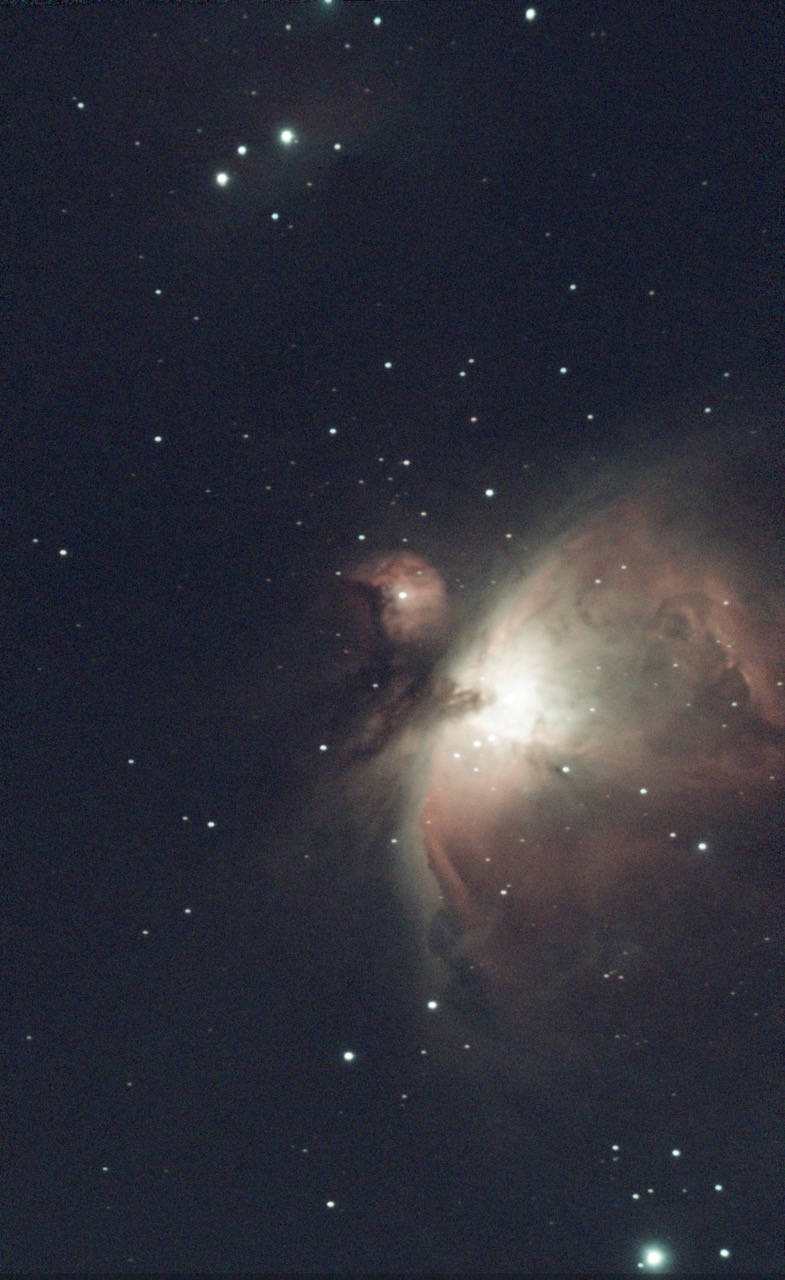
Included here are comparison photos of the deep-sky Orion nebula (M42) at two different locations and the effect that light pollution has on the results.
One was taken at my home in rural Indiana on Feb. 7, and the other on April 4 in the NPS campground on Ocracoke.
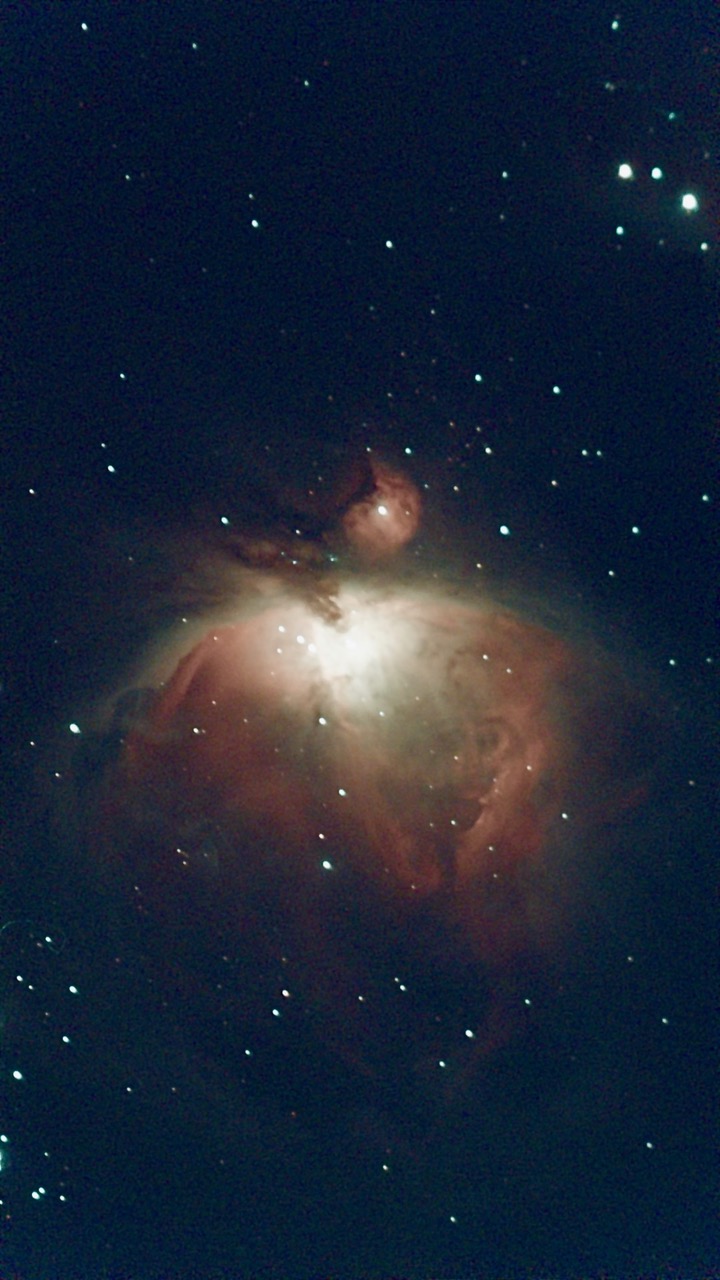
Light pollution is measured using the Bortle scale, with 1 being the lowest (very dark skies) and 9 the worst (downtown Raleigh). The town limits of Ocracoke are rated as 3 rural skies, the campground 1.5-2. All this depends upon humidity, haze, etc. My home location is probably a 4-4.5 suburban.
The picture taken on April 4 consisted of about five minutes of individual 10 second shots stacked on top of each other to bring out the definition.
The one at home took about an hour, as many of the individual photos were discarded due to light pollution. So, I ended up with only two minutes of information in the photo.
The first photo is from my home in Indiana; the second from Ocracoke. They are rotated due to the difference in dates as the earth rotates around the sun.
So, “It’s all about the quality of the photons” and the photons on Ocracoke Island are first class with relatively easy access. Certifying the Cape Hatteras National Seashore as an International Dark Sky Park will preserve this rare resource for future generations to experience. Cape Lookout National Seashore along with Many other National Parks have been certified.
If you agree that this great viewing opportunity should be preserved, please show your support by writing to Cape Hatteras National Seashore, 1401 National Park Drive, Manteo, NC 27954. Phone: 252-473-2111.
Email: https://www.nps.gov/aboutus/contactus.htm
Michael Meyer is a retired engineer, an avid amateur astronomer and frequent visitor to Ocracoke.


I’ve been shooting deep space images with my Unistellar EVSCOPE 2 from our deck on Ocracoke (just up the street from Connie L.) for several years. The quality of ‘night’ here in Ocracoke makes a profound difference. We really don’t have much light pollution here, especially relative to my evenings in the DC metro area. Arguable better ‘dark’ from the pony pen than the village but often not significant enough to schlep the 30lb scope.
Comments are closed.