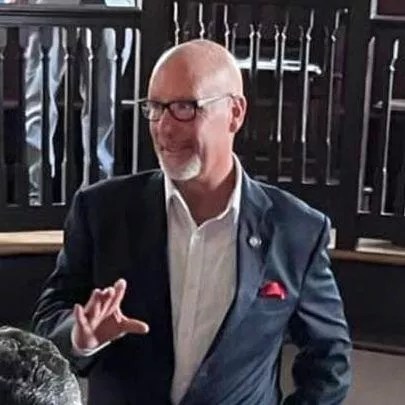
Bill Gravely with the old and new headstone for his cousin ‘Little’ Jake Alligood. Photo: C. Leinbach/Ocracoke Observer
By Connie Leinbach
Old time island character “Little” Jake Alligood lived his life in the shadow of his more colorful father, “Old” Jake Alligood.
The two were part of the unique flavor of remote Ocracoke when people started discovering the island and its simple ways in the 1950s.
Dare Wright wrote about the Alligoods in her “Ocracoke in the Fifties” as did Carl Goerch in his famous book “Ocracoke.”
The elder Alligood was known as “Old” Jake, not “Big” Jake, said Bill Gravely in July as he and several cousins, all relatives of the Alligoods, replaced an old wooden headstone at Little Jake’s plot in the Ocracoke Community Cemetery.
Little Jake was his first cousin once removed and his mother’s first cousin, Gravely said. Old Jake was his great uncle.
Gravely was a small boy when he knew Little Jake, who was 30 years older.
So, Gravely didn’t have much in the way of first-hand remembrances of Little Jake during the installation of a new, granite headstone at Little Jake’s grave.
Years ago, Gravely had noticed that Little Jake’s headstone, which is alongside Old Jake and his second wife, Myra, was made of wood and showing signs of deterioration.
So, Bill, who with his wife Jill divide their time between Ocracoke and (little) Washington, got contributions from other family members, and purchased a new headstone.
Since there are few stories about Little Jake, Gravely talked to islanders Jimmy Jackson and Martin Garrish about Little Jake.
They all remember Jake as a man of few words.
‘Little’ Jake and ‘Old’ Jake Alligood outside the Channel Bass Inn.
“If you asked him whether it was gonna be good for fishing the next day, he’d ponder on it for several minutes and then would say, ‘Maybe,’” Gravely related.
But Jake was a member of the beloved Alligood family, whose home was across from the Flying Melon. Old Jake was frequently called upon by the visitors at the nearby Wahab Hotel, now Blackbeard’s Lodge, to drive them over the mile of sand flats to the beach.
He also owned the Channel Bass Club, a Quonset hut across the street from the Wahab and to which islanders and visitors went every night to dance to the jukebox.
They’d be dancing so hard on the wooden floor, making it bounce, that the records would skip, Gravely said.
“So, they came up with the idea to cut a hole in the floor the size of the jukebox,” he said.
They dug out a hole and filled it in with a concrete monolith level with the floor.
“The jukebox sat on it so then the floor could shake like crazy (while the kids danced) and the jukebox could remain stable,” Gravely said.
In 2019, Jimmy Jackson, founder of Jimmy’s Garage, and Ronny Van O’Neal, both of whom were across-the-street neighbors of the Alligoods, tried to do the right thing for Little Jake, Gravely said, and constructed their own concrete tombstone for Little Jake, but never installed it.
Even though Little Jake was 25 years older than they were, the gesture shows the sense of community.
“They wanted to do right for one of their community members,” Gravely said. “It’s not like they did it for a stranger, but (Little Jake wasn’t) family.”
It is undecided what to do about that make-shift headstone, but Gravely will ask the Ocracoke Preservation Society if they want it and the old wooden headstone, which was carved by Little Jake’s stepbrother Willie “Three Fingers” Hunnings, who was a carver and whose decoys are part of the OPS collection.
Little Jake’s new headstone won’t have the character that this wooden headboard had.
“But this granite stone will last a whole lot longer,” Gravely said. “We all won’t be here that much longer to look at it. So, we want it to be right.”
Attendees at the installation of a new headstone for ‘Little ‘ Jake Alligood. From left, Jill Gravely, Bill Gravely, Tommy and Rosemary Harris, Bill and Susan Stuart, Bill Mac and Mary Ann Alligood. Rosemary, Susan, Bill Mac and Bill Gravely are first cousins-once removed of ‘Little’ Jake. Photo: C. Leinbach
National Parks of Eastern N.C. Superintendent David Hallac provided updates on the problematic and endangered oceanfront homes in Rodanthe at a well-attended public meeting at the Rodanthe-Waves-Salvo Community Building on Wednesday night, Aug. 24.
In the past two years, four homes along a severely eroded stretch of shoreline in Rodanthe have collapsed into the ocean, creating a debris field that spanned for 15 miles or more. One home, built in 1977, collapsed in 2020, while three additional homes collapsed in the first five months of 2022. A 1980 house fell into the ocean in February, while two more 1980s-era homes collapsed within hours on May 10 during a nor’easter.
At a similar March public meeting, (held after the first 2022 home collapse in February), Hallac noted that there were–at the time–11 other properties in the area that were in danger, and said that the National Park Service and Dare County had been in contact with the homeowners to encourage them to initiate a plan to move or remove their homes before they fell into the ocean.
“We came here and talked in March, and in March, we just had one home [that had] collapsed,” said Hallac. “We knew that others were going to collapse, so we [started urging] homeowners to do something about this problem. We were in touch with these homeowners well before these homes collapsed.
“We were advised by the Dare County Building Inspector that collapse was imminent, and we urged the homeowners to do something to stabilize or remove the homes in advance. They were not able to do so, and as you can tell, [two more homes collapsed in May.]
“But the other thing we did… was get a permit in place for their contractor to clean up the beach immediately following the collapse. We didn’t want any regulatory issues associated in the permitting process holding anything up.”
Photo by Don Bowers of the home in Rodanthe, hours before it collapsed on May 10.
Nevertheless, the two May home collapses led to excessive debris and international media attention, due to a viral video taken of the second home collapse as it was occurring, which was seen more than 20 million times on social media.
“I’m not sure we ever saw this many requests for interviews,” said Hallac. “From every news outlet, from The New York Times to The Washington Post, to Fox News, The Weather Channel – you name it, they were calling us wanting to know more about this story.”
“Generally speaking, the media really picked up on this, and the reason they picked up on it was because it was an environmental disaster that is actually still ongoing at the Seashore.”
Following the May home collapses, Hallac stated at Wednesday’s meeting that there was progress on some of the other properties in danger.
“Since then, two homeowners have moved their homes, and four other homeowners are working with [the Cape Hatteras National Seashore] right now to secure a permit to facilitate moving their homes either back on their lots, or to new lots,” said Hallac. “This is amazing progress for the community to have, because in a short period of time, up to six homes will have moved to prevent future problems.”
Hallac also stated that since the May collapses, the National Park Service had coordinated with the county and the state to communicate with 24 homeowners to formulate a plan. A number of beach cleanups have also been launched in the past several months, and meetings and other communications have been facilitated to keep ongoing updates in the public eye.
Still, it was clear at the meeting that the problem was not going to go away anytime soon. Hallac noted that the National Seashore was eroding at roughly 10-15 feet per year, “and while that might not seem like much, slowly over time and over the years, that adds up to a lot of beach that erodes into the Atlantic Ocean.”
Hallac also touched on the lingering and still-present issue of debris that remains from the home collapses, months after they occurred. There are small bits of tar paper as big as fingernails all along the shoreline, thousands of pieces of carpet padding, sheetrock remnants, fabric from pillows and mattresses, and more minute reminders of the 2022 collapses.
Rodanthe shoreline on Friday, May 13. Photo by Brad Handon.
“One of the questions that comes to us is ‘Why are there so many things all over the beach?’” said Hallac, while showing a photo of the May debris that included miscellaneous household items, like a toilet plunger. “In this case, this homeowner was well aware that the house was about to collapse for many, many months before it happened. At least that’s the way it was articulated to us, and they made a conscious decision to leave all of the contents in the house. And exactly why that happened, I don’t know.”
As a silver lining, Hallac stated that the National Park Service had purchased a new raking machine that targets the top layers of sand to remove the hidden and tiny piles of debris that still remains on the shoreline.
“It will take weeks, but we’re hoping that we can use this to sift the sand from your National Seashore and remove all this tar paper and other debris that should not be there.”
And while the cause of the debris was obviously tied to the homes that fell into the ocean, Hallac pointed out that the issue wasn’t because of new development, or in many cases, a lack of concern on the homeowners’ part – especially when it came to the six homeowners who are currently and actively looking to move their properties out of the ocean’s way.
“We thank those homeowners for working so hard. It is not easy, and it is not cheap, to find a lot, to jack the house up, to move it with new pilings, and to reconnect it to utilities. We’ve had some really great success here.”
“I just want to be clear, none of the owners of these homes wished this situation would happen, or built their home – all of a sudden – on a National Seashore. This is something that is just happening due to natural erosion.”
Following the presentation, Hallac fielded questions from meeting attendees which focused on a range of topics, and especially a potential beach nourishment project for Rodanthe.
The NPS adopted a new Sediment Management Framework in May of 2021, which makes it easier and faster to issue permits for projects such as beach nourishment, but as County Manager Robert Outten explained at the March public meeting, the issue with starting a Rodanthe beach nourishment project is funding, and identifying an emergency need to widen the shoreline.
A beach nourishment project can only move forward if it is demonstrably shown that the eroding shoreline is creating a community-wide safety issue. For example, when Hurricane Irene impacted northern Hatteras Island in 2011, the highway was torn to shreds, and the only access on or off the island was via an emergency ferry from Rodanthe to Stumpy Point. With the Jug Handle Bridge now open, bypassing N.C. Highway 12 in northern Rodanthe, beach nourishment may not be necessary in Rodanthe to keep the island accessible.
Debris along the beach.
As for funding, communities that benefit from a beach nourishment project, (which costs roughly $10 million for every mile of shoreline), typically pay about 50% of the total cost of the project. For the recent Avon beach nourishment project, a new tax service district was formed, increasing taxes for roughly 3,700 Avon property owners. For a small area like northern Rodanthe, where few property owners are directly impacted, the taxpayer cost would likely be prohibitively high.
Questions were also raised about what could be done to prevent future home collapses and similar debris fields, such as soliciting FEMA for assistance, looking into criminal charges for homeowners who do not take action, or installing jetties, (which are not permitted and could increase erosion in neighboring areas.)
“There is no silver bullet to these problems,” said Hallac. “We have to recognize that some of these oceanfront developments are going to be very hard to keep long term. So, we’ll do our best and try to plan for it, which might include some short-term solutions like beach nourishment, but long term, I think Mother Nature is going to [dictate what happens.] It’s a tough situation.”
Having been damaged by recent floodwaters from hurricanes, the Ocracoke light station complex will undergo renovation. Photo: C. Leinbach
From our news services
The National Park Service has approved and selected a plan to rehabilitate the Ocracoke Light Station.
After evaluating three alternatives, the NPS selected and approved the preferred alternative, which allows for the elevating of the double keepers’ quarters by four feet, and raising the carpenter’s shop, store house, privy and generator house by up to two feet.
The lighthouse itself and oil house will not be elevated. All buildings and structures will also be repaired and repainted.
“Elevating most of the structures at the Ocracoke Light Station is an important step in adapting to potentially stronger storms and higher water levels near the property,” said David Hallac, superintendent, National Parks of Eastern North Carolina. “After detailed designs are completed in the next year, Cape Hatteras National Seashore will begin the process of selecting contractors to do the elevation and rehabilitation work to these important buildings.”
An environmental assessment (EA) of the property found “no significant impacts,” according to an NPS press release, allowing the project to go forward.
Rehabilitating is needed because the historic structures have been damaged from recent storms and if the buildings are left as they are it is expected they will be damaged further by future storms that could be exacerbated by climate change and sea level rise, the NPS said.
Under the approved alternative, the Ocracoke Lighthouse will be rehabilitated to include the following actions:
Remove the shotcrete from the exterior of the lighthouse and replace it with a coating that will allow appropriate protection of the masonry and moisture control
Replace damaged masonry, including bricks and mortar
Repair or replace windows with historically appropriate windows
Repair leaks at the top lantern and repaint
Recoat interior masonry
Expose the original stone foundation
As an option, replace interior metal staircase with wooden spiral staircase to match original material and orientation
A new Catholic chapel is being built behind Ocracoke United Methodist Church. Photo: C. Leinbach
By Peter Vankevich
Ocracoke has two churches, the Life Saving Church on Lighthouse Road and the Ocracoke United Methodist Church on School Road. These are Protestant churches.
Although there has never been a Roman Catholic church on the island, masses have been held at various times over the years.
That will soon change as the Diocese of Raleigh announced recently that a new chapel is being built in a secluded area behind the Methodist Church.
For the Reverend Alfred Smuda, OSFS, affectionately known as Father Fred, it couldn’t come sooner.
Since 2013, when he replaced the deceased Father Bob Brown, he would leave his Our Lady of the Seas parish in Buxton and head for Ocracoke.
Formerly weekly and now twice a month, ferry service permitting, the Catholic mass takes place on a weekday, usually Wednesday or Friday afternoons, but never on Sunday when masses take place in the Buxton church.
Expressing appreciation to the Methodist Church for permitting use of their facilities over the years, he said, “We need something to call our own, a place, kind of an anchor or support. That’s one of the reasons we’re doing it: A place to congregate, hold mass and meetings for a group of people that are excited about God and want to stay together as a community.”
When he would leave the Methodist rec hall after mass, he would gaze at an adjacent house surrounded by trees and muse, “That would be a wonderful place to build a chapel and use the house as the priest’s residence and meeting place.”
He was right about the church having no anchor.
“Roman Catholics on the island and visitors attended mass over the years on Ocracoke in many locations,” said Nancy Carlson who has attended weekly mass since she moved here full-time in 1998.
Architect’s rendition of the new chapel.
In addition to the Methodist properties, mass has been held in the Community Center, the old fire station, the Berkely barn, outside at Books to be Red and in various people’s homes, including her own and her former Pelican Bed and Breakfast.
The dream is about to come to fruition.
The home and the land graced with old live oaks he would often gaze upon belonged to the Wilson and Martha Garrish family as it was the home of Wilson’s late parents, Preston “Jule” Garrish and Etta Mae Howard.
Through the gift of a small land parcel and the sale of the Wilson property, it will become home to a Catholic chapel and a parish house.
The house renovations are almost finished, and with pilings in place, building of the 80-seat chapel has begun.
The principal architect for the project is Russ Woods of Kinston and the chapel is based on the Holy Family Parish in Davidsonville, Maryland.
The Stained Glass window at the Back of the Chapel was designed and created by Wayne Cain. Restoration and installation of the stained glass window behind the altar was done by Rudi Waros and contains “Drape Glass” and is circa 1900. The altar was built by New Holland Carpentry. The Statues of St. Anne, mother of Mary and St. Joseph, are solid wood.
Waters Contracting of Newport is the builder.
Completion is expected in about eight months and the grounds, with some benches, will retain their native plants and trees, including laurel, wax myrtle, cedar and live oak trees.
Martha Garrish, a realtor for Ocracoke Island Realty, is delighted that her husband Wilson’s family home and the adjoining land that they donated will serve a new purpose. “Actually, my sister Donna [Drilling] and I have always had a dream of building a small chapel church here in recognition of my parents who were devout Catholics, so it just all came together.”
A native of Buffalo, New York, Martha has lived on Ocracoke for about 40 years. When she and Wilson married on the island in 1984, they needed a special dispensation to have a Catholic wedding outside of a Catholic church and be married by a Methodist minister.
“This will be really nice. People will be able to get married here,” she said, adding that the chapel will also be important for locals’ faith life and for visitors who want to attend mass.
“What I am looking forward to is that this will serve the Hispanic community,” Father Smuda said. “I’m looking forward to growth, and what I am really going to enjoy is the presence of the Blessed Sacrament.”
“I’m excited for them. I know they’ve been using the church for years and then with Hurricane Dorian they were displaced alongside us for a while,” said Methodist Pastor Logan Jackson. “I’m excited to see how they can grow and to see how our church and their church can come together and continue to be an encouragement to each other and community.”
HOW TO OCRACOKE. Cooling off on a hot summer day. Photo: C. Leinbach
Tuesday, Aug. 23 Ocracoke Oyster Company: Bryan Mayer, 7 pm 1718 Brewing Ocracoke: Kate McNally
Wednesday, Aug. 24 Roanoke Island Animal Clinic at the Ocracoke Community Center, 9 am. Call for appointment. Ocracoke Oyster Company: Bryan Mayer, 7 pm
Thursday, Aug. 25 Bingo: Ocracoke Community Center. Doors open at 6 pm; games at 6:30 Ocracoke Oyster Company: Mike Norris, 7 pm
Friday, Aug. 26 Ocracoke Oyster Company: Kate McNally, 7 pm The Breeze: Will Guyton & Wild Ride, 9:30 pm 1718 Brewing Ocracoke: DJ Yess
Saturday, Aug. 27 Bake sale to support the Island Inn renovation at the Island Inn; 9 am to noon. Ocracoke Oyster Company: Ray Murray, 7 pm The Breeze: Will Guyton & Wild Ride, 9:30 pm
Sunday, Aug. 28 Ocracoke Oyster Company: Mike Norris, 7 pm
NPS Programs
Unless otherwise stated, programs are held outside the Ocracoke Discovery Center at Pilot Town Road by the south end ferry docks. The schedule may change without notice. Programs are subject to weather. Sunscreen and bug repellent are recommended for all outdoor programs. Visit the on-line program schedule for additional events at http://www.nps.gov/caha/planyourvisit/calendar.
Discovery Center hours open daily: 10:30 a.m. to 12:30 p.m. and 1:30 to 4:30 p.m.
Ocracoke Lighthouse base open daily: 10:30 a.m. to 12:30 p.m. and 1:30 to 4:30 p.m. Twenty-minute talks are at 11 a.m. Monday to Thursday.
Shaping these Barrier Islands Monday to Thursday at 2:30 p.m. Wars, hurricanes, winds and ocean currents have all had impacts on the shores of Cape Hatteras.
Banker Ponies Monday, Wednesday, Friday at 9:30 a.m. at the pony pen. Meet the ponies who once roamed as a wild herd and learn about their living history on Ocracoke Island.
A committee of Republicans from North Carolina’s First Senate District have unanimously selected state Rep. Bobby Hanig (R-Currituck) to move across the Legislative Building for at least the rest of this year.
Meeting at the 1767 Chowan County Courthouse on Thursday, a panel of 41 delegates from the 11 county districts recommended Hanig to the state Republican Party as the replacement for former Sen. Bob Steinburg (R-Chowan) after he stepped down at the end of July.
“I am grateful for the unanimous support from each county party member,” Hanig said in a statement. “I believe my record of fiscal management, advocating for students and families, and standing up to help families helped secure my recommendation.”
The senator-designate’s nomination will now be forwarded to Gov. Roy Cooper, who will make Hanig’s appointment official within the next seven days.
A Republican from Powells Point, Hanig has been in the N.C. House of Representatives since 2018. He was elevated last year to Deputy Majority Whip, a key leadership position.
“I am excited about the opportunity to continue to represent Northeastern North Carolina,” Hanig said. “I am focused on fighting inflation to help families who are struggling. I look forward to continuing my public service to a larger audience and continue to make northeastern North Carolina values a priority in the legislature.”
Hanig was unopposed in the May primary for the Republican nomination to the Third District Senate seat.
That district covers Bertie, Currituck, Camden, Gates, Halifax, Hertford, Martin and Warren counties.
Hanig will face Valerie Jordan, a Democrat from Warren County, in the November general election.
Earlier this week, Hanig filed a protest of Jordan’s residency, claiming she actually lives in Raleigh. A hearing on that challenge is scheduled for Tuesday in Currituck.
Once Hanig is sworn into the Senate, that will leave open his House seat representing Currituck, Dare, Hyde and Pamlico.
Paul O’Neal, a former Currituck County commissioner from Waterlily, is the likely candidate to serve out the remainder of the House term ending in January.
From last year’s redistricting, the northeast corner of the state has been split into three House districts ahead of the 2022 elections.
Ocracoke and Hyde County is in the new District 79, which also covers Beaufort, the rest of Dare, and Pamlico counties. Rep. Keith Kidwell (R-Beaufort) is the incumbent and is running unopposed in the November election.
Rep. Edward Goodwin (R-Chowan) is unopposed in the First District covering Currituck, Chowan, northern Dare (Kitty Hawk, Southern Shores and Duck), Perquimans, Tyrrell and Washington.
Rep. Howard Hunter (D-Hertford Co.) faces a challenge from Republican Bill Ward of Elizabeth City in the 5th district, which includes Camden, Pasquotank, Gates and Hertford counties.
While the legislature wrapped up its work in the short session at the beginning of July, they still have not officially adjourned.
Hanig said last month no major votes will be taken, with skeleton sessions taking place about every 30 days.
Hyde County Farm Days, sponsored by the Hyde County Chamber of Commerce, on Oct. 21 and 22 is looking for food vendors, sponsors and participants for the Miss Hyde County and Little Miss Hyde County contests on the Mattamuskeet School campus, Swan Quarter.
Produced by the Hyde County Cooperative Extension, Friday events begin at 5 p.m. in the gymnasium with a Farm Days meal followed by the pageants at 7 p.m. Events continue Saturday at 10 a.m., capped by fireworks at 8:30 p.m.
Those seeking to be a non-food vendor can find the application here and are asked to submit them now.
Those interested in being a sponsor can find a formhere.
Fig competition entries being prepared for sampling. Photo: P. Vankevich
This story has been updated to include Ocracoke business contributions
By Peter Vankevich
If one were to produce an event that would be pure Ocracoke, an attraction for both islanders and visitors, one might say, how about figs? Eight years ago, people did and the Ocracoke Fig Festival has become a major summer attraction.
The recent event Aug. 4 to 6 drew about 300 attendees and another round of creative fig cakes.
Fig trees are a fixture in many yards throughout the village which take to the island’s sandy soil and mild climate Worldwide, there are some 700 fig varieties, not all are edible. On Ocracoke, some of the varieties are brown, pound, sugar, Celeste, lemon, turkey, blue, the late fig and the Portsmouth.
Ruth Toth and Ricky Moore on the porch of the Ocracoke Preservation Society Museum. Photo: P. Vankevich
Many islanders make preserves or a compote that is frozen in bags to be thawed for making fig cakes throughout the year. Preserve-making is even a cottage industry for some islanders like John Simpson and Trudy Austin, who were one of many vendors in the barn selling fig products and fig-themed goods.
The festival has grown since its modest beginning back in August 2014, notably with celebrity foodies.
Seafood Chef Ricky Moore of Durham added pizzazz to this year’s event. Moore recently was named a James Beard award winner as Best Chef for the Southeast for his Saltbox Seafood Joint. The Beard awards have been described as the Oscars of the food world.
The festival kicked off Thursday evening with a special dinner prepared by Moore which sold out almost immediately after being announced. Island commercial fisherman Casey Tolson provided fresh-caught seafood.
The meal included fig-themed dishes and contributions from many of the Ocracoke businesses including Helios Hideaway, Native Seafood, The Ocracoke Fish House, Eduardo’s Taco Stand, The Flying Melon, 1718 Brewing Ocracoke, Moonraker Tea Shop and Old Salt Sandwiches and a dish from the Café Atlantic Cook Book prepared by Debbie Leonard.
A highlight of the festival are the tasting competitions. Their popularity stems not only from seeing who wins, but after the awards, folks can sample the many submissions.
On Friday, Cindi Davia of Carteret County won the Best Traditional Fig Preserves award. A long-time fan of the festival, her preserves have been put to good use as her grandson, Walker Raeburn, has won the Kids’ Bake-Off competition in the past using her preserves.
Islander Bethany Diehl won Best Non-Traditional Fig Preserves category with her habanero pepper and fig combo. She harvested the figs from her yard and also grew the peppers.
Trudy Austin. Photo: P. Vankevich
At midday Saturday, 11 judges, including Ricky Moore, tasted the many Fig Cake Bake-Off entries along with a new competition class called Fish ‘n’ Figs, added in honor of Moore.
Islander Trudy Austin took the blue ribbon for Traditional Ocracoke Fig Cake category, the second year in a row. “Ricky Moore came over to congratulate me afterwards and he said your cake is made with history,” she said.
Another islander, Mike Dalgleish captured runner-up.
Evangeline Lisa Ann-Marie Inwood won the 16 & Under Bake-Off with her lemony fig cake. If there was an award for the competitor from farthest away, she would have also won that as she is from London, England.
For Innovative Dessert, Jenny Leinbach of Durham won with her traditional fig cake of candied lemon and orange peel, with a cream cheese frosting. Chris Joyner of Hatteras Village, was runner-up with an Italian ricotta fig cake with two figs and a homemade fig-amaretto preserve glaze.
The new Fish ‘n’ Figs category was won by Austin Daniel, chef and proprietor of Stockroom Streetfood in Community Square. His dish was cobia with caramelized fig, palm sugar, and fish sauce served with a side of cucumber salad.
The festival is also a fundraiser for its presenter, the Ocracoke Preservation Society. Although there are invoices and bills to pay, Horn thought this year’s event was more successful than last year, which netted about $5,000 after expenses.
Many folks and businesses donate goods and services for the silent auction, organized by Debbie Leonard. Estimates for that total are about $1,500.
Chester Lynn and Sundae Horn talk figs on Ocracoke. Photo: P. Vankevich
Chester Lynn, Ocracoke’s fig expert, interviewed by Sundae Horn, provided many details about the island figs. His mission is to preserve the fig tree culture of the island.
One may not go as far as to describe the festival as “Ocrafolk-lite,” but music and dancing Friday and Saturday afternoons featured local performers Kate McNally, Brook & Nick, Daniel Bradley, Molasses Creek and Mitch Barrett.
Ocracoke square dancing. Photo: Debbie Leonard
Music fans were delighted to see the return to the island of Coyote, Marcy Brenner and Lou Castro who moved to Florida earlier in the year.
A special performance was billed as “Ocracoke Kids with Mr. Lou” and featured 9-year-old drumming sensation Dallas Mason. The evening music included the Ocracoke square dance with the music by Molasses Creek followed by Raygun Ruby and the Ocracoke Rockers.
Chef Moore spent the week on the island with his wife Norma and their children, Hunter and Greyson. He made his way around the village visiting the Fish House, Native Seafood, Chester Lynn at his antiques shop and many local eateries. He also went sailing on the Windfall II and clamming with Ruth Toth’s family.
Zachary and Aubrey Fisk. Photo: P. Vankevich
”I am really loving my visit on the island this week,” he said looking relaxed Friday afternoon on the porch of the OPS museum where he spent time chatting with cookbook author and former restaurateur Ruth Toth of Atlantic Café fame and meeting with folks and signing books for those lucky enough to have one. They sold out on the island.
Many attendees chose their visit to the island primarily for the Fig Festival. Zachary and Aubrey Fisk of Raleigh read about it in “Our State” magazine and decided to attend. It lived up to their expectations.
“You can walk around to every restaurant and they’ve got some kind of fig dish and I loved how everyone is celebrating figs,” Zachary said. “On our visits, we like to bring something back home and this time it will be a small fig tree.”
“Hopefully, a sugar fig,” added Aubrey.
Among the vendors was Erica Morales Mondon, with the Engelhard Health Center, who conducted health srceenings such as blood pressure checks, distributed free COVID test kits and provided health information.
Tuesday, Aug. 16 Bird Walk (NPS program), 8:30 a.m. Meet winged residents of Ocracoke and those traveling the Atlantic Flyway. Binoculars are available. (60 minutes) Meet at the parking lot adjacent to the NPS Campground. Ocracoke Oyster Company: Barefoot Wade, 7 pm 1718 Brewing Ocracoke: NY Jazz Ska Band, 7-9 pm
Wednesday, Aug. 17 Ocracoke Waterways Commission: Ocracoke Community Center, 6:30 pm Ocracoke Oyster Company: Barefoot Wade, 7 pm Ocracoke Preservation Society Kids Kraft: Decoys, 1 pm Ocracoke Coffee Company: Team trivia, 6-8 pm
Thursday, Aug. 18 Bingo: Ocracoke Community Center, doors open at 6 pm; game at 6:30 pm The Breeze: Barefoot Wade, 9:30 pm Kids Kraft: Decoy Carving: Ocracoke Preservation Society, 1 pm
Friday, Aug. 19 Ocracoke Oyster Company: Kate McNally, 7 pm The Breeze: Steel County Express, 9:30 pm
Saturday, Aug. 20 Ocracoke Oyster Company: Barefoot Wade, 7 pm The Breeze: Steel County Express, 9:30 pm Latino Dances: Ocracoke Community Center, 7-9 pm
Sunday, Aug. 21 Ocracoke Oyster Company: Barefoot Wade, 7 pm
Discovery Center hours open daily: 10:30 a.m. to 12:30 p.m. and 1:30 to 4:30 p.m.
Ocracoke Lighthouse base open daily: 10:30 a.m. to 12:30 p.m. and 1:30 to 4:30 p.m. Twenty-minute talks are at 11 a.m. Monday to Thursday.
NPS Programs on OcracokeUnless otherwise stated, these programs are outside the Ocracoke Discovery Center at Pilot Town Road by the south end ferry docks. Check out the on-line program schedule at nps.gov/caha/planyourvisit/calendar. The schedule may change without notice. Programs are subject to weather. Sunscreen and bug repellent are recommended for all outdoor programs.
Shaping these Barrier Islands Monday to Thursday at 2:30 p.m. Wars, hurricanes, winds and ocean currents have all had impacts on the shores of Cape Hatteras.
Banker Ponies Monday, Wednesday, Friday at 9:30 a.m. at the pony pen. Meet the ponies who once roamed as a wild herd and learn about their living history on Ocracoke Island.
For many people, creating art is therapeutic, a nice respite from the many demands and challenges of daily life.
What is depicted in a drawing can shed an insight into one’s feelings at a given moment and even a psychological profile.
Islander Sonya Allen knows that. Not only is she a prolific artist and former art teacher, but she has worked as an art therapist, helping those who have experienced trauma in their lives.
“Like most artists, I have always done art, but I knew that I could not make money on that alone,” she said. “So, I got a double major in college in English and psychology, and then went to graduate school.”
Graduate school meant moving on from Old Dominion University and getting a master’s degree in art therapy from Eastern Virginia Medical School.
After that, she left to work in Long Island, but that was just a holding period.
She had applied to be a volunteer for the Peace Corps and after a year, headed to Romania. Her work there included providing art therapy for the elderly and for children in severely overcrowded orphanages.
Sonya Allen in Romania as a Peace Corp Volunteer. Photo by Rob Livengood
“I taught basic therapeutic techniques to psychologists because they had a very limited knowledge of the soft sciences, anything that’s not a STEM program,” she said. “They didn’t really know how to deal with PTSD, trauma and the many children who had AIDS.”
After her volunteer service, she returned to her hometown in Virginia and taught art at Chesapeake Western Branch High School and later returned to art therapy.
Just what is art therapy?
“As a professional art therapist, you use art as a way to just help people communicate – a medium to open people up,” she said. “So, the art isn’t necessarily beautiful. It’s a way to express what’s going on the inside of the person in a visual manner that we can then talk about and use as an opening point for conversation and discussion.”
Another aspect of art therapy tries to get clients to delve into personal issues, she said.
She worked in a battered women’s shelter that included children whose lives have also been totally disrupted.
“When you ask children to draw their favorite weather, you expect a sunny scene, something happy, you know, with clouds,” she said. “But when you have kids suffering from trauma, they draw things like rain, thunderstorms and lots of tornadoes. So that’s what I mean about you can uncover what’s going on inside and have them be more conscious of what’s going on.”
Allen’s extensive art background enabled her as a high school art teacher to better understand students.
“I had parents that would come to open houses and tell me your class is the only reason why my kid goes to school every day,” she said.
Island Inn girl with bike, by Sonya Allen.
But being empathetic – the ability to understand and share the feelings of another – contributes to success as a teacher, she said. “Art is a medium to help with their emotional development.”
While teaching, she continued art therapy and and developed a program helping military veterans using farm therapy, having them work with horses and other activities.
Allen moved to Ocracoke last August with her family, husband Daniel and two daughters Skyann and Mira, both students at the school. Daniel, originally from Pantego, has family roots tied to both Ocracoke and Portsmouth Island.
The family hosted Ukrainian exchange student Sonya Voitenko for the last school year.
Surfing Sloth by Sonya Allen
Since arriving on the island, Sonya Allen has been able to focus more on her art, mostly using acrylics these days. Possessing a long-time fascination for wildlife, she paints Ocracoke fauna, such as pelicans, ponies and sea turtles, but also ventures into whimsical surrealism. Her Surfing Sloths painting is an example. Among her community activities, she is a member of the Ocracoke Alive board of directors. A sometimes plein air artist, she can be seen painting outside of Spencer’s Market at the corner of School Road and Irvin Garrish Highway. She sells her paintings at her Art Ocracoke Gallery on Creek Road.
Roma Life by Sonya Allen
Sonya Allen outside her gallery on Creek Road. Photo: P. Vankevich