While it is still too early to know the exact path of what is expected to be the season’s first hurricane, the Outer Banks will likely experience rip currents, some ocean overwash and beach erosion next week from Erin.
The fifth tropical cyclone of 2025 formed off the west coast of Africa on Monday but has been battling dry air and cooler water temperatures over the last 48 hours.
Forecasters at the National Hurricane Center said Wednesday evening that Erin is starting to move into a more favorable environment and are calling for it to reach hurricane status sometime on Friday.
Erin is expected to reach major status of category 3 or higher over the weekend, with maximum sustained winds forecast to reach 120 mph in the core by Monday.
However, the track of the storm is much less certain beyond the next five days.
“(T)here is a greater than normal uncertainty about what impacts Erin may bring to portions of the Bahamas, the east coast of the United States, and Bermuda,” NHC said in their forecast discussion Wednesday evening.
But the hurricane center said there is increasing confidence that the risk of dangerous surf and rip currents along the Outer Banks and the rest of the coast is increasing.
A juvenile coyote at Cape Hatteras National Seashore. NPS photo
Editor’s note: Cape Hatteras National Seashore‘s workshop on coyotes previously scheduled for Aug. 27 has been rescheduled for 12:30 to 1:30 p.m. Tuesday, Sept. 23, in the Ocracoke Community Center.
By Connie Leinbach
Cape Hatteras National Seashore and the N.C. Wildlife Resources Commission will co-host public workshop on Ocracoke Island covering the behavior and biology of coyotes, from 12:30 to 1:30 p.m. on Wednesday, Aug. 27, in the Ocracoke Community Center.
Workshop attendees will also learn laws and regulations regarding coyotes and practical methods to prevent or reduce conflicts with them.
Evidence of coyotes has been seen on the Ocracoke beach, and, along with the destruction of sea-turtle and bird nests, islanders have been concerned about the possibility of the animals venturing into the village and attacking island pets, community cats and chickens.
A group of island volunteers met in July with Cape Hatteras National Seashore Superintendent Dave Hallac and Meaghan Johnson, chief of resource management and science, to voice concern for their own safety as well as the village, and they take issue with the stance that “we’ve just got to live with coyotes.”
These volunteers, many of whom also helped rescue sea turtles stunned by cold weather this winter, monitor the turtle nests in the early evening hours when the nests are close to hatching.
Cape Hatteras National Seashore Superintendent Dave Hallac. Photo: P. Vankevich/Ocracoke Observer
During the July meeting, Hallac said that starting Aug. 5 officials from the U.S. Department of Agriculture Wildlife Services would be on Ocracoke for two weeks to better understand the situation and possibly do some trapping.
After the USDA group finishes, from that information, the turtle group and the Park Service, with input from Hyde County, can develop a plan and a community meeting would be scheduled.
“Coyote predation on sea turtle nests is not uncommon, not only at Cape Hatteras National Seashore, but along many of the sea turtle nesting beaches in the southeast U.S.,” Hallac said. Several nests were impacted by coyotes in the northern areas of the Seashore this year.
Just to the south, Cape Lookout National Seashore, which includes Portsmouth Island, is also experiencing coyote predation.
“Over the last couple of years, we have had between 13 and 24 nests impacted annually,” he said.
NPS programs are centered on nest protection but not so much on predator control, he said, although they have removed coyotes from other areas with a surgical approach.
But the Ocracoke group pushed back.
“We feel we have a problem predator,” said James Aiken, speaking on behalf of the group.
One of the Park Service’s edicts is to protect endangered species, such as sea turtles, Aiken said.
“That’s put at risk by these additional coyotes,” he said.
Aiken cited Sanibel Island, Florida, where the coyote population mushroomed from one in 2011 to 27 in 2017.
“So, it’s a progression (of growth) and I see us at the beginning of that progression,” he said. “If we follow the advice that we just have to live with them and adapt because we don’t have the money to spay and neuter them, we’re going to no longer be the sanctuary for turtle nests or for birds.”
Susan Aiken added that they also live in Atlanta, Georgia, where coyotes have made inroads and can be heard howling at night.
“If we don’t deal with it now, in a few years they’re going to adapt to this very unique environment that we have here and wipe it out,” she said.
Ruth Fordon said that she hopes the village, be they businesses or the Ocracoke Civic & Business Association, can participate in this effort.
“The village is going to be concerned if this increases,” she said about coyotes. “We don’t want to be overwhelmed.”
Rita Thiel said that island residents cannot legally go on Park Service land to control coyotes from venturing to the village.
“So, it is your responsibility to stop a top predator from entering the village – and he is the top predator here — that could do decimating damage,” she said.
Hallac responded that the Park Service is not responsible for coyotes and cannot guarantee to remove every coyote from the island.
Coyotes are a wild canine species native throughout North America and, by extension, the Outer Banks, he said.
He also said multiple studies have confirmed that attempts to eradicate coyotes from selected areas have not been successful, in fact, resulted in more coyotes than before.
As to how they have shown up in the last couple of years, Johnson said that scat analysis from samples taken on Portsmouth and Ocracoke have revealed that some are swimming across Ocracoke Inlet.
Aiken said he worries about the slow mechanics of government and asked that whatever plan is devised, they should act quickly.
“Seeing a coyote at night, particularly in a developed area, is not abnormal behavior,” Hallac said. “If they’re approaching humans, in almost every case they’re doing that because there is a human food source that should not be there that’s attracting them.”
As for islanders’ concerns about the village, Hallac reiterated that “the best things they can do are to keep their pets inside and to eliminate any overnight pet or wildlife feeding outside. If you’re feeding pets outside, you’re going to likely have a problem.”
Late afternoon on Ocracoke Island. Photo: P. Vankevich/Ocracoke Observer
Monday, Aug. 11 Ocracoke Community Library: Used Book Sale continues during public hours: M-F, 3-7 pm; Saturday 9 am to 1 pm.
Ocracoke Oyster Company: That Guy Shane, 7:30 pm
Tuesday, Aug. 12 MiniBar at Ocracoke Coffee: Family game night. 6-8 pm
1718 Brewing Ocracoke: Barefoot Wade, 7 pm
Wednesday, Aug. 13 MiniBar at Ocracoke Coffee, 6-8 pm: Island Trivia (Corrected from a previous version.)
Deepwater Theater: Ocrafolk Opry, 8 pm
Ocracoke Oyster Company: Barefoot Wade 7:30 pm
Thursday, Aug. 14 Ocracoke Preservation Society Porch Talk: Amy & Julie Howard: Shells of Ocracoke, 1 pm
MiniBar at Ocracoke Coffee, 6-8 pm: Brooke & Nick
Ocracoke Oyster Company: Ray Murray, 7:30 pm
Friday, Aug. 15 What’s Happening on Ocracoke 11:30 am, 90.1 FM on the island and wovv.org
MiniBar at Ocracoke Coffee, 6-8 pm: Kate McNally
DAJIO: Allegra, 8 pm
1718 Brewing Ocracoke: Brooke & Nick, 7 pm
Ocracoke Oyster Company: Raygun Ruby, 7:30 pm
Saturday, Aug. 16 Fundraiser Fish Fry and bake sale for Clifton Garrish: Cook shack behind Ocracoke Volunteer Fire Department, 4 pm. $20 per plate. See flyer below Postponed to Aug. 23.
Sunday, Aug. 17 Church services: Ocracoke United Methodist Church, 11 am Ocracoke Life Saving Church, 11 am Stella Maris Chapel: Sunday afternoon Mass time varies. Go to Masstimes.org and type in the zip code: 27960
DAJIO: Allegra, 8 pm
1718 Brewing Ocracoke: Open mic, 7 pm National Park Service programs:
The following free programs run from June 16 to Aug. 28. Banker Ponies at the Ocracoke Pony Pen: Every Monday and Wednesday, 8:30 am — 9 am Ocracoke Lighthouse: Every Monday, Tuesday, Wednesday and Thursday, 11 am to 11:30 am Life on a Barrier Island: Every Monday, Tuesday, Wednesday, Thursday, 2 to 2:30 pm. Outside the Discovery Center. MorningBird Walk: Every Tuesday from 8:30 to 9:30 am. Meet at NPS campground parking lot.
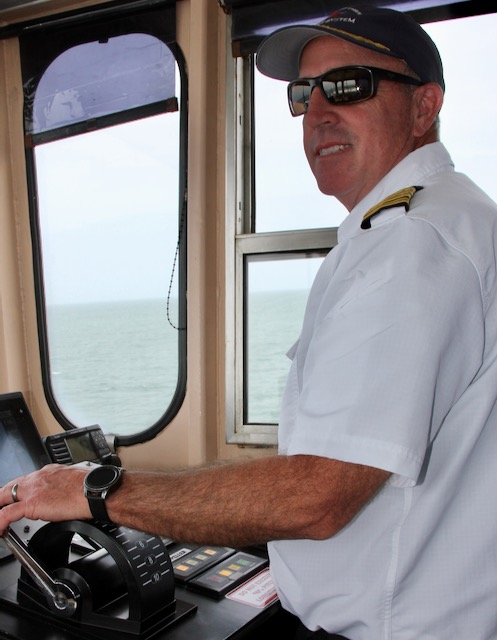
Hatteras Ferry Captain Anthony Gavetti at the helm during a recent transport to Ocracoke Island
Text and photos by Patty Huston-Holm
Hatteras Ferry Captain Anthony Gavetti ruined my vacation last year. This year, after meeting him and learning about his work, I’m glad he did.
As a captain of the ferry traveling Hatteras-to-Ocracoke and back, Gavetti is one of 45 captains in the North Carolina Ferry Division.
We’re not 100% sure he was calling the shots in March 2024 as my husband, Mike, and I tried desperately but unsuccessfully to get from Hatteras Island to Ocracoke Island for our off-the-social-media dream trip with our granddaughter. But if he didn’t, he would have.
In the name of safety, Gavetti calls the “go” or “no-go” shots for all the ferries traveling from Hatteras to the NC Highway 12 connection on the north end of Ocracoke Island.
Sometimes, the boats are suspended due to mechanical problems.
But usually, it’s inclement weather, including high wind. Gusts of 35 to 40 mph and shifting sand can make water unsafe for all boats.
Sand, wind and unpredictable water levels within the Pamlico Sound, Hatteras Inlet and Atlantic Ocean were issues during the unseasonably cold temperatures in that last week of March in 2024.
“Don’t get me wrong; I care about tourists,” Gavetti said. “But my focus is more on the people who live on the island and need to get home and the delivery trucks with food or maybe somebody’s prescription medicine. I need for it to be safe for everybody.”
Gavetti is a captain of the 22-year-old M/V Croatoan, named after a small Native American group living on what is now Hatteras Island back in the 1500s when Europeans first landed there.
I knew the Hatteras-to-Ocracoke route is the busiest of the seven routes. I have been among the estimated 1 million passengers per year using the ferry there. More than once, I was an impatient, cranky one.
I also knew the North Carolina ferry system to be the second largest in the country behind Washington state.
I shadowed Captain Gavetti, 50, on April 4. For six hours that day I posed incessant questions to him and his older and semi-retired captain back-up partner, Ricky Jones.
The average ferry passenger wants to know how long the trip will take and if the boat is going in the right direction. The average passenger hears the horn upon takeoff, absent-mindedly taking in the message to do what the captain tells you “in case of emergency.”
I wanted to know more. Gavetti patiently complied, sharing his background, credentials, stories and why the banana I ate was bad luck.
Ferry service began across the Hatteras Inlet to Ocracoke 72 years ago, in 1953. This is Gavetti’s 28th year.
Most of my conversation with Gavetti was in the wheelhouse up two flights of stairs where often it’s only the radiator and music that break the quiet.
Shortly after 8 a.m. the Croatoan pulled away from South Dock (as the north end dock is called) into the Hatteras Inlet and then into the Pamlico Sound. A sound is a body of water, typically a long, wide inlet or channel, connecting two larger bodies of water, in this case the Atlantic Ocean.
The two share in “guiding,” or directing a 275-ton, 150-feet-long, 42-feet-wide vessel between buoys and around often-changing piles of sand making up a shoal or sandbar.
The water needs to be deep enough. The depth a ferry sits in the water, also known as its “draft,” varies greatly, depending on the size and type of ferry, but generally ranges from around 3 to 15 feet (1 to 4.5 meters).
Alongside Jones, his teammate of 16 years, Gavetti works 12-hour shifts, 7 a.m. to 7 p.m., seven days a week (Tuesday to Monday) with seven days off after that.
Under the captain are chief engineer, oiler/assistant to engineer, senior AB (able body), AB and ordinary seaman. Two people must be in the captain quarters at all times.
To be captain, a minimum requirement is at least 360 days working on a vessel of 100 tons or greater.
“Able-bodied is probably the most important qualification for all of us,” Gavetti, a native of Carteret County, said. “I had to take a test to do this job, but my physical condition is what is monitored.”
The captain has the job of steering the boat and directing vehicle placement based on boat weight balance. The rest of the crew maintains order, safety and cleanliness with backup for each role.
“Sometimes, they fix me breakfast,” Gavetti. As I finished my banana, he added, “But no bananas.”
He then relayed legends of African ships disappearing under the Atlantic Ocean with “only bananas floating on top” and of deadly spiders hitching a banana ride. Thus, the yellow fruit has taken the blame for death and destruction.
“It’s just a tale, I suppose, but we all know about it,” he said. “Nobody in the crew eats bananas on the boat.”
To passengers who on this day made the boat less than half of its 30-to-40 vehicle capacity, the work of the captain might seem seamless.
Hatteras Ferry Captain Anthony Gavetti directs cars onto the boat.
Passengers exit their cars, trucks and vans to use the bathroom, feel the ocean air on their faces, get a closer view of the gulls gliding above the rear wake and peel their eyes for dolphins. On this day, a half dozen dolphins were diving in and out, “getting food that we stir up,” Jones said.
Research revealed that the Roanoke Sound, which includes Hatteras Inlet, is home to an estimated 400 to 800 dolphins.
“It might seem very monotonous, and it is,” Gavetti said, noting that on a ferry sometimes the front (bow) becomes the back (stern) and vice versa. “But you need to be ready. You have to be able to detect something different.”
Brewing storms are always on a captain’s radar.
The worst of them, hurricanes, suspend water travel, with the last one having been Isaias in 2020, though that storm went well to the west of the Outer Banks.
What most passengers don’t know about – but all Hatteras ferry crew members do – are the problems the last two years with Sloop Channel, which the ferries encounter about a third of the way into the run from the Ocracoke side.
This channel had bulged out to skirt shoals but could not accommodate two ferries, causing time delays while one ferry waited for the other to pass through. Last year, Hyde County and the Ferry Division received an emergency permit to cut off that bulge, shortening the run time.
“This was the section that aged us all by 10 years,” Gavetti said of that bulge. “We were always struggling to get through that without incident.” Creation of the channel that is used today required research by archeologists to determine that dredging wouldn’t destroy something (an old, buried ship, etc.) as well as engineering study. “We called this ‘the gauntlet,’” he said of that route “that kept getting further and further out” before the emergency cut was dredged. “There were so many agencies involved in making that better that when it was finally opened as a big slough, we saluted it.”
From the Hatteras dock, Gavetti can see his house. He has a wife who teaches kindergarten and four children, ages 25, 17 (twins) and 15.
Gavetti and Jones, who hails from Frisco, go home at night while other crew members from farther away stay in dormitories.
Gavetti’s father was a fisherman and a ferry boat captain. Also, once a commercial fisherman, Gavetti gravitates to the water even when on vacation. Marathon City in the Florida Keys is a favorite spot.
Gavetti’s first ride on a ferry was in seventh grade when his basketball team was coming over to compete against the Ocracoke Dolphins. He recalls always being fascinated with boats – tugboats, dredging spider barges, cruise ships and, of course, ferries. “Village councils and businesses are talking about us – the ferries – all the time,” the captain said. “Businesses get ticked off because the tourists can’t get over, and then they’re not making money. But when they realize it’s about safety, they calm down.”
This image of the Hatteras Inlet shows the route the ferries take and the recent cut-through at the bulge area.
NPS Ranger Ash Keiper-Kintz holds a loggerhead hatchling from a recent sea turtle excavation on Ocracoke Island. Photo: P. Vankevich/Ocracoke Observer
Visitors and residents on Ocracoke Island are invited to join rangers at the Cape Hatteras National Seashore for a public sea turtle nest excavation on Ocracoke Island at 9 a.m. Sunday, August 10, at off-road-vehicle Ramp 70. Park at the Ocracoke Island Airport, 1731 Irvin Garrish Hwy. On the beach, walk north (left) for approximately 500 feet.
Be sure to allow for extra time to walk to the nest as the excavation will begin promptly at 9 a.m.
During the excavation, spectators can watch National Park biologists dig up a recently hatched nest, and inventory what’s inside. Biologists will count empty eggshells, collect unhatched eggs, and occasionally find live and/or dead hatchlings during these excavations. While the biologists perform their examination of the nest, a park ranger will present a program on sea turtles and share what the biologists have found.
The Dare Arts building in Manteo. Photo by Dare Arts
Artists may now apply for Artist Support Grants through a partnership between the North Carolina Arts Council, Pocosin Arts, Beaufort County Arts Council, Dare Arts, Ocracoke Alive, Pettigrew Regional Libraries, and Martin County Arts Council.
Grant ranging from $500 to $1,000 will be awarded to eligible applicants in Beaufort, Dare, Hyde, Martin, Tyrrell and Washington counties to support a broad range of disciplines, including visual arts, performing arts, literary arts and interdisciplinary arts.
Emerging and established artists are encouraged to apply for a grant for a variety of professional and artistic development including the creation of work, improvement of business operations, purchase of equipment and/or materials, professional development workshops, travel support associated with a professional opportunity, and development of promotional materials.
Dare Arts Executive Director Jessica Sands will lead a free Artist Support Grant application help sessions on Zoom at 5 p.m. Wednesday, Sept. 24, and at 11 a.m. on Thursday, Sept. 25. Artists wishing to participate can sign up online at DareArts.org/asg, where the grant application is available.
The deadline to apply is 11:59 p.m. on Friday, Oct. 10.
Kill Devil Hills artist Emily Holmes was awarded an Artist Support Grant last year to help her purchase a glass fusing kiln, which has enabled her to add painted glass elements into mixed-media pieces.
“The Artist Support Grant allowed me to purchase a kiln that is helping me explore new techniques, and maybe more importantly, it provided encouragement and support for my creative work,” said artist Emily Holmes. “Receiving the grant motivated me to dedicate more time and energy to focusing on and expanding my creative practice as a mixed media artist. I’m deeply grateful for the assistance, and for programs like this that invest in local artists.”
The program, now in its sixth year, is funded by the N.C. Arts Council to provide the opportunity for regional consortia of local arts councils to award project grants to artists in their regions.
An extensive project to rebuild the dune barrier between the Atlantic Ocean and N.C. Highway 12 on northern Ocracoke Island is underway, with minor traffic delays expected for the next few weeks.
Sawyer & Sons Construction out of Columbia, Tyrrell County, was awarded a $250,000 contract to move roughly 14,500 cubic yards of sand from the N.C. Ferry Division’s dredge spoil site to this stretch of the island. From there, the contractor will cover exposed sandbags and reconstruct the dune protecting the roadway approximately two miles south of the Hatteras-Ocracoke ferry terminal.
An estimated 7,115 feet of dune will be reconstructed as a result of the project, which is spearheaded by the North Carolina Department of Transportation (NCDOT).
The contractor will also be stockpiling nearly 3,000 cubic yards of sand on the right-of-way west of N.C. Highway 12 at this location for use by NCDOT maintenance crews throughout the ongoing hurricane season.
Work began on Monday, July 28, and per the NCDOT contract, the project must be completed by Sept. 19.
“Automated flaggers are being utilized to allow traffic to safely pass through the work zone in a single lane configuration while work is taking place,” said Tim Hass, communications officer for NCDOT Division One. “As the ferry runs on a schedule, prioritization is given to traffic heading towards the ferry dock.”
This venture is one of many recent projects aimed at protecting this vulnerable stretch of N.C. Highway 12.
An estimated 800 sandbags in this area were last repaired in April 2024 after a series of winter and spring storms washed over N.C. 12.
Sunset over the Pamlico Sound. Photo: C. Leinbach/Ocracoke Observer
Events will be added and deleted as necessary.
Monday, Aug. 4: Hyde County Board of Commissioners, 6 pm. Livestreamed in the Community Center. See agenda below. Ocracoke Oyster Company: Bryan Mayer, 7:30 pm
Tuesday, Aug. 5 Ocracoke Preservation Society Porch Talk: Ray McAllister: Things Ocracoke (plus book signing), 2:15 pm. MiniBar at Ocracoke Coffee: Family game night. 6-8 pm 1718 Brewing Ocracoke: Barefoot Wade, 7 pm Ocracoke Oyster Company: Bryan Mayer, 7:30 pm
Wednesday, Aug. 6 MiniBar at Ocracoke Coffee, 6-8 pm: Island Trivia Ocracoke Oyster Company: Barefoot Wade, 7:30 pm Deepwater Theater: Ocrafolk Opry, 8 pm
Thursday, Aug. 7 Ocracoke Preservation Society Porch Talk: Bevin Hardy: Understanding Local Perspectives: a year of fieldwork and interviews on Ocracoke, 1 pm OVFD meeting, 6 pm. Volunteers always needed and welcome. MiniBar at Ocracoke Coffee, 6-8 pm: Brooke & Nick Ocracoke Decoy Carvers Guild meeting, 7 pm. Community Center. Ocracoke Oyster Company: Billy Breslin, 7:30 pm DAJIO: Ray Murray, 8 pm
Friday, Aug. 8 What’s Happening on Ocracoke: Ray McAllister will discuss his new book, the Update Ocracoke, Pearl of the Outer Banks, 11:30 am, 90.1 FM on the island and wovv.org MiniBar at Ocracoke Coffee, 6-8 pm: Kate McNally 1718 Brewing Ocracoke Ocracoke Oyster Company: Raygun Ruby, 7:30 pm
Saturday, Aug. 9 MiniBar at Ocracoke Coffee: artist TBD, 6 pm Ocracoke Oyster Company: Ray Murray DAJIO: After School Surf Club, 8 pm
Sunday, Aug. 10 Church services: Ocracoke United Methodist Church, 11 am Ocracoke Life Saving Church, 11 am Stella Maris Chapel: Sunday afternoon Mass time varies. Go to Masstimes.org and type in the zip code: 27960
Ocracoke Oyster Company: Martin & Friends, 7:30 pm
National Park Service programs: The following free programs run from June 16 to Aug. 28. Banker Ponies at the Ocracoke Pony Pen: Every Monday and Wednesday, 8:30 am — 9 am Ocracoke Lighthouse: Every Monday, Tuesday, Wednesday and Thursday, 11 am to 11:30 am Life on a Barrier Island: Every Monday, Tuesday, Wednesday, Thursday, 2 to 2:30 pm. Outside the Discovery Center. MorningBird Walk: Every Tuesday from 8:30 to 9:30 am. Meet at NPS campground parking lot.
Former North Carolina Poet Laureate Joseph Bathanti once remarked that Ocracoke is the perfect place for those struggling to “finish that book.”
Jean Skipper talks with islander Ruth Toth.
This sentiment resonates with many artists and writers who find inspiration in the island’s natural beauty and from its small, friendly community.
Ocracoke can be a haven for creativity.
Donald Davis runs two week-long storytelling workshops in June. North Carolina Poet Laureate Jaki Shelton Green facilitates sessions for her Sistah Write creators and island yoga practitioners hold retreats.
Each October, a small group of plein air artists descends upon Ocracoke, spreading out across the village to paint the boats, houses, shacks and diverse flora and fauna.
At the end of their week, these artists invite the community to view and purchase their works, fostering a sense of connection with island residents and visitors.
Since 2013, Jean Skipper, an artist and small business consultant, has been conducting retreats on the island aimed at inspiring creativity and building confidence.
Skipper’s love for Ocracoke blossomed during visits in her mid-20s. The island’s natural beauty and the friendships she has formed there strengthened her bond with the area.
A significant aspect of this connection is her husband, Ken, whom she met at Howard’s Pub. He proposed to her on the island. After their marriage, they moved to Vass, Moore County, where she continued her career in finance.
But her passion for art eventually drew her away from corporate banking. She decided to embrace her artistic side fully and use her business skills to help other artists flourish.
Her ARTworks Vass Gallery showcases the work of more than 200 artists and offers a variety of classes in different media, including painting, pottery, glass and metalworking.
It also sponsors numerous events, workshops and summer camps for kids.
“I discoveredARTworks Vass retreattowards the end of COVID-19,” said Stacy Metaxis Whitlow, one of the retreat participants. “It was a nice escape for me and my daughter.”
Melissa Rian, who holds a BFA from Wayne State University, shared how the studio provided her with a fulfilling balance between her IT career and her passion for teaching printmaking, eco-dying and painting.
“I’ve surrounded myself with talented people who inspire me,” Skipper said, highlighting the importance of community in the creative process.
Skipper also acts as a consultant for small businesses, particularly those focused on the arts. She has conducted seminars on Ocracoke over the years, helping artists understand the business side of their craft.
A central theme of her retreats is encouraging participants to embrace their identities as artists. “Children are natural creators,” she explained. “If you ask them, ‘Are you an artist?’ their answer is simply ‘Yes.’ They inherently know they are artists.”
ARTworks Vass retreat social with islanders.
Unfortunately, societal pressures and self-criticism often diminish this confidence as people grow older. “Somewhere along the line, whether through self-doubt or external criticism, that belief can diminish,” she said.
So, Skipper wants to change that.
“I’m on a mission to help individuals realize their artistic potential and cultivate confidence in their creative abilities,” she stated during an interview on Ocracoke’s community radio station, WOVV.
She believes that everyone possesses an artistic spirit, even if they don’t recognize it.
On air at WOVV 90.1 FM, Ocracoke’s community radio station, Jean Skipper talks about her retreats.
“I’ve encountered many talented individuals who struggle to declare themselves as artists,” she said, reflecting on her own journey.
She encourages participants to be kinder to themselves, reminding them that self-criticism can stifle creativity.
“Every successful artist has created imperfect work at some stage. The key is to keep showing up and practicing,” she advised.
The supportive environment of her retreats often leads to breakthroughs for participants.
“When someone tells me they’re not an artist or teacher, I see it as a personal challenge to show them that they can be if they choose to,” she said, smiling.
This philosophy fosters a community of growth and encouragement, where individuals feel empowered to embrace their artistic identities.
At her studio, Skipper creates a welcoming atmosphere for exploration.
“I encourage participants to experiment and try new things,” she said. “Whether it’s painting, pottery, or any other form of art, the goal remains the same: to create something beautiful and enjoy the process.”
One evening, Skipper and the visiting artists hosted a gathering for islanders to share insights on creativity and camaraderie, generating lots of spirited observations and much laughter.
The spirit of Ocracoke Island is woven into her own artistic journey and her mission to help others.
Ocracoke’s Day Use, or ‘Lifeguard,’ beach. Photo: C. Leinbach/Ocracoke Observer
With all this crazy disinformation that is being spread on social media, it’s unfortunate that this is worsened with AI, or artificial intelligence.
A case in point recently was that a local news service identified Ocracoke’s Lifeguard Beach as having the worst thefts in the country for beaches. Currituck beach and Carova beach also made the top ten giving the Outer Banks a bad reputation and which might cause potential visitors to look for safer locations to spend their vacation.
The rates of theft were, of course, totally false.
While we are reluctant to reiterate errors, on July 15, 2025, this appeared:
“EMERALD ISLE, N.C. (WNCT) — A new report found that three of North Carolina’s beaches are in the top ten for most theft prone beaches in the country.
“The Action Network ranked Ocracoke lifeguarded beach in Hyde County number one. Currituck beach and Carova beach in the Outer Banks tied for seventh. The report analyzed property crime data across 520 US beach zip codes with a focus on theft, robbery, vehicle and burglary.”
So, what is Action Network? It’s described as a sports media company featuring news and analysis focused on sports betting in the United States.
And where did Action Network get its information? One source is CrimeGrade.org.
On this organization’s website is this: “A complex process of statistical computation and machine learning to find the safest and most dangerous areas. This data is then parsed into simple maps and grades that anyone can understand. Put in your zip code to see crime in your city.”
We put in 27960 and Ocracoke got Fs for all crime.
Crime Grade’s property crime map highlights the safest areas in Ocracoke in green, the most dangerous in red, and moderately safe areas in yellow. Crime rates on the map are weighted based on both the type and severity of the crime.
The whole island is red.
And these howlers: “Ocracoke residents generally consider the north part of the city to be the safest. Your chance of being a victim of property crime in Ocracoke varies by neighborhood – ranging from 1 in 11 in the northeast neighborhoods to 1 in 12 in the north. Cost of Crime for Ocracoke, NC is $239,129 and murder alone will cost islanders $736 per household. And finally: Of 27960’s 588 residents, few live near recreational areas.”
A search of these websites does not give the owners nor how to contact them.
On the good side of this was the quick reaction to the July 15 “news.”
Randal Mathews, Ocracoke’s county commissioner, wrote to the WNCT-TV station to say, despite what CrimeGrade.org may say, there’s no data to support these allegations.
“I have contacted the Park Superintendent to inquire and neither of us have ever heard of a theft problem at the lifeguard beach,” he said. “It’s questionable why your station would report something like this and say it came from another network.”
Cape Hatteras National Seashore Superintendent David Hallac quickly wrote to the station to refute the evidence, saying “A search of our law enforcement statistics for ‘thefts,’ ‘burglary,’ ‘robbery’ or ‘breaking-and-entering indicates that there has not been a single incident of theft at the lifeguarded beach on Ocracoke Island over the last 10 years.
“While it’s possible that a theft may have occurred but was not reported, these data demonstrate that theft is extremely rare at the Seashore on Ocracoke Island and that our visitors can enjoy visits without significant concerns about theft, burglaries, or robberies.”
Although they did not retract the original story, WNCT-TV to their credit, followed up on July 18 with an online news report “Ocracoke is safe: County leaders dispute recent national study.”
The news site on Actionnetwork.com for “The Most (and Least) Theft-Prone U.S. Beaches in 2025” was updated July 18, and Ocracoke was no longer listed, but Carova and Currituck beaches were tied for sixth place.
To have credibility, news services need to provide accurate information, which involves fact-checking and making sure the sources of information are credible.
In the case of Crime Grade’s information on Ocracoke, it is egregiously wrong.
Anyone even mildly acquainted with the island would know that labeling Ocracoke the most theft-prone beach in the country would not pass the smell test, and that must be done by a human being, not a machine.
It is not just news services that need to be careful.
People using social media have responsibilities as well. Photos showing people in untoward circumstances, or documents appearing as though typed on old Remington typewriters that appear authentic but are totally false, can be whipped up and circulated with light speed on the Internet.
For the record, over the years, safety reports in the Observer (see page 20) show that Ocracoke Island is not a hotbed of crime.
As Mathews told WNCT: “This is the kind of place where you can drop your wallet and when you get it back, all the money is still in it.”