Home Blog Page 334

NPS Ocracoke campground to close at noon today ahead of potential tropical storm conditions

0
Cape Hatteras National Seashore Ocracoke campground.

For an update on Hurricane Maria’s potential impact on the Outer Banks, click here

Sunday, Sept. 23, 2017. 10:56 a.m.

The NPS campground on Ocracoke will close temporarily at noon today (Sept. 24) and will reopen post-storm after safety assessments are completed. 

Beach access ramps will remain open to off-road vehicles and pedestrians at this time, but some beach routes may become impassable. Daily beach access ramp status updates are available on the Cape Hatteras National Seashore Facebook page at http://facebook.com/capehatterasns.

Swimming is not advisable while there is a high risk of rip currents, the NPS said in a press release.  For a daily rip current forecast, click here. For information on rip currents safety, go to: http://www.ripcurrents.noaa.gov.

For more weather-related information, check local NOAA weather forecasts, and local radio and media for updates and advisories.


Ocracoke events week of Sept. 24 to 30

1
Zillie’s Island Pantry, Back Road

Update Sept. 25, 9 a.m.: With the approach of Hurricane Maria up the Atlantic Coast, Hyde County issued a mandatory evacuation for visitors today starting at 5 a.m.  The OCBA has postponed the meeting for tonight. Some of the events below may also be canceled as the week continues.

Sunday, Sept. 24
Ocracoke Bar & Grille: Kim France, 7 pm

Monday, Sept. 25
Berkley Manor, James Scott Farrin law firm of Durham. Free meeting about PCL claims. Noon
Community Center Ocracoke Civic & Business Assn., meeting about new software for submitting contributor dues. 5:30 to 7:30 pm (POSTPONED. New date TBD.)
Ocracoke Bar & Grille: Aaron and Jackie, 7 pm

Tuesday, Sept. 26
Gaffer’s: Texas Hold ‘Em Poker, 7 pm
Ocracoke Bar & Grille: Barefoot Wade, 7 pm
Coyote Music Den: Coyote Plus One, Danny Gotham. 8 pm, doors open at 7:30 pm (CANCELED)

Wednesday, Sept. 27
Gaffer’s: Team Trivia to benefit Megan Aldridge. 7 pm
Ocracoke Bar & Grille: Barefoot Wade, 7:10
Coyote Music Den: Just We Two, 8 pm, doors open at 7:30 pm (CANCELED)
Deepwater Theater: The Dingbatter’s Guide to Ocracoke, 8 pm
Ocracoke Oyster Co.: Karaoke, 9 pm

Thursday, Sept. 28
Deepwater Theater: Molasses Creek band, 8 pm
Ocracoke Bar & Grille: Kate McNally, 7 pm

Friday, Sept. 29
Zillie’s Island Pantry, Back Road: Wine tasting, 6 pm. Reservations required: 252-928-9036.
Jolly Roger: Willis Gupton, 6 pm
Ocracoke Bar and Grille: Barefoot Wade, 7 pm
Ocracoke Oyster Co.: Kate McNally, 7 pm
Coyote Den: Martin & Friends Playing your Ocracoke memories, 8 pm; doors open at 7:30 pm
Gaffer’s: Frozen Head & the Squirrels, 9 pm

Saturday, Sept. 30
Jolly Roger: Willis Gupton, 6 pm
Ocracoke Oyster Co.: Martin and Lou, 7 pm
Ocracoke Bar & Grille: Barefoot Wade, 7 pm
Gaffer’s: Frozen Head & the Squirrels, 9 pm


Outer Banks fall within the cone of Hurricane Maria as it expects to shift slightly west

0

For Ocracoke news, click here 

By Peter Vankevich

Hurricane Maria has begun a slow trek north still as a Category 3, though is expected to decrease in strength.  It was hoped that the storm would  remain well out to sea, but the National Weather Service out of Newport/Morehead City Saturday evening (Sept. 23) said the hurricane’s track is expected to shift westward and possibly stall for a while early to the middle of next week.

Tropical storm-force wind probabilities have increased across Dare and Hyde counties, and the entire Outer Banks are  now within the western part of the forecast cone as the National Weather Service said it is becoming increasingly likely that some impacts will occur along portions of the Mid-Atlantic coast next week.

A forecast cone indicates the center of the storm will most likely pass, but impacts from hurricanes extend well away from the center. Those living near, not just inside the cone, should be prepared for possible impacts.

Swells generated by Maria are already increasing along portions of the southeastern United States coast and Bermuda.

Even if the center of Maria remains offshore, rough surf, a high risk for rip currents, beach erosion and ocean over wash are probable. Suspended ferry service may be possible during this time.

Maria made landfall Sept. 19  in Dominica as a Category 5 hurricane with winds of 160 mph and was the strongest storm to ever strike the island.  

The following day, Maria made landfall in Puerto Rico as a high-end Category 4 hurricane with winds of 155 mph, becoming the strongest to hit the territory since 1928.  

Both islands have been devastated by this storm, leaving Puerto Rico entirely without electric power and its electrical grid being described as having been totally destroyed. The full extent of  the extensive damage and casualties are yet be determined.


PCL seeks to dismiss class-action lawsuits on power outage; another law firm on island Monday

0

For Ocracoke news, click here

By Connie Leinbach

Attorneys for PCL Constructors filed a motion Sept. 12 in the U.S. District Court of Eastern North Carolina to dismiss all class-action lawsuits stemming from the weeklong power outage in July.

The motion says a lawsuit filed July 31 by Wallace & Graham of Salisbury on behalf of six plaintiffs should be dismissed because of the “Economic Loss Rule,” as set forth in a 1927 U.S. Supreme Court case, which says plaintiffs must show injury to person or property and not for “purely economic loss.”

The motion, filed by Rodney Pettey, a Raleigh attorney for PCL, is against the six plaintiffs “individually and as representatives of a class of those similarly situated.”

If this motion is granted it would kick all of the class-action lawsuits out of court, said Robert Zaytoun, a Raleigh lawyer whose firm also has filed a class-action lawsuit.

The plaintiffs have not shown that PCL was “reckless and negligent,” nor that they suffered personal or property damage, says the memorandum of law filed with Pettey’s dismissal motion.

When contacted Thursday (Sept. 21), Pettey’s law firm said they could not comment on the case. No court date has yet been set. 

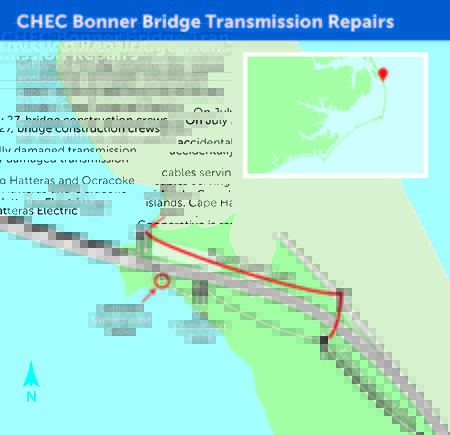
The power outage occurred July 27 to Aug. 3 when crews rebuilding the Bonner Bridge dropped a steel casing into the ground damaging the main electric transmission lines feeding Hatteras and Ocracoke islands causing a blackout.

While both islands were partially powered by portable generators during the week-long repair, Hyde and Dare counties issued a mandatory evacuation of all visitors during the high tourist season because the generators could only power the needs of residents.  

Although the cables were restored Aug. 3 and visitors were allowed back to both islands Aug. 4, in the uncertainty of how long the repair would take, many vacationers canceled their vacations in the weeks afterwards.

“The impact to the island is catastrophic,” said Bob Chestnut, co-owner of Ride the Wind Surf Shop. “You take our little island economy at X million dollars a year and we just lost a big chunk of our cash flow, and you can’t recover cash flow.”

Pettey’s memo says there are no allegations that “PCL consciously, intentionally, knowingly, or deliberately disregarded or were indifferent to the rights and safety of others.”  There are no allegations that PCL defendants acted “with a wicked purpose,” and any contention that PCL was “grossly negligent is not a statutory basis for punitive damages,” the motion says.

Punitive damages are the keys to winning class-action lawsuits, said Zaytoun and Steve Lacy, Zaytoun’s co-counsel from Pamlico County, both of whom visited Ocracoke Sept. 7 to meet with islanders interested in joining in a class-action lawsuit against PCL.

“We believe this is premature,” Zaytoun said in a later interview about this motion to dismiss because he said the eight lawsuits—some filed in state and some filed in federal courts–will first need to be consolidated in the Eastern N.C. federal district court No. 1.  “It’s early and we were surprised to see the motion filed.”

He said the Economic Loss Rule does not apply in North Carolina unless there was a contract between the plaintiff and defendant.

“This should not have happened,” Zaytoun said about the damaging of the electric cables, and the state may share responsibility if they had people on the bridge to supervise.

“We don’t know the degree of negligence or how aggravated it was,” he said. “There is no accident if they knew the power line was there. Why did this happen?”

North Carolina Dept. of Transportation contracted with PCL to build the bridge.

“NCDOT has the duty to supervise them,” Lacy said. “The question is, where was (the supervisor)?”

The standard in North Carolina for awarding punitive damages is “willful and wanton” misconduct, Pettey’s motion says, and that’s what the class-action lawyers are trying to discover.

“The threat of punitive damages will make (PCL) settle,” Zaytoun said.

Zaytoun said North Carolina law allows for recovery of the intangibles of “stress and inconvenience.  If we show (PCL was) reckless, (the claimants) could get triple what they lost.”

Since the outage, PCL set up claim forms on their company website and Facebook for anyone—vacationers, businesses and employees—on which to compile their losses during the time the island was closed and beyond.

Hyde County Manager Bill Rich said in a recent interview that PCL has already processed 600 claims from individuals and businesses impacted by the week-long power outage in July.

“No one’s complained,” he said. “They got what they wanted.”

He did not know the amounts of these settlements.

Rich had called a community meeting Aug. 4 to tell islanders that PCL wanted to “settle this peacefully” and that the community should work together and with the county to get compensation.

The county had created its own claim form, and though they initially asked islanders to send these claim forms to them and they would forward the forms to PCL, the county has since said islanders should send claim forms directly to PCL.  

In addition to personal and business losses, nonprofits could also be affected. The island will also lose a substantial amount of money collected through the Occupancy Tax and may be entitled to compensation. Each year, Occupancy Tax revenues, which amount to about $450,000 per year, are distributed in grants to island nonprofits.

But if claimants ask for a specific amount, will PCL deduct the overhead costs involved with these losses, and did they sign a release before receiving a check?  Zaytoun asked.

“They’re not going to pay you your gross profits,” Chestnut said about individual claims to PCL. But Janille Turner, co-owner of Ocracoke Oyster Co., said they should do so “regardless of what you had to spend to get that profit” because businesses would still have to pay taxes on any remuneration they receive.

Turner, who had a restaurant on Mon Louis Island on the Alabama coast and lived through the BP oil spill in 2010 before returning to Ocracoke in 2011, said she’s still waiting for payment in the two class-action lawsuits she joined as a result of the BP spill.

“In class-action lawsuits, lawyers charge for everything—every piece of paper, every stamp,” she said. “These costs are not included in your percentage. So they will still get 75 percent.”

Judy Eifert, co-owner of Dajio Restaurant, said some of her employees have received compensation from 10 days of lost wages, and they signed waivers before receiving their checks.

As are several other island businesses, Eifert is still weighing her claim options and thinks island business owners should not “just jump.”

“People should get what they deserve,” she said. “They’re (PCL) trying to settle as much as they can as fast as they can.  People should really research what they lost because there probably are hidden costs they’re not realizing.”

John Giagu, owner of Island Golf Carts, said that although he hasn’t yet filed a claim or taken other action, he said he would be OK with PCL deducting “a reasonable percentage.”

Another business owner, who declined to be identified and who lost thousands of dollars each day during the outage, is also weighing the options, but trying to choose how best to proceed is adding to her stress.

“I just want what I lost,” she said.

Turner did receive compensation from BP in much the same set up as PCL is doing with this outage.  She, along with some islanders, is seeking compensation through a public insurance adjuster,  Rob Izzo of Southern Loss Consultants, Inc., who visited the island on Aug. 20, and, in two meetings sponsored by the OCBA, talked about how his profession works as a go-between with insurance companies.

One island hotel owner who declined to be identified and who said his business lost “a significant amount” from the outage and its aftermath, said he doesn’t think there’s a right or wrong answer about how to get compensation.

“It’s whatever anyone’s comfortable with,” he said.

Also, noting that there are concerns that the PCL claim form “is a trap,” lawyers with James Scott Farrin of Durham have scheduled a free public meeting at noon on Monday (Sept. 25) in the Berkley Manor, and again at 7 p.m. in Buxton at the Inn on Pamlico Sound, 49684 Highway 12. 

Several island businesses have received packets from them including a spiral bound booklet and a sample PCL claim form with their annotated comments.

Gary Jackson, a spokesman for the law firm, said his company has not filed a class-action suit but knows people have a lot of questions and will talk to islanders about individual law suits.

 

Documentary film on VOICE trip to Ocracoke last year wins top honor in film festival

3
UNC-CH Assistant Professor Joseph Cabosky, with a big smile, holds the glass trophy after winning the award for Best Film at the Arts of the Pamlico’s Marquee on Main Film Festival, Sept. 15, in Washington, N.C. Photo by Carlton Koonce

To read about the Durham Voice visit to Ocracoke, click here

Reprinted courtesy of the Durham Voice 

By Yizhou Jiang

Joseph Cabosky received the Best Overall Film Award for his feature documentary, “Writing My Own Happy Ending,” in the Marquee on Main Film Festival in the Historic Turnage Theater in Washington, Beaufort County, earlier this month.

Cabosky, an assistant professor at School of Media and Journalism of UNC-Chapel Hill, focuses on diversifying and disrupting strategic communication, public relations and advertising.

Of the 732 films entered in the festival, 26 were selected for viewing of which Cabosky’s film won the top prize, Cabosky said. The film narrates the story of both newspapers, the Durham VOICE and the Ocracoke Observer, and a trip for the six teen writers to Ocracoke Island in the Outer Banks last summer.

Documentary filmmaker Joe Cabosky focuses in his subject during the shoot on Ocracoke Island, August 2016. Photo by Jock Lauterer.

“The film started from the idea that we needed to document how valuable the Durham VOICE was, particularly to its teen writers,” Cabosky said. “I initially was only going to do an assessment plan, starting with qualitative interviews of the students. Since I thought it’d be best if we captured the students telling their own stories, I decided to film the one-on-one interviews. After doing so, I determined a documentary would be a much more powerful way to tell their story.

Natasha Graham, 19, of Durham,  and the narrator and co-writer of the film, said that she was nervous at first because she had never been filmed before but later she adjusted along with it because it was something new and exciting for all of the students involved. She is the former teen-editor-in chief of the VOICE and is now a sophomore in Wells College, Aurora, New York.

“Because Joe is so subtle and compassionate, his presence with the camera was never a bother or an intrusion — and in fact, I think added to the realization among the PYO kids that this was something really special — worth recording,” said Jock Lauterer, the founding publisher of the VOICE and the project leader.

The film was shot during the first week of August 2016, and most of the footage came from ethnographically documenting the trip. Together the six teens and four adult leaders visited the island newspaper, the Ocracoke Observer, wrote stories in a completely different environment, and experienced a cultural exchange with the local people.

Graham said her most memorable part of the trip was probably swimming in the Pamlico Sound for the first time.

“I remember just how calm the water was, and how everyone was just enjoying themselves because most of us had never swam in such calm water before,” Graham said.

About the film, Graham said, “I felt really good about it. Of course I still cringe every time I hear my narration, just because it’s always weird to hear your own voice aloud. But I was really happy with the end product. And above all I’m so happy that the awesome time in our lives was captured for us to look back on.”

Cabosky thinks documentary is a great way to share the story of the VOICE and the realities of the VOICE teen writers with other communities and other youth.

He said that he could not believe it when he heard the film won the prize.

“The success of the film means that we’ll be able to reach more and more audiences, so that more people will be able to experience these powerful and amazing kids,” Cabosky said. “And hopefully, it will help the program spread to other towns, communities and schools. ”

Taking a brief moment to tour the historic Turnage Theater in Washington, N.C., before the screening of the documentary film, “Writing My Own Happy Ending,” the Durham VOICE team includes, left to right, Shay Kimzey, PYO associate director of programming; Elijah McCloud, VOICE teen intern; Qaadir McFadden, VOICE teen intern; award-winning film maker and UNC-CH Assistant Professor Joe Cabosky; and LaMon Jones, last year’s VOICE teen editor-in-chief. Cabosky’s documentary on the VOICE beach work-trip to the Ocracoke Observer in August 2016 was named Best Film at the film festival, Sept. 15. Photo by Carlton Koonce
Every minute of the Durham VOICE interns’ visit to Ocracoke in August 2016 is documented. Photo: C. Leinbach


Yizhou Jiang is a journalism student at the UNC-CH School of Media and Journalism. A native of China, this fall she is serving as a photographer-writer for the VOICE.


Secret Garden Gallery to relocate to Washington, N.C.

0
Barbara Hardy and Bob Ray at their Ocracoke home. Photo courtesy of the Turchin Center for the Visual Arts, Appalachian State University

Secret Garden Gallery’s last day on Ocracoke is Saturday, Sept. 23. Stop by to see Barbara and Ray off.  There will be sales including  Barbara Hardy’s signature silver and gold pieces are 50 percent off. Open 10 to 5:30 or 6.

By Connie Leinbach
Island artists Barbara Hardy and Bob Ray are moving their Secret Garden Gallery to Washington, Beaufort County.

The two have had their gallery/jewelry store on Ocracoke for 26 years, and are moving back to Hardy’s hometown to be closer to children and grandchildren.

“I started in a tiny shop on the harbor,” Hardy said. “But we’re reinventing ourselves after 26 years. It’s been a good run.”

While their Back Road shop, which closes on Saturday, sells jewelry and the couple’s art, the new quarters at 144 W. Main St., Washington, is twice the size and will have an expanded offering “for living a good life,” Hardy said. It will open at the end of October and have room for art shows, events, poetry readings and special workshops. Their website is secretgardengallery.net; phone: 252-588-0067.

The Secret Garden Gallery on Back Road will move to Washington, N.C., and reopen in October. Photo: C. Leinbach

“We’re hoping all of our customers from Ocracoke and surrounding areas will find us,” she said.

Earlier this year, they sold their properties to Nat Schramel, whose family owns the Flying Melon Café. Plans for the gallery space after September are pending.

Meanwhile, Hardy and Ray’s two-person show, “Circles of Influence,” will continue until Dec. 2 in the main gallery of the Turchin Center for the Visual Arts at Appalachian State University in Boone.

Both artists are inspired by found objects, patterns and designs found in nature.

“The influence the artists have on one another and their shared love of rich texture and layered patterns will be immediately apparent even though each artist’s practice and techniques are unique and quite different from one other,” said Mary Anne Redding, Turchin Center curator and assistant director, about the show.

Ray, born just east of Kansas City, Missouri, works in a variety of media, from drawings, paintings, collage, and sculpture to correspondence and performance works.

He is a 2015 recipient of the North Carolina Arts Fellowship. His aesthetic borrows heavily from the Dada and Fluxus movements, with a strong combination of word, gesture, and image.

“A sense of something a little extra is the way I constructed an idea of life and then a life through art,” Ray said.
Since 1990, he has been active in the International Union of Mail-Artists, in which artists around the world share their work on postcards or clippings via the mail services.

Ray’s early body of music evolved into performance, poetry and theater.  For a couple of years, Ray had an evening show on Ocracoke’s community radio station WOVV 90.1 FM, called “Bobby Lovely and the Rabbit Opera.” The offbeat broadcast featured him and invited guests reading poetry and other creative works.
Hardy knew at the age of 9 that she was an artist.

‘Visible Ghosts,’ multimedia by Barbara Hardy. Photo courtesy of the Turchin Center

“At an early age I drew, painted and made things. At 9 years old, I knew and called myself an artist. Art fed me then and continues to feed me.”

Her artistic journey formally began at Appalachian State University, studying art education, with many media interests. She later studied painting and metal at Eastern Carolina University.

After attending college, Hardy taught art enrichment briefly in public schools. Later, she taught children and adults through local arts councils, community colleges and volunteer programs. The focus was to bring art out to local rural communities and villages that might not have art opportunities.

“After experimenting in many areas, I now concentrate in painting, sculpture and metal design,” she said.

In the last 25 years, she has shown her work at Emerge Gallery, Brevard College, Imperial Arts Center and various galleries on Ocracoke, Asheville, in private collections and in shows with Ray and others.

‘Circles of Influence’ art by Barbara Hardy and Bob Ray on view in the Turchin Center for the Visual Arts, Appalachian State University. Photo courtesy of the Turchin Center

Durham youth taste life on a sandbar

1
The Durham VOICE interns and staff outside of Howard’s Pub in August 2016. At the back, from left: Gwendolen Payne and Joe Cabosky. Second row: Yusuf Shah, LaMon Jones, Julie Wells (with camera), Carlton Koonce and Bruce Wilkerson. Front, Eric Johnson, Natasha Graham, Peter Vankevich, Christian Lawrence and Connie Leinbach. Photo by Jock Lauterer

For Ocracoke news, click here

This article was published in the September 2016 print edition of the Ocracoke Observer. Tomorrow we will post a follow-up on this visit. 

By Jock Lauterer

Take six inner-city urban teens, send them to a remote island village far across the water from the mainland, take away their smart phones, put cameras, pens and computers in their hands and set them loose to photograph and write about island life, and what do you get?

A little chaos, a dose of culture shock, a boatload of surprises, plus lots of what the locals call “the Ocracoke Effect,” in which community connectivity produces a sort of invisible free-floating chemistry of serendipity that pervades island life.

In early August, the Durham VOICE, a community newspaper written by teens, and the Durham nonprofit  teamed up with the Ocracoke Observer to bring the teens to this Outer Banks island for a working weekend.

All six teens spent the last year as writer-photographers for the VOICE, the community newspaper and website (durhamvoice.org) serving central Durham, created seven years ago as a gang intervention community project.

Two years ago, Connie Leinbach and Peter Vankevich, co-owners of the Ocracoke Observer, broached the idea of inviting the VOICE youth to learn more about the workings of another community newspaper, learn about island culture and document stories of the islanders. Their internships are supported by Julie Wells, the PYO executive director and Workplace/Mentoring Coordinator Carlton Koonce. Other mentors serving as volunteers on the trip included Eric Johnson of the UNC-CH Office of Student Aid and Assistant Professor Joe Cabosky of the School of Media and Journalism.

Each student was given an assignment. Gwen Payne wrote about Emilia Jordan, a 10-year-old who, with Maren Donlon, cohosts “Island Girl Talk,” a radio show on the village’s community radio station WOVV 90.1 FM and wovv.org (which publisher Vankevich helps anchor).

Natasha Graham interviewed Emily Schweninger, an international health professional working with UNICEF in Equatorial Guinea and focusing on HIV prevention.

LaMon Jones wrote about world-ranked judo master Gustavo Sanchez.

Christian Lawrence spent a day with a 17-year-old entrepreneur, Kaylee Gaskins, who runs her own smoothie stand.

Yusuf Shah learned the story of the Hutcherson family, owners of the village’s iconic Variety Store.

Bruce Wilkerson wrote about how Leinbach and Vankevich, both transplanted northerners, came to own the village’s newspaper.

At trip’s end, the student shared their take-aways from the experience.

Here are some of their comments: “I really have learned a lot. I love the vibe of this island and this community. I wish Durham was like Ocracoke. Then it could help the community rise.” – Bruce Wilkerson “I’ve never been on a boat before; never been to a bonfire, never been on a beach trip…and I learned I’m good at adapting to new situations.”— Natasha Graham. “I have gained new skills as a reporter by being here.” — LaMon Jones “I’ve never gotten off the mainland before so that’s pretty cool. And this place is better than Durham. There’s a lot of culture here.” — Gwen Payne “This experience really brought me out. Everybody knows each other and is so friendly. Y’all are like family here.” — Yusuf Shah.

All of the young journalists were interviewed on WOVV and played a song of their choice. Gwen Payne elected to sing hers. It was not all work. The group toured the island, consumed an Ocracoke special—a seafood feast prepared by Captain Puddle Ducks–attended a Molasses Creek concert; made a few trips to the beach, including an evening bonfire and a morning stroll through Springer’s Point.

The stories from the teens’ Ocracoke trip will be in several publications including the Durham VOICE, the Ocracoke Observer and PYO’s website and newsletter.


Among their many activities last summer, the PYO youth visit the Ocracoke Preservation Society. Photo: C. Leinbach


Jock Lauterer, senior lecturer, UNC-CH School of Media and Journalism, is the originator and project leader of The VOICE.


Surfing-related fatality occurs off beach in Rodanthe

0

For Ocracoke news, click here 

MANTEO–A 66-year-old male from North Carolina was found dead Thursday afternoon (Sept. 21) in the ocean off Rodanthe, Dare County.

A press release from the Cape Hatteras National Seashore said the man, with a surfboard attached to his ankle, was observed floating face-down in the water just north of the village.

Bystanders brought the man to shore and began cardiopulmonary resuscitation efforts. 

Shortly thereafter, Dare County Emergency Medical Services, Chicamacomico Banks Water Rescue and National Park Service rangers arrived on scene and pronounced the man dead.

The cause of death is unknown at this time and no further information was available.

“Cape Hatteras National Seashore extends our condolences to his family and friends during this very difficult time,” said David E. Hallac, Outer Banks Group superintendent.

John Weske and his bands of terns

0
On Big Foot Island John Weske does what he loves best: banding pelicans and terns. 

Text and photos by Peter Vankevich

Neither hot weather nor age stops John Weske, 81, from his passion—banding birds—work he has done since he was a young man.

Royal and Sandwich Terns and Brown Pelicans are the species Weske, of Sandy Spring, Md.,  has focused on for nearly 60 years, having begun banding in North Carolina in 1974.

In July, Weske and two wildlife specialists headed to Big Foot Slough Island, a dredge spoil area just off Ocracoke that the long-route ferries pass.

Their mission: To band young pelicans missed a few weeks earlier.

Young Brown Pelican already banded on Big Foot Island.

This was a nighttime venture because it’s easier to quickly band larger birds when they are not moving around.

“We banded our first pelican at 10:10 p.m. and our last at 4 a.m. and a total of 400 young birds,” he said the following day. “By the time we reached the docks of Ocracoke, dawn was breaking.”

Weske’s banding efforts have contributed greatly to the knowledge of these species, including longevity, distribution and how many return to the grounds where they were born to nest their own young.

Banding also can help document if there are declines or increases in populations.

Weske has seen major changes, especially the return of Brown Pelicans in North Carolina, which were nearly extirpated from the region during the 1950s and 60s due to DDT in the environment which caused thin egg shells that prevented birds from hatching.

After the pesticide was banned, the number of pelicans and many other species, including Bald Eagles and Ospreys, rebounded. These days, pelicans are not only in healthy numbers in the state, but they also have expanded their nesting range north into the Chesapeake Bay.

Islands in North Carolina, including dredge spoils created by maintaining sufficient depths for ferry channels, are important nesting locations for several species since they have fewer mammal predators, Weske said.

Although islands are safer, they do have dangers for nesters. A while back, a coyote found its way on to an island near Oregon Inlet that caused a pelican colony to be deserted. 

Increasing numbers in North Carolina of Herring and Black-backed Gulls in the summer can also be a detriment  since they will eat unprotected eggs and hatchlings. Other avian predators of nesting colonies are Black-crowned Night Herons and Great Horned Owls, which will kill adult birds. One theory is that the owls can hear the nesting birds from their territory, fly over the water and make their kills. Although Great Horned Owls are present on Ocracoke, there is no evidence that they have made it over to Big Foot. 

A few  years ago on an island  in the upper Pamlico Sound,  Weske came across 24 dead Royal Terns, mostly banded adults in close proximity, and he suspected a lightning strike caused their demise.

Banding has perils besides the occasional nip from beaks.

In 1974, Weske spent two successive stints amidst the Royal Tern colony on Metompkin Island in Va. At the time, he was oblivious to the high decibel levels of the birds’ calls and their “gakkering” sounds, but later discovered he had suffered a permanent hearing loss.

John Weske with Letitia Lussier. Banding pelicans is a two-person operation.

Weske is a legend among those familiar with coastal water birds, especially for his stamina that is stronger than most people’s regardless of age.

One day in the late 1970s, he and a colleague, Donald Schwab, a biologist at the Great Dismal Swamp, banded 2,900 birds at the nearly disappeared North Rock Island near Portsmouth Island.

“There wasn’t much that stood in John’s way when it came to banding,” said Maria Logan, a former islander who worked with him and helped recruit and transport volunteers to Beacon and Big Foot islands for annual banding.  “As long as the colonies were safe, the banding continued.”

Royal Terns on Big Foot Island

Sara Schweitzer, a wildlife diversity expert for the state Wildlife Resources Commission, who has worked with Weske since 2011, said his long-term banding data are “incredibly unique and rare.”

The two oldest known Royal Terns living in the wild–found in Belize and Florida–were 30 years old and had been banded by his projects in North Carolina.

Lindsay Addison, coastal biologist for Audubon North Carolina, noted that his friendliness and willingness to share his knowledge have been paramount in building a cadre of volunteers to assist him over the years.

Highly educated, Weske followed his father’s footsteps and obtained a bachelor’s degree from Harvard University in engineering and applied physics. Working briefly in that field, his interests changed and after a two-year stint in the Army, he obtained a master’s degree in vertebrate zoology from Cornell and a Ph.D. in ornithology from the University of Oklahoma. His dissertation was on bird species in the Andes Mountains in Peru where he spent five summers in mountainous wilderness.

In 1959, he got his master banding permit and at the suggestion of renowned ornithologist Chandler Robbins, co-author of Birds of North America: A Guide to Field Identification (also called the Golden Guide) and founder of the North American Breeding Bird Survey, he banded his first Royal Terns at South Point in 1959, just south of Ocean City, Md., which is the most-northern colony of this species in the country.

In the 1970s, Weske worked for the U.S. Fish and Wildlife Service (FWS) in a unit based at the Smithsonian National Museum of Natural History.  He started as the chief of the Bird Section and later was a staff zoologist. He conducted research on birds, handled avian-related inquiries and served as a curator of the North American collection which consisted of skins, skeletons, “pickles”, eggs, and nests.

Sandwich Tern with young. Note the black bill and yellow tip on adult

In the 1980s, he got interested in computers, left the FWS, and set up a consulting business called Weske Associates that he ran for many years while continuing his banding passion.

Why does he care so much about terns?  

“Ecologically they belong here, and there is the aesthetic sense and beauty that visitors appreciate seeing,” he said.

When asked for a good banding story, he came up with this:

“The most interesting find was a Royal Tern with one of my bands inside the belly of a 346-pound tiger shark caught off the waters of Florida.”

How did it end up there? “Probably it was going after a small fish and didn’t see the larger fish,” he explained.

Retiring isn’t a consideration and he also is working on publishing the results of his research.

            Birds banded on Big Foot Island:

                                2015          2016       2017      Total

Brown Pelican     1,988         1,623       1,225         4,836

Royal Tern           4,926        5,265      3,070        13,261

Sandwich Tern     1,029         434          700           2,163

Regarding year-to-year banding numbers: Sara Schweitzer, Wildlife Diversity Biologist with  the NC Wildlife Resources Commission, points out the number of birds banded on Big Foot Island may differ among years due to several factors: different number of chicks available to band; birds nested on other islands; all chicks were not banded due to personnel, weather or other factors..

So, if anyone is concerned about numbers going up or down, it likely doesn’t reflect a change in population numbers. The islands available for nesting birds differs among years so birds may be at high or low density on Big Foot Island. 

Micou Browne, Weske’s friend and longtime banding compatriot, holds two young terns about to be banded.  Browne died earlier this year.
John Weske briefs bird-banding volunteers.
Terns being banded on Big Foot Island

Ocracoke spared from Jose’s wrath, but be careful driving on Hatteras

0
Photo of Pea Island taken Tuesday morning, Sept. 19. Photo courtesy of NC DOT.

For Ocracoke news, click here

Ocracoke got some minor flooding in the village at high tide this morning (Tuesday, Sept. 19) but it has subsided.  Unless tropical storm Jose does another doughnut and heads south, this should be it.

Hatteras and Pea island weren’t so lucky as the N.C. Highway 12  was closed for a while today because of major ocean overwash from areas south of the Bonner Bridge to Hatteras. There is also standing water in Hatteras Village. 

This afternoon, after the high tide subsided, N.C. 12 was reopened but still has lots of standing water. NCDOT urged caution when traveling through the  standing water and to drive slowly to avoid creating wakes. There may be more overwash this evening when high tide returns.

Meanwhile, Hurricane Maria hit the island of Dominica as a Category 5 storm and has caused substantial damage, the extent yet to be determed. It is heading directly to Puerto Rico and expected Wednesday morning to strike the island as a Category 4 or 5.

How far Maria  heads east is yet to be determined, but two models have it moving north out to sea without hitting the United States.  The direction will be better  known in the next few days.

If the storm moves north out to sea when it  passes offshore North  Carolina, high winds and surf may affect the area later in the week. For more information from the National Hurricane Center on Hurricane Maria, click here for updates.

Unrelated to the storms, the Hatteras-Ocracoke ferry has once again been modified starting today due to mechanical issues.  Click here for the schedule that will be in place for the next two weeks.