I had a vacation to Ocracoke like many of you may have never had, before. I got to take the ferry and a ride up the OBX in an ambulance!
It turns out, I had a gallbladder attack, but it felt like a heart attack. After calling the health center’s off-hour number, they said I should head to the Outer Banks ER in Nags Head. A family member and I hopped into the truck and headed up to the ferry.
While waiting for the ferry, the pain began to increase. I also got increasingly worried that maybe it wasn’t as simple as it seemed, so I placed my first ever call to 911.
When EMS got there, they immediately took charge of the situation. It was quickly determined that it wasn’t the heart, but I should still go to the hospital. It could be various things, including the gallbladder.
I was glad that I chose to call for the ambulance; this all came on so amazingly quickly. Lastly, I need to mention how well equipped and trained they are here on Ocracoke–as well as any large city in the United States.
I want to send a big huge thanks to all of the EMS personnel, but especially to the ones that took me north to ultimately have my gall bladder removed last week. I am eternally grateful for all that you did to take care of me and to make me feel so very comfortable in your care and for the smooth ride up the banks.
Robb Foster
Linden, Virginia
Robb Foster is a songwriter, recording artist and poet. His most recent book is Lyrics and Poems from the Shenandoah.
School talent shows have their benefits. They can be an opportunity for break-out moments where both the performer and the audience realize something remarkable is happening.
Such was the case for Corey Yeatts at the Ocracoke School Talent Show in February when he wowed the audience with a virtuoso performance of “For the Love of God,” by Steve Vai.
Corey, 16, who will be a junior in the fall, won the talent show after having taken lessons in earnest with Lou Castro over the last year.
Corey’s love of the guitar started slowly. When he was 12, he got one for Christmas and started lessons but it didn’t jell.
“The teacher started by teaching notes and I didn’t feel any inspiration,” he said and set his instrument aside.
May 13 last year was a pivotal day back to the guitar. He attended a Def Leppard concert in Greensboro with his parents Deena and Sandy Yeatts. Before the concert, they visited a music store and he purchased a Squire electric guitar.
When he returned to the island, at the urging of his mother, he started taking lessons from Lou Castro who, with Marcy Brenner, are the popular performers and recording artists known as Coyote.
“When I got to meet Lou, I thought he was the coolest dude ever and he totally inspired me,” Corey said. “After just a few lessons, I was playing better than ever and practicing five to eight hours per day. Within weeks I could play all of the chords perfectly.”
Castro said Corey is a great guitar student and has come a long way.
“I’ve been teaching him for only a year, but he is now tackling music by Steve Vai, an amazing guitarist who is like a modern-day Hendrix,” Castro said.
Both Vai and Castro are graduates of the Berklee College of Music in Boston.
“I give direction to my students but I can’t make them learn a thing,” Castro said. “They must teach themselves, and Corey has definitely taken the initiative.”
Castro said he learns himself from teaching Corey.
“It’s a pleasure teaching someone who forces you to reach higher and challenge yourself,” he said.
Vai’s song, “For the Love of God” that Corey performed at the talent show, is a six-minute instrumental encompassing a number of difficult techniques, including using a whammy bar, harmonics, fast legato runs and sweep-picking.
This March, Corey released his first original instrumental on Spotify, “Racing to Forever.”
“I still have a lot to learn,” Corey said. “Right now I rely on guitar tablatures (a form of musical notation indicating instrument fingering rather than musical pitches), but now want to learn to read music.”
Corey pretty much plays in the garage now, often jamming with island paramedic Mike Damba, but is looking forward to performing live.
Corey and his family moved from Yadkinville to the island four years ago when his dad took a job as an EMT. All three of the Yeatts family are members of the Ocracoke Volunteer Fire Department.
NAGS HEAD – As work on the Bonner Bridge replacement project moves into its next phase, the North Carolina Department of Transportation will be closing the bridge several times during the overnight hours between 11 p.m. Monday, July 24, and 5 a.m. Tuesday, July 25. The closures are required for the re-positioning of cranes and other building materials used for the project.
The process for the closures will be as follows:
At 8 p.m.July 24, one lane of N.C. 12 will be closed at the south end of Bonner Bridge. Flaggers will allow traffic to flow in a one-lane pattern until the closures are required.
After 11 p.m., the bridge will be closed to both directions of traffic for up to 30 minutes. After a road closure, traffic will be cleared in both directions through the one-lane pattern.
After traffic in both directions is cleared, the bridge will close again for another 30 minutes. This process may repeat throughout the night until 5 a.m.July 25.
By 5 a.m.July 25, traffic on the bridge will resume in both directions.
Please keep in mind that all these activities are weather and equipment dependent. NCDOT will notify the public if the closures need to be rescheduled.
NCDOT began the Bonner Bridge replacement project in March of 2016 and the new bridge is more than halfway through construction.
The new bridge is expected to open to traffic in late 2018
Ocracoke Day Use Area. Swimmers on Ocracoke are cautioned about the high threat of rip currents now. Feel free to talk to the lifeguards at the Day Use Area about rip currents and swim there, too. Photo: C. Leinbach
The body of a missing 30-year-old man from Lewisburg, Pa., was found off Corolla Beach about 12:45 a.m. Friday, the Coast Guard Sector North Carolina Command Center in Wilmington has reported.
A Currituck County deputy sheriff found the body of Thaddeus A. Davis, 30, at 12:45 a.m. Friday.
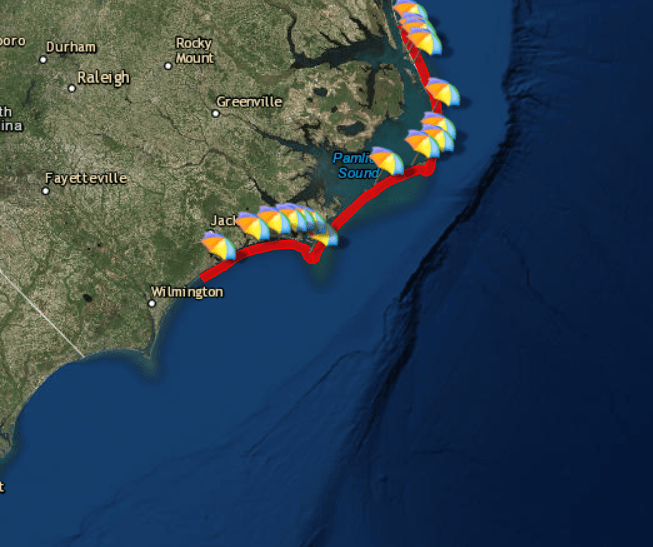
Red color indicates the surf is dangerous for all levels of swimmers.
Davis had been swimming with his 10-year-old son Thursday off Corolla Beach when his wife, Amy, and a friend saw him go under the water and not resurface at about 12:45 p.m.
Officials say the pair apparently was caught in a riptide. A lifeguard was able to rescue the boy, but Davis went under the surface and did not reappear.
The Coast Guard initiated a search after they were notified at 2 p.m. and sent two search-and-rescue helicopters, along with Corolla Ocean Rescue, Corolla Volunteer Fire Department, Currituck County Fire and EMS, as well as the Currituck County Sheriff’s Office.
The Corolla Beach Rescue Life Guard Service had reported rip currents in the area at that time Davis disappeared and his death is being ruled as an accidental drowning.
Davis was an annual fund development officer for the Bucknell University and a football coach, according to PennLive.
The National Weather Service reports that the surf on the Outer Banks down to Surf City remains dangerous for all levels of swimmers. Swimmers are cautioned to heed the advice of the local beach patrol and flag warning systems. To view the NWS riptide threat webpage, click here.
To read more about avoiding rip currents, click here.
The National Weather Service in Newport/Morehead City has issued a beach hazard statement warning of a high threat of rip currents in effect from Friday morning through Friday evening from Rodanthe to Cape Lookout. The threat is due to a southeasterly swell combined with southwesterly winds and high astronomical tides.
Yesterday, (Thursday), the U.S. Coast Guard searched all afternoon for a missing swimmer off the Pine Island section of Corolla in Dare County.
The 30-year-old male was seen by his wife and friend going underwater and not resurfacing at approximately 12:45 p.m. Sent to help search were a MH-60 Jayhawk helicopter and a life boat from the Oregon Inlet station.
The Outer Banks Voice reported that lifeguards with Corolla Ocean Rescue along with personnel from Corolla Volunteer Fire Department, Currituck County Fire and EMS and the Currituck Sheriff’s Office began an immediate search of the water, according to Currituck Fire and EMS deputy chief Tim Riley.
Currituck authorities suspended their portion of the search at 7:45 p.m., and planned to resume at daylight. The Coast Guard helicopters and watercraft planned to continue until at least 9:30 p.m.
On Wednesday, the National Park Service, Hatteras Island Rescue Squad, Dare County EMS and the Dare County Sheriff’s Office responded to a report of CPR in progress on an adult male on the beach in Frisco. The 43-year-old man from out-of-state, was pulled from the ocean by bystanders and CPR was initiated. Dare County EMS and Hatteras Island Rescue Squad were unable to revive him, the NPS said in a press release.
Rip currents are present all along the Outer Banks waters. In June, a teen-aged Thailand boy drowned in a rip current off the Frisco beach.
According to the National Weather Service, the most likely time for strong rip currents to occur is a couple of hours either side of low tide, which will occur around 3 p.m. today (Friday). For information about the alert from NOAA, click here.
To read Observer stories about rip currents, click here and here.
This August and September, Cape Hatteras National Seashore will offer park visitors an opportunity to observe excavations of recently hatched sea turtle nests. During an excavation, biologists will dig up the hatched nest, count empty eggshells, and collect unhatched eggs for research. Live and dead hatchlings are occasionally found during these excavations.
The first public excavations of the season will likely take place in early August. Persons interested in finding out when and where an excavation will take place can call the excavation program hotline at252-475-9629.Due to the unpredictability of sea turtle hatchings, notice of these excavation programs is usually posted only one day in advance. So check the hotline often.
While the biologists perform their examination of the nest, a park ranger will present a program on sea turtles and share what the biologists have found.
Nest excavations are an important way for the National Park Service to collect valuable data on sea turtle hatch and emergence success rates. These data are added to the turtle nesting databases for the Seashore and the state of North Carolina.
Each spring and summer, female sea turtles–loggerhead, green, and occasionally leather back–make a brief trip to these shores to nest. Approximately two months later, under the cover of darkness, up to 150 hatchlings emerge from each deep sandy nest in a mad dash across the beach to reach the safety of the Atlantic Ocean.
If you’re touring around the island and have a sharp eye, you might spot empty wine bottles on metal armatures or on trees in islanders’ yards.
Some sport bottles of varying colors, but more are created with blue bottles.
Renowned island storyteller Donald Davis has the low-down.
“They catch the evil spirits, but only the blue ones are legitimate,” he says.
That’s because the evil spirits can’t see blue.
Blue is a new color in human cognition, he said.
“In the Pictish culture, they coated themselves in blue because evil spirits couldn’t see blue,” he explains. The Picts were a tribal confederation of peoples who lived in what is today eastern and northern Scotland during the Late Iron Age and early Medieval periods.
Thus, the evil spirits cannot see the blue bottles; they go into them and—voila!–are captured.
“When you deal with superstitions, you have to do it right,” Davis says.
He said the bottle trees trace back to African culture, and even further back into to Egyptian culture.
A blog post by Smithsonian Gardens offers more about the history of bottle trees here, as does this blog post at the Appalachian History website here.
A bottle tree in Martha and Ron Faulkner’s yard.
Bottle trees are mostly a Southern thing.
“Up North, people keep their evil spirits,” Davis says.
The trees in Davis’s own yard are festooned with arguably the most blue bottles on the island.
“Sometimes when Merle (his wife) washes them, they break and she lets (the evil spirits out),” he says, which gives the couple the opportunity to hunt for more bottles—unusual ones—in antiques shops.
When he was a child, Davis saw his first all-blue bottle tree in his grandmother’s yard in the mountains.
“They were Milk of Magnesia bottles,” he says. “Now we just have to drink wine out of blue bottles.”
To make your own, bottles can be placed on tree branches or tree chandeliers are available at Ocracoke Garden Center.
A bottle tree along Trent Road.Cindy Fiore did a variation on the theme in her yard.A colorful bottle tree in Nathan and Amy Spencer’s yard.
Summer Haze, oil on canvas, by Douglas Hoover, will be among the new works on view starting Wednesday in Down Creek Gallery.
N.C. Press Association award-winner, first place best lede, 2017.
By Connie Leinbach
Award-winning artist Douglas Hoover has accomplished what Hollywood movie director Michael Moore could not.
When he was 15, as a rising young artist in a national show called “Artistic Discovery” in Washington, D.C., he got to meet the late Roger Smith, chairman and CEO of General Motors Corp.
“I spoke to Roger Smith, even shook his hand,” Hoover said in an interview at his artisan booth at the Ocrafolk Festival in June.
Smith, who helmed the auto company from 1981 to 1990, became widely known in Moore’s documentary “Roger & Me,” in which Moore seeks an interview with the elusive Smith.
Hoover still has the newspaper article showing his triumph.
The drawing that afforded this opportunity to show his work in the nation’s capital still hangs in his Archdale studio.
Islanders and visitors may view Hoover’s new work at a reception from 5 to 8 p.m. Wednesday, July 19, in Down Creek Gallery.
Sun Dog, oil on canvas by Douglas Hoover.
A full-time painter, Hoover’s artistic talents appeared early when his maternal grandmother encouraged his work.
“I would stay with my grandmother in the summer and would sit at her kitchen table and doodle,” he said.
His family encouraged him as did his school art instructors, especially his high-school teacher Mike Durham, with whom Hoover is still friends.
“He entered me into a lot of shows and contests” Hoover said, including the juried show in Greensboro that sent his work to Washington.
When his mother took him at the age of 12 to a nearby art gallery to see a show by local artists Bob Timberlake and Ward Nichols a light went on.
“Their work was pretty inspirational,” Hoover said. “I realized that you could make money at this.”
Drawing in charcoal was his preferred medium for a long time but these days oil paints reign.
In college at Randolph Tech, Asheboro, Hoover concentrated in graphic design and advertising.
Doug Hoover, at his booth at the Ocrafolk Festival in June., shows the book of essays by Our State magazine ‘How to Collect a Life” that Hoover illustrated. Photo: C. Leinbach
“My dad’s a printer,” he said. “Printer’s ink is in my blood.”
He then worked in graphic design for 20 years all the while continuing his painting.
“My work is very ocean-centric, very coastal,” he said.
Of note on the island, Hoover produces the calendars for Ocracats and created the logo for Blackbeard’s Pirate Jamboree. His artwork for the latter organization will be on this year’s jamboree T-shirts.
When the recession hit in 2008, he decided to quit graphic art and jump fulltime into fine art.
“And I became the happiest man in the world,” he said.
About a year before that, Corky and Sue Pentz agreed to show his original paintings in their Harborside Motel office-gift shop.
“They helped me get my foot in the door,” he said.
Hoover gets commissions for pet and people portraits, but he is most well-known on the island for his prolific scenes of island life.
Last year, Ocracoke Coffee commissioned him to do a painting of the popular gathering spot in honor of the business’s 20th anniversary.
Several months ago, he got a call out of the blue from Our State magazine to illustrate a recently published book of Editor Elizabeth Hudson’s essays titled “How to Collect a Life.”
“They wanted 35 paintings in one and a half months,” he said, a feat he accomplished.
The small book is liberally illustrated with Hoover’s paintings.
WANCHESE – As the Gulf Stream passes Cape Hatteras, the movement of water is some 45 times greater than the flow of every river on earth. That amount of moving water represents an extraordinary amount of potential energy, enough energy, according to the Coastal Studies Institute, that harnessing just 0.1 percent of the available power would yield the equivalent of 150 nuclear power plants. That’s 300 gigawatts of power.
The Coastal Studies Institute and the University of Georgia’s Skidaway Institute of Oceanography are studying the potential for power generation from the Gulf Stream off Cape Hatteras. Image: Coastal Studies Institute
Cape Hatteras is the point at which the Gulf Stream passes closest to the continental United States – about 12 miles offshore. It is also the point at which the stream is most restricted, and therefore, most accessible. This two-part special report will explore the methods researchers are using to better understand the Gulf Stream’s power.
For the past four years, the Coastal Studies Institute’s North Carolina Renewable Ocean Energy Research Program has been studying the Gulf Stream, trying to determine if its power can be harnessed.
“What is the resource? Is it viable? How does it vary? Maybe we’ll find out that it’s not a viable resource,” said Mike Muglia, lead researcher for the program.
Although it is often described as a river within the Atlantic Ocean, that description falls short of what is happening.
The Gulf Stream is more like a fire hose that no one is holding; there is always flow and a lot of it, but the actual location of that flow is constantly changing.
The key to successfully harvesting the energy of the Gulf Stream is to always be where that flow is greatest.
University of North Carolina professor John Bane is an expert in wind and ocean current energy production and has been modeling the variability of the Gulf Stream.
John Bane
Speaking at a recent CSI symposium on ocean energy Bane said, “This is one of the most important aspects in considering harvesting ocean energy from the Gulf Stream. The Gulf Stream is always there, but it’s not always in the same place.”
The modeling is getting better, and with the recent addition of the PEACH, or Processes driving Exchange at Cape Hatteras, a system launched in cooperation with the University of Georgia’s Skidaway Institute of Oceanography, the ability to predict where the best resource will be is improving.
“We are getting a much better handle on variability and the resource’s specific location from the information … and modeling we’ve gathered,” Muglia said.
With predictability of the resource improving, researchers are beginning to confront the next step.
Mike Muglia
“It probably is a viable resource,” Muglia said. “How are we going to get at it? How are we going to think about this?”
Some things are known.
Turbines would harvest the energy. Although there are design features of a water turbine that are different than wind turbines, the principals are the same.
What is different, and significantly, is how the turbines would be deployed.
A wind turbine is stationary. The blades move to the wind, but the platform on which it rests does not move.
The ocean is a three-dimensional environment. The Gulf Stream flows northward but within its stream, the strongest current is constantly moving east and west. There is also the possibility that useful amounts of energy can be harvested at varying depths.
“The Gulf Stream is variable in space. It is also variable in time,” explained Chris Vermillion, assistant professor of mechanical engineering at UNC-Charlotte. Vermillion was one of the presenters at the CSI Energy Symposium.
“There are some (other) challenges. One of the challenges is the Gulf Stream is a deep-water resource. It could be a couple of hundred meters (or about 650 feet) deep while the Gulf Stream is adjacent to North Carolina,” he added.
Chris Vermillion
Although a turbine theoretically can harvest ocean energy from the Gulf Stream, it’s never been done. Florida Atlantic University in Boca Raton is also studying how to harness the energy of the Gulf Stream, although their focus differs from the Ocean Energy Program.
“They’ve focused more on … how you design a turbine and put it in the water and what does it do,” Muglia said.
The UNC team is focused on how that energy will be collected.
“We do have a side project that I’m collaborating on that is trying to figure out some unique way to put a turbine in the stream so that it can move,” Muglia said.
The Coastal Studies Institute The University of North Carolina Coastal Studies Institute is a estuarine and coastal research and education facility located in Wanchese. The 213-acre campus is a partnership between East Carolina University, the UNC-Chapel Hill, North Carolina State University, UNC-Wilmington and Elizabeth City State University.
The turbine would have to be attached to a submersible – an autonomous underwater vehicle, or AUV, with the ability to move to the location of the best resource. The AUV would have two turbines attached to it, almost like propellers on an airplane wing.
There is an AUV that meets the criteria of the design team: the ISE Theseus that was developed for the Canadian Department of National Defense.
“It fits very nicely … to make this system work. You wouldn’t necessarily have to design that whole thing from scratch,” said Andre Mazzoleni, a member of the design team.
As the problem of harvesting energy underwater has been examined in detail, some things have become clear.
“It’s very unlikely a single turbine in isolation is economical. The likelier case is that turbines need to be installed in arrays. Because of the depths, it’s very unlikely a towered system is economical. The systems would have to be tethered to the ocean floor,” Muglia said. “The tether would not just be a part of the system that moves energy, but it also would be part of the system that moves information.”
The information that would be sent along the tether would tell the AUV where the best resource was located.
Any commercial harnessing of energy from the Gulf Stream is years in the future. Muglia points out, though, that the concept of energy from the ocean does not exist in isolation.
The International Submarine Engineering Theseus AUV was originally developed to lay long lengths of fiber-optic cable under the Arctic ice pack. Photo: ISE
“The area that we’re working in the Gulf Stream is the only area that has been identified (by the Department of Energy) as a viable wave-energy resource on the East Coast,” he said.
There is also ongoing research at North Carolina State University to develop an ocean compressed air energy storage, or OCEAS, system. The system would use the pressure of ocean waters to compress air in storage. As the air is released it would turn a turbine, creating usable energy. Needing a minimum depth of more than 1,300 feet to operate, the requirements of an OCEAS system match the anchor depths of the tethers for the AUVs.
“You need storage, which is why compressed air research is going on,” Muglia said. “To make it economically viable, part of the thing is, you need to be able to store this energy and put it on the grid when the demand is high.”
“Part of (the) economy of scale comes from diversity,” he said. “If I’m going to go to the trouble of cabling the areas of the Gulf Stream, now I’ve got energy infrastructure in place. I truly think that if we do a project like this it’s not going to be Gulf Stream energy alone.
Kip Tabb
Kip Tabb is a freelance writer living on the Outer Banks. He has covered transportation, environmental and related topics for a number of publications. He’s the former editor of the “North Beach Sun,” a quarterly newspaper on the northern Outer Banks covering community interest issues. His Coastal Review Online articles can be seenhere.
Monday, July 17 Ocracoke Bar & Grille: Aaron & Jackie, 7:10 pm Deepwater Theater: Blackbeard: An (Historical/Hysterical) Account, 8 pm Gaffer’s: Formula, 9 pm
Tuesday, July 18 Jolly Roger: Aaron Caswell & Jackie Willis, 6 pm Ocracoke Oyster Co.: Bryan Mayer, 7 pm Ocracoke Bar & Grille: Jon Lea, 7:10 pm Coyote Music Den: Coyote Plus One–Kim France, 8 pm; doors at 7:30 pm Gaffer’s: The Ramble, 9 pm Gaffer’s: Texas Hold ‘Em Poker, 7 pm
Wednesday, July 19
Taking a Break, oil painting by Douglas Hoover, will be among the new works on view in Down Creek Gallery. Opening reception 5 to 8 p..m. July 19
Down Creek Gallery: Painter Doug Hoover shows new works. Refreshments. 5 to 8 p.m. Jolly Roger: Mike Burns & Andy Burns, 6 pm Ocracoke Oyster Co.: Bryan Mayer, 6:30 pm Dajio Restaurant: Jon Lea, 7 pm Coyote Music Den: Just We Two, 8 pm, doors open at 7:30 pm Deepwater Theater: The Dingbatter’s Guide to Ocracoke, 8 pm Ocracoke Oyster Co.: Karaoke, 9 pm Gaffer’s: The Ramble, 9 pm
Thursday, July 20 Ocracoke Oyster Co.: Martin Garrish & Lou Castro, 3 pm Jolly Roger: Mike Burns & Andy Burns, 6 pm Dajio Restaurant: Raygun Ruby, 80s music, 7 pm Ocracoke Bar & Grille: Kate McNally, 7:10 pm Deepwater Theater: Molasses Creek band, 8 pm
Friday, July 21 Jolly Roger: Willis Gupton, 6 pm Ocracoke Oyster Co.: Will Roberts, Ventura Highway, 7 pm Dajio Restaurant: Mercy Creek, 7 pm Ocracoke Bar & Grille: Mike Norris, 7:10 pm Coyote Music Den: Playing your Ocracoke Memories, Martin Garrish, 8 pm; doors at 7:30 pm Gaffer’s: Willie Painter Band, 9 pm
Saturday, July 22 Jolly Roger: Willis Gupton, 6 pm Ocracoke Oyster Co.: Martin Garrish & Lou Castro, 7 pm Ocracoke Bar & Grille: Mike Norris, 7:10 pm Gaffer’s: Willie Painter Band, 9 pm
Sunday, July 23 Ocracoke Oyster Co.: Will Roberts, Ventura Highway, 7 pm Gaffer’s: Aaron Burdett Band, 9 pm
PASTEL CLASSES Create an Ocracoke pastel painting and bring a piece of the island home with you. No experience necessary. Artist Mary Bassell will teach you in the Pastel Studio on Back Road. Children: $35 per 1 1/2-hour session; Adults: $45 per 2 1/2-hour session. All materials included. Call 252-573-9195 for information and reservations.