Home Blog Page 405

Ocrafolk Festival: like a family reunion

0
Jam 2 Ocrafolk Fest
The all-star jam session of the 2016 Ocrafolk Fest. Photo: P. Vankevich

By Connie Leinbach

Cassie MacDonald feels that the Ocrafolk Festival is like a big family reunion.

She and her sister Maggie, both from Nova Scotia and who perform Celtic music, have gotten to know many of the musicians and locals.

“But somehow you meet someone new each time that you’ve felt you’ve always known,” she said in an interview as the festival wound down on a sunny Sunday.  “It’s one of my all-time favorite festivals.”

Bob Zentz, left, introduces Maggie and Cassie MacDonald at the workshop stage of the Ocrafolk FEstival.

The annual festival of music and arts produced by Ocracoke Alive, held June 3 to 5, slipped in between two coastal storms, was doused Wednesday, leaving the main stage audience area on the Books to Be Red grounds a small lake along with numerous large puddles on School Road and Howard Street.

Volunteers worked Thursday pumping as much water as they could off the grounds.

“I’m the human clamp,” said Andrew Havenhand, as he held the hoses siphoning off the water from a pump operated by another volunteer, John Brock.

By Friday afternoon, the small pond in front of the stage had greatly diminished allowing for chairs and the sound booth to be set up, though a large area of mud remained in part of the seating area.

Despite a brief shower early Saturday morning, all of the artisans had set up, the sun had come out and the festival was a go.

Festival first-timers Cindy and Jim Barnett of Kitty Hawk were enjoying the different genres of music, including jazz, folk, world, rock, Celtic, bluegrass and more.

“It’s a good time,” Cindy said.

Islander Monroe Gaskins was enjoying the MacDonald sisters’ performance at the Workshop Stage beside the United Methodist Church.

Andrew Havenhand, an Ocrafolk Festival volunteer, holds hoses together while John Brock pumps water from a large puddle on the Books To Be Red grounds. Photo: C. Leinbach

“I come every year,” he said. “It brings a lot of people to the island.”

John Hodge of Lebanon, Pa., attended the festival for the day on Sunday with his family, all of whom were staying in Hatteras.

“I look forward to this every year,” he said. “Ocracoke has a lot to offer. I like all the restaurants and especially the music.”

Robin and Chad Macek of Wilmington were first-time artisans at the festival with their jewelry line called YouMeUS Designs, and were thrilled with their sales.

Robin and Chad Macek of Wilmington, were first-time artisans at the festival. Photo: C. Leinbach
Robin and Chad Macek of Wilmington. It was Robin’s first-time as an artisan at the festival. Photo: C. Leinbach

“It was the best two-day festival we’ve been to,” Robin said. “We’ve been doing shows for four years.”

Delaney Golberg, a jewelry artist from Kitty Hawk, has been displaying her work at the festival for the last seven years.

The threat of rain didn’t deter her.

“I woke up at 6:30 (Saturday) and there was an orange and red spot right over the island (in her weather app), but by 10 a.m. the rain had passed,” she said.  “It’ a great show and I enjoy it every year.”

Elizabeth Smith of Greenville won the raffle of the quilt “Block Party” made especially for the festival by the Ocracoke Needle and Thread Club.

But she almost didn’t get it.

Elizabeth Smith of Greenville, right, won the raffle of the "block party" quilt. Islander Debbie Leonard, left, helped make the quilt with the Ocracoke Needle and Thread Club. Photo: C. Leinbach
Elizabeth Smith of Greenville, right, won the raffle of the quilt created by. Islander Debbie Leonard, left, helped make the quilt. Photo: C. Leinbach

The first ticket David Tweedie, president of Ocracoke Alive, pulled contained a number and not a name.

When no one came forth to claim the number, he pulled another one, which was Smith’s.

But when Smith went to the information booth to claim the queen-sized quilt, one of the volunteers, Deborah Leonard, who also happens to be a member of the quilting club, said that the first ticket pulled was hers.

Leonard was gracious in deferring to Smith, who has been attending the festival for 10 years.

“I’m not going to take it away from her,” Leonard said of the quilt. “I want you to have it.”

Tweedie, who is also the fiddler for Molasses Creek, the festival hosts, was happy with the festival.

“We were really fortunate,” he said Tuesday about the festival dodging the rain that returned late Monday afternoon and again Tuesday. “We’re fortunate with how everyone pitches in to make this festival happen, and everyone’s willing to adapt.”

He noted that fest-goers were excited with new acts, such as Lipbone Redding, the Bucket Brothers, the Oak Grove String Band and Michael Stanwood.

“The new faces make it a lively experience as well as the return of favorites, such as Beleeza, Kaira Ba, and the MacDonald Sisters, and new local groups, such as the Madame Presidents.” he said. “It was another magical weekend.”

Humberto Oliveira of Beleeza. Photo P. Vankevich
Lipbone Redding performs in the Deepwater Theater. Photo: P. Vankevich
The main stage crowd at the 2016 Ocrafolk Fest. Photo: C. Leinbach
Artisans and food vendors line School Road. Photo: C. Leinbach


Face painting at the 2016 Ocrafolk Festival. Photo: C. Leinbach
Jim Alberti wows passersby with his flea circus. Photo: C. Leinbach


Artisan Delaney Goldberg from Kitty Hawk has been exhibiting her jewelry designs for the past seven festivals.
Artisan Delaney Goldberg from Kitty Hawk has been exhibiting her jewelry designs for the past seven festivals. Photo P. Vankevich


OCBA monthly meeting today

0

OCBA Pearl Logo_sample A


Monthly meeting 7 p.m. Wednesday, May 11, 2016

Ocracoke Community Center

Agenda

      1. Call to Order

  1. Approval of May meeting minutes.
  1. Treasurer’s report
  1. Travel & Tourism Director report (Sundae Horn)
  1. Election to the board:

Chip Stevens
Martha Garrish

  1. Ferries and the NC budget (Connie Leinbach)
  1. President’s report
  1. As-needed reports:

County Manager’s report (Bill Rich)

National Park Service

County Commissioner (John Fletcher)

  1. Old Business
  1. New business
  1. Announcements
  1. Adjourn

           Note: Meetings are held the second Wednesdays of the month at 7 p.m. in the Ocracoke Community Center (unless otherwise stated).   The next 2016 meetings will be:   July 13, Aug. 10, Sept. 14, Oct. 12, Nov. 9, Dec. 14.

For Ocracoke news, click here.


NC Transportation officials to seek feedback on Rodanthe N.C. 12 bridge option​

0

Rodanthe-Bridge-052416-e1464141190521Raleigh – The NC Department of Transportation will hold a series of meetings along the lower Outer Banks for public input on a proposed bridge on Pea Island around the Rodanthe area.

Officials are seeking public comment on their preferred option — a 2.4-mile-long bridge known as a “jug handle”– extending from the southern end of the Pea Island National Wildlife Refuge over the Pamlico Sound into Rodanthe.

This design is preferred over a bridge along the existing route of N.C. 12 because it minimizes impacts to the Pea Island National Wildlife Refuge, the ocean shoreline and the community of Rodanthe while maintaining safe and reliable access for area residents.

The meeting on Ocracoke is scheduled from 4 to 7 p.m. Monday, June 20, in the Ocracoke Community Center, 999 Irvin Garrish Hwy.

The meeting will be informal, and citizens may drop in at any time. Comments will be accepted through July 15.

Other meeting locations are as follows:

Tuesday, June 21, 4 to 7 p.m.
Rodanthe-Waves-Salvo Community Center
23186 Myrna Peters Rd., Rodanthe

Wednesday, June 22, 4 to 7 p.m.
Dare County Administration Building
954 Marshall Collins Dr., Manteo

Hard copies of meeting maps and the environmental assessment are available for public review online and at the following locations:

      Ocracoke School and Community Library, 225 Back Road, Ocracoke 

  • Dare County Planning and Inspections Satellite Office, 50347 N.C. 12, Frisco
  • NCDOT Resident Engineer’s Office, 349 Waterplant Road, Unit B, Manteo
  • Dare County Library, 700 U.S. 64/264, Manteo
  • Dare County Library, 57709 N.C. 12, Hatteras
  • Dare County Library, 400 Mustian St., Kill Devil Hills
  • Fessenden Recreation Center, 46830 N.C. 12, Buxton

For additional information, call (866) 803-0529, or send an email to publicinvolvement2@ncdot.gov.

You may also contact Drew Joyner, P.E., with NCDOT’s Human Environment Section, at (919) 707-6077, or by mail at:  1598 Mail Service Center,  Raleigh, NC 27699-1598

NCDOT will provide auxiliary aids and services under the Americans with Disabilities Act for disabled individuals who want to participate in these meetings. Anyone requiring such services should contact Joyner as early as possible so that arrangements can be made. For individuals who speak only Spanish or have a limited ability to read, speak or understand English, interpretive services will be available at the meeting upon request. For more information, please call 1-800-481-6494 prior to the meeting.

For Ocracoke news, click here.

Ocracoke residents, visitors advised to monitor Tropical Storm Colin

0
NOAA Colin
The latest forecast today (June 6) from the National Weather Service (NWS) shows Tropical Storm Colin tracking slightly closer to Ocracoke.
Colin is an unorganized storm and significant uncertainties remain in its exact track and thus the local impacts, according to the NWS. There have been only minor changes. A tropical storm warning is now in effect on the coastal waters south of Oregon Inlet, but no watch or warning has been issued for the land at this time.
The Hyde County Emergency Service Department issued the following statement:
Ocracoke Island visitors should strongly consider the projected impacts from Tropical Storm Colin when deciding whether to remain on the island or preparing to depart for their stay this week. Ocracoke and the Outer Banks in Dare County are forecast to receive heavy rainfall starting this evening, which may result in transportation delays or impassable roads.
Additionally, the current forecast places Ocracoke within the tropical storm force wind field for approximately four hours starting at around noon tomorrow.
Standing water and tropical storm force winds could impact ferry operations tomorrow.
Due to the forward speed of the system, there is little to no chance of issuing and implementing emergency protective measures before conditions deteriorate this evening into tomorrow.
Hyde EMS recommends those on the island to closely monitor the forecast and exercise sound judgment when making travel plans.

National Park staff at Cape Hatteras National Seashore , Fort Raleigh National Historic Site and Wright Brothers National Memorial are preparing for potential storms impacts such as localized flooding or temporary road closures that could be caused by the storm once it arrives in the Outer Banks region. Currently, there are no plans to suspend operations at any of the three national park sites. Park management is monitoring the storm and will make adjustments as necessary for visitor and staff safety.

Campgrounds: Monday afternoon, park staff will advise campers at Oregon Inlet, Frisco and Ocracoke campgrounds of the inbound tropical storm and the possible impacts associated with the storm (flooding, high winds, cut-off roads). Tent camping is not advised. The reservation system for Cape Point Campground was paused for a seven-day period last Thursday, which is being extended by another seven days due to the additional rainfall that Tropical Storm Colin is expected to bring to the area.

Beach Access Ramps: Visitors should review signs posted at the ramps and use best judgment when using the ramps.

Daily ramp status updates are available on the Cape Hatteras National Seashore Facebook Page at http://facebook.com/capehatterasns. At this time, no ramps have been closed due to standing water.

Updates: For more weather-related information, listen to NOAA weather radio, local radio, and media for updates and advisories.

For Ocracoke news, click here.

Primary voting Tuesday includes state supreme court justice, U.S. Congressional seats

0
Voting for Tuesday's general election is at the Ocracoke Volunteer Fire Department.
Voting for Tuesday’s general election is at the Ocracoke Volunteer Fire Department.

By Peter Vankevich

A special election for a state supreme court seat and several North Carolina U.S. Congressional seats, include the representative for Ocracoke, will be held tomorrow (Tuesday, June 7).

Voting will be from 6:30 a.m. to 7:30 PM p.m. in the Ocracoke Volunteer Fire Department, 822 Irvin Garrish Hwy.

On Ocracoke, voters will choose nominees for the U.S. House of Representatives District 3.

This Congressional seat is currently held by Walter Jones. Vying with him for the Republican nomination are Taylor Griffin and Phil Law.

Registered Democrats will choose between David Allen  Hurst and Ernest T. Reeves.  

Unaffiliated voters have two choices: They can elect to vote in one of the two major party primaries (but only one), or they can choose a non-partisan ballot, which will include only the judicial race.

Voters will vote for one of the four state supreme court associate justice candidates. The two with most votes will appear on the November general election ballot.

Since many are unfamiliar with the judicial candidates, the Observer is providing some information on them.

From Ballotpedia:

One seat on the North Carolina Supreme Court joins four seats on the North Carolina Court of Appeals on the ballot.

The supreme court seat up for election is held by Justice Robert H. Edmunds Jr.

Prior to tomorrow’s primary, Edmunds was to have run in North Carolina’s first retention election under a 2015 law, which would have been part of the November general election. So, this seat had not been part of the March 15 primary.

However, a Wake County court struck down the retention law as unconstitutional, and the state supreme court upheld that ruling. Edmunds therefore faces a contested election in a new primary tomorrow.

Morgan and Robertson are considered to be Democrats, Edmunds a conservative and Faires, an independent.

The appeals court seats up for election are held by  Judge Robert N. Hunter Jr., Judge Linda Stephens, Judge Richard Dietz, and Judge Valarie J. Zachary. Each judge elected to the court serves an eight-year term

The Outer Banks Voice has profiles on  Robert H. Edmunds Jr. and Michael “Mike” Morgan.

The following is from the NC Board of Elections website.

Morgan 2016_Supreme_Court candiates

Edmundsd 2016_Supreme_Court candiates


Faires 2016_Supreme_Court candiates


For Ocracoke news, click here


Hyde County commissioners meeting tonight

0

Hyde sealThe regular monthly meeting of the Hyde County commissioners begins tonight at 6 in the Ocracoke School Commons room with a hearing on the proposed budget for 2017.

For more Hyde County information, click here.

Below is tonight’s agenda:

June 6, 2016 Agenda Hyde Co_Page_1

June 6, 2016 Agenda Hyde Co_Page_2

June 6, 2016 Agenda Hyde Co_Page_3

June 6, 2016 Agenda Hyde Co_Page_4


Senate budget version retains ferry tolls, reinstates $150 priority pass fee

0
A view of the back of the Swan Quarter ferry. Photo: C. Leinbach

By Connie Leinbach

The NC General Assembly this week will begin the negotiating process on the two houses’ differing versions of their respective budgets, and ferry tolls and $150 priority passes are back in the mix. 

This priority pass provision is in section 35.12.(b) (page 142) of the Senate budget:

SECTION 35.12.(e) G.S. 136-82 is amended by adding a new subsection to read: 11 “(f2) Priority Boarding. – The Department of Transportation may issue annual passes to 12 individual passengers that entitle the passengers to priority when boarding a ferry passenger 13 vessel. The Department of Transportation shall charge an annual fee of one hundred fifty dollars 14 ($150.00) for each pass issued under this subsection. The fee would be in addition to any 15 applicable ferry toll. Proceeds from fees collected under this subsection shall be credited and used 16 in the same manner as toll proceeds under subsection (d) of this section. Notwithstanding any 17 other provision of law, and except as authorized under this subsection or for emergency vehicles 18 responding to an emergency, the Department of Transportation shall not provide priority boarding 19 of a ferry passenger vessel to any passenger or vehicle. For purposes of this subsection, the term 20 “emergency vehicle” has the same meaning as in G.S. 20-146.2.” 21 SECTION 35.12.(f) This section becomes effective July 1, 2016, and the fee 22 established in subsection (e) of this section applies to passes issued on or after that date.

While both budgets propose a $22.225 billion spending plan, the Senate’s budget, which Sen Bill Cook, representing Ocracoke in District 1, voted for, eliminates the $13 million appropriation out of the Highway Fund for replacement ferry vessels that the House’s budget included.

Both versions of the budget are available online at www.ncleg.net.  The different ways in which the two chambers would spend the total dollars is in the first seven pages of each budget version.

While Cook and Sen. Norman Sanderson had introduced a bill–prior to the budget bill–that would eliminate tolls on all ferries, and also appropriate $23 million to the Ferry Division, neither of these items is in the Senate’s version of the budget.

Under the Highway Fund section of this “money report,” so-called by Rep. John Torbett (R-Gaston), a co-chair of the House Transportation Committee, under the “Intermodal Divisions,” the House proposes $13.010 million for the Ferry Division and $4 million for public transportation.

In the Senate version, of these same line-items, the Ferry Division would get zero, public transportation $4 million, aviation: $14.82 million and rail would get $13.75 million.

In a press release, Cook noted his support of the “Senate version of the state budget, which cuts taxes, controls the growth of government spending, bolsters the state’s savings, and dramatically increases teacher pay while providing over $180 million to state employees in performance-based pay increases or bonuses.”

While the Senate budget contains also several coastal provisions, such as support for aquaculture, beach nourishment and shallow-draft dredging.

“I am against the priority pass provision pertinent to our ferries,” Cook said in an email about the Senate budget.

“Senator Norman Sanderson and I have crafted legislation that would remove mandatory tolls on the three N.C. Ferry routes that currently have a fee. The legislation would also prevent a fee from being added to the four routes that currently do not have a toll.”

Rep. Paul Tine (U-Kitty Hawk), who in April introduced a bill to eliminate all ferry tolls and appropriate money for replacement ferry vessels, said Friday that the budgets are statements of priorities in each chamber and that he expects to be named a conferee next week.

“We need to fix the ferry system,” he said. “We need enough money to run the routes we have, and we have the extra money (for ferry replacement funding).”

Tine was referring to the close to $240 million surplus the state will realize this year.

“The existing tolls aren’t going to get you enough revenue and the $150 (for priority passes) isn’t going to get us there,” Tine said about the ferry tussle.

He said that ferries are always a central disagreement between the House and Senate.

“But we made (ferries) a priority and will continue to fight,” he said about the House.

At issue is the new way in which replacement car ferries, which cost about $15 million each, are funded. A few years ago, the state put this issue into local hands by dividing the state into 10 districts and giving them each a pot of about $32 million with which to fund all transportation needs within each district.

Along with funding new roads and bridges, the counties within each district prioritize their needs. For Ocracoke’s area, replacement ferry boats must compete with the needs of the other counties.

Tine and Torbett have been arguing that the state should treat ferry routes the same as highways and fund the equipment needed for them out of the Highway Fund.

Torbett, one of the sponsors of the House’s version of the transportation section of the budget along with Tine, said Thursday that since he is a co-chair of the House Transportation Committee he also expects to be appointed a conferee.

“I can be just as tenacious as the next guy,” Torbett said about his quest to stabilize ferry funding. “If they don’t want to hear about ferries anymore then they can pass our plan.”

Total expenditures represent a 2.3 percent increase over the current fiscal year.

Since the House budget does not concur with the Senate’s version, they will call a conference and appoint conferees to negotiate all the sections of the budget, said Henri McClees, a lobbyist hired by Hyde County to fight enacting or raising ferry tolls.

Each chamber has a different approach to what is funded, McClees said.

“They don’t agree on the ferries,” she said. “They did not take the house plan. Tolls are still in Senate budget.”

While they both agree teachers need raises, how these raises will be given is different, she said, with the Senate giving the raises more quickly.

State retirees would not get a cost-of-living increase under the Senate plan, while the House wants to give them a 1.6 percent increase.

The two budget have different sales tax approaches, she said.

According to other news sources, the Senate’s bill makes up for a tax cut it has included by expanding sales tax on services.

Both Torbett and McClees said that the senators most in favor of ferry tolls are Bill Rabon (R-Southport) and Kathy Harrington (R-Gaston).

But Sen. Wesley Meredith (R-Cumberland) is OK with the House plan, McClees said.

McClees said islanders should write to all of the senators now about their views on the budget.

“The whole Senate is working on the budget,” she said. “It’s very important that other Senators become aware of this (ferry) problem.”


Birds of Ocracoke: Indian Runner Ducks (Seriously)

0
Indian Runner Ducks
Indian Runner Ducks

To see more profiles in the Birds of Ocracoke series, click here 

Text and photos by Peter Vankevich

Note: Indian Runner Ducks can occasionally be seen in the village. These are released domesticate birds. Since we have gotten a few inquiries recently about some “funny-looking” birds along Middle Rd., here is an article from our archives.

First published: Ocracoke Observer, July 2010

Over the past year or so, I’ve received several inquiries about some strange-looking waterfowl seen on occasion around the North Pond area of Ocracoke Village and an another one hanging with the Mallards near Silver Lake.

People weren’t even sure if they were ducks or geese and they didn’t even look remotely close to any species of either family in any of the popular bird identification field guides of North America.

Scott Bradley tipped me off that this flock of six were Indian Runner Ducks. Anyone who keeps a life list of birds personally identified in North Carolina or the United States will probably know that they are not countable for the same reason that they do not appear in a field guide to the birds, i.e. they are not wild birds, but are released domesticated ducks. Nevertheless these “runners” are not your common barnyard fowl and, indeed have an interesting history worth telling.

Indian Runner Ducks get their name from two sources. Their origins are traced to the South Asian East Indies (more specifically the Indonesian Islands of Lombok, Java and Bali). The second part of the name derives from the fact that, unlike other ducks that waddle when on land, these critters will run – a positive trait since like many domestic ducks they do not fly.

Their unusual appearance is that they stand in an erect manner, have an extraordinarily long neck for a duck, and males measure up to 26 inches from bill to tail. Because of this unusual posture, many people referred to them in the 19th Century as Penguin Ducks. Based on ancient stone carvings, this domesticated breed has been on the South Pacific islands at least a thousand or more years.

The first Indian Runners were imported from Asia to Great Britain around the mid-1830s and became quite popular among breeders. Their arrival in the United States occurred towards the end of the 19th Century.

Although the overall shape is well-defined, the plumage, as with many domestic ducks, can vary considerably as they have been cross-bred to obtain certain colors and patterns such as black, chocolate, white and others with imaginative names like Cumberland Blue, Apricot Trout, Split-pea Yellow, and Silver Wild.  Fawn and white has been a traditional color scheme.

In 2000, the Indian Runner Duck Association was created to preserve the purity of the breed and contribute to its standardization as well as look after the health and welfare of this unique duck.

Looking at their appearance one would think it might be a bit of a stretch to believe that they derive from the Mallard Duck but that is the conventional theory. They are active foragers seeking out grubs, worms and even catching flies in air. In Asia they are used to control pests in rice paddies. In addition to their appearance and mobility, they also have lively personalities. When moving in fields they tend to do so in synchronization. Their speed and herding instincts make them a favorite for use by Border collie trainers.

To help with this article, I was able to get my hands on The Indian Runner Duck Book: The Only Authoritative American book about the Marvelous Egg Machine by C.S. Valentine published in 1911.

As you may surmise from the title, their popularity derives not so much from their looks or colorful personality, but from their deserved reputation as a prolific egg layer with some hens producing 200 and more eggs a year.

This ranks right up there with the top commercial leghorn chickens.  They do not use a traditional nest routine and eggs may be laid and abandoned.

So how are these eggs?  Our noted island chef and author of The Back Porch Restaurant Cook Book, Debbie Wells, has eaten their eggs, baked cakes with them, etc., and with their thick whites and deeply colored yolks thinks that they are far better than chicken eggs.

Of all the color variations, Valentine favored those with pure white plumage opining that “nothing in nature [is] more lovely and charming than white water fowl playing on the water.”

While acknowledging the beauty of the swan and White Emden Goose, Valentine weighed in “But the White Indian Runner slimmer, graceful as a fawn, bids fair to become infinitely more popular than either the goose or even the swan could ever become.”

One hundred years later, his prediction has yet to be true, and the unusual sighting of Indian Runners these days will raise an eyebrow or two. And on Ocracoke, at least for now, there are some interesting runners worth taking a look at.

Indian Runner Ducks PS IMG_8089

Rip current awareness week starts June 5

0

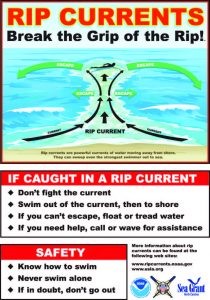
Rip currentNorth Carolina and South Carolina will observe Rip Current Awareness Week June 5 to 11.

Rip current fatalities rank among the top of fatalities across the Carolinas, especially on the Outer Banks.

Fatalities occur when panicked swimmers get exhausted and drown or have a heart attack, according to authorities.

Dr. Stephen P. Leatherman, aka “Dr. Beach,” America’s foremost expert on beaches, named Ocracoke Lifeguard beach the No. 4 best beach this year. It was the best beach in 2007.

Rip currents are like rivers in the sea, Leatherman says. They often look like an area of calm water between waves, but they are actually funneling out through a hole in the sand bar and into deep water.

If you are caught in a rip current:

–DON’T PANIC, which wastes your energy and keeps you from thinking clearly. 
–Don’t attempt to swim against the current directly back to shore. 
–Swim parallel to shore until you are out of the current as the offshore flow is restricted to the narrow rip neck. 
–Float calmly out with the rip if you cannot break out by swimming perpendicular to the current.  When it subsides, just beyond the surf zone, swim diagonally back to shore.
–If you are on shore and see someone in distress, alert lifeguards and call 911. If you go in the water, take flotation devices for yourself and the person or persons caught in the rip.

To read last year’s story, click here.  For more information, click ripcurrents.noaa.gov.

For Ocracoke news, click here.

Public comments sought on new oyster sanctuary, fishing reef in Hyde County

0
Oyster Reef, courtesy of commons.wikimedia.org

MOREHEAD CITY – The N.C. Division of Marine Fisheries is seeking public input on a proposed oyster sanctuary near Wysocking Bay. Comments will be accepted at a meeting scheduled for 6 p.m. June 14 in the Hyde County Government Building, 30 Oyster Creek Road, Swan Quarter.

Staff with the state’s Oyster Sanctuary Program will discuss a plan to construct Gull Shoal Oyster Sanctuary, a 10-acre sanctuary located about 4 miles (3.5 nautical miles) southeast of Wysocking Bay. Those in attendance will be asked for input on the plan.

Oyster sanctuaries are areas where oyster reefs are created with the aim of providing a brood stock to help restore oyster populations. The reefs attract native oyster larvae, which settle and grow to produce millions of eggs annually that are carried by currents and tides to surrounding areas. The reefs also serve as habitat for fin fish populations and provide hook-and-line fishing opportunities. To protect the brood stock, no shellfish harvest or bottom-disturbing gear is allowed within oyster sanctuaries.

Oyster reef restoration, courtesy of commons wikimedia.org
Oyster reef restoration, courtesy of commons. wikimedia.org

Once constructed, the Gull Shoal Oyster Sanctuary will be part of the Sen. Jean Preston Oyster Sanctuary Network, a system of small, interconnected oyster sanctuaries within the Pamlico Sound and its tributaries.

For more information, contact Curt Weychert with the Oyster Sanctuary Program at 252-808-8055 or Curt.Weychert@ncdenr.gov.

For information on the eastern oyster, click here.

For Ocracoke news, click here.