Birders will fan out all over Ocracoke on Dec. 31 to count the island’s various avian species. Photo: C. Leinbach/Ocracoke Observer
Note: The Portsmouth Island Christmas Bird Count has been changed and will take place on Jan. 1, 2026
The Ocracoke and Portsmouth Island Christmas Bird Counts (CBC) are planned for Dec. 30 and 31.
These bird census counts held at the end of the year are two of more than 60 counts that take place in North Carolina.
Portsmouth is scheduled for Dec. 30 but may change to Dec. 31 if weather conditions warrant. So, an RSVP is necessary. See contact info below.
This bird-counting tradition began modestly in 1900 and was billed as an alternative to a traditional holiday activity known as the “side hunt.”
This hunt was a competition to see who could shoot as many birds and animals as possible.
Instead, the CBC focused on just counting birds, recording both species and the number of individuals — a means to promote conservation and improve knowledge of bird populations.
It is now a worldwide effort coordinated by the National Audubon Society to encourage people of all ages and skill levels to engage in birdwatching and contribute to citizen science.
The results track bird populations and can help develop conservation strategies.
Last year, the 30 Ocracoke observers fanned throughout the island, which experienced seasonally chilly temperatures, light winds and sunny skies.
It tied a record for the count of 102 tallied species and for only the third time reached up to 100 species.
Novices and seasoned birders are needed. To participate in these counts, contact the compiler, Peter Vankevich: petevankevich@gmail.com, text: 202 468-2871, or message via Facebook.
Double-crested Cormorants. Photo: P. Vankevich/Ocracoke Observer
The N.C. Division of Motor Vehicles has temporarily opened a driver license office in Manteo to provide continued service to Outer Banks residents while the Nags Head office undergoes maintenance.
The temporary office is located in the old College of the Albemarle – Dare County campus at 132 Russell Twiford Rd. and will offer express services on a walk-in basis.
That includes renewals and issuing of REAL IDs.
No driving test services will be available at the temporary location.
Operating hours for the temporary office are as follows:
Thursday, Dec. 18: 9 a.m. to 5 p.m.
Friday, Dec. 19: 8 a.m. to 5 p.m.
Monday, Dec. 22: 8 a.m. to 5 p.m.
Tuesday, Dec. 23: 8 a.m. to 5 p.m.
All NCDMV offices statewide will be closed Wednesday, Dec. 24, through Friday, Dec. 26, in observance of the Christmas holiday.
The Nags Head Driver License office at 2808 S. Croatan Highway (U.S. Hwy. 158) is scheduled to reopen on Monday, Dec. 29.
“This temporary solution allows us to maintain service in the area during the Nags Head office closure,” said Commissioner Paul Tine. “Thanks to the College of the Albemarle for its partnership and DMV staff for their dedication and hard work in quickly establishing this temporary location.”
Many driver license services, including renewals and duplicates, are also available online at NCDMV.gov.
The sandbag area at Ocracoke’s north end at high tide Nov. 6. Photo: C. Leinbach/Ocracoke Observer
From our news services
The Ocracoke Access Alliance (OAA) is calling on Gov. Josh Stein to take immediate emergency action to address the escalating threat to North Carolina Highway 12, the sole ground transportation link serving Ocracoke Island.
The Alliance strongly supports recent requests submitted by state Senator Bobby Hanig and Hyde County officials urging Stein to issue a State Disaster Declaration for NC-12.
Such a declaration could unlock critical Federal Highway Administration emergency funds needed to stabilize and protect this vital corridor.
“Ocracoke’s access is at risk, and delays put our community, economy and public safety in jeopardy,” said Justin LeBlanc, executive director of the Ocracoke Access Alliance. “Emergency action is necessary now to ensure safe and reliable access for residents, businesses, and the hundreds of thousands of visitors who depend on NC-12 each year.”
Justin LeBlanc at an Ocracoke community meeting. Photo: P. Vankevich/Ocracoke Observer
The Alliance has formally requested a meeting with Stein to discuss emergency and long-term actions and stands ready to work collaboratively with state leaders to protect NC-12 and the future of Ocracoke Island, LeBlanc said
On Ocracoke, immediate sandbag reinforcement work is currently planned to begin this spring. OAA expressed appreciation to Stein, the North Carolina Department of Transportation, and Highway Division 1 for their continued efforts to keep NC-12 passable under increasingly challenging conditions. The Alliance urged that every possible step be taken to expedite this work.
Beyond emergency stabilization, OAA emphasized the importance of pursuing long-term solutions.
Hyde County Board of Commissioners Chair Randal Mathews identified beach nourishment as a critical next step. Once evaluated, the Alliance urges that the permitting process for beach nourishment move forward without delay.
“The National Park Service already approved a Sediment Management Plan in 2023,” said LeBlanc. “With federal approval in place, we must act swiftly to secure state permits—or appropriate waivers—to fast-track this work before conditions worsen.”
Ocracoke County Commissioner Randal Mathews. Photo: P. Vankevich/Ocracoke Observer
According to NCDOT Highway Division 1, approximately $18 million has been spent since 2019 maintaining NC-12 on Ocracoke alone, underscoring the financial case for larger, more durable investments that could reduce long-term costs and repeated emergency repairs.
OAA also stressed the importance of community involvement as decisions are made about long-term solutions.
“Our residents and business owners live with these challenges every day,” LeBlanc said. “Their experience and insight are essential to identifying solutions that work for both the island and the state.”
The Ocracoke Access Alliance is a nonprofit advocacy organization composed of local businesses and residents dedicated to securing safe, reliable, and efficient access to the island.
The organization focuses on sustainable funding for the North Carolina Ferry System and long-term solutions for recurring NC-12 “hotspots” in both Dare County and on Ocracoke Island.
The NC Weather Forecast Office out of Newport/Morehead City has issued a warning of a cold front that will impact the Outer Banks and mainland eastern Carolina.
Travelers should be wary of these conditions. The high winds may cause a temporary delay in ferry service.
Here is what to expect:
Heavy Rainfall: 1–3” expected; Potential for ponding of water on roadways Thursday night into Friday morning.
Strong Winds: Potential for isolated power outages between Cape Hatteras and Cape Lookout where wind gusts are the strongest. A Wind Advisory is in effect for this region.
Coastal Impacts: High surf south of Cape Hatteras may lead to beach erosion and localized overwash on NC Highway 12 through Friday afternoon.
A High Surf Advisory is in effect for this region.
Marine: Hazardous conditions due to strong S/SW winds and large breaking waves.
Gale Warnings in effect for coastal waters south of Oregon Inlet.
As the north end of Ocracoke continues to be overwashed during King Tides and nor’easters, the Hyde County Board of Commissioners has asked Gov. Josh Stein to step in.
During its November board meeting, the commissioners approved sending a resolution and Board Chair Randal Mathews sent a letter to Gov. Josh Stein asking him to address “the imminent failure” of North Carolina Highway 12 on Ocracoke Island.
“This is no longer a matter of infrastructure,” he wrote. “It is an emergency threatening the very viability of our community. Recent and devastating storm damage has pushed this critical roadway past its breaking point. Highway 12, our singular, fragile connection to the mainland, is facing catastrophic collapse. Its loss would instantly:
Maroon our residents, cutting off life-saving emergency medical services and essential supplies.
Decimate the economy, ending tourism to our island abruptly and causing irreparable financial ruin for our local businesses.
“We cannot afford to wait. Every passing storm brings us closer to complete isolation. We must secure Ocracoke Island now.”
Mathews asked the state to immediately repair the sandbags at the north end and begin a beach nourishment study.
Then, he asked for immediate implementation of beach nourishment in the overwash area,
“This beach nourishment project will buy Ocracoke and the state of North Carolina valuable time to develop a long-term plan,” he said.
Next needed is fast-track development of long-term alternatives for this section of the island.
“Governor, the situation is critical,” Mathews wrote. “We implore you to treat this as an immediate state-level emergency. Your decisive action is required to prevent a full-scale disaster on Ocracoke Island.”
Mathews said on Dec. 17 that he hadn’t heard from Stein.
Several weeks ago, Dare County asked the state to declare an emergency on Hatteras Island, where houses are falling into the ocean, and for Ocracoke’s north end.
In late October, North Carolina State Senator Bobby Hanig (R-SD 1) submitted a written request to Stein urging the declaration of a State of Emergency for portions of North Carolina’s Outer Banks, specifically N.C. Highway 12 on Hatteras to Ocracoke Islands, in response to accelerating erosion and the resulting infrastructure damage in the Buxton and northern Ocracoke Island areas
“I expect Dare and Hyde will continue to pursue some type of emergency proclamation,” Mathews said. “The condition of NC12 is impacting our health and safety at least part of the time.”
Ferry operations/funding North Carolina Ferry Division leaders say more than $92 million in new state funding, up from the current Ferry Division budget of about $70 million, is needed to maintain service, modernize key infrastructure and prevent breakdowns across the nation’s second-largest state-run ferry system.
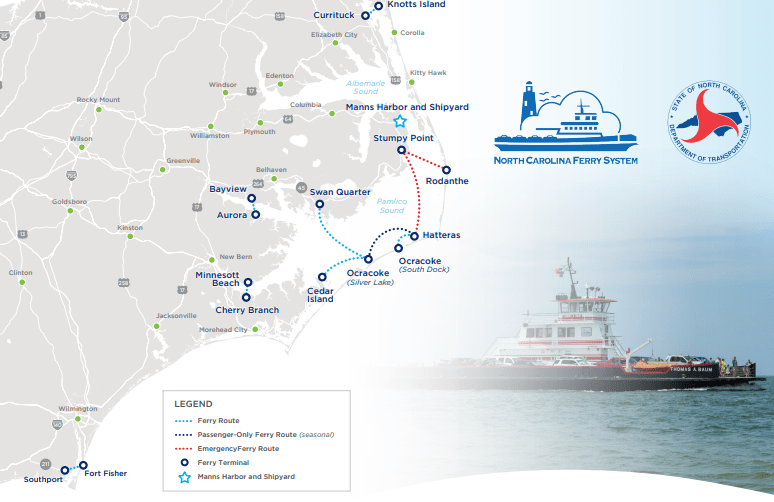
The division operates 23 ferries and 11 support vessels on eight routes carrying about 1.47 million passengers per year. A 2020 analysis found the system supports roughly $735 million in statewide economic activity.
Several senators on the committee questioned the scale of the funding proposal and the state’s long-standing subsidies for ferry operations.
Sen. Bill Rabon, a Republican from Brunswick County, argued that ferry subsidies for Ocracoke residents have reached an excessive level.
“We’re spending about $25,000 per person, per year to support 700 people on Ocracoke,” Rabon said. “These numbers don’t add up, and we cannot ignore them.”
Following that and other comments, Hyde County Manager Kris Noble and Mathews met with the OCBA, Justin LeBlanc, who is the director of the Ocracoke Access Alliance, and Helena Stevens, the Tourism Development Authority director, to devise a joint plan of action and subsequent marketing/outreach campaign to counteract misconceptions about Ocracoke and rally for support to keep our access as an extension of the NC DOT Highway system.
Hyde County is planning a trip to Raleigh Jan. 12 and 13 to educate members of the NC General Assembly and staffers on what the ferry system does for the state.
“To the best of my knowledge, worldwide, all public transit systems, including ferries, are support with funding beyond toll collection,” LeBlanc said.
The eroded north end at South Dock. Photo: C. Leinbach/Ocracoke Observer
South Dock stabilization Hyde County continues to advocate for the South Dock Ferry Terminal to be stabilized. After community and county input, this option was added to a slate of options for solutions to erosion issues at South Dock and is now being more closely investigated.
“Hyde County will continue to support this as a solution moving forward and will engage with federal, state and foundational agencies to advocate for this option,” Noble said.
Home elevation Mathews said in an interview that while Hyde County is the facilitator for the next round of home elevations, it forwards all applications to the state.
Start dates have not been set.
Last year, 30 homes on Ocracoke were raised, and that took five years (after Dorian flooding).
One hundred applications have been submitted, but this is a state program funded through FEMA, which approves the elevations, he said. So, it’s not state or county making the decisions for each home.
The contractor that is awarded the bid works with the list of homeowners to determine when the house is raised. Some homeowners asked for extra time since they needed to relocate temporarily which can bump someone down the list as opposed to someone who is able to relocate with short notice.
The state has informed Hyde County that no contractor bids have been awarded, and it may be two years or more before elevations begin, Mathews said.
Hyde County does not receive any regular updates from the state or federal agencies.
Hannah Elkins, who is the grant administrator, is very knowledgeable about to home elevations can be reached at 252-926-4191.
When Hyde knows the schedule, it will be announced.
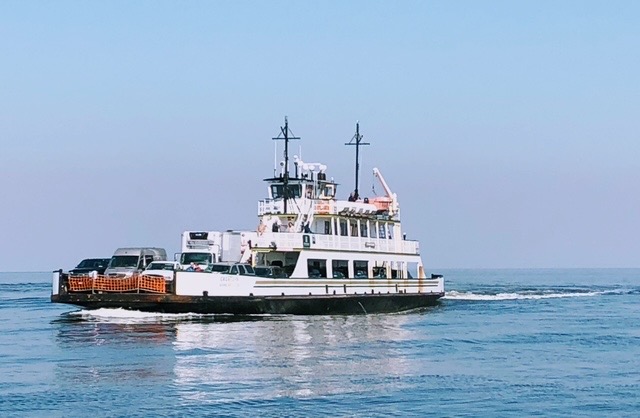
The Hatteras-Ocracoke ferry will run on a modified schedule Dec. 24 and 25. Photo: C. Leinbach/Ocracoke Observer
MANNS HARBOR – Three routes in the North Carolina Ferry System will be operating alternate schedules on Christmas Day, which is a traditionally low ridership day.
One of the three routes, the Hatteras-Ocracoke route, will also be running an alternate schedule on Christmas Eve. The holiday schedules for the Hatteras-Ocracoke, Cherry Branch-Minnesott Beach, and Southport-Fort Fisher routes will be as follows:
On the North Carolina license plate is “First in Flight,” noting the remarkable achievements of the Wright Brothers in the early years of the 20th century.
Could North Carolina also claim the distinction of being “First in broadcasting?”
That’s the question addressed by historian Kevin Duffus in his latest book, published in association with the North Carolina Broadcast History Project, “The Inventor Reginald Fessenden and the Origins of American Radio on North Carolina’s Outer Banks” (Looking Glass Productions 2025).
Duffus’s excellent writing makes this, which might seem to be a dull topic, into a page-turner.
His interest was sparked by a historical marker outside of Buxton that proclaims that “R.A. Fessenden sent the first musical notes ever relayed by radio waves. Received 48 miles north.”
Duffus determined that Fessenden sent his radio waves from Hatteras, not Buxton, and details the story in this book that’s both a semi-biography of a driven man with detailed insights into the early years of radio broadcasting and North Carolina’s significant contributions to this field.
Fessenden was a brilliant but pompous and combative Canadian-born inventor who is often described as the “Father of Radio” for his groundbreaking work in developing the technology for both radio transmission and reception.
Largely self-educated, he had a passion for science and experimentation that led to a frantic life, never staying long in one job or location.
He and his wife, Helen May Trott, moved to New York City with the hope of working with Thomas Edison, who initially refused to hire him because in his job application he wrote that he didn’t know much about electricity but was willing to learn.
Fessenden persisted and eventually was hired in 1888 as an assistant tester for the Edison Machine Works.
He quickly rose to work directly with the inventor. At age 23, he became the head chemist in Edison’s new laboratory in West Orange, New Jersey.
Facing financial difficulties, Edison laid off most of the laboratory employees, including Fessenden, who moved on, working at a series of manufacturing and academic positions.
Around the turn of the century, a major driving force for the need for wireless communications was hurricanes.
At that time, the U.S. Weather Bureau transmitted information by telegraph–carried by wires.
Widely regarded as the most powerful storm to strike the Outer Banks was the 1899 San Ciriaco Hurricane.
Not only did it destroy or severely damage every building on Hatteras Island, but it also blew down all the telegraph poles, isolating the Outer Banks with no way to communicate with the outside world.
Much of the book focuses on 1900 to 1902 when Fessenden accepted a contract with the U.S. Weather Bureau and moved to Manteo on Roanoke Island to develop a system to telegraph wireless weather forecasts and hurricane warnings.
Eventually, he created a whole new system of sending electromagnetic waves that could carry the human voice.
Much of this occurred by use of transmitters on Roanoke and Hatteras islands.
Communications technology at the beginning of the 20th century was of high public interest. Guglielmo Marconi, the Italian inventor, was a household name.
Marconi’s means of wireless communication used what is called spark-gap technology that permitted Morse Code transmission.
Fessenden viewed Marconi as an archrival and believed that he had a much better system for wireless transmissions, sending rapid electromagnetic waves that could include voice and music which Marconi’s spark-gap system could not.
Duffus goes into great detail regarding these two systems and how the popular press regarded them.
Over his lifetime Fessenden, who died in 1932, was granted approximately 500 patents that included radio transmission and others in sonar, radar, television, submarine detection, agricultural engineering, and many electrical and mechanical innovations.
Within this book of Fessenden’s tumultuous life is a love story. His wife stood by him through thick and thin. Perhaps to show a gentler side of Fessenden, Duffus brings out his life-long passion of rescuing and adopting cats.
Duffus takes pride in his reputation as a myth buster or iconoclast.
A much-repeated myth was when Fessenden was 10 years old, he was a neighbor of Alexander Graham Bell in southern Ontario and watched Bell conduct the very first long-distance phone call. Duffus reveals that the two did not know each other.
“These popular writers don’t understand the impact that their fictional versions of history will have on the future, because today we have these major institutions and government websites that parrot or repeat these legends which are not based on fact whatsoever,” he said in a recent interview on WOVV, Ocracoke’s community radio station. “I don’t think North Carolina can call itself first in broadcasting, but we can say that it is the home of the origins of American radio.”
Perhaps to the dismay of Buxton residents who claim he did his transmissions there, Duffus concludes that Hatteras village was the location of Fessenden’s southern transmitter station.
Thoroughly researched, Duffus scoured through thousands of original source materials and hundreds of old news articles producing 259 footnotes and includes many historic photographs and documents.
“Many published sources—good and bad—were also reviewed,” he writes. “Most challenging, innumerable hours were spent working on separating fact from fiction—no easy task.”
Lawmakers approved an extra $7 million, but the ferry division still needs tens of millions of dollars more to cover rising maintenance and other long-term costs.
This news story is provided courtesy of NC Local, a nonpartisan, nonprofit news organization serving all 100 counties of North Carolina by explaining how statewide issues and government decisions impact local communities.
North Carolina’s ferry system transports passengers to the hard-to-reach areas and islands in the eastern portion of the state, including Ocracoke. It also plays a critical role in evacuating locals and visitors during hurricanes or other strong storms that often threaten the coast.
The North Carolina Department of Transportation oversees the ferry system, which operates seven year-round routes plus one seasonal route.
The system has more than 20 ships in its fleet, not including support vessels. It transported more than 1.5 million passengers in 2024.
North Carolina’s ferry system has been in operation for more than 75 years and is the second largest state-run operation in the nation behind Washington state. It’s the only form of public transportation for some Outer Banks residents.
What funding challenges does the ferry system face? The ferry system’s annual operating budget totals more than $70 million. Of that, labor and fuel costs make up about 70%. Maintenance, equipment, supplies and other costs round out the remainder.
Earlier this year, the budget stalemate between state lawmakers in the House and Senate put ferry service in North Carolina at risk. At issue was $7 million needed to fund ferry operations and external shipyard work, including repairs for Sea Level, a ship that runs between Ocracoke and the mainland.
Lawmakers ultimately approved the funding measure in October.
“That’s going to go a long ways in ensuring that we have the boats we need for next summer,” Jed Dixon, the ferry division’s director, told lawmakers during a November meeting of the Joint Legislative Transportation Oversight Committee. “And it also will help with our overall reliability.”
Still, the ferry system faces several funding challenges.
At the same meeting, Dixon said the ferry system’s shipyard is “in dire need of infrastructure improvements” and has limited space for work.
Maintenance costs are another challenge because of the system’s aging fleet of vessels — 16 of 23 passenger vessels are more than 20 years old, Dixon said — plus, inflation is making repairs more expensive.
“The parts that we need to keep the ferries going are getting more expensive every year and we’re not seeing any decline from that,” Dixon said.
At the meeting, Dorene Creech, deputy director of business administration for the ferry division, said the system has identified $23.5 million in recurring annual needs — $13.5 million for operations and maintenance and $10 million for vessel replacement.
“This funding supports critical areas like overtime and temp staffing to keep service consistent; routine facility and marine maintenance to prevent costly breakdowns; ramp rehabilitations; and Coast Guard compliance work at external shipyards,” Creech said. “It also provides steady funding for replacing aging vessels, which improves reliability and reduces long-term costs. These are not new initiatives. They’re the core needs required to keep the system running safely and sustainably.”
The division, she said, has also identified about $69 million in unfunded, non-recurring critical needs, like replacing its shipyard’s aging air and electrical systems; dredging and shoreline and other infrastructure maintenance.
It’s unclear whether lawmakers will provide the funds the ferry system’s leaders say it needs when a budget agreement is ultimately reached. North Carolina is the only state in the nation without a new budget.
What is the ferry system’s impact on the state economy? North Carolina’s ferry system helps generate more than $735 million in revenue each year, according to a study of the ferry system published in 2020. Some of the routes help transport workers to their jobs, students to school and military personnel to the Marine Corps Air Station Cherry Point in southeastern Craven County.
The ferry system, according to the study, also helps generate: $32.5 million in state and local taxes $217.3 million in employee earnings 5,860 jobs $40.3 million in passenger benefits like safety, and vehicle cost and travel time savings.
Learn more: The Ocracoke Access Alliance is an advocacy organization committed to improving transportation access to Ocracoke Island and the Outer Banks.
NC Local is a nonpartisan, nonprofit news organization helping people in all of North Carolina’s 100 counties understand how statewide issues and government decisions affect their communities.
Another Shave Shack Christmas event will be Thursday evening, Dec. 18. Photo: C. Leinbach/Ocracoke Observer
Monday Dec. 15: Luminaria labyrinth at the OUMC. Will be up to Dec. 25
Ocracoke Island Realty Christmas Cheer quilt raffle drawing.
Tuesday, Dec. 16: Ocracoke Civic & Business Association board meeting, 6 pm. Community Center
Thursday, Dec. 18: Shave Shack Toy Drive and visit from Santa. 5:30 pm
Friday, Dec. 19: Ocracoke School Basketball at home vs. East Carteret: Girls varsity, 5 pm; boys, 6:30 pm.
Saturday, Dec. 20: Island Celebration Holiday Lights contest judging at dark.
“Lights of Love” luminarias on the lawn of the Pony Island Inn.
Sunday, Dec. 21: Church services: Ocracoke United Methodist Church, 11 am
Ocracoke Life Saving Church, 11 am
Stella Maris Chapel: Sunday Mass time at 4:30 p.m. unless otherwise noted. Go to Masstimes.org and type in the zip code 27960 but refresh your browser for it to work properly.
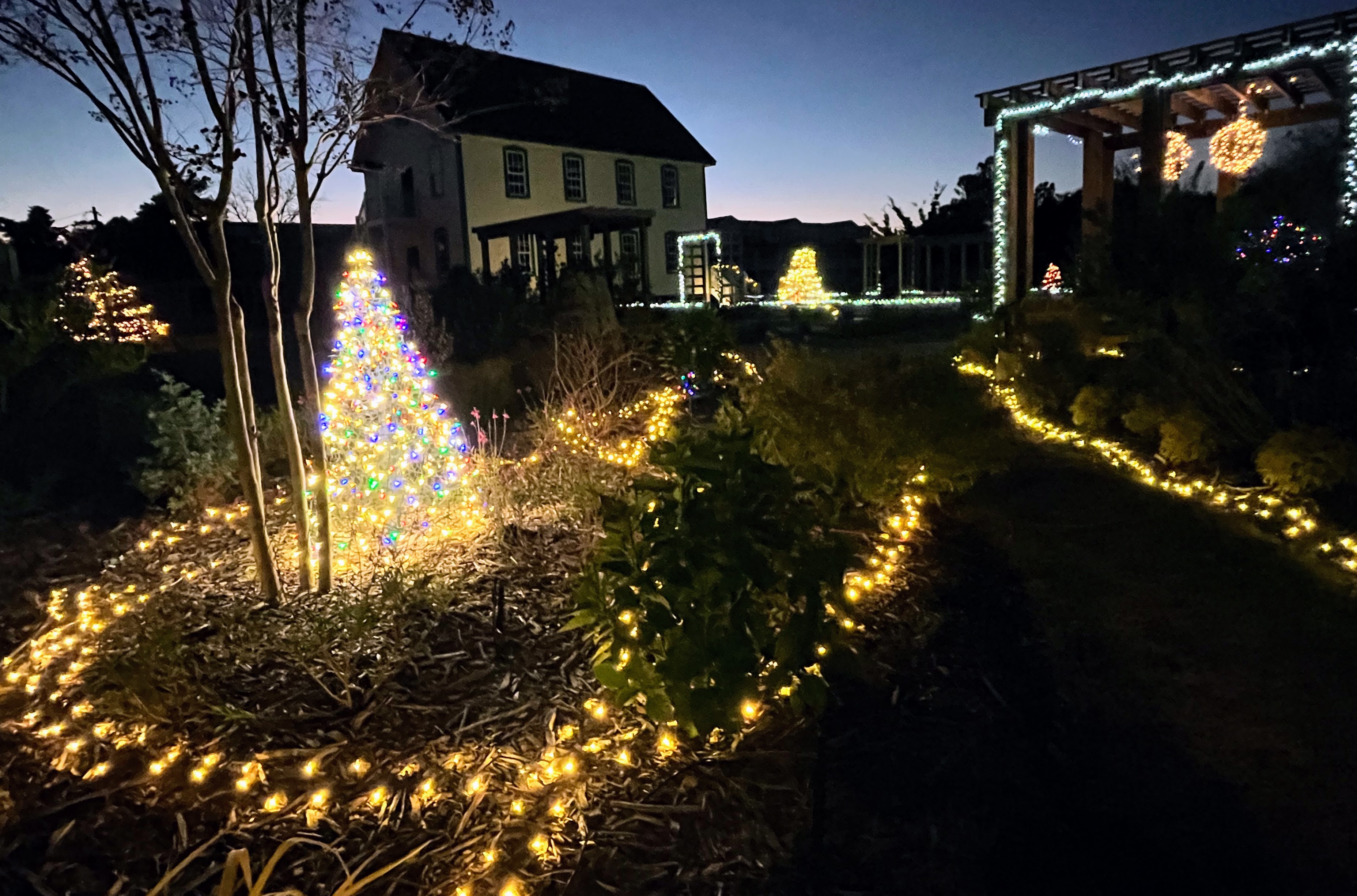
An army of volunteers, both community and visitors, over almost two years helped create this garden space at the Ocracoke Preservation Society Commons for all to enjoy year round. The light are designed and installed each year by Islander Trudy Austin. Photo: C. Leinbach
As another year closes, we reflect, in this season of thanksgiving and hope, on what it is about Ocracoke that’s so unique.
One of our late friends, Bill Jones, once said that he came here for the beach and stayed for the community.
New resident, Ben Knight, noted in a recent story that he wants to raise his daughter in this “extraordinary community.”
Is it?
All kinds of people with varying degrees of education, skills and professional accomplishments visit and live here in what seems like a non-hierarchical environment.
Many of the recent residents note the instant rapport they establish with many of the islanders, both from the ancestral families and newcomers.
“I’ve never lived in a place like this,” said Steve Brook, who with his wife, Jeanne, moved here in 2023. He’s lived in several places, including Canada and England.
“I’ve never felt connected to a community like I do now,” he said.
Native islander Albert O’Neal said he’s never wanted to live anywhere else. He’s OK with the slower lifestyle without the trappings of more developed places.
There’s about zero crime, he said, and “I will not live anywhere else.”
Another native, Trudy Austin, has lived here all her life and has worked in the Variety Store for the last 43 of those.
“People from all walks of life come together in this community,” she said as she gazed at the crowd attending the Holiday Market held Nov. 29 in the Ocracoke School Commons.
Austin meets lots of people at the Variety Store and when selling her fig preserves at various events.
She tries to explain to people why she doesn’t want to live elsewhere.
One either “gets it”—Ocracoke—or they don’t because “it can be a hard way of living.”
But that “it” is hard to put into words.
“It’s more like a feeling like when you come to an event like this,” she said. “Everyone who comes to stay, they bring something to the community.”
Elizabeth Dyer said on Ocracoke, one can get to know people on many different levels—through their work, their families and how they respond to stress.
Not all small communities with long-standing families are like Ocracoke, she said.
“But if you show up and make nice and contribute, people will be happy you’re here,” she said.
Ocracoke School Principal Jeanie Owens agreed.
“People who don’t have kids show up for the basketball games,” she said. “They care about our kids. We have people who show up for everything we do.”
Postmaster Celeste Brooks said that Ocracoke could be the definition of “community”—people helping each other.
There may be a touch of a social hierarchy here, she said, but when it comes to need, that disappears.
Kathleen O’Neal, who came to Ocracoke as a college student in the 1970s and married the late islander Ronnie O’Neal, said Ocracoke wasn’t always like this.
“If you weren’t from Ocracoke or related or going with somebody from here, it was different then,” she said.
She was among the cadre of college students back then who provided summer labor for the restaurants and motels.
“I couldn’t understand the brogue; they couldn’t understand me,” she said. “It’s changed over the years. Now, it’s much more welcoming.”
Raul Espinoza Ibarra, who’s been here about 25 years, felt the welcoming vibe when he arrived.
He experienced Ocracoke’s generosity when his house was destroyed by fire in 2017 and he received an outpouring of support regardless of nationality.
“People come together when needed. As long as you’re a good person, people will appreciate that,” he said,
He also noted that kids can ride their bikes to school here.
“They’re safe,” he said. “You can’t really do that somewhere else. I feel like it’s those little things make Ocracoke unique.”
Lori Rich, who lives part of the year in her small Vermont hometown, said the people there are all Vermonters.
“There are a few people that come in from the outside, but not like here,” she said, “where we have an eclectic array of people coming from all over.”
Maybe because it’s an island everybody jumps in to help, she said.
Of course, Ocracoke is not Shangri-La. But what place is?
Ocracoke sometimes has contention among residents and struggles with its problems.
Nowadays, a constant worry is overwash on NC12 at the north end and getting on and off the island, even when the ferries are running on time—for doctor’s appointments, for interscholastic sports games, or business.
Everything is either very close or too far, one person quipped.
Another struggle is conveying to lawmakers that the NC Ferry System does not serve just island residents but also the hundreds of thousands of people who visit year-round.
Ocracoke is different from any other shore point in North Carolina and thus not always understandable to everyone who comes here.
So, the island may not be for everyone, but it is for those who choose to stay.
To them, “It’s an amazing place,” Austin said. “It’s an amazing feeling.”