The Ocracoke Health Center wants to light up the Pony Island Inn lawn for the holidays.
They plan to do that with a special luminaria fundraiser, “Lights of Love,” the night of Saturday, Dec. 20.
Each luminaria will celebrate a living person or honor the memory of a loved one, said Crystal Hardt, who is organizing the event as a fundraiser for the health center.
People interested in purchasing one or several luminarias for $10 each may do so during the Holiday Market Saturday, Nov. 29, from 10 a.m. to 4 p.m. in the Ocracoke School Commons where the health center will be among 20 local vendors.
“Even if you cannot be here for the celebration, please consider purchasing some luminarias,” Hardt said. “This celebration is a special way of bringing your favorite place to you and yours for the holidays.”
Luminarias also will be available for purchase via PayPal, Square or Venmo or online. See flyers and order forms below.
Purchasers may drop forms off at the health center with the donation/payment, and all forms need to be returned with donations by Dec. 18.
Then, on Dec. 20, the luminarias will be placed in a pathway design in front of the Pony Island for people to wander through starting at 5:30 p.m.
A Blessing of the Luminarias and a Christmas carol sing along will follow at 5:45 p.m.
Attendees are asked not to park cars or drive on the Pony Island Inn lawn.
Refreshments of hot chocolate, coffee and cookies will be available for a donation that night in the Back Porch Lunch Box.
The Health Center will video the event and post it online on their Facebook page.
For questions, call Hardt at 252-944-5480.
According to the National Park Trust website, the luminaria tradition originated in 16th-century Mexico to light the path to Midnight Mass for the religious festival Las Posadas.
Initially, these were small bonfires, but the tradition evolved to use paper bags filled with sand and a candle, or farolitos, especially in New Mexico, to provide light and welcome during the Christmas season.
In Spanish, luminaria means “illumination” and farolito means “little lantern.”
Today, luminarias are used in a variety of celebrations, including Christmas, memorials and other events, and can be made with traditional candles or modern electric lights.
These decorative winter holiday lanterns are made with brown paper bags, which are filled partway with sand and a lit tea candle or small votive.
An example of decorative luminarias in New Mexico. Photo by WikiCommons
Silver Lake harbor on Ocracoke is calm at dusk. Photo: C. Leinbach/Ocracoke Observer
A lot is going on on Ocracoke Island this Thanksgiving week. See story here and events below.Also, correction in Boat Parade time of 6:30 pmand change in time for Lighting of the Commons.
Wednesday, Nov. 26 Fundraising bake sale, 1 pm. Ocracoke Volunteer Fire Department. See flyer below.
Friday, Nov. 28 Sold Out OPS Historic Homes tour, 2 to 4 pm followed by a presentation at the Island Inn at 4:30, followed by lighting of the Commons at 6 pm. All are welcome. See flyer below.
Holiday Boat Parade, 6:30 pm. Silver Lake harbor. See flyer below.
Ocrafolk Opry concert, Deepwater Theater, 8 pm
Saturday, Nov. 29: Holiday Market, 10 am to 4 pm, Ocracoke School Commons. See flyer below.
Howard’s Pub Oyster Roast, 5 pm. Free, and all are invited.
Ocracoke Oyster Company: Martin & Friends
Sunday, Nov. 30 Church services:
Ocracoke United Methodist Church, 11 am
Ocracoke Life Saving Church, 11 am
Stella Maris Chapel: Sunday Mass time at 4:30 p.m. unless otherwise noted. Go to Masstimes.org and type in the zip code 27960 but refresh your browser for it to work properly.
King’s men, David Snyder a militia man with the Leviathan Living History Group, and Alex Foster of the Sword Circle, playing Lt. Robert Maynard, with Blackbeard’s head at the 2025 Blackbeard’s Pirate Jamboree on Ocracoke. Photo: C. Leinbach/Ocracoke Observer
Editor’s note: Kevin Duffus gave this talk on Nov. 1 during Blackbeard’s Pirate Jamboree on Ocracoke Island.
By Kevin Duffus
Let’s talk about the notorious pirate Blackbeard’s head, the one fixed atop his shoulders before it was unceremoniously removed by a sword at Ocracoke on Nov 22, 1718.
Blackbeard’s detached head is one of the handful of reasons why he became America’s most famous pirate soon after his death. He was not known then for how successful or how wealthy he was or where his treasure was buried; not for how many houses he had; and not for how many wives and girlfriends he had. That notoriety, and those myths, came later.
Edward Teach’s severed head hangs from Maynard’s bowsprit, as pictured in Charles Elles’s The Pirates Own Book (1837)
He became a household name in the 18th century for how he had been gruesomely decapitated in his final fight and how his head was reported to have been impaled upon a pike staff and displayed to visitors at Hampton, Virginia.
Take away his unique nickname, his out-of-fashion beard, and his spectacular downfall at Ocracoke Island, and Blackbeard would have just been your run-of-the-mill, garden-variety pirate. And there wouldn’t have been movies & television documentaries made about him.
You know the story: After the battle on Nov 22, 1718, Royal Navy Lieutenant Robert Maynard purportedly snatched Blackbeard’s head by its hair and strung it up so that it would hang from the bowsprit of his sloop as a sort of literal figurehead—or “hood ornament” for you non-boaters—for shock value when he sailed into the pirate’s home port of Bath.
No doubt it worked. You see, even though the notorious arch-pirate was dead, his severed head with its blood-caked beard and hair, taut leathery skin, and contemptuous frozen grin, was not done striking terror in the hearts of its beholders. The sight may no longer have caused dread for his victims, but it did strike horror and grief for those who were once his friends, admirers, and townsfolk.
From Bath—if we are to believe the fertile imaginations of the many pirate scholars and archaeologists who have parroted this odoriferous folktale over the centuries—the head continued to dangle from its precarious perch all the way back to the Chesapeake Bay. Now, imagine that.
It’s well-documented that it took six weeks for Maynard to return to Virginia—a journey of 300 nautical miles. Consider, for the moment, the likelihood that Blackbeard’s head would have survived the journey, swarmed by flies and maggots while crossing Pamlico Sound, pecked and greedily clawed by voracious seagulls, and repeatedly dunked beneath the winter waves in the Graveyard of the Atlantic as Maynard’s little flotilla beat its way against northeast gales. What if, when the sun rose after a stormy night at sea, the head, or whatever was left of it, was no longer hanging from the bowsprit? Oops! There goes our bounty!
Maynard log entry Jan. 3, 1718
The most reliable source in historical research is the handwritten testimony of an eyewitness who had direct knowledge of an event. Thus, we turn to the very words of Lt. Maynard, recorded in his own journal on January 3, 1719, six weeks after the battle:
“Little winds and fair weather. This day I anchored here from No. Carolina in the Adventure sloop Edward Thache formerly master (a Pyrat) whose head I hung under the bowsprit of the said sloop in order to present it to the Colony of Virginia…”
So, there it is. Blackbeard’s rotting head did not see the light of day until January 3rd, when it was almost certainly removed from a cask filled with lime. For the British sailors tasked with attaching the six-week-old relic to the bowsprit, it must have been an odious honor.
But from then and there, what happened to the head? There are numerous myths and legends concocted by various writers over the past 300 years that mostly follow a similar storyline—Blackbeard’s skull, or a portion of it, was turned into a silver-plated punch bowl that was used by a secret fraternal society to honor the world’s most notorious pirate.
It all started with the London newspaper, The Post Boy, published on April 9, 1719. The newspaper reported a preposterously inaccurate account that “the famous Teach, alias Blackbeard” was captured alive, not at Ocracoke but in a battle in Chesapeake Bay, nearly three months after he had actually been killed. The dubious newspaper account was the first and only period source claiming “that the head of Teach is fix’d upon a pole for that purpose.” Even though historians have accepted and repeated the story as fact, there exists no official government or Royal Navy document that describes Blackbeard’s head stuck on a pole.
Watson’s Annals
The legend, however, was just getting started. The antiquarian John Fanning Watson, 124 years after Blackbeard’s death, wrote the book Annals of Philadelphia and Pennsylvania, in the olden time. Likely using the 1719 London newspaper account for his inspiration—especially since it was the sole source of the “head on a pike” story—Watson embroidered the tale even more, writing:
“Afterwards, when his head was taken down, his skull was made into the bottom part of a very large punch bowl, which was long used as a drinking vessel at the Raleigh tavern at Williamsburg. It was enlarged with silver, or silver plated; and I have seen those whose forefathers have spoken of their drinking punch from it, with a silver ladle appurtenant to that bowl.”
Punch bowls in places like Williamsburg not long after Blackbeard’s death were generally made of ceramics or decorated China. Assuming that the skull survived the ravages of an untold number of seasons on a pole, silver was a rare commodity in the 1720s and it is difficult to imagine a sufficient amount of it being used to enlarge a punch bowl, the bottom part of which included the notorious pirate’s skull.
The other problem with Watson’s Raleigh Tavern legend is that, according to a 1932 Colonial Williamsburg historical resource report, it’s uncertain if the tavern was even there when Blackbeard’s head would have been around.
But Watson was not the only writer who concocted a story revolving around Blackbeard’s skull being fashioned into a ceremonial drinking cup. The late Greenville district court judge Charles Harry Whedbee loved a good fish tale, especially those about his beloved Outer Banks. The stories he collected over the years were turned into a highly popular series of five little books featuring his favorite legends of coastal lore.
Charles H. Whedbee
One of Whedbee’s recurring topics was Blackbeard. In his fifth and final book, Blackbeard’s Cup and Other Stories of the Outer Banks, the judge wrote that the pirate had built himself a large house on Ocracoke, “two stories high and containing many large rooms,” which was known over the years among the islanders as “Blackbeard’s Castle.” Somehow the pirate managed to accomplish this during the few weeks he was at the island in 1718.
The structure Whedbee referred to was located at Springer’s Point, near the old well. He described the time in the 1930s when he and a fellow law student at the University of North Carolina visited Ocracoke. While there, they were invited to participate in a secret fraternal ritual with a dozen bearded, blue-eyed, “hoi-toiders” inside Blackbeard’s Castle.
Illuminated only by the wavering light of a kerosene lantern, the secret conclave gathered with great solemnity around a large table and took turns sipping a special communal libation from a peculiarly shaped silver cup with the words, “Deth to Spotswood,” carved around the rim.
The participants also chanted the cup’s oath, over and over, in their heavily accented, gravely voices: “Deth to Spotswood.” In case you didn’t know, Alexander Spotswood was Virginia’s pompous lieutenant governor who ordered the killing or capture of Blackbeard.
After the first round of toasts, the young law student and future judge was informed that the vessel from which he and his companion drank was none other than the skull of the ritual’s revered honoree, Blackbeard. The judge-turned-folklorist invented the tale that, contrary to the facts in Lt. Maynard’s logbook, Blackbeard’s head was never taken to Virginia but instead his skull was fashioned into a punch bowl by a Bath Town silversmith funded by some of the dead pirate’s grieving friends (even though silver was even scarcer at Bath than it was at Williamsburg). Whedbee surmised that the silver-plated skull eventually found its way to Ocracoke where it was used by the secret Deth to Spotswood society.
Snow vs. Whedbee cup
Now for some historical facts. In the long history of literature and plot devices, there is truly nothing new under the sun. The English have always had a macabre fascination with human heads and they were especially keen on impaling the heads of traitors on pikestaffs, or lances, and then displaying them to the public as a means of discouraging bad behavior. The south end of London Bridge between 1300 and the late 1600s was festooned with the rotting heads of miscreants.
Typically, the heads in London were dipped in tar in order to prevent decomposition and also to keep birds from devouring the Monarch’s trophies of justice. Oliver Cromwell’s head was stuck upon a pole atop Westminster Hall where it remained, sort of like a weathervane, for more than 20 years. One day, a high wind blew it down and it was taken home by one of the King’s guards. Awhile later, it was sold for £100 to a collector and member of Parliament named Horace Wilkinson who purportedly popped it out for fun at parties.
I believe that the Philadelphia antiquarian John Watson’s tale of Blackbeard’s head displayed at the entrance to Hampton harbor may have been partly inspired by the story of Cromwell’s head which was in the news while he was writing his book. As for Whedbee’s story, “Blackbeard’s Cup,” the house he claimed to have visited to participate in the secret Deth to Spotswood ritual, often referred to as “Blackbeard’s Castle,” was, at the time, the summer residence of the Springer family. Although the origins of the structure are undetermined, it was unlikely that it, or any other manmade structure, was there in Blackbeard’s day.
My research on skulls employed as drinking cups, however, led me to an unexpected source and one that very likely gave Watson the idea—Whedbee as well—to spin the yarn of Blackbeard’s silver-plated skull.
In 1824, about the time that Watson was gathering material for Annals of Philadelphia, the English poet Thomas Medwin published a book titled Journal of the Conversations of Lord Byron. In Medwin’s book, he quotes Byron who described the years when he lived in his ancestral home at Newstead in Nottinghamshire, England:
“There had been found by the gardener, in digging, a skull that had probably belonged to some jolly friar or monk of the Abbey… Observing it to be of giant size, and in a perfect state of preservation, a strange fancy seized me of having it set and mounted as a drinking cup. I accordingly sent it to town, and it returned with a very high polish and of a mottled colour like tortoiseshell. I remember scribbling some lines about it; but that was not all. I afterwards established at the Abbey a new order. The members consisted of 12, and I elected myself grand master. A set of black gowns, mine distinguished from the rest, was ordered, and from time to time, the [cranium] was filled with claret, and, in imitation of the Goths of old, passed about to the gods of the Consistory, whilst many a prime joke was cut at its expense.”
Byron’s recounting of his secret order of a dozen members dressed in black gowns at chapter meetings drinking wine from a polished skull drinking cup sure sounds a lot like Judge Whedbee’s attendance at Ocracoke’s secret Blackbeard society, which also consisted of a dozen members.
In popularizing the legend of Blackbeard’s skull, Lord Byron, Watson, and Whedbee, and innumerable other writers have, intentionally or not, co-opted a tradition originally found in Knights Templar mythology, and rumored to be practiced in modern Freemasonry as recounted in books like Dan Brown’s The Lost Symbol. Skulls have long been associated with the Templars and there are those who believe modern Freemason rituals mimic some of the ancient Templar practices, where initiates of the secret society drink a bitter wine from a human skull cup. The somber ceremony is intended to be symbolic of the bitter cup of death, from which everyone must drink eventually.
There are those who believe the allegory assumes an even darker form—that the celebrants invite the sins of the person who once inhabited the skull to be “heaped upon them,” and to appear against them on Judgement Day should they ever willingly violate their solemn vow and steadfast obligation to their organization and brethren.
I don’t know about you but I’m not sure that I would want to face Judgement Day with Blackbeard’s sins heaped upon me even though my research into the pirate revealed that he was not nearly as ruthless as pop-culture has made him out to be.
What truly happened to Blackbeard’s head? It’s anyone’s guess.
About the author Kevin Duffus is an award-winning North Carolina historian, filmmaker, and author whose previous works include The Inventor Reginald Fessenden and the Origins of American Radio on North Carolina’s Outer Banks, The Last Days of Black Beard the Pirate, The Lost Light: The Mystery of the Missing Cape Hatteras Fresnel Lens and War Zone—World War II Off the North Carolina Coast.
Known for his exhaustive archival research and his ability to uncover forgotten truths, Duffus has spent decades documenting the hidden histories of the Carolina coast.
His latest work, he says, aims to do for Fessenden what others have done for the Wright brothers — “to finally put his achievements in their proper place in world history.”
“Fessenden is every bit as significant as Wilbur and Orville Wright,” Duffus said. “His experiments on the Outer Banks laid the groundwork for nearly every form of human communication today.”
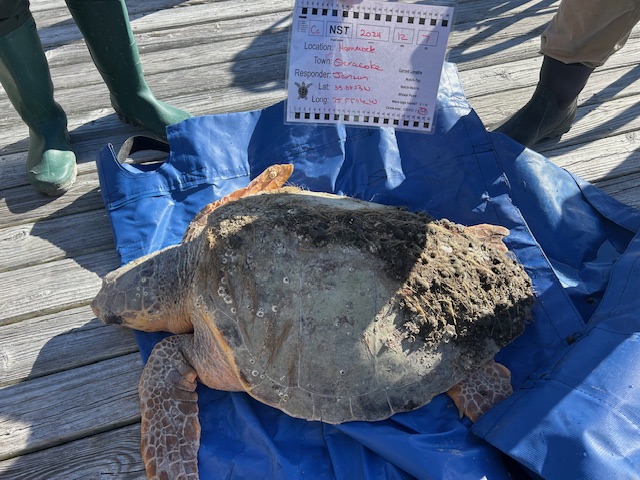
A cold stunned loggerhead sea turtle last December 2024 is prepped for transport to rehab at STAR. Photo by Susan Atkins
From our news services
The National Park Service and N.E.S.T. (Network for Endangered Sea Turtles) will hold a cold-stun sea turtle volunteer training at 10 a.m. on Tuesday, Dec. 2, in the Ocracoke Community Center.
The training is open to all who want to help locate cold-stunned sea turtles that wash up on Ocracoke’s sound and ocean sides.
Cold stunning is a condition similar to hypothermia that is caused by dropping water temperatures. Sea turtles are cold-blooded reptiles that depend on the temperature of their surroundings to maintain their body temperature. During a cold snap when water temperatures dip below 50 degrees, they go into a state of hypothermic shock also known as “cold stunning,” causing them to float to the surface. At that time, winds and currents may push them onto land.
The session will include a Zoom session with N.E.S.T. Director Jerrica Rea who will review the updated cold-stun patrol and response policies for this year.
This year, volunteers will patrol once a day in the morning during cold-stun conditions and will drop off sea turtles for the 11:30 a.m. ferry to Hatteras.
If a stunned sea turtle is reported by the public after the morning patrol is concluded, the latest guidance is that NPS staff will target removal of the sea turtle on the next day’s patrol.
The Buxton staging site will close at 1 p.m. this year daily for increased safety of volunteers driving at night and reducing burnout of transportation volunteers and aquarium staff/volunteers at the Manteo STAR Center.
During extraordinary events, the NPS can coordinate with North Carolina Wildlife Resources Commission staff to send sea turtles on the 1 p.m. Cedar Island ferry where they will ultimately be transported to the Pine Knoll Shores Aquarium or Karen Beasley Sea Turtle Center in Surf City.
The session will include new volunteer leadership opportunities with N.E.S.T., such as joining an updated call list that enables you to respond as a permitted N.E.S.T. volunteer to living and dead stranded sea turtles on private property in Ocracoke Village (including Springer’s Point, North Pond, Oyster Creek, etc.).
This will free up NPS staff to respond to sea turtles on Cape Hatteras National Seashore property and mirrors the N.E.S.T/NPS relationship that is in place on Hatteras Island currently.
Additionally, NPS will need assistance patrolling Seashore property, much the same as last year.
For those interested in joining patrols on Cape Hatteras National Seashore, NPS staff will have Volunteer Service Agreements prepared similar to those of prior years for the nest-sitting program
The dredge Merritt works in the Hatteras Inlet. Photo: C. Leinbach/Ocracoke Observer
From our news services
After years of coordinated engagement among several coastal agencies, a winter dredging campaign is slated for the 2025–2026 season to safeguard year-round access to Ocracoke Island and the greater Outer Banks.
As detailed in a press release from Ocracoke Access Alliance, the project will target two trouble-prone corridors: Sloop Channel in Hatteras Inlet and Big Foot Slough in Pamlico Sound.
These spots are essential to reliable ferry operations, emergency response and the island’s tourism-driven economy, local officials say.
The U.S. Army Corps of Engineers (USACE) will conduct the dredging efforts through their contractor, supported by Hyde County and financed through the North Carolina Shallow Draft Navigation Channel Dredging and Aquatic Weed Fund.
Why dredging matters this winter Shifting shoals, storms, and long-period swell frequently choke the navigation routes that connect Ocracoke with Hatteras and the mainland. When channels pinch—sometimes by mere inches—ferries are forced to reduce loads, wait on favorable tides or cancel runs outright.
Winter is the most practical time to perform dredging when traffic is lighter and contractors can work between weather systems to restore depths ahead of spring and summer demand. It is also the window allowed for dredging to avoid harm to protected species.
In Sloop Channel in Hatteras Inlet, theUSACE will fund the dredge project for the 100-foot-wide, federally authorized channel in Sloop Channel (between Ocracoke and Hatteras) to the congressionally authorized 10-foot depth, restoring a reliable path through one of the inlet’s most dynamic choke points.
Cottrell Contracting out of Chesapeake, Virginia, was awarded the dredging contract and has worked on Ocracoke before. In parallel, Hyde County, with the Shallow Draft fund, will finance an additional 50 feet on either side of the federal cut, also using Cotrell.
The combined 200-foot working width is intended to improve maneuverability and reduce the frequency of emergency closures when wind and current stack shoals against the banks.
“Restoring these cuts each winter is how we keep Ocracoke connected,” said Randal Mathews, chair of the Hyde County Board of Commissioners. “The added width at Sloop Channel will make a real difference when wind and tide don’t cooperate.”
On the Pamlico Sound side, USACE and Cottrell will focus on Big Foot slough this year.
To better “follow the deepest water,” in future years, USACE is finalizing an Environmental Assessment that will expand the dredge template so crews can work either Big Foot Slough or Nine-Foot Channel as conditions dictate.
That flexibility is designed to keep the Swan Quarter–Ocracoke and Cedar Island–Ocracoke routes open and predictable, even as the shoaling patterns migrate with storms and seasons.
Dredging is expected to begin in early January with active dredging scheduled through the winter maintenance window, weather permitting. Crews will sequence work to minimize impacts on ferry operations.
The recent government shutdown did not delay the finalization of paperwork necessary for this work to begin, noted Justin LeBlanc, executive director of the Ocracoke Access Alliance.
Restored depths in these channels should create more reliable ferry service by reducing weather-related cancellations and loading limits, particularly during strong crosscurrents, LeBlanc said.
“With ferries carrying residents, workers, students, visitors, and essential goods, steady access underpins livelihoods on Ocracoke Island as well as across the Outer Banks and mainland Hyde County,” he said. “This winter’s dredging plan is a practical, partnership-driven investment in Ocracoke’s future. By restoring depths in Sloop Channel and Big Foot Slough, and by widening the working corridor where it matters most, the project aims to deliver safer transits, fewer cancellations and a more resilient connections for the island when the 2026 season begins.”
The partnership between Dare and Hyde counties, the NC Department of Environmental Quality (NCDEQ) and the USACE brings together federal capability and state-local initiative.
Hyde County is a Tier 1 county, a designation by the N.C. Department of Commerce that puts Hyde among the most economically distressed, with Tier 3 as the least distressed. A year ago, the N.C. Legislature exempted Hyde from having to fund a local match when applying for money from the Shallow Draft Fund, which provides the state’s share of the costs associated with dredging projects in state waters. Sloop Channel is in state waters, while Big Foot Slough is in federal waters.
“This layered approach is increasingly seen as a model for coastal communities facing dynamic waterways and constrained budgets,” LeBlanc said.
What mariners and travelers should know
Ferry Operations: The NC Ferry Division will announce any temporary schedule changes or loading adjustments tied to dredging movements. Most work is planned to preserve regular service.
Navigation Notices: Commercial and recreational boaters should monitor Local Notices to Mariners and heed any temporary markers, safety zones, or speed restrictions near active dredges.
Environmental Stewardship: All work will proceed under applicable state and federal permits. Timing, methods, and placement sites are selected to protect the environment while preserving the region’s navigational lifelines.
For updates: Travelers should check NC Ferry Division advisories before departure. Mariners should consult the latest “Local Notice to Mariners” and observe on-scene instructions near dredging operations
The next meeting of the Ocracoke Waterways Commission is at 6:30 p.m. Wednesday, Nov. 19 in the Ocracoke Community Center and Livestreamed on Hyde County Public Information Facebook Page: https://www.facebook.com/HydeCountyNC
Birds and fisherman hope for a catch on South Point. Photo: C. Leinbach/Ocracoke Observer
Monday, Nov. 17: Ocracoke School girls and varsity boys play their first basketball game away at TEACH in Washington.
Tuesday, Nov. 18: Ocracoke Civic & Business Association, 6 pm. Community Center.
Wednesday, Nov. 19: Roanoke Island Animal clinic sees patients in the Community Center. Call 252-473-3117 for appointments and check Facebook for last minute changes.
Ocracoke Waterways Commission, 6:30 pm. Community Center.
Saturday, Nov. 22 Ocracoke Oyster Company: Ray Murray 1718 Brewing Ocracoke: Kate McNally, 7 pm
Sunday, Nov. 23 Church services: Life Saving Church, 459 Lighthouse Rd. Sunday Worship, 11am; Wednesday: Bible study, 6:30 pm.
Ocracoke United Methodist Church: Sunday worship, 11 am. Streaming via its Facebook page.
Stella Maris Catholic Chapel, 95 School Rd. Sunday Mass time at 4:30 p.m. unless otherwise noted. Go to Masstimes.org and type in the zip code 27960 but refresh your browser for it to work properly.
Loggerhead sea turtle hatchlings. Photo by Sarah Shellow
By Ruth Fordon
November 14 was a sunny crisp fall morning with temperatures hovering around highs of mid 50s all week. Ocracoke residents Lou Castro and Sarah Shellow were at the Lifeguard beach for sunrise. In Castro’s words, “We noticed some deer tracks coming from south of the Lifeguard beach ramp next to three turtle nests and going back into the dunes.
“We followed the deer tracks then we were heading back to the ramp when I noticed a baby turtle outside of the fenced in turtle area, on its back in a depression in the sand. It wasn’t moving so I assumed the turtle was dead.
“Then we looked into the fenced-in area on the dune and saw seven more turtles moving very sluggishly. They looked a little bit like grey pinecones with heads and flippers. Some of the babies were on their backs unable to right themselves like the first one. We immediately called Matt Janson.”
Within five minutes, Janson, who is the lead NPS biotech for Ocracoke, arrived with his intern, Margaret Knight. It was obvious that this loggerhead nest was hatching and that the turtles were having some issues with the cooler temperatures.
Matt Janson performs a late season excavation. Photo by Ruth Fordon
Ordinarily, a sea turtle nest on an average needs 55 days from the nesting of the adult to reach the hatching window. This particular nest at day 85 was laid Aug. 20– when the island was under an evacuation notice and had been discovered by a local watching the hurricane surf.
From the beginning there was weather-related interference with two well-out-to-sea major hurricanes sending rough surf and high tides that flooded the beach followed by a couple of nor’easters causing the same level of flooding and rough tidal conditions.
Janson speculated that the female loggerhead dug her nest high into the dune because she came ashore during a time of high storm tides and that was the first dry area she found.
This writer arrived at the nest site about 30 minutes after the nest excavation began. Nests that are laid after Aug. 15 usually have longer incubation times due to the cooling temperatures. The NPS biotechs keep an eye on nests that remain unhatched to confirm that a nest is still viable. This nest was still considered viable, but 85 days after nesting is beyond the date where it seems possible that it will produce live hatchlings.
As Janson carefully probed into the nest cavity he eventually recovered 27 live hatchlings before reaching eggs that were still in late stages of hatching. At this point, the nest cavity was refilled with sand so the remaining turtles could hatch when they were ready without further interference.
The live hatchlings were placed in a sand filled cooler and the decision was made to hold them for the rest of the day and to release them toward midafternoon on an outgoing tide, hoping for a rip current to assist them in their efforts.
Volunteer Jennifer Garrish holds hatchling about to be released at South Point. Photo by Stephanie Ihle
Volunteers who assist with the cold stunned turtle rescues over the winter months were alerted to the release and about a dozen folks arrived at South Point beach to assist with the release.
NPS biotech Matt Janson releasing hatchlings at the South Point. Photo by Ruth Fordon
Because these hatchlings were still very sluggish and disoriented, volunteers were needed to monitor the progress of the hatchlings to reach swimming depth and to escape the pull of the surf. The surf was tricky and many times the little hatchlings were swept back to shore. Eventually all were able to move into the deeper water with the turtle team sending prayers for their survival.
Two more turtle nests are near where this nest hatched that are at days 83 and 84 in the nesting window. Will they also defy the odds and produce live hatchlings?
If you are on Ocracoke during the winter months and would like to be involved with assisting cold stunned sea turtles, there will be a training workshop at 10 a.m. Tuesday, Dec. 2, the Ocracoke Community Center.
Installing more energy-efficient appliances can save you money on your energy bills, but those purchases can be costly.
Starting in December, you can get big rebates on certain appliances and other energy-efficiency work.
For income-qualified residents, some upgrades could be completely free.
The Energy Saver North Carolina program (EnergySaverNC.org) administered by the N.C. Department of Environmental Quality has been expanding gradually statewide and is coming to Hyde County in December.
It was funded by the 2022 Inflation Reduction Act and is intended to benefit low- and moderate-income renters and homeowners. Income qualification is based on household size and percentage of area median income.
Energy Saver NC offers rebates in two ways. HEAR (Home Electrification and Appliance Rebates) offers rebates on appliances like HVAC heat pumps, water heaters, electric ranges and washer/dryers, as well as on insulation, air sealing, wiring and electrical panels.
In Hyde County, a two-person household, for example, qualifies for a rebate as high as 100% if their income is below $48,900, and an up to 50% rebate if their income is below $104,200.
The 100% rebate is not guaranteed to be no-cost, because there are caps on certain items.
For example, the maximum rebate on an electric heat pump is $8,000.
A household may claim rebates for multiple purchases; the maximum total rebate value per household is $14,000.
A great feature of the program is that you don’t have to lay out the money for these purchases and wait to get your rebate.
Your contractor will deduct the amount of the rebate from your bill.
The second part of the program is HOMES (Homeowners Managing Efficiency Savings), which provides rebates on energy-efficient appliances and other work in your home that reduces overall energy usage by at least 20%.
HOMES starts you off with a free energy audit (a $500 value) and has potential savings up to $16,000. The same income qualification guidelines are used.
HEAR rebates are not available retroactively; you must wait to get program approval before installing upgrades.
In very limited cases, HOMES rebates may be retroactive.
Check the Energy Saver NC FAQ page to learn whether you can get a HOMES rebate for work you have already done.
The program is looking for more contractors who want to help their communities get access to these funds.
As of this writing, the closest approved company to Ocracoke is All Weather Mechanical in Jacksonville.
If you know other contractors, ask them to apply on the Energy Saver NC website.
As healthcare costs continue to climb nationwide, Outer Banks small business owners finally have a new option to provide affordable coverage to their employees.
The Outer Banks Chamber of Commerce is hosting free information sessions November 18 to 20 across the region to explain how local businesses with as few as two employees can now access the same purchasing power as large corporations through a new partnership with Carolina HealthWorks and Blue Cross NC.
“Healthcare costs have squeezed small business owners for years,” said Karen Brown, President & CEO of the Outer Banks Chamber of Commerce. “We’re hearing from members who want to offer benefits to attract and keep good employees, but the costs have been prohibitive. This changes that.”
Small businesses—the backbone of the Outer Banks economy—have historically paid significantly more for health insurance than larger employers, with fewer plan options and less control over costs. For many local restaurants, retail shops, and service businesses operating on tight margins, offering health benefits has been simply out of reach.
Carolina HealthWorks allows small employers to band together for better rates—some businesses could see savings of up to 40% compared to ACA marketplace plans. The program offers approximately 38 plan options including medical, dental, and vision coverage, with streamlined administration that saves business owners time.
“This isn’t just about saving money—it’s about being able to compete for talent and take care of the people who make our businesses run,” Brown added. “In a tight labor market, benefits matter.”
Chamber members and non-members are invited to attend free sessions throughout the Outer Banks to learn how the program works, eligibility requirements, and enrollment details. Business owners can ask questions and get one-on-one guidance.
Eligibility Carolina HealthWorks is available to North Carolina businesses with two to 50 employees. Businesses must be Outer Banks Chamber members to participate. Non-members are encouraged to attend sessions to learn about both the healthcare program and Chamber membership benefits.
Ocracoke Alive is in the process of planning the Winter Activities Community Calendar, which will be running mid-January through the end of March.
Last year, the organization offered activities in art, music, dance, writing, wellness and cooking classes as well as films, concerts and presentations, in the evenings and during the day.
Ocracoke Alive Executive Director David Tweedie said the impetus for the offerings was that it’s difficult for islanders to get cultural enrichment on the island.
“Part of our mission is to bring entertaining things to the island,” he said. While everyone is busy during the tourist season, if you don’t travel (like many islanders do in the winter) “doing creative things is a way you can travel in your mind,” he said.
Since we don’t have a university nearby, why not see what we can do with people here, he thought, and he found a wealth of creative talent, some of which he hadn’t known about.
For the coming winter, he said they have a few ideas but they want to hear about islanders’ ideas:
What kinds of activities would you like to join?
Are there programs you’d like to see that aren’t on our list?
Would you be interested in teaching or hosting a session?
This year, the group also is making a special effort to create events that bring together Ocracoke’s Latino and non-Latino communities—sharing language, culture and creativity.
Please take a moment to share your thoughts by scanning the QR Code in the image or through a link at www.ocracokealive.org.