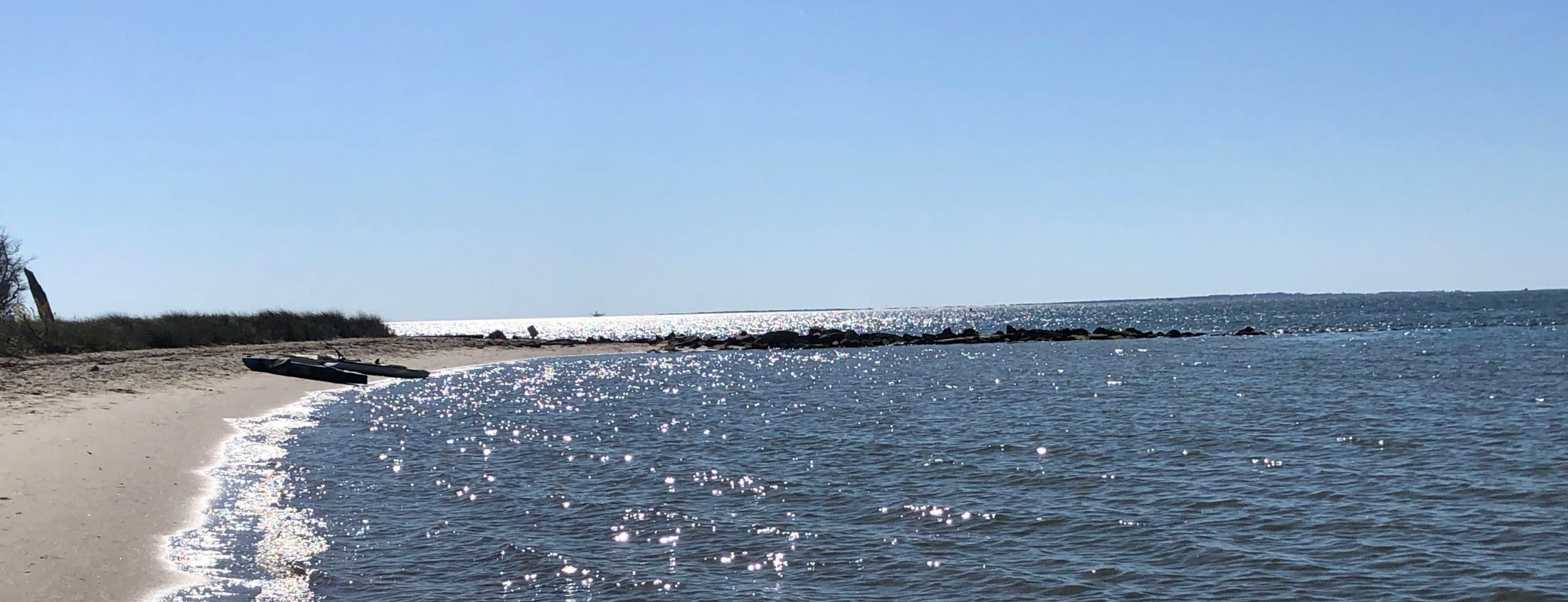
October afternoon at Springer’s Point. Photo: C. Leinbach
Do you have a favorite season or month?
Many of those who have lived on Ocracoke for many years consider October to be the best month. No guarantees, but by then, in a good year, one sees the hurricane season (typically from June to November) winding down and that the island will be spared.
But October yields pleasant temperatures, the softening light from the glare of summer and fewer visitors. It is not hard to find solitude in an early morning or late afternoon beach walk and see dolphins just beyond the breakers.
Fishing in October
October is the peak fishing month on Ocracoke Island. It’s a time when the big fish are likely to be caught, although the big ones are captured year ‘round.
According to Tradewinds Tackle, jumping mullets move along the inlets and beach providing a great source of bait for game fish such as drum and bluefish, which makes the fishing productive.
Water temperatures start to cool down toward the end of October bringing larger bluefish and citation red drum (over 40 inches) to the surf.
Surf fishing for smaller fish and trophies can be excellent throughout the month. Puppy drum are the primary target of surf fishermen, with many yearling-sized drum (27 to 37 inches) mixed in as well.
Birding
Brown pelicans on their evening commute under a waxing October moon. Photo: C. Leinbach
Brown Pelicans fly lazily in strings overhead and along the waters. Peregrine Falcons pass through, sometimes perching on the water tower in the village.
Toward the end of the month, Myrtle Warblers will appear throughout the island, especially in the village, and will remain until late winter/early spring.
Gone will be those beautiful Black Skimmers that had an excellent nesting year with lots of fledglings that will return. These black-and-white beauties with their long unusual red bills delight beach walkers in the late afternoon as they fly just above the water line, their lower bills dipping through the water, in search of food.
Soon, the Northern Gannets will arrive. These large white birds with long black-tipped wings are an equal delight to watch as they make spectacular dives into the ocean.
Various other seasonal birds — possibly rare ones, too — can be spotted throughout the island in the fall during migration.
Northern Gannet off Ocracoke Island. Photo: P. Vankevich
The above, somewhat idyllic, portrayal of October on Ocracoke is for what may be categorized as “normal times.”
But the last couple of years have been far from that. Hurricane Dorian in 2019 and a pandemic that began in early 2020 and is far from over on the island and almost everywhere else. Many now are experiencing an increased sense of anxiety that climate change is already here — far sooner than many scientists predicted.
Getting on and off the island has been difficult and time-consuming. The N.C. Ferry Division has had challenges. Along with the ongoing battle with shoaling, inadequate staffing and COVID-19 have caused many cancellations on Ocracoke’s lifeline –- the ferries between Hatteras, Swan Quarter and Cedar Island.
In many ways, we are no different from most communities that face challenges. It’s just that ours are different from most others.
We all need to find ways to lower our stress levels, especially on issues over which we have no control.
Where we do stand out and which is why those of us who stay here and “live on the edge” is because we can easily walk the beach, enjoy the susurrant wind, marvel at some of the world’s most beautiful sunrises and sunsets and find a spot on the dunes to peacefully reflect and enjoy the solace one can find in nature.
Even a Black-bellied Plover can enjoy an October day on Ocracoke beach. Photo: P. Vankevich
Ruth Fordon helps the Cape Hatteras National Seashore staff with sea turtle patrol. Here she helps get a disoriented loggerhead back to sea. Photo by Amy Thompson, CAHA
This story has been updated
By Peter Vankevich
As the 2021 sea turtle nesting season winds down, it turns out to be a very good year once again for loggerhead sea turtles on the Outer Banks and the approximately 330 miles of North Carolina’s sandy ocean beaches.
Here are some of the nesting highlights and facts about sea turtles in North Carolina waters, home to five of the seven species worldwide.
From a sea turtle perspective, coastal North Carolina is loggerhead territory, comprising of 97 percent of all recorded sea turtle nests this season. According to Seaturtle.org, an organization that supports sea turtle research and conservation, a total of 1,496 nests from 25 coastal locations were recorded throughout the state: 1,446 loggerhead, 42 green, seven Kemp’s ridley and one unknown. From these nests, unofficially as of Oct.20, 107,967 hatchlings emerged.
Federal agencies such as the National Park Service, U.S. Fish and Wildlife Service, U.S. Marine Corps, U. S. Army Corps of Engineers, state agencies and nongovernment organizations and individuals input their data to the website.
Ruth Fordan holds a loggerhead hatchling during an excavation. Photo by Amy Thompson, CAHA
Since 1983, the N.C. Wildlife Resources Commission has administered the North Carolina Sea Turtle Protection Program to monitor sea-turtle nesting activity in North Carolina and document reproductive success and failures.
The Cape Hatteras National Seashore (CAHA), which includes Hatteras and Ocracoke islands and part of Bodie Island, reported a total of 315 nests, 298 loggerhead, 14 green and three Kemp’s ridley. As of Oct. 19, only seven nests were still incubating and a total of 19,634 hatchlings have already emerged.
Ocracoke has had 97 turtle nests: two green, one Kemp’s ridley and 94 loggerhead. This is the second highest number of nests for the island since records began in the 2000s, with the highest of 147 nests in 2019.
Volunteers to the rescue
Improving nesting success of sea turtles relies heavily on many volunteers. Most receive extensive training from the Network for Endangered Sea Turtles (N.E.S.T.), an all-volunteer non-profit organization dedicated to the protection and conservation of sea turtles and other protected marine wildlife on the Outer Banks.
This was a particularly demanding year because of so many nests. Ocracoke, as with other locations, has welcomed volunteers. More than 1,000 state-wide have participated in nest monitoring activities, which has contributed to this year’s nesting success.
Islander Ruth Fordon has been a turtle-nest volunteer since 2004.
“I’m an early riser which is important because you have to be ready at 5 a.m. to meet with the Park Service staff for the morning turtle patrols,” she said. “I just love going out and riding with them in the morning from South Point all the way up to the north end looking for the tracks and if there is a nest, helping them set up protective enclosures, as well as all the other nest maintenance tasks that occur as the summer progresses.” She is also an evening nest sitter volunteer.
Amy Thompson, Ocracoke’s lead biotechnician for CAHA, has nothing but praise for Fordon. “Ruth’s assistance was absolutely invaluable,” she said. “She was on the morning turtle patrols assisting in the often-labor intensive tasks and with her long experience, provided lots of insights.”
Frank Welles, N.E.S.T. volunteer, examines a dead leatherback sea turtle that washed ashore last January in Frisco on Hatteras Island. Photo by James Rowe
“Everyone on our resource management team loved working with her,” Thompson added.
The patrols also include looking for turtle strandings, which occurred five times this summer when adult loggerheads crawled over the dune line and onto Highway 12 at the north end overwash area.
In the evenings, the volunteer nest sitters make sure the nests are not disturbed and will block out any artificial lighting from nearby buildings with tarps. Light pollution is a serious threat to hatchlings, which have a strong attraction to light. It can cause them to become disoriented and crawl toward the light and away from the beach. People are strongly encouraged to turn off lights that impact the beach. Volunteers will also smooth out the tire tracks between the nest and the water so that hatchlings don’t get trapped in the sand.
Sometimes volunteers have the wonderful opportunity to see the hatchlings emerge, called a boil. They will serve as escorts to protect hatchlings from ghost crabs as they crawl to the ocean.
Once in the water, the hatchlings are on their own and face a new set of dangers — fish, sharks and dolphins, among others.
The hatchlings will swim out to the Gulf Stream, which provides shelter in the floating sargassum weed, a temperate climate and plenty of small organisms that the hatchling can feed on.
Males will remain at sea and females return to land only to nest and at the general location where they hatched.
If they make it past the first few years and avoid the causes for their endangerment, they may live up to 50 years.
It is not only during nesting season that volunteers help sea turtles. In winter, when temperatures drop below 50 degrees for sustained periods, a deadly form of hypothermia will cause sea turtles to wash ashore. Then, volunteers will head out to search for and help rescue these cold-stunned sea turtles, which would otherwise die.
Depending on the season and location on the coast, volunteers may be managed by different organizations. Anyone interested in volunteering to help respond to and monitor sea turtle and marine mammal activity can start by contacting N.E.S.T on its website.
Upward trends in nesting success
The Outer Banks has seen a remarkable trend of increased nesting of loggerhead sea turtles, whose nests have more than tripled since the early 2000s.
The highest year was 2019 with a state total of 2,358 nests of all species (2,293 loggerhead, 63 green and two Kemp’s ridley). An amazing number of 146,888 hatchlings emerged that year. Cape Hatteras National Seashore reported a total of 440 loggerhead, 32 green and one Kemp’s ridley and 28,093 emerged hatchlings.
These high numbers are vital for their survival. Very rough estimates are that only one in 1,000 or more hatchlings makes it to adulthood.
Dangers start immediately upon emerging. A nest-to-surf mortality study of loggerhead sea turtle hatchlings on Florida’s East Coast estimated that 7.6% of the hatchlings did not make it to the ocean. The main predators were ghost crabs, mammals and birds, notably yellow-crowned night herons.
Threats to sea turtles
Historically slaughtered for their eggs, meat, skin, and shells, sea turtles now have protection against these activities, but poaching remains a problem in many areas.
Threats to the survival of sea turtles are many. They include vessel strikes, persistent and abrupt low-frequency noise such as from seismic tests for energy exploration, plastics in the ocean they ingest thinking it is food and accidental capture in fishing gear —known as bycatch. The use of turtle excluder devices (TEDs) in shrimp trawls, gillnet bans, and other gear modifications have reduced sea turtle bycatch but it remains a major cause of mortality.
More research on the impact of climate change is needed, but one known problem is that warmer sand temperatures can affect their future. The sex of a sea turtle is determined by the temperature at which the egg is incubated, with higher temperatures producing more females. Fewer males can diminish nesting success.
North Carolina’s sea turtles
Five species of sea turtles may be seen in North Carolina. Three, Kemp’s ridley, leatherback, and hawksbill are listed as endangered, and two, loggerhead and green, are listed as threatened.
Leatherbacks nested in North Carolina in small numbers in the early 2000s, the most recent were two in 2018. The last one that nested on Ocracoke was in 2012 but no hatchlings emerged.
Leatherbacks are regularly seen traveling along the North Carolina coast in late spring/early summer as they migrate from nesting grounds in the Caribbean to foraging grounds off Nova Scotia, according to Sarah A. Finn, Coastal Wildlife Diversity Biologist with the NC Wildlife Resources Commission. They are also seen on occasion in the winter off the coast, especially around the Gulf Stream.
A dead leatherback was found last January on the sound side of Frisco on Hatteras Island.
The only known hawksbill nests on the Outer Banks occurred in 2015. One was successful and the other was washed out by a nor’easter storm. These turtles are sub-tropical and tropical, and the nests were the most northerly of its distribution range documented in the Atlantic Ocean.
Sea turtles nest more than once per season. So, when you see a report of 97 nests on Ocracoke this year, it doesn’t mean that 97 individual sea turtles nested. In fact, it is probably far fewer. DNA analysis of the eggs which takes time, provides insight as to how many individuals did nest.
Here is some information on the five sea turtles of the Outer Banks.
Loggerhead (Caretta caretta):
A released rehabbed loggerhead returns to the ocean. Photographed in 2018 by Peter Vankevich
Named for their large head, female loggerheads reach maturity at about 35 years of age. Every 2 to 3 years they mate in coastal waters and return to nest on a beach in the general area where they hatched decades earlier.
Loggerheads nest at intervals of 2 to 4 years and lay between 3 to 6 nests per season, approximately 12 to 14 days apart. An average of between 100 to 126 eggs are laid in each nest. Hatchlings emerge in about 60 days.
The successful hatchlings from coastal North America spend years in the Gulf Stream.
Adults vary considerably in size, ranging from 150 to 375 pounds. Loggerheads feed primarily on shellfish. Their range includes the Atlantic, Pacific and Indian Oceans. They forage in coastal bays and estuaries, as well as in the shallow water along the continental shelves. Carnivores, their powerful jaw muscles enable them to feed on hard-shelled prey such as whelks and conch.
Skeletochronology research in the NOAA lab in Beaufort, North Carolina, has shown that loggerhead sea turtles are likely live to be 70 years or older.
Loggerhead turtles are found worldwide primarily in subtropical and temperate regions of the Atlantic, Pacific, and Indian Oceans, and in the Mediterranean Sea. In the Atlantic, the loggerhead turtle’s range extends from Newfoundland to Argentina.
One study conducted many years ago estimated that worldwide, there are between 40,000 and 50,000 nesting females.
Green turtles (Chelonia mydas)
An adult green turtle on Hatteras Island. Photographed in 2021 by Molly Mays, CAHA
Don’t expect to see green shells on these turtles. They were named for the green color of the fat under their carapaces, i.e., shells. Carapace colors range from brown, olive-and-gray to black.
Females nest at intervals of about every two years and between three to five times per season. They lay an average of 115 eggs in each nest, with the eggs incubating for about 60 days.
Because there are so few nesting females on the Outer Banks, adults are rarely seen, and they are huge — weighing between 240 and 420 pounds — and can be up to four feet in length. Young green sea turtles, weighing in the 10 to 20-pound range, are the most likely species to be seen washed up on shore during cold spells, because many forage in the Pamlico Sound.
Unlike the loggerhead, adult greens are herbivores feeding on subaquatic vegetation and algae. Young sea turtles will also feed on worms, crustaceans and insects. Their jaws are finely serrated, which aids them in tearing vegetation.
Green turtles are found in all temperate and tropical waters throughout the world near coastlines, islands, bays and protected shores with seagrass beds. Rarely are they observed in the open ocean.
The Sea Turtle Conservancy estimates that worldwide, there are between 85,000 and 90,000 nesting females.
Kemp’s ridley (Lepidochelys kempii)
A stunned Kemp’s ridley photographed in 2019. Photo: C. Leinbach
This sea turtle is named after Richard Kemp, a Florida fisherman and naturalist who discovered this species in 1880 and sent the specimen to Harvard University to be studied.
They nest more often than other sea turtle species, every one to three years on average and two to three times each season. They lay an average of 110 eggs in each nest and the eggs incubate for about 55 days.
Their range is mostly limited to the Gulf of Mexico, which explains why so few nest on the Outer Banks.
Much smaller than loggerheads and greens, adults measure around two feet long and weigh between 70 and 108 pounds. Carnivores, they feed on crabs, clams, mussels, shrimp, fish, sea urchins, squid and jellyfish.
On the brink of extinction in the 1960s, they were listed as “endangered” under the U.S. Endangered Species Conservation Act, the predecessor to the U.S. Endangered Species Act in 1970. Efforts to bring them back included clamping down on illegal harvesting and a successful relocation of more than 20,000 eggs from Mexico to Texas over a period of 10 years.
They remain the rarest of the sea turtles but have made a slow but steady increase. Estimates today are between 7,000 and 9,000 nesting females.
Leatherback (Dermochelys coriacea)
A stranded leatherback turtle on Atlantic Beach, March 2014 (Photo: Sarah Finn, NCWRC)
This sea turtle gets its name from its unique carapace, which is composed of a layer of tough, rubbery skin, strengthened by tiny bone plates that gives it a leathery look.
Sightings in the region are highly newsworthy, even if found dead, as was the case this past January when one was found on Hatteras Island.
By far, the leatherback is the largest sea turtle and reptile on earth. Adults are four to eight feet in length and most weigh between 500 and 1,000 pounds. The largest leatherback ever recorded, weighed 2,019 pounds with a length of nearly 10 feet from head to the tip of the tail.
Leatherbacks nest at intervals of two to three years, and between four to seven times per season. Incubation of an average of 80 eggs is about 60 days.
Unlike the other sea turtle species that return to where they hatched, females may change nesting beaches, though they tend to stay in the same region.
Their primary food source is jellyfish. Strong swimmers, they can dive to depths of approximately 4,000 feet — deeper than any other sea turtle — and can stay down for up to 85 minutes.
Open ocean wanderers, they have the widest distribution of sea turtles because they can tolerate cold temperatures. In the Atlantic, they can be found as far north as Norway and the Arctic Circle and south to the tip of Africa.
In the Pacific, their range extends as far north as Alaska and south beyond the southernmost tip of New Zealand.
They migrate to tropical and subtropical coastal regions to mate and nest, which explains why they are rare nesters in the Carolinas. In the Atlantic, they nest on beaches of the West Indies and Trinidad and Tobago.
Because of their fondness for jellyfish, they are particularly susceptible to harm caused by ingesting plastic bags and other plastics, which can lead to their death.
Estimates are between 34,000 and 36,000 nesting females.
Hawksbill sea turtle (Eretmochelys imbricata)
A post-hatchling hawksbill turtle awaits release after being rehabilitated at the NC Aquarium at Pine Knoll Shores. April 2017 (Photo: Sarah Finn, NCWRC)
Named for their narrow, pointed beak, the hawksbills’ beautifully-colored, patterned carapace is the classic “tortoiseshell” that nearly drove them to extinction as hunters sold the shells to those making jewelry and trinkets.
Today, the Convention on International Trade of Endangered Species (CITES) forbids the trade of any turtle products on the international market, including hawksbill tortoise shell, but illegal hunting continues to represent a threat to the species in many parts of the world.
Hawksbills are found mainly throughout the world’s tropical oceans, which accounts for why they are so rare here, with just one known nesting in 2016 and 10 reports of stranded hawksbill sea turtles since records were kept beginning in the mid-1980s; all were small juveniles, and all were observed between 2001 to 2009, according to a published report.
They nest at intervals of two to four years and between three to six times per season, with an average 160 eggs in each nest.
Adults can weigh up to 150 pounds.
They forage mainly on sponges around coral reefs by using their narrow-pointed beaks to extract them from crevices on the reef. The also eat sea anemones and jellyfish.
In addition to illegal hunting, they are threatened by the deterioration of coral reefs which is linked to climate change.
Population estimates are between 20,000 and 23,000 nesting females.
The NPS will begin repaving the Lifeguard beach parking lot starting Oct. 25. Photo: C. Leinbach
From our news services
Beginning Oct. 25, the Ocracoke Beach Access (Lifeguard beach) parking lot will be closed for approximately a week for a paving and repair project conducted by a Hyde County contractor.
The parking lot will receive a 1.5-inch overlay of asphalt and new striping as part of a project to repair damages incurred while the area was used for Hurricane Dorian debris storage.
During the project, the restroom facility at Ocracoke Beach Access will remain open for beach visitors.
An alternate parking area will be available for visitors next to the Ocracoke Campground.
Dan Nelson paints outside DAJIO on Wednesday. Photo: C. Leinbach
Several artists from around the region have returned to Ocracoke to paint the island.
All plein air — or outdoor — artists, the group is painting this week on the beaches, by the marina and throughout the community.
A sale of their work will be held from 4 to 7 p.m. Friday (Oct. 22) at 171 Silver Lake Drive. The artists will donate a portion of the proceeds to a local organization.
“We are excited to be able to paint the unspoiled beauty of Ocracoke, see our island friends and discover what’s new this year,” said Ann Hair, one of the group members.
Among the group -– including Mike Rooney, Dan Nelson, Joanne Geisel, Ann Hair, Karen Crenshaw, Peg Sharp, Oona Lewis and Lynda Chambers — are painting instructors, award-winning artists and highly recognized ones represented by North Carolina galleries.
Mike Rooney is among several plein air artists doing their thing on Ocracoke this week. Photo: C. Leinbach
Their varied approaches and their final paintings represent their unique perspectives of the Ocracoke marina, historic homes, marshes and beaches.
“Ocracoke’s unspoiled beauty provides a magical setting for artists to commune, create art, share ideas and enjoy,” Geisel said. “While painting on previous years, I loved meeting the people who call Ocracoke home, learning about their beautiful island and sharing our interpretations of it.”
Story time for babies and toddlers is Wednesdays at 10 a.m. in the Ocracoke Community Library’s temporary venue in Deepwater Theater on School Road. From left are Jenny Mason and her son, Regina Boor and her daughter, and Sundae Horn, library manager. Photo: C. Leinbach
An online survey on the future of the Beaufort, Hyde, Martin Regional Library, of which Ocracoke’s Community Library is a part, will stay active at least through the end of October.
The data is being gathered by a consultant hired by BHM Regional Library and all comments will be totally anonymous.
Ocracoke’s library manager, Sundae Horn, says even if you don’t use the library, they want to hear from the community: Is there something the library can offer that would bring you in? If you do use the library, how can it serve you better?
“As we look forward to getting back into our library building, this is a perfect opportunity to ask the community what they want and need from the library,” Horn said. “Our budget is limited, but we can dream big and plan ahead, but we won’t know what people want unless they tell us.”
The library, like many island buildings, was flooded Sept. 6, 2019, during Hurricane Dorian.
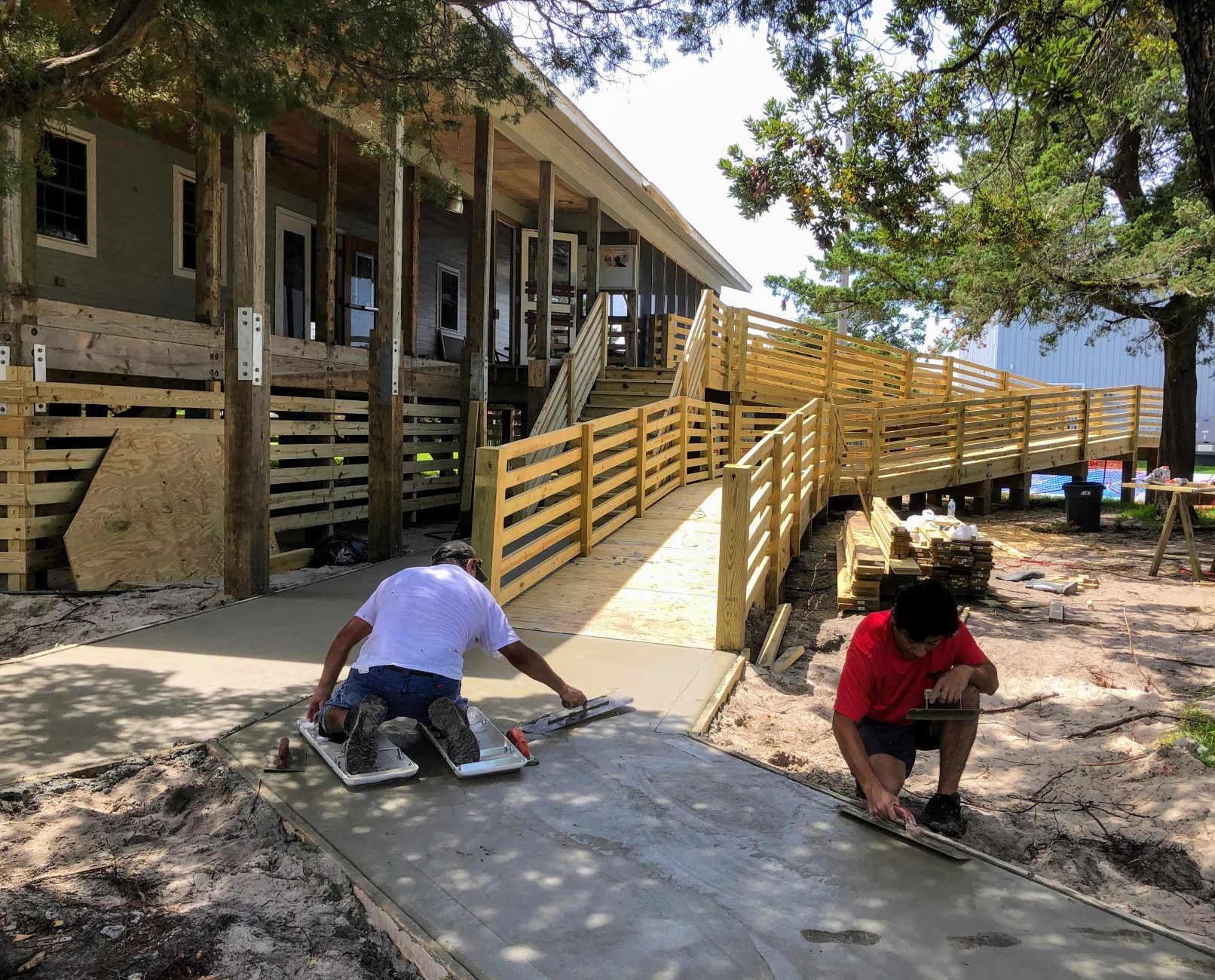
It has been raised and inside repairs are being completed, which is expected to take several more months.
To see the survey options (English and Spanish), scroll down to the bottom of the page on this link.
The library building has been raised and awaits the interior finishes. Photo: C. Leinbach
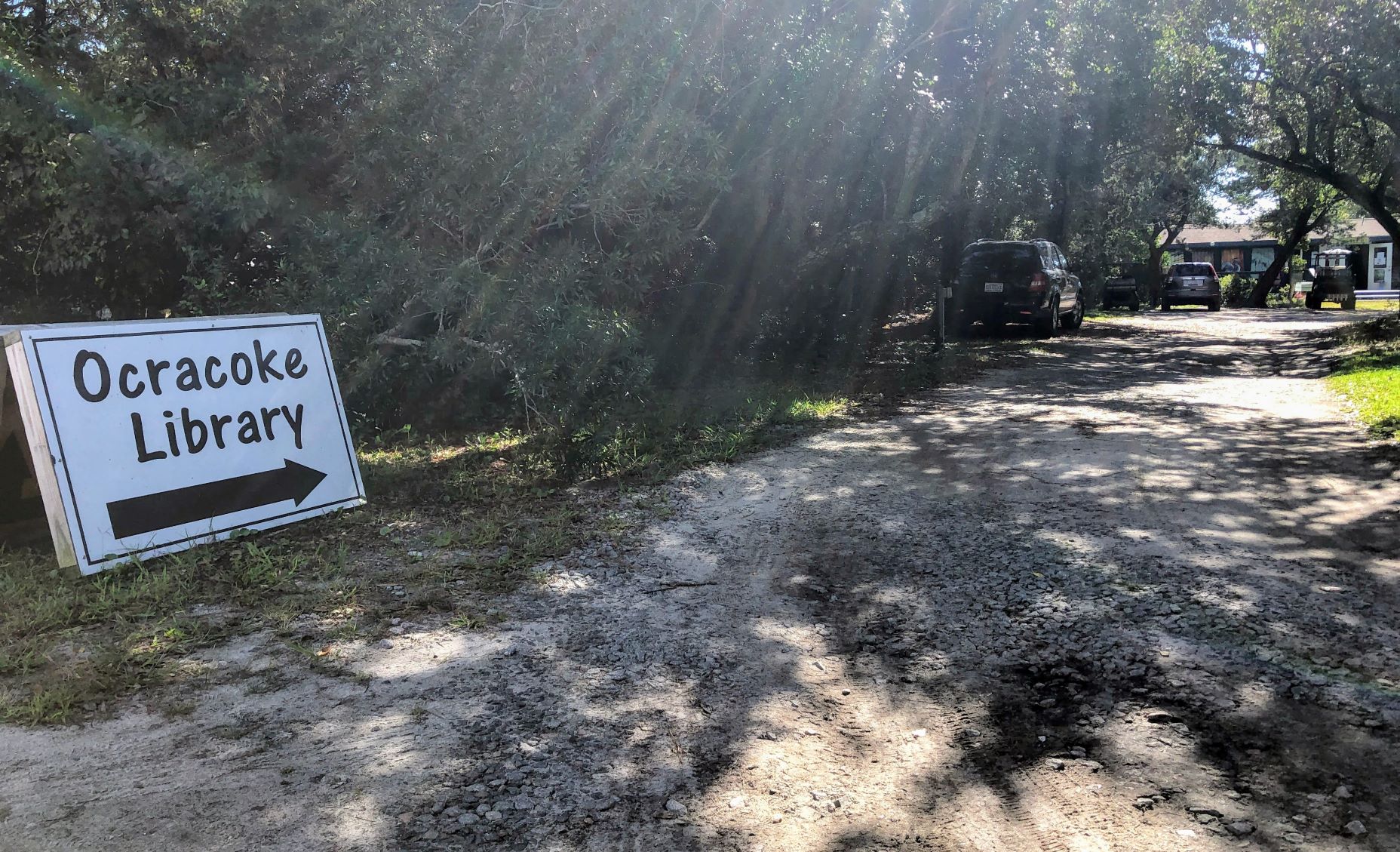
Ocracoke Community Library is temporarily in the Deepwater Theater. Photo: C. Leinbach
Groundbreaking for a new Ocracoke School will be held at 1:30 p.m. Friday, Oct. 22. Photo: C. Leinbach
After more that two years from when the Ocracoke School was flooded Sept. 6, 2019, in Hurricane Dorian, officials will break ground at 1:30 p.m. Friday for the new building.
The groundbreaking will be held near the circle at the end of School Road.
The historic devastation Dorian caused flooded all campus buildings beyond use, except for the second floor of the elementary building.
School staff scrambled to find alternative locations for administration and classroom space in the Ocracoke Child Care building and at the North Carolina Center for the Advancement of Teaching (NCCAT) located in the large, former U.S. Coast Guard building beside the ferry docks at Silver Lake Harbor.
A modular unit was installed for middle and high school students, which has been in use since last year. Pre-K, kindergarten and elementary students are in the repaired and raised up elementary building and administration offices are in the Ocracoke Child Care building.
The innovative design of the new building will integrate all school departments — pre-K to 5, middle and high schools, and athletics.
“This building roughly follows the footprint of what’s there now,” architect Ben Cahoon, of Cahoon & Kasten Architects said in an earlier interview. “We’ve created a new commons area and moved the entrance.”
Because the building must comply with the new village flood elevation ordinance, it will be raised five and a half feet above ground level, or seven and a half feet above mean high tide.
Hyde County School Superintendent Steve Basnight will appear “What’s Happening on Ocracoke” on WOVV, Ocracoke’s community radio station Friday morning, 11:30 a.m. 90.1 FM and wovv.org.
The Ocracoke School elementary building has been repaired and raised. Photo: C. Leinbach
The new design for Ocracoke School by Cahoon & Kasten Architects of Nags Head.
Wednesday, Oct. 20 Ocracoke Community Library. Temporarily in the Deepwater Theater, School Road. Storytime for babies and preschoolers 10 am Wednesdays. Open from 1 to 5 pm Monday through Friday, and 9 am to 1 pm Saturdays.
Ocracoke Oyster Company: Bryan Mayer, 6:30 to 9:30 pm
Friday, Oct. 22 Ocracoke Tourism Development Authority meeting, 9 am. Ocracoke Community Center.
Ocracoke School groundbreaking for new building, 1:30 pm
Ocracoke School Halloween Carnival, 2 to 6 pm. Ocracoke Community Ballfield. Masks required. See flyer below.
Plein air artists show and sale, 4 to 7 p.m. at 171 Silver Lake Drive. The artists will donate a portion of the proceeds to a local organization.
Saturday, Oct. 23 Molasses Creek & Coyote in concert at First Flight High School Auditorium, 100 Veterans Dr. Kill Devil Hills. 7 pm. Tickets $15 available at the door; no advance tickets. Masks will be required. Bring your own or pick up one at the door.
South dock ferry terminal located at the north end of Ocracoke Island. Photo: P. Vankevich
This story was corrected from an earlier version to explain that the South Dock at the north end of Ocracoke is for vehicle ferries.
By Kip Tabb | Outer Banks Voice on October 16, 2021. published courtesy of Outer Banks Voice
As the NC12 Task Force continues to address how to keep open the only road connecting Hatteras and Ocracoke Islands with the rest of the world, consensus is growing within the group that short-term and temporary fixes will not solve the problem.
At its Oct. 14 meeting in the Dare County Administration building, the working group of the NC12 Task Force subcommittee stakeholders discussed how to address the hotspot between Frisco and Hatteras Village.
The group had come to consensus that a bridge in the sound was going to be needed to bypass the Frisco/Hatteras hotspot and the discussion was focusing on where on the Frisco side it should begin. At the Oct. 14 meeting, National Park Service Superintendent Dave Hallac cautioned against short-term solutions.
“A study had been done showing that the short-term solutions that are put into place…are having long term impact,” Hallac said. “For example, every time you push that dune back up and make it higher, it prevents the overwash from making the island wider, and for making elevation where roads could be higher. So you’re actually exacerbating the problem with a short-term solution.”
The group, however, did not see a way to get to the long-term solutions without stabilizing the shoreline using beach nourishment, and the members agreed that the best way forward at the Frisco/Hatteras hotspot was to stabilize the beach until the long-term solution could be constructed.
“What I’m hearing is that we’re going to look at short-term nourishment to preserve the road. Long-term, we’re going to look at a longer bridge alternative…that extends the bridge from around the bathhouse area into the sound to avoid that whole area,” said Task Force Chair and Dare County Manager Bobby Outten.
Perhaps the most complex issue that the working group will address in its work is the South Dock Ferry terminal on Ocracoke Island for the Hatteras/Ocracoke vehicle ferries.
Located on the north end of Ocracoke Island, most of the visitors to Ocracoke arrive through the terminal — but the highway and the terminal are increasingly at risk. Shoaling in Hatteras Inlet has doubled the transit time for ferries, and the terminal itself is endangered.
“The…problem you have is that the physical South dock structure is eroding away extremely quickly to the point where we declared this an emergency,” Hallac said.
Even if the South Terminal can be saved, keeping Ocracoke linked through the South Terminal may not be possible. NC12 between the ferry docks and the village is subject to frequent overwash and damage.
A potential solution, and one that is currently being studied, would move the South Terminal to a location just to the north of the island’s pony pens.
However, moving the terminal would exacerbate the existing problem that the longer ferry runs are negatively impacting Ocracoke’s economy, something Ocracoke representative Bob Chestnut pointed out in his remarks.
“If you have the same number of ferries and your trip is twice as long, you can only carry half as many. So it does…impact the people that come in,” he said.
There are several concepts for the plan, but the most current NCDOT studies were not included in the working group’s information, and the decision was made to table the discussion until the November meeting when the material will be available.
The Blackbeard’s Pirate Jamboree encampment on the Berkley Manor grounds Oct. 30 will recreate life in colonial America. Photo: C. Leinbach
By Connie Leinbach
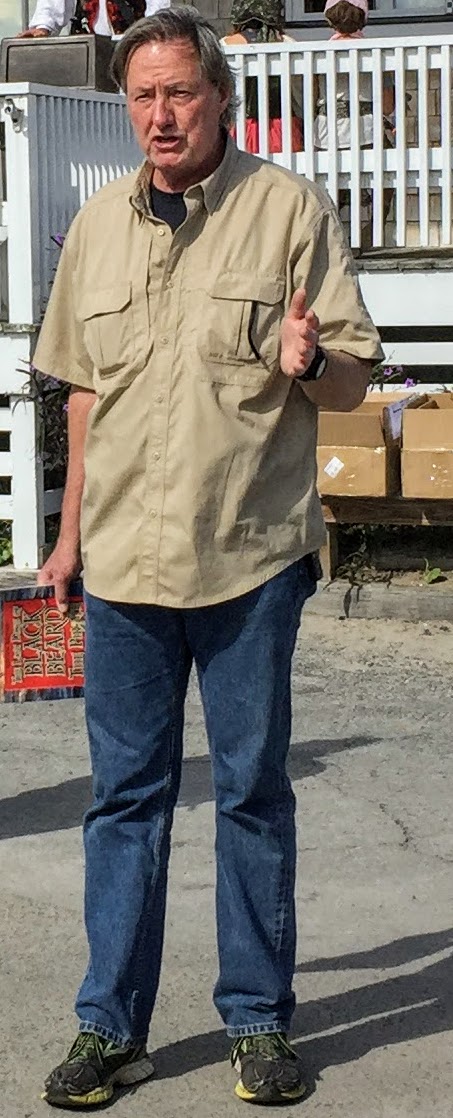
Kevin Duffus wants Blackbeard Pirate Jamboree attendees to realize that the event is celebrating history, not criminals.
Duffus, an award-winning North Carolina historian, is the founder of the event, which will take place Oct. 29 and 30 (2021) on Ocracoke, the place where the famous Blackbeard met his demise at the hand of British Royal Navy Lt. Robert Maynard in 1718. All events are free.
Duffus’s whole purpose is to come as close to the truth as possible. He will attempt that in three talks during the festival, which will take place on the Berkley Manor grounds and the Berkley Barn.
“Everything I do is with the hope to inspire future historians,” he said in an interview.
Pirates and piracy aren’t his inspirations.
“What interests me is how history becomes so distorted,” he said.
Duffus will first talk about the difference between history and media embellishment following the showing Friday night at 7 of the 1968 Disney comedy “Blackbeard’s Ghost” in the Berkley Barn.
This was the film that inspired his quest — to see the place where Blackbeard was killed in the bay below his hotel perched upon a 100-foot cliff.
He saw the film when he was 14, and at the age of 17, he and two friends rode their bikes from Greenville to Ocracoke to see that location.
“We pulled up to the Community Store and asked three old timers in their rocking chairs where the cliff was,” he said. “After they wryly glanced at each other, one man, with his thick hoi toide brogue, answered, ‘Son, you done come to the wrong place. Hoighest point on this ‘ere oyland is about eight feet.’ They all laughed lustily and returned to their own conversation.
“It was on that day that I first learned that movie theaters were not the best place to learn history,” he said.
Thus finding out the true history of the fearsome pirate latched onto him and never let go, along with other aspects of Outer Banks history of which he has written: about “Torpedo Alley” during WWII, the Hatteras lighthouse and more.
“Seeing that movie when I was 14 years old changed my whole future,” he said. “My whole interest in history was forged by that very first experience of going to Ocracoke and wanting to find the hotel on the 100-foot high cliff.”
Kevin Duffus.
And Blackbeard is such an interesting historical figure because he’s been recreated and portrayed in so many different types of movies and by so many different actors, he said.
“Blackbeard’s Ghost” was so memorable because of Peter Ustinov, a classically trained actor who put his all into this Disney movie.
“When you watch it, he really did quite a terrific job,” Duffus said. “It’s hard not to watch it and fall in love with his Blackbeard, unlike some of the other portrayals.”
In a nod to “The Rocky Horror Picture Show,” the audience will have a chance to shout out certain lines in the movie that Duffus will select and which will be projected onto a screen alongside the movie.
On Saturday, at 11:30, Duffus will present: “The Pamlico Pirates: Who were they and why did they stand with Blackbeard?”
Duffus said his research shows that those crew members were Blackbeard’s friends and neighbors from Bath. He will discuss why they were with Blackbeard and what prompted their life of piracy.
His talk at 1 p.m. “Who was William Howard – pirate or quartermaster or Ocracoke owner?” will present some new evidence about this question that he says will settle the matter.
Finally, Duffus will lead the memorial service at 5 p.m., which honors the fallen of both Blackbeard’s and Maynard’s crews.
It was on Nov. 22, 2007, when Duffus was at Springer’s Point taking photos for his book “The Last Days of Black Beard” that he landed on having a memorial service for those killed in the Battle of Ocracoke on Nov. 22, 1718.
He recruited some pirate living history re-enactors to join him in 2008 for a service amongst themselves and while they marched to Springer’s Point, numerous visitors and locals joined in.
“By the time we got to Springer’s point I estimated we had about 200 people,” he said.
For several years, the event was just the memorial service until about 2012 when Chip Stevens, co-owner of Blackbeard’s Lodge, got involved along with others in the community to create more of an event around the memorial service.
“If I’m able to inspire even one historian, then you know I think I’ve succeeded and that’s what the memorial service was all about,” he said. “There is a truth to history and oftentimes what I found is that the truth of history is more interesting than the fictional version of history.”
See schedule of events below and visit Blackbeard’s Pirate Jamboree on Facebook, for updates, especially in case of inclement weather.
‘Blackbeard’s Ghost,’ a 1968 Disney comedy will be shown at 7 p.m. Friday, Oct. 29, in the Berkley Barn. The Motley Tones will entertain before the film at 6:30.
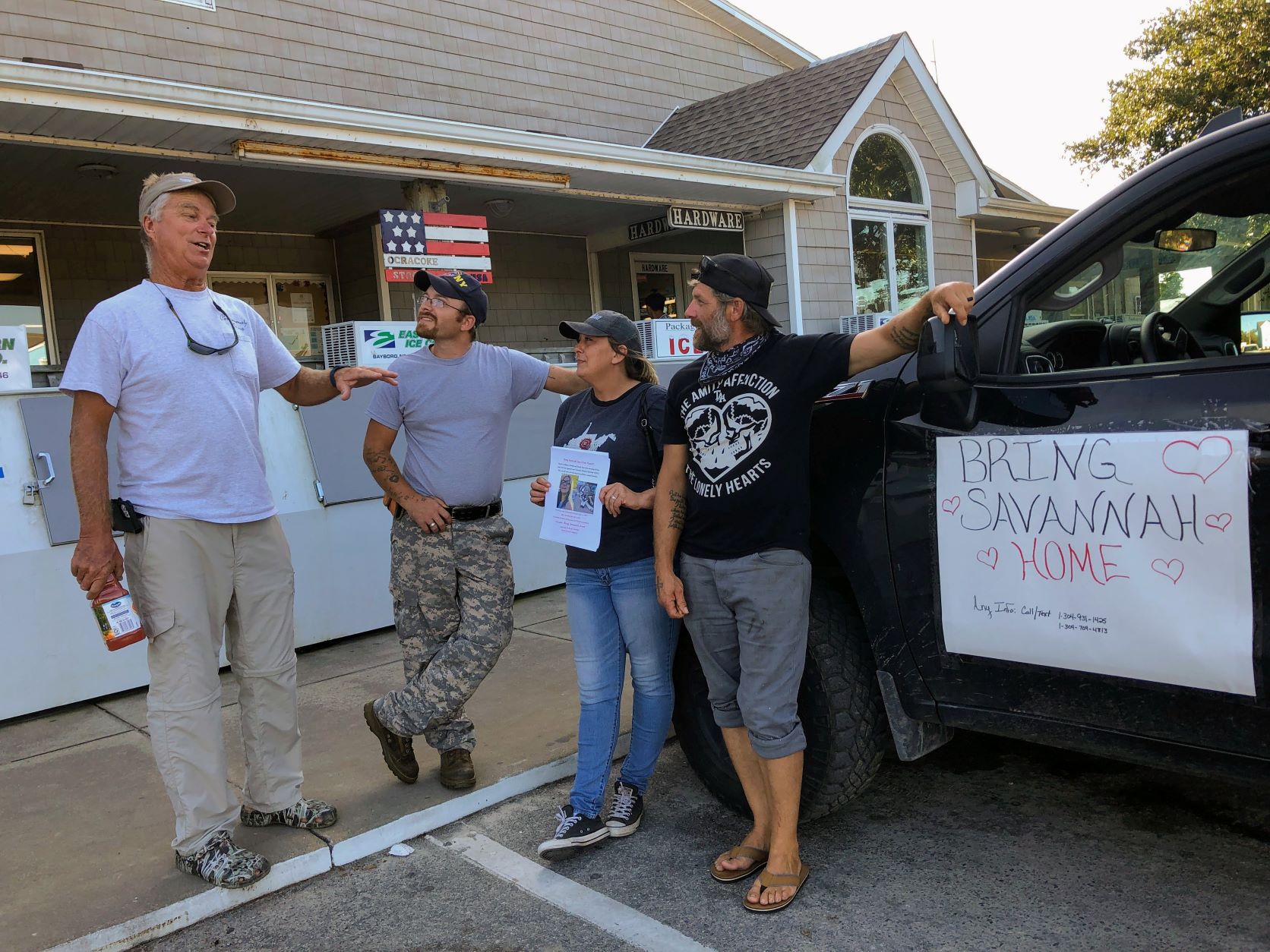
From left, islander Donald Austin talks with D.J. Taft, Debbie Costello and James Weekley about their search for Weekley’s missing niece, Savannah Grant. Photo: C. Leinbach
Correction: North Carolina Wildlife Resources Commission is the name of the agency that has jurisdiction. The original story misnamed the agency.
By Connie Leinbach
James Weekley and his friends are doing whatever it takes to find some resolution to the whereabouts of his niece, Savannah Grant, 27, who went missing in a boating accident Saturday (Oct. 9) off Portsmouth Island.
Weekley is a brother of the missing woman’s mother, Tonya Weekley. He, along with close friends D.J. Taft and Debbie Costello, all of Grafton, West Virginia, arrived on Ocracoke Island on Tuesday (Oct. 12) after the U.S. Coast Guard ceased its searching on Monday (Oct. 11).
A Coast Guard spokeswoman said North Carolina Wildlife Resources Commission has jurisdiction because this is considered a boating accident.
According to the three, Grant was on Ocracoke with Jason Quickle, her boyfriend, and John Pierson. The three had been camping on Portsmouth and left sometime Saturday to come back to Ocracoke. That was the same day the National Weather Service issued warnings about a low-pressure system off the coast that was forecast to bring strong, possible gale-force, winds, with wind gusts of 45+ mph, across the Outer Banks.
Ernie Doshier, Ocracoke’s assistant fire chief and captain of the “Gecko” sport fishing boat, said he and Deputy Sheriff Blackburn Warner, after hearing the 911 call, took Doshier’s boat and got into the inlet about 20 minutes before the Coast Guard.
When the Coast Guard got there, the light was low, he said.
“The rain squalls were coming through there and you couldn’t see nothing,” Doshier said. “The tide was rolling out of there. It took them to the ocean. There’s no doubt about that because that’s where they found ‘em,” Doshier said about the two male survivors.
A Coast Guard press release on Monday said they found a conscious male survivor (Jason Quickle) alongside a green canoe approximately 2.8 miles offshore of Drum Inlet at approximately 9:54 a.m. on Sunday.
Quickle was hoisted into the aircraft and transported to Carteret Hospital in Morehead City, Carteret County. He was released on Tuesday, according to Weekley.
A second survivor, John Pierson, who made the 911 call, was found ashore on Great Island on the Cape Lookout National Seashore by a good Samaritan, at which point he reported swimming to shore and had last seen Savannah in the early morning hours of Sunday, the Coast Guard said.
Weekley, Taft and Costello are one of two groups searching for Grant. Weekley said on Friday that they are seeking help from anyone who could possibly help locate the missing woman – any agency or volunteer groups, those with tracking dogs or whatever that could aid in the search along Portsmouth, Cedar Island and Great Island on the Cape Lookout National Seashore.
Weekly and Costello try not to break down as they talk about Savannah, who has cystic fibrosis, and her possible fate.
But the trio won’t take no for an answer, Taft said.
“As long as it takes to find some closure, we’ll be here,” Weekley said. “We probably won’t stop even after we get home. We’re gonna continue to get answers.”
Taft has 15 years of experience as an emergency responder.
“I’ve never come back empty handed without some closure for a family,” he said.
Part of that closure will be to piece together what really happened since the three have gotten conflicting stories about various aspects of the incident.
Weekley’s truck.
To help cover costs, Weekley’s sister, Rachel, set up a GoFundMe page at Bring Savannah Home.
Donald Austin took the group to Portsmouth on Tuesday where they canvased the beach.
On Thursday, a Marine pilot took Weekley and Taft up in a Cessna and searched Portsmouth Island for four hours, Weekley said. They went almost to Jacksonville.
On Friday, they were hoping the Civil Air Patrol can help.
“We’ve contacted someone with drones,” Weekley said. The trio also will get flyers made with Savannah’s photo. Phone numbers to contact the group are in the flyer below.
A few locals with airplanes have been searching, Weekley said, and an off-island homeowner has donated the use of her island home for the group to stay in, Costello said.
Weekley said islanders have been very concerned and helpful.
“Everybody’s just been outstanding down here,” he said.
Savannah Grant and a dog are still missing after a boating accident Saturday in Ocracoke Inlet off Portsmouth. The dog was not mentioned in Coast Guard dispatches.