Jerniman’s opened their restaurant on Friday. Photo: C. Leinbach
To catch up on Ocracoke news and much more, click here
By Connie Leinbach
Ocracoke got a new eatery on Friday when Jerniman’s opened their restaurant inside the refurbished gas station building along Irvin Garrish Highway.
Clayton Jernigan waited on customers and bused tables while his business partner, Drew Batts, cooked in the refurbished kitchen.
“This is what I’ve always wanted to do,” Batts said on Saturday as the burgers and barbeque sizzled.
The grill has been more than a year in the making.
“We bought (the property) Aug. 1 (2019) and the building was ours on Sept. 1,” Batts said in an interview on Monday.
Then Hurricane Dorian hit Sept. 6, inundating and upending the island.
Since then, Jernigan and Batts have had to rebuild their building and the campground from the devastating flooding just like the rest of the island.
For now, the restaurant has in-person seating at only five four-seat tables and five seats at the bar, Batts explained. That’s because of septic system restrictions, he said.
“What we serve we can get people in and out fast,” he said. Those menu items are hamburgers, hot dogs, fried and barbecue chicken, barbecue, side dishes and more.
As it gets going, Batts said he will have specials, such as fried pork tenderloin or steaks.
Drew Batts is the head cook in Jerniman’s. Photo: C. Leinbach
Lots of meat. Well, it’s a “man thing.”
Batts said he wanted to have a place where you could use your “man card,” and the name reflects that: half of Jernigan’s name and “man card,” or Jerniman’s.
Batts got the cooking bug when years ago he worked at Parker’s in Wilson, known for its barbecue.
“I got a lot of practice eating,” he quips about graduating to cook, but then explains that he did a lot of catering work and kitchen work with them. “I like cooking for lots of people,” he said. “It’s like cooking for friends. I like to be busy.”
Hungry islanders and visitors are encouraged to call for take-out orders for breakfast, lunch and dinner at 252-928-0308.
The lunch and dinner menu is the same and the breakfast menu offers “a big country breakfast,” steaks, pancakes, biscuits and gravy and more.
Jerniman’s is open Monday, Tuesday, Thursday, Friday and Saturday at 7 a.m. and Sunday at 8 a.m., All until about 7 p.m. The restaurant is closed Wednesdays.
When they get their beer license, they will have an appetizer menu from 7 to 11 p.m.
Jerniman’s has two pool tables. Photo: C. Leinbach
As soon as the easing of COVID-19 restrictions allow, the Jerniman group will open “The Breeze” nightclub and bar next door in the former Gaffer’s.
Jamie Jernigan, Clayton’s wife, said that they want to be open 100 percent—not partially– and hope that may be by the end of April when the band Steel Country Express is booked for that night and April 24.
Since it will be designated as a private nightclub, all those entering will have to join for $1.
“We will have your ID on file,” she said. So patrons won’t need to remember their cards.
The Breeze is named in honor of Jamie’s father who for many years had a bar of the same name in Wilson.
And the signature drink will be “The Breeze,” she said, also a drink her father created.
“It tastes like cotton candy,” she said.
It, as well as all drinks made with mixes will be made with home-made juices, no pre-made mixes.
“Our main goal is to keep a safe place for everyone,” she said. “Keep it classy and in a safe environment.”
Hours will be 3 p.m. to 1 a.m. Wednesday through Sunday.
The Breeze nightclub hopes to open by the end of April. Photo: C. Leinbach
Sunshine Week was launched in 2005 by the American Society of News Editors — now News Leaders Association — and has grown into an enduring initiative to promote open government.
By Paul Mauney and Bill Moss It’s Sunshine Week across America, March 14 to 20, a time when the public’s right to see government records and attend government meetings — in order to hold government officials accountable to the people who employ them — is traditionally celebrated.
So it’s an especially good time to take stock of where the people’s right to know about government stands in our state. Unfortunately, for as long as anyone can remember, North Carolinians have been forced to suffer under the weight of one of the worst public records laws in the country.
For more than 50 years, transparency of North Carolina government has been badly hindered by the lack of public access to arguably the most important government records, those surrounding the hiring, promotion, suspension, demotion, termination or discipline of state and local government employees. And yet public access to these records — vital to holding public officials from teachers to law enforcement officers accountable— is guaranteed by the law in the states surrounding North Carolina and about 35 others.
This sad state of public affairs could change, thanks to a bill soon to be filed in the North Carolina General Assembly by Senators Bill Rabon (R-Brunswick) and Norm Sanderson (R-Craven).
The bill, titled The Government Transparency Act of 2021, would open the door ever so slightly to public viewing of the reasons for terminating, promoting, suspending, demoting or disciplining a government employee. From our perspective, it is a sea change long overdue, and we strongly support the bill.
In an odd twist of thinking on the subject, other General Assembly members are preparing to file a bill at the urging of NC Attorney General Josh Stein to continue the culture of secrecy surrounding government employee misconduct records. We are told this would be accomplished principally by creating a pair of databases containing law enforcement disciplinary and use-of-force incident records that law enforcement agencies would see, but not the public.
The idea behind the Stein bill is the polar opposite of government transparency. These state criminal justice sector databases would be created under the guise of criminal justice reform that is misleadingly claimed to improve visibility of records on wayward law enforcement officers. But by barring the public from seeing these records, something routinely done in 40 states, North Carolinians would remain in the dark about the records of those who police their streets and manage their state and local law enforcement agencies. Stein’s is a secrecy bill, not a transparency bill.
At the end of the day, what is our government trying to hide in refusing to make public the reasons for disciplining, suspending, demoting or even firing government officials? Instead of inspiring public confidence in government, blocking public access to government personnel records of this kind simply creates suspicion. And that erodes our public institutions, which are staffed by and large with principled and dedicated people.
We are thankful the Republicans in the North Carolina Senate who are behind the real government transparency bill have come to understand that the culture of secrecy that underlies government employee personnel records in our state is public policy that needs to change. The current policy prevents all North Carolinians from being equipped with information necessary to separate good teachers and law enforcement officers from bad ones.
But the winds may be shifting with the Republican Senators’ bill, one that unlike the criminal justice “reform” bill backed by AG Stein, is charting a course for renewing the public’s confidence in government through real transparency. It’s high time.
Paul Mauney
Paul Mauney is regional president of Adams Publishing Group’s news publications in North Carolina and serves as President of the North Carolina Press Association
Bill Moss is publisher and editor of Hendersonville Lightning and hendersonvillelightning.com, a digital and print edition newspaper serving western North Carolina and is Chair of the North Carolina Press Association’s Legislative Committee.
Roy Huntley with his message in a bottle. Photo by Ann Huntley
By Connie Leinbach
Flotsam bottles containing messages are one of those treasures that beachcombers dream of finding.
Roy and Ann Huntley of Raleigh, who have a house on Ocracoke and visit frequently, got a longtime wish when they found such a bottle on the beach last November.
“I mean, I was pretty excited,” Roy said. “I never found a message in a bottle before. It had a big ole piece of paper in it and I got pretty excited that we were gonna rescue somebody somewhere.”
The Huntleys took the 12-ounce green bottle home and tried to remove the screw top. But that didn’t work and though they didn’t want to, they broke the bottle to retrieve the message.
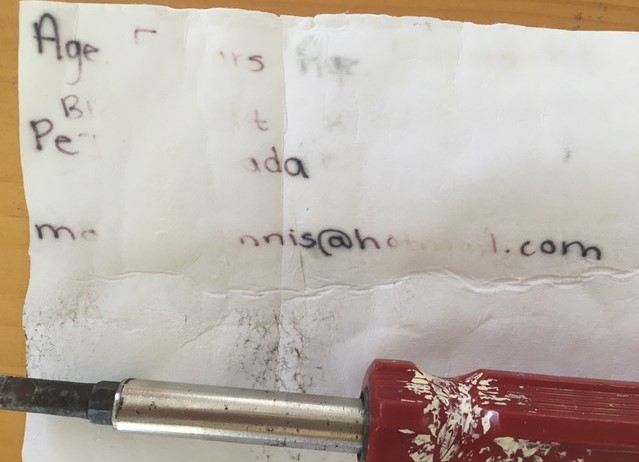
Condensation incursion had erased about three fourths of the message, Roy said.
But they persevered and figured out “Canada,” a town starting with “Br” and ending in “t,” and then deciphered “PEI” for Prince Edward Island.
Roy and Ann knew P.E.I. was small from their trip there in 1986 when they’d visited while camping in a Volkswagen van.
Ann suggested they try another tack—contact the local media.
They contacted “The Guardian,” a newspaper on P.E.I., and reporter Alison Jenkins contacted the couple.
The Huntleys sent her photos and after the story ran the community weighed in with clues. The day after the story ran the author of the message, a little girl Dani McCormack and her family were found, said Jenkins in an email.
Dani is now eight but was five when she threw the bottle into the water three years ago during a boating trip off the Naufrage Harbor, according to Jenkins’ story.
“We thought that bottle had been around for a few months,” Roy said.
The faded message from Prince Edward Island. Photo by Ann Huntley
But it was three years before it landed on Ocracoke’s beach.
If someone threw a message in a bottle into the ocean off the coast of maritime Canada and three years later it turned up on an Ocracoke beach, what route would it have taken?
Viewing graphics of Atlantic Ocean currents show it could have gone a variety of ways—over toward England, down along Europe and Africa and back across the Atlantic to pick up the Gulf Stream and a ride north to Ocracoke.
Or, it could have attached to currents that go up and down along the Continental Shelf along the East Coast in the mid-Atlantic and south Atlantic bights, said Dr. Michael Muglia, an oceanographer with the Coastal Studies Institute in Wanchese.
Cape Hatteras is the dividing line of water going north and south, he said.
“If we get a north blow, eventually that Hatteras flow will make its way to Ocracoke,” he said.
Soon after learning about Dani, the Huntleys called the girl.
“I asked her how did she get the idea (to throw the bottle in the ocean) and she said, ‘My mom made me do it,’” Ann said.
Ann learned that Dani, who’s in third grade, loves to read.
“So, we sent her two of my favorite books,” Ann said. “’Taffy of Torpedo Junction’ and ‘Misty of Chincoteague’ just to give her a flavor of our beach.”
Oh, and a Cape Hatteras National Seashore map of Ocracoke.
So, Roy and Ann might not have rescued someone from a desert island, but they added to the friendship between the United States and Canada.
A graphic depiction of the ocean currents off Ocracoke, by Dana Savidge.
Hurricane Isabel over the Outer Banks,September 18,2003. NOAA photo
By Peter Vankevich
No official statements regarding how active this year’s Atlantic hurricane season have yet been made, but changes may be forthcoming.
For more than 50 years, the official start of the Atlantic Hurricane season is June 1 and ends on Nov. 30, but next year it may begin earlier.
This follows from a December discussion at the National Oceanic and Atmospheric Administration’s (NOAA) hurricane conference on starting the season earlier. The reason is that tropical level storms have formed in May in each of the past six years.
Last year, Tropical Storm Arthur formed on May 16, followed by Tropical Storm Bertha on May 27.
The World Meteorological Organization (WMO), an agency under the auspices of the United Nations and which controls all the major storm names worldwide, will have the final say and will discuss the potential change for 2022 at its spring meeting.
In any event, the National Hurricane Center said it will begin issuing Tropical Weather Outlooks in May, weeks before the official start of hurricane season. This is an important notice for those who live on the Outer Banks and along the Atlantic Coast.
Tropical storms that originate in the Atlantic Basin—the area encompassing the Atlantic Ocean, Caribbean Sea, and Gulf of Mexico — and that reach sustained wind speeds of 39 mph get a name. Any storm that reaches a sustained wind speed of 74 mph on the Saffir–Simpson Hurricane Wind Scale qualifies as a hurricane. As intensities rise, they are classified up to Category 5 if they reach winds of 157 mph and over.
Here is the list of the 2021 storm names in alphabetical order. The letters Q, U, X, Y and Z, which have few common names, are not used. Ana Bill Claudette Danny Elsa Fred Grace Henri Ida Julian Kate Larry Mindy Nicholas Odette Peter Rose Sam Teresa Victor Wanda The names selected come from one of six rotating alphabetic lists of 21 names. So, this list will be used again in 2027 with the possible exceptions that some storm names will be retired and replaced with other names.
If this year, as in 2020, the names are all used, storms will be named in the order of the Greek alphabet. Last year, the following letters were used: Alpha, Beta, Gamma, Delta, Epsilon, Zeta, Eta, Theta and Iota.
Should there be even more for this year, then Kappa, Lambda, Mu and Nu would follow.
The year 2020 will go down in history as one of the worst storm seasons — the most active and fifth most costly on record. Despite its name, the last, Hurricane Iota, was not a small or insignificant storm. It was the latest Atlantic hurricane to attain Category 5 intensity and only the second Category 5 Atlantic hurricane on record to occur within the month of November. Iota caused severe damage to areas of Central America already reeling from devastation caused by Hurricane Eta two weeks earlier. The deadly 1932 Cuba hurricane was the first November Category 5 storm.
According to Hurricane Facts, the etymology of the word hurricane comes from the Taino Indigenous Caribbean word hurakán meaning “god of the storm.”
The Spanish took the word and added the names of patron saints on whose feast days the storms occurred. “Hurricane Santa Ana,” which struck Puerto Rico on July 26, 1825, is an example.
In addition to having saint names, prior to 1950, storms were frequently named for a location, year or even an object. Examples are the Great Colonial Storm of 1635, the Great Galveston Hurricane (1900), the Lake Okeechobee Hurricane of 1928 and Racer’s Hurricane (1837), which got its name from the Royal Navy ship “HMS Racer,” which encountered this storm in the northwestern Caribbean Sea.
Because they were not formalized, these older hurricanes have gone by various names. The Great Atlantic Hurricane of 1944 — one of the most powerful storms to ever strike the eastern United States and which is frequently compared with Hurricane Dorian (2019) as to its intensity and damage to Ocracoke Island — locally is referred to as the ’44 Storm.
For several years in the late 19th and early 20th centuries, the Australians used various naming systems for tropical cyclones, but discontinued their efforts. The story goes that it got out of hand when the weatherman Clement Wragge started naming them after politicians he disliked.
The 1950 Atlantic hurricane season was the first year the National Weather Service gave official names for hurricanes but not tropical storms. The names were taken from the Joint Army/Navy Phonetic Alphabet, beginning with Able, Baker, Charlie, and so on. It was a highly active season with 16 tropical storms, 11 of which developed into hurricanes.
In retrospect, that may not have been the best system for naming hurricanes. Notable names were Hurricane Dog, Hurricane Jig, Hurricane How, Hurricane Item and, perhaps worst, Hurricane Love. Adding to the confusion, the same names and order were continued for 1951 and 1952.
Women’s names In 1953, the National Hurricane Center overhauled the system by creating an alphabetical list for Atlantic tropical storms that would change from year to year and would be exclusively women’s names. It is not official, but one speculated reason is the NHC took it from the habit of naval meteorologists, who named the storms after their wives or girlfriends.
There was no unanimous support for assigning women’s names only which led to many stereotypical clichés and descriptions of these storms in headlines and news reporting.
Efforts to change the naming system grew. In 1969, pushed by activist Roxcy Bolton, the National Organization for Women (NOW) passed a motion at its national conference “that a communication be sent to National Hurricane Center in Miami asking that hurricanes not be named exclusively female names.”
The naming system of using only women’s names in the Atlantic Basin continued until 1979. Juanita Kreps, the first woman to be Secretary of Commerce which oversees NOAA, urged that the name list, by then controlled by the WMO, have alternate men’s and women’s names. A year earlier, storms in the Eastern North Pacific, which get a separate list of names, began alternating gender names with the first male being the largely forgotten Tropical Storm Bud.
This naming change, which few even think about these days, generated both support and resistance and became part of the raging culture wars of the 70s and linked to the women’s liberation movement.
A critical article in the New York Times back then began with the pun “Hell hath no fury like a woman stormed.”
The Washington Post later cited a 1979 Houston Chronicle column. Here are some excerpts: Bob. Hurricane Bob. Utterly ridiculous. Like many seafarers who look south to the winds and tide of capricious fate, I am insulted and offended by this sell-out labeling of storms. “Bob” rather than “Barbara” or “Brenda” or “Betsy” typifies the lack of character that seems to be stifling the 70s. That decision, which shows a total void of tropic sensitivity and respect, was surely made in some landlocked office far removed from salt breeze and common sense. The sea is a “she.” Fisherman and sailors around the world know that. Boats and ships that ply the open currents are “shes.”
Retired names If you cannot find your name on a current hurricane list, there could be a reason.
When a hurricane is so destructive or costly, for reasons of sensitivity, the name is retired and no longer used, a decision made by the WMO Hurricane Committee.
Up to 2018, 89 names have been retired. In 2018, Both Florence and Michael, after causing extensive fatalities and damage from Florida north to Virginia, will be replaced with Francine and Milton on the 2024 list.
Decisions on retiring names from the 2019 and 2020 years were delayed due to the COVID-19 pandemic and will be forthcoming and expect more.
Ferry workers getting ready to load cars onto the ferry from Ocracoke to Hatteras. Photo: C. Leinbach
From our news services
HATTERAS – The N.C. Department of Transportation’s Ferry System is looking for qualified applicants to fill a variety of summer positions on its popular Hatteras-Ocracoke route.
Positions include ferry captains, engine room positions and traffic coordinators.
“We weren’t able to hold a job fair this year due to COVID restrictions, but we still need to fill positions for what will likely be a busy summer season,” said Ferry Division Deputy Director Jed Dixon.
All positions run on week-on, week-off schedules, and dormitory housing is provided during shift weeks for those who need it.
All applicants must either have a current Transportation Worker Identification (TWIC) Card or need to have applied for one.
People interested in applying for openings should contact the Ferry Division’s Human Resources Coordinator Alma Fountain at afountain@ncdot.gov.
For a wealth of information on regional weather, visit the National Weather Service out of Newport/Morehead City by clicking here
The Community Collaborative Rain, Hail and Snow network, or CoCoRaHS, is looking for new volunteers across North Carolina.
The grassroots effort is part of a growing national network of home-based and amateur weather spotters with a goal of providing a high-density precipitation network across the country.
Through CoCoRaHS, thousands of volunteers, young and old, document the size, intensity, duration and patterns of rain, hail, and snow by taking simple measurements in their own backyards.
The process takes only five minutes a day, but observers help the community by supplying additional useful data to scientists and others.
In Hyde County, there are four active observers: one in Scranton, one in Swan Quarter, one in Engelhard, and one on Ocracoke.
“We’d love to have eight to 10 observers on Ocracoke to really map out the spatial differences in rainfall across the island,” said David Glenn, meteorologist in charge at the National Weather Service office in Newport.
In this program, volunteers report precipitation with a simple, four-inch plastic rain gauge.
CoCoRaHS came about as a result of a devastating flash flood that hit Fort Collins, Colorado, in July 1997 when a local severe thunderstorm dumped over a foot of rain in several hours.
The ensuing flood caught many by surprise and caused $200 million in damages.
CoCoRaHS was born in 1998 with the intent of doing a better job of mapping and reporting intense storms.
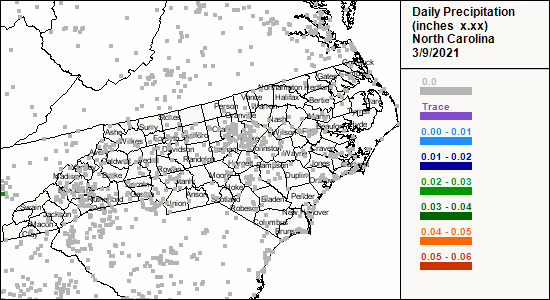
Photo courtesy of NASA.GOV
Recently, drought reporting has also become an important observation within the CoCoRaHS program across the nation.
North Carolina became the twenty-first state to join the CoCoRaHS program in 2007.
“CoCoRaHS observers provided valuable data for both Hurricane Florence and Dorian,” said Sean Heuser, CoCoRaHS state co-coordinator and manager of the NC ECONet at the State Climate Office of NC. “For these high intensity events, whether they are tropical systems or afternoon thunderstorms, CoCoRaHS observers are able to fill in gaps and provide a clearer picture of where we see precipitation maximums.”
Volunteers may obtain program details and receive an official rain gauge for about $33 plus shipping on the CoCoRaHS website www.cocorahs.org.
Besides the need for the official rain gauge, volunteers are asked to review simple training modules online and use the CoCoRaHS website to submit their reports.
Vaccines await arms at the Hyde County Health Department in Swan Quarter. Photo: C. Leinbach
Hyde County Health Department on Wednesday (March 10) sent out an emergency message saying any Hyde County citizen interested in receiving a COVID-19 vaccine, regardless of which group you fall into, should call the Hyde County Health Department at 252-926-4467 to register.
By Connie Leinbach
Ocracoke is set to receive more Moderna vaccines today to inoculate islanders against the COVID-19 virus.
Mandy Cochran, the RN at the Ocracoke Health Center who’s in charge of organizing the vaccine program, has a juggling act each week doling out the vaccines.
Interrupted ferry service on the Pamlico Sound routes due to low water near Big Foot Slough has added to the scheduling difficulties.
“With the ferries, we don’t schedule (inoculations) until we have (the vaccines),” she said. Once the health center receives its allocation, the scramble begins to get them into peoples’ arms since it has five days to use them “or we jeopardize our allocation,” Cochran said.
As of today (March 9), the health center has administered 550 doses, she said, with most of them first doses.
Second doses are paired with the first doses, Cochran said. So, those who’ve had a first dose will be scheduled for their second shot 28 days later. The second dose needs to be administered on the day the person is scheduled for it, she said, and four days beyond the appointed date is the outer limit.
The health center didn’t receive any vaccines for the first three weeks of February owing to severe weather across the country, Cochran said.
The Ocracoke Health Center on Back Road is not doing in-person appointments. Photo: C. Leinbach
Fortunately, COVID-19 numbers in North Carolina and across the nation have been declining.
According to Hyde County Health Department’s report of Friday (March 5), the county has two active cases. Out of a total of 641 cases, 631 are recovered yet there have been eight deaths owing to the virus.
The Hyde number differs from that on the NC Department of Health & Human Services COVID-19 dashboard, which as of Monday says there are 94 cases on Ocracoke within the last 14 days.
Vaccine distribution is prioritized according to five phases. Currently, North Carolina is in Phase 3 for Frontline Essential Workers, mostly childcare and PreK-12 school workers.
Group 4 vaccinations for people at higher risk from COVID-19 due to underlying medical conditions will become eligible to receive a vaccine, as well as people in certain congregate-living settings, starting March 24.
Vaccines safe Cochran stressed that the vaccines are safe even though the time to develop them was relatively short in the history of vaccine making.
That’s because the scientific community had already had a foundation from having worked on other coronaviruses starting with Severe Acute Respiratory Syndrome (SARS), a viral respiratory disease caused by a SARS-associated coronavirus, first identified in 2003.
“It’s not like they just started (research) up,” she said about COVID-19. “Coronaviruses have been around. We’ve been able to build upon this. They stopped working on other viruses to work on this one.”
COVID-19 rampaging through the world is new to the group of viruses in the coronavirus group, she said.
The speed with creating this vaccine was also because certain groups, such as children under 18, were excluded from the trials, she said.
Moreover, the vaccine is not a “live” virus, as some vaccines are, she said.
“You’re only getting a piece of it,” she said.
She likened the two-dose process to a military campaign.
“The first dose is like showing the uniform of the invader to a group of soldiers so they know what the enemy looks like,” she said.
Then the second dose ramps up the defenses.
And everyone’s response is different, she said. Some people get a mild reaction; some not so mild, but the vaccine will not give you COVID-19.
Although the vaccines are not 100% effective, all COVID-19 vaccines currently available in the United States have been shown to be highly effective at preventing COVID-19, and experts believe that getting a COVID-19 vaccine may also help keep you from getting seriously ill if you do get it, according to the CDC website.
The consensus among public health officials and infectious disease experts is that vaccination is the best chance we have to end the pandemic and return to something resembling normal life. But its success depends on the willingness of eligible individuals to be vaccinated.
Cochran said islanders wanting vaccinations can register online or in-person—outside—at the health center.
On MSNBC last night, CDC Director Dr. Rochelle Walensky talked about the race to get as many vaccinated as possible to prevent the virus from mutating thus rendering the current vaccines ineffective.
While cases are declining, the pandemic is still raging.
Anyone who is having COVID-19 symptoms is urged to go to the Ocracoke Health Center and get tested. The health center has both tests, Cochran said.
Walensky and state officials continue to caution that the recent improvement in COVID-19 metrics in the state can be “fragile” and that the “Three Ws” are still imperative: Wear a face covering; Wait six feet apart; and Wash your hands frequently.
These measures have also helped prevent a host of flu cases here, Cochran said.
“Masks work,” she said.
Flu shots are available until April, she said.
The Ocracoke Health Center has a special number, 252-489-3622, for COVID testing or prescription refill requests only.
Islanders can also travel to the mainland and get vaccinated at the Hyde County Health Department. To get on the vaccination list, call 252-926-4467.
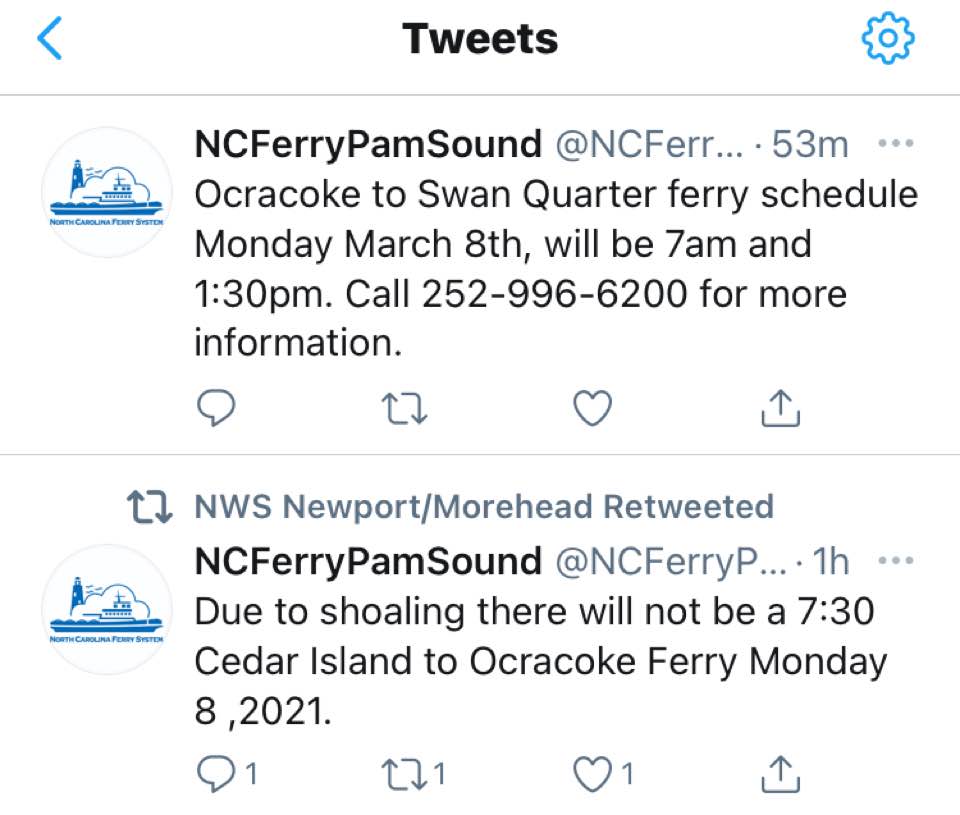
Recent Tweets by the NC Ferry Division alert the public to run cancellations.
By Connie Leinbach
Last week, the NC Ferry division modified its Pamlico Sound ferry routes due to maintenance issues and alerted the public via Twitter.
In the last few days, the Division has tweeted that some runs have been canceled due to low water in the Pamlico Sound, said Ferry Division Spokesman Tim Hass in an interview today.
Low water causes problems in the Big Foot Slough area to the west of Ocracoke.
“On Sunday, a boat bumped the bottom there,” he said.
The cancelling of certain ferries wreaks havoc with islanders’ schedules, but it keeps most ferries running so that they don’t have to wholesale cancel all of the long route runs.
“We’re hoping to make as many runs as possible,” Hass said. “It’s sort of day-to-day but it’s better than canceling all trips.”
So, islanders will have to stay tuned to Twitter to find out if runs have been canceled.
The Twitter posts come directly from the various ferry terminals and all of the ferry terminals have their own Twitter feeds.
In the meantime, Hass said the Division has been talking to the Army Corps of Engineers to get the Dredge Merritt to the Slough in a couple of weeks. Right now, it’s in the Hatteras Inlet.
The last time the Merritt dredged the Slough was in September with funding help from Carteret County.
An early morning ferry in the Pamlico Sound. Photo: C. Leinbach
A Snowy Owl on a dune at Ocracoke’s South Point Jan. 14, 2021. Photo by Peter Vankevich
To read more about the birds of Ocracoke Island, click here.
Text and Photos by Peter Vankevich
This winter, Ocracoke did not get the Arctic blast and heavy snow that affected much of the country.
The relatively mild winter was a contrast from 2014 when two major snowstorms struck the island shutting down the school for several days and blanketing the island in a white shade of winter.
Adding to the excitement of an old-fashioned winter were two Snowy Owls observed almost every day from Dec. 26, 2013, to March 8, 2014. The island became a mecca for birders who flocked to the island to see them, bringing an economic boost during a slow time of the year.
Subsequently, the memories of the Snowy Owls reached near folklore level with lots of conversations beginning with, “Do you think the Snowy Owls will return this winter?”
After several years of absence, one finally appeared. Drama and anticipation began when a Snowy Owl was sighted on Dec. 29 in the Pea Island National Wildlife Refuge, then near the Marc Basnight Bridge at Oregon Inlet.
On Jan. 7, a Snowy Owl was photographed perched on a house in Hatteras village putting Ocracoke on alert to the possibility that it would continue moving south.
Then, on Jan. 13, Walker Garrish and Elizabeth Aiken spotted the owl.
“We walk our two dogs daily at the same location at the South Point, and Walker noticed something unusual in the dunes he sees every day,” Aiken said. “It turned out to be a Snowy Owl.”
The owl was observed for a week, last seen on Jan. 19. During that time, it alternated between perching on a dune and spending time on the South Point’s extensive salt flat.
A Snowy Owl on Ocracoke Island’s South Point salt flat. Jan. 14, 2021. Photo by Peter Vankevich
The Cape Lookout National Seashore reported that on Feb. 7 one of its biologists spotted a Snowy Owl on South Core Banks. The photo of that one looks like the owl seen on Ocracoke and farther up the Banks.
Owing to bad weather and the isolated location of the owl, it has not been seen in the Cape Lookout area since Feb. 11.
Circumpolar, Snowies nest in the Arctic tundra of the northernmost stretches of Alaska, Northern Canada and Euro Siberia. The normal wintering range is difficult to know, but it is believed some stay in the darkened Arctic. One can only imagine the challenges of covering hundreds of miles of the dark winter Arctic in search of these owls.
They are well-suited to withstand the cold. Their entire bodies including toes are covered with soft, fluffy feathers, and their feet have extra thick pads. They also have superb night vision to locate prey.
What is known is that others migrate south and winter throughout Canada and the northern areas of the United States.
Every year some migrate farther south than their normal wintering range. When that occurs in large numbers, it is called an irruption.
That winter of 2013-14 was one of the largest Snowy irruptions in a century with sightings as far south as Florida and even in Bermuda.
The cause of irruptions is complex and not fully understood. Some species may migrate farther south when their food crop is scarce.
Snowy Owl on Ocracoke Island, Jan. 14, 2021. Photo by Peter Vankevich
This year, several not normally seen northern bird species were seen in North Carolina, especially Pine Siskins. Evening Grosbeaks, Purple Finches, Red Crossbills and Red-breasted Nuthatches have appeared at bird feeders and in parks.
Close off the Outer Banks, large numbers of Dovekies and Razorbills, normally seen in winter well out to sea and farther north, have been present.
Unlike some other bird species, in the case of Snowy Owls, according to the website Project SNOWstorm, a large collaborative research project that focuses on Snowy Owls, it is a myth that it is hunger or lack of their normal sufficient food sources that drives these owls south.
Rather, it is the opposite. The root cause is abundance of food during the summer breeding season. When high populations of lemmings, voles, ptarmigan and other Snowy prey are easily available, it leads to larger clutches of eggs and many more fledglings who are forced out of established territories and move south as the colder weather approaches.
Always a popular local news item when they appear, one gained international attention as it was seen briefly in the North Meadow ballfields area of New York City’s Central Park on Jan. 27.
The last official sighting there was in 1890, which news reports then also indicated an irruption year.
When Snowy Owls show up south of their normal range they tend to move around as the one seen on the Outer Banks has done this year.
So why did the two owls stay so long on Ocracoke back in 2014?
With the expansive salt flat and dunes then covered in snow, it looked a lot like their home court: the tundra.
Sunset on Ocracoke Island’s South Point, winter of 2014. Photo by Peter Vankevich
Peter Vankevich is the Christmas Bird Count compiler for Ocracoke and Portsmouth islands and author of the Birds of Ocracoke profiles for the Ocracoke Observer.
The NCDOT is looking to train more highway construction workers to maintain the state bridges and roads, such as Route 264 above on the way to Swan Quarter, Hyde County. Photo: C. Leinbach
To catch up on Ocracoke news and much more, click here
From our news services
Raleigh – The N.C. Department of Transportation is looking for more skilled highway construction workers and has begun new Highway Construction Trade Academies around the state. The academies aim to address the growing need for skilled labor to help safely build and maintain our state’s roads and bridges. “Our goal is to target women, minorities and other disadvantaged populations, including veterans, the disabled, and residents of our poorer Tier 1 counties where there’s a need for such training and jobs,” said Vanessa Powell, who administers the program for NCDOT’s Office of Civil Rights. “The course combines a mixture of safe classroom, virtual, hands-on and work-based learning formats.” The HCTA program is a minimum four-week, full-time training course that initially will be hosted by community-based organizations statewide. Participants will be provided training on specific jobs as well as how to conduct job searches. They will also receive supportive services such as needed emergency short-term housing, day care and transportation assistance. The first two programs are being hosted at Passage Home in Southeast Raleigh and the Opportunities Industrialization Center in Rocky Mount. Three additional academies will come online shortly in James City, Fayetteville, Charlotte and Greenville. The class includes basic construction math, written and interpersonal skills, the OSHA-10 certification, and other more advanced skills such as flagger certification. Plans call for five more HCTAs in Wilmington, Robeson County, the Triad, Asheville and Morganton. Each will be longer eight-week programs. As with all such HCTAs, the two Western North Carolina sites will be located in a major highway construction project area, namely I-26 in that instance. It is projected that a workforce shortage of 60 %, or 500,000 skilled highway construction workers, will exist over the next decade across the United States. The trend for North Carolina is similar, partly due to retirements of an aging industry labor force. A non-traditional labor supply is part of the answer for this essential sector.
Applications for the program will be available at each site as they continue to open around the state. The program is being funded by the Federal Highway Administration.