Researchers present findings on Ocracoke’s NC12 problems, possible solutions

By Connie Leinbach
NC Highway 12 on Ocracoke needs action if it is to survive, according to UNC researchers who presented their findings at a meeting Sept. 10 on Ocracoke on the perils to the highway after a year-long study.
In collaboration with the Cape Hatteras National Seashore, Dr. Laura Moore of UNC-Chapel Hill led the study, “Evaluating the Effects of Adaptation Strategies on Ocracoke Island,“ along with NCDOT and scientists from North Carolina State, Duke and East Carolina University.
Their presentation in the Community Center, attended by about 60 islanders, focused on the section at the north end that’s currently shored up with sandbags to hold back ocean waves during storm and high-wind events.

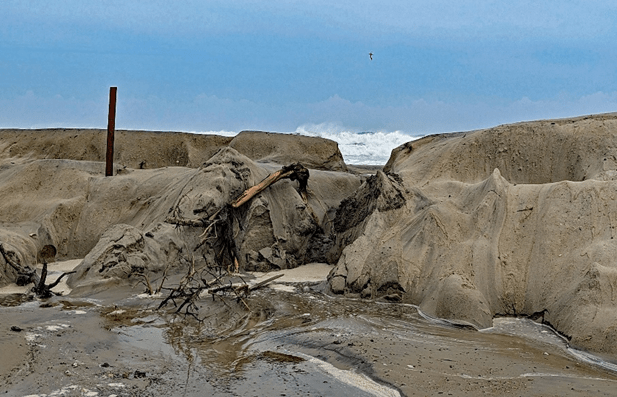
That area that has increased in just the past couple of years to about two miles long. After the recent impact of Hurricane Erin, it experienced two to six feet of sand on the road which NCDOT workers continuously scooped away.
The natural progression of barrier islands is for the ocean to overwash them resulting in sand buildup in the interior, Moore explained. Ocracoke’s (and the Outer Banks on Pea and Hatteras islands) accretion is impeded by the road.
The team’s study involved a model the group created to predict how sea level rise, in the next 25 to 100 years, will further encroach on the island, both from the sound and ocean sides, in this most vulnerable area of the island.
Soundside sea level rise has impacts but not for decades, according to their models.
Moore explained three scenarios:
Status quo would be to continue the current management strategies as has happened with continual overwash and repair. Coupled with sea level rise, this area would eventually be under water, or “drowned,” Moore said.
According to their model, beach nourishment would add an indeterminant number of yards of beach to this area to hold back the ocean and stem the loss of land mass, though for how long is unknown.
Although beach nourishment is expensive and eventually ultimately futile since sand washes away, it could buy the island time while it develops a plan for the road.
The third alternative would involve an elevated road (of undetermined length) under which the ocean could flow and nature could take its course.
But Moore said that stabilization leads to more rapid loss of beach/land.
“If you’re slowing down (beach loss) somewhere, you’re speeding it up elsewhere,” she said.
Ocracoke must be creative and find new ways of managing living on a barrier island, she said, or (the island) will manage itself out from under us.
“I don’t know what the answers are,” she said. “You are at the forefront of and have the opportunity to do something different. It will take creativity.”
Katherine Anarde, a postdoctoral scholar in coastal Geomorphology, said the situation is not hopeless.
“The next step is knowledge of the landscape,” she said.
One islander mentioned the methods that the Netherlands, which is below sea level, have been successfully holding back the sea for centuries.
Dr. Reide Corbett, executive director of the Coastal Studies Institute, who attended the meeting and was part of the research team, said in an interview afterwards that hardened structures, like jetties, don’t solve the problem of beach erosion.
Moreover, he said, the Netherlands doesn’t have answers for coastal North Carolina.

“Their dikes and levees are inland,” he said. “Our dynamics are wind-driven rain and storms. They have tide issues. We need beach nourishment and to build dunes.”
Representative Keith Kidwell (R-Beaufort), who was on Ocracoke that day to visit and hear islanders’ concerns, attended the meeting. He represents House District 79 which comprises Hyde, Beaufort, Dare and Pamlico counties.
“If we can’t do something to stabilize the island, it’s going to disappear,” he said.
Earlier in the morning, he met with business owners and others in an hour-long session in the Community Center.

Kidwell said he is part of a legislative Coastal Coalition Caucus, with members from both parties, which includes the area of Wilson to the coast.
“We realize we have an issue and we gotta deal with it,” he said about the beleaguered NC12 as well as the underfunded ferry system. “Congressmen Greg Murphy and Budd are on board.”
Along with hundreds of people descending on Raleigh in July, the coastal caucus stopped a bill containing a ban on shrimp trawling in inshore waters.
“When it hit that caucus we were like, not just ‘No. Hell, no,’” Kidwell said.
One of the best ways to change legislative minds, he said, is for constituents to physically show up in Raleigh—as what happened for the shrimp trawl ban.
Physically showing up in the legislative hallways is the best way to make our voices heard, he said.
Kidwell said coastal House and Senate representatives, Bobby Hanig, Norman Sanderson, Frank Ihler and Ed Goodwin are on board with finding solutions.
Hyde County Manager Kris Cahoon Noble said she was with the Board of Transportation when they visited Buxton following Hurricane Erin and one member noted that abandoning the north end is not an option.
“Because I told them how I’ve got to have that for quick ambulance transport and for our economy, too,” Noble said.
But the road belongs to the DOT, she said, and we need an engineering study to determine the costs of beach nourishment. This should not take a long time nor cost a lot of money, she said.
“I’m going to be advocating for the DOT go ahead and do a short-term closer look at what a beach nourishment project would look like,” she said.