Home Blog Page 271

Medicaid changes will become more visible to beneficiaries, providers

0

Reprinted courtesy of North Carolina Health News 

Now that the providers for a privatized Medicaid managed care system have been chosen, HHS Secretary Mandy Cohen says beneficiaries will soon need to choose their providers.

By Rose Hoban
Most of North Carolina’s 2.1 million Medicaid recipients are likely unaware that the program is about to dramatically change. That’s because for years most of the activity to make the transformation has taken place in legislative hearings and departmental conference calls.

But no longer. After years of planning, the changes to North Carolina’s Medicaid system are about to get real.

That was the message from state Health and Human Services Secretary Mandy Cohen to a legislative committee in Raleigh on Tuesday (Feb. 12).

Last week, DHHS announced which companies won their bids to work with the state for a total of $6 billion in annual contracts. This week, lawmakers from the House Health Committee asked Cohen to explain publicly how her team at the Department of Health and Human Services decided on which companies to provide services to the first 1.6 million Medicaid beneficiaries who will be in the first wave of change.

Beneficiaries will start seeing advertising campaigns roll out in early summer. Companies that won bids will start putting up billboards, sending mailings and running TV and radio ads encouraging those people, who are mostly low-income children, some of their parents and pregnant women, to choose their health insurer.

“The way we’re going to do the start of managed care is going to be in a phased way. That’s to make sure we get as smooth of an implementation as we possibly can,” Cohen told lawmakers.  The regions surrounding the Triangle and Winston-Salem will launch the managed care program on Nov. 1, with the rest of the state following next February.

In the 2015 bill that created this new Medicaid regimen, lawmakers made it clear they wanted to have some locally managed “provider-led entities” with majority ownership by health care providers to provide care.

Out of eight bidders, only three such provider-led organizations made bids for contracts. When Cohen displayed the numerical scores given to those bids by members of the DHHS team, it showed the three provider-led entities (PLEs) had the three worst outcomes. Only one, Carolina Complete Health, a consortium formed by the state medical society, the state community health center association and national managed-care giant Centene, won a contract to provide care in two regions despite departmental reservations.

chart showing the evaluation scores for ach of the Medicaid managed care programs
Chart by HHS Sec. Mandy Cohen shows the scores of each of the companies bidding for Medicaid contracts. Chart courtesy of NC DHHS

“We definitely wanted to recognize the fact that a lot of work went into the negotiations around getting to the legislation from 2015 and the contemplation of the provider-led entities,” Cohen said.  “We felt like it was in the service of the intent of the law to include a regional provider-led entity. Carolina Complete Health was the only PLE that met minimum expectations.”

“It’s time,” says Cohen
In recent public appearances, Cohen has become vocal about her desire to see the Medicaid program expand to cover people who make too much to qualify for Medicaid, but who earn too little to qualify for insurance subsidies available under the Affordable Care Act.

Many of these people falling into the “coverage gap” are family caregivers, people going to school and other low-income adults who earn less than $34,638 a year for a family of four. The number of people who would qualify range from a recent Kaiser Family Foundation estimate of 208,000 to older estimates generated by state-based researchers that say as many as 500,000 would qualify. Kaiser also estimated about 60 percent of these people are already working.

“If you really want to care about access … we have to think about using Medicaid to get more folks coverage,” Cohen told members of the House Health Committee on Tuesday. “If we’re really going to help folks get access to care in rural areas, having an insurance card and keeping those access points open is going to be really critical.”

While Cohen was more circumspect in front of legislators Tuesday, she offered a more full-throated endorsement of expansion during the recent Mental Health Legislative Breakfast in Chapel Hill in early February.

“It’s the right thing to do for North Carolina,” she told that gathering, to applause. “Think about that insurance card that’s sitting in your wallet that gives you that peace of mind. The fact that we have not done Medicaid expansion here in North Carolina is actually increasing the cost of care for all of us who do have insurance.”

She cited the fact that states that have expanded have lower rates of uninsurance, and that research shows 7 percent lower increases in prices for all health care consumers.

“I’ll say it another way,” she said. “Our prices are 7 percent higher than they need to be.  And that is affecting every single one of us.”

When asked after the breakfast if she was taking a political risk by speaking out, Cohen said her message shouldn’t come as a surprise.

“I’ve always said access to care is so critical, we’ve been saying that all along,” she said. “I’ve done the work for two years to get us ready for this moment, to say that it’s time for Medicaid expansion. I didn’t come here two years ago and say, ‘We’re ready,’ I said, ‘Let’s work hard, let’s get the system ready. Let’s move to manage care. Let’s lay all that foundation.’

“Now I’m saying it’s time.”

Cohen explained that she and Medicaid head Dave Richard decided to give the group only two of the state’s six regions, which will be included in the second phase of the managed care rollout, “to give folks the most time to be ready.”Another consortium, My Health by Health Providers, made up of the state’s hospitals along with a managed care company based in New Mexico, actually received a slightly higher overall score than Carolina Complete Health, but the group had only bid for a statewide contract and scored lower the other statewide bidders.

“Missed opportunity”
Committee chair Rep. Greg Murphy (R-Greenville), a physician who practices at Vidant Medical Center, expressed his disappointment that North Carolina-based PLEs were “locked out” of the contracts. Another member, Hugh Blackwell (R-Valdese) pressed Cohen for details of the decision-making process.

Cohen told him that all the bids were rated on 14 points, that were scored in parallel.

“There were very, very, very detailed questions and criteria… and we had a RFP that was nearly [300 or 400] pages long, with an appendix that was even longer, so folks had clear understanding of criteria by which they were going to be scored against,” she explained. “And the evaluation committee needed to use the words on the paper, but they were able to ask clarifying questions, and they did, through the process if things were unclear.”

“It just seemed that the legislative intent …  was to have a good mix between provider-led entities and private managed care orgs. I don’t see a big mix there,” Murphy responded. “I understand the scoring process, but … it’s a missed opportunity.“

It’s expected that some of the organizations not receiving contracts will challenge DHHS’ decision before the close of a 30-day appeals period.

Getting everyone on board
Most beneficiaries will see little difference in the process of getting Medicaid for now: County social service workers will continue to do perform eligibility screening for applicants. Cohen said beneficiaries don’t have to do anything other than to make sure that their contact information is up to date.

Although that sounds like a simple thing, Cohen said that’s hugely important.

“I will say that we haven’t been good about collecting multiple …  ways to communicate with folks. We know most of our Medicaid beneficiaries do have a cell phone, but we don’t systematically collect cell phone numbers,” she said. “We need to start doing that and communicating with folks by text message and not by snail mail all the time.”

But as changes get closer, there will be more public outreach.

Rep. Carla Cunningham, (D-Charlotte), who works as a nurse, said she’s been looking for public outreach since the start of the Medicaid changeover process.

Cohen said, though, that it’s best to wait.

“There’s a fair amount of research that shows that if you actually tell folks too soon when there’s actually not something to ‘do’ you lose them,” Cohen said. “You want to capture folks at a moment … when you want them to do something.  So you will see us ramp up a lot of our communications just before and very much during that open enrollment period when there is something for them to do.”

Ocracoke events Feb. 13 to 17

0
Ocracoke beach meeting. Photo: C. Leinbach

Wednesday, Feb. 13
Gaffer’s: Trivia Night benefit for Ocracoke Archery Team,  7 p.m.
Coyote Music Den, Word Play, 7 p.m.

Thursday, Feb. 14
1718 Brewing Ocracoke: Brooke & Nick special Valentine’s Day performance, 6 to 8 p.m.

Gaffer’s:  Raygun Ruby Valentine’s Day Dance, 8 p.m.
Ocracoke Bar & Grille: Lonely Hearts Club party, 3 p.m.

Friday, Feb. 15

The Ocracoke Drama Club presents The school Spirit, Free admission and donations accepted, School gym, 7 p.m., doors open at 6:30.


Weekend writing workshop slated at Lightkeepers Guest House

0

To catch up on Ocracoke news and more, click here

Karen Jones

Island Path on Ocracoke will present a weekend writing workshop, “Creativity & Craft,” with author Karen Jones April 11 to 14 at Lightkeepers House on Creek Road.

Over two and a half days, Jones will help writers exploring their creativity, honing their craft and make their writing sing while enjoying the pristine beauty of the Cape Hatteras National Seashore.

The camp includes:
13 hours structured workshop/seminar class time
1:1 mentoring
Workbook and handout materials
4 hours of informal discussions with visiting, working authors
Time to learn, write, reflect and enjoy the island.

An author, broadcast journalist and freelance writer, Jones has taught writing seminars at the University of Richmond, Christopher Newport University, Louisiana State University and Old Dominion University, and has taught courses in romance novel writing at the University of Richmond and Christopher Newport University.

She currently teaches writing workshops and writes scripts for a major media company.

Her published works include both fiction and nonfiction:  Up the Bestseller Lists! A Hands-On Guide to Successful Book Promotion, Kingdom of Hearts, The Highland Witch, and Death for Beginners.

In addition, she has written for various publications including Virginia Super Lawyer, The Daily Press, Tidewater Women and has had her short work, “Chic’s Beach,” performed by Playwrights Premiere Theatre.

Jones is a veteran of radio and television, having spent 15 years at WVEC, an ABC affiliate, as an on-air anchor and feature reporter.  She also wrote and produced the series, “The Haunting of Virginia,” which won an Associated Press Award.

She has directed the Chesapeake Writer’s Conference and belongs to the American Pen Women and The Authors Guild.

Her fourth book, the historical romantic suspense, The Highland Witch, is on Kindle and other e-readers. She is currently shopping her fifth book, The Marcell Glide, a southern literary fiction coming-of-age story.

For more information about the daily schedule and to register, visit kjwriter.com. 

Lightkeepers Guest House, along Creek Road, is clad in summer blooms. Photo: C. Leinbach

Congressman Walter Jones dies at 76

0

By Peter Vankevich 

Congressman Walter B. Jones died today, his 76th birthday,  according to a statement on his congressional website.

In failing health beginning last fall, he entered into hospice care in late January. His undisclosed illness kept him from voting in Congress since September. He was sworn in by fellow North Carolina Rep. G.K. Butterfield (D-NC 1st District) to the new Congress at his home in Farmville, Pitt County, on Jan. 4, the day after the newly elected Congress began its session.

Jones has represented North Carolina’s 3rd congressional district since 1995. Prior to that, he was first elected as a Democrat to the North Carolina House of Representatives in 1982 and served for five terms until 1992.

His father, Walter B. Jones Sr., represented the 1st congressional  district as a Democrat from 1966 to 1992.  After his father retired, the younger Jones ran for that seat as a Democrat and lost.

He switched parties to run as a Republican and won the 1994 election in the newly configured 3rd congressional district, which includes the Outer Banks and areas near the Pamlico Sound and large portions of his father’s former territory. He has won all reelections, garnering at least 60 percent of the vote.

Jones announced last year that this would be his last term in Congress. He ran unopposed in the November election but had to win a primary challenge by Phil Law, who is expected to run for this seat in 2020.

Jones is known as an independent with libertarian leanings. He endorsed Ron Paul in the 2008 race for president. He has often broken with the Republican leadership, supporting raising the minimum wage, opposing offshore drilling, and he voted against the repeal and replacement of the Affordable Care Act.

He sided with Democrats in advocating for an independent commission to investigate Russian interference in the 2016 election and signed a letter to urge Congress to request Donald Trump’s tax returns so that they can be reviewed in a closed session of Congress and determined whether the returns can be released to the public.

Beginning in his days in the General Assembly, he has advocated for campaign-finance and lobbying reform.

A fierce deficit hawk, he voted against the Tax Cuts and Jobs Act of 2017 due to the anticipated $2 trillion that would be added to the national debt. “I’m all for tax reform, but it must grow the economy, not the debt,” he stated.

On Dec. 28, Jones issued a press release stating as portions of the federal government remain shuttered over a standoff between the president and Congress regarding funding for the wall, all parties should be reminded that increases in federal spending, including expenditures for the wall, should not be paid for by raising the debt.

“America’s national debt is nearly $22 trillion,” he said.  “Next year our annual deficit is projected to top $1 trillion.  We can’t afford to keep financing the provision of government services by borrowing more and more money. It’s morally irresponsible and it’s got to stop.”

Jones is perhaps best known nationally for his turn against the Iraq War, which he voted for in 2002. “I will never forget my mistake because people died because of my mistake,” he told the AP. “I bought into believing that President (George W.) Bush didn’t really want to go to war. That’s how naive I was at the time. … I could have voted no, and I didn’t.”

He is a strong supporter of the War Powers Act, a post-Vietnam reform that requires the president to consult with Congress before sending U.S. troops into actual or imminent hostilities.

Raised as a Southern Baptist, he converted to Catholicism as an adult. He is a member of the Pro-Life Caucus and a staunch supporter of legislation to protect the rights of the unborn and on record that Planned Parenthood should no longer receive taxpayer money.

An animal lover, he was the author of the Corolla Wild Horses Protection Act that affects wild horses living in North Carolina.

Birds of Ocracoke: The Bufflehead

2
Buffleheads on Ocracoke.

By Peter Vankevich

Here’s a quiz question. What do ducks and woodpeckers have in common? Read on. 

In the waters of Ocracoke one can see North America’s two smallest ducks, one of which is the subject of this story.

The Green-winged teal is the smallest North American duck. It is a “dipper,” which means they just dip their heads in the water but do not submerge. But the smallest diving ducks in North America are Buffleheads — “sprightly little ducks” that can be seen in great numbers here every winter.

Weighing only about one pound and with a wingspan of about 20 inches, the Bufflehead’s peculiar name is derived from an earlier name–the buffalo-headed duck–presumably based on its large, showy, ruffled head and short bill. They are in the genus Bucephala (Bucephala albeola) along with the Common and Barrow’s goldeneyes.

Males are easily identified by their distinctive black-and-white heads. In certain light, the black color can appear an iridescent green or purple. Their bright white plumage appears on the back of the head and underparts.  Females and first-year males are mostly dark brown on the head, back and wings; pale gray on underparts and have a prominent white ear patch.

In flight, they have a rapid wing beat. The adult males have a large white patch on the upper wing; females and first-year males have a smaller white wing patch.

True water birds, they are rarely seen on land unless injured or when leading their broods from the nest to the water. After a big rain in the late fall of 2018, many Buffleheads landed in large puddles in the village.

A Bufflehead is seen in an Ocracoke Village puddle during a heavy rain.

The vast majority of Buffleheads nest near ponds and lakes in the boreal forests and the aspen and poplar park lands of Canada and Alaska from Manitoba westward.  A few nesters  can also be found in isolated locations in Washington, Oregon and California. There are no breeding records outside of North America.

Buffleheads nest in tree cavities and prefer holes excavated by Northern Flickers and sometimes Pileated Woodpeckers.  Competitors for these prime real estate cavities are not from other ducks which are too large, but from the original hole-drilling Northern Flickers along with  Mountain Bluebirds, Tree Swallows and the most serious competitor, the European Starling. Like Wood Ducks, Buffleheads will also nest in artificial boxes placed in suitable habitats that lack natural nest cavities due to logging and other reasons.

Females line their nests with the downy feathers from their chests and lay eight to 10 eggs. Incubation is approximately one month.  Precocial hatchlings leave the nest within a day or two and are led to water by the mother who will tend to them, but the young feed themselves. It takes approximately 50 to 55 days for their first flight. During this time the males go into seclusion to molt.

This is one of the few duck species that often keeps the same mate for several years and prefers returning to the same nest.

Buffleheads forage by diving underwater–usually between 12 and 22 seconds.  Under water, they hold their wings close against their bodies and use only their feet for propulsion.  In winter, they feed primarily on crustaceans, mollusks and sometimes shrimp.  On their nesting grounds, they feed on insect larvae and amphipods which are small, flat-bodied crustaceans such as the beach fleas and sand hoppers and some seeds.

Wintering on both coastal regions of North America, some of the highest concentrations of Buffleheads in the East can be found in Virginia and North Carolina, primarily from late November into March.  On Ocracoke, they prefer the sheltered waters of the Pamlico Sound, though they can be seen sometimes on the ocean.  They are also common in impoundments, such as at Pea Island, Lake Mattamuskeet and the Alligator River Wildlife Refuge, and mainland ponds, lakes and slow-moving rivers.

Like most ducks, Buffleheads migrate at night.  In the spring migration heading north, they follow major river systems or water bodies in valleys because these waters are the first to become ice-free. In the fall migration they use more aquatic habitats. 

Both hatchlings and adults face an array of threats that impact their survival rate. Breeding so far north, cold weather and rain can cause mortality in the young, especially in the first few days after hatching. During adverse weather the young will huddle close to each other on either side of the female which may perch on a floating log or the shore.

Avian predators include Peregrine Falcons, Snowy Owls and Bald Eagles and Barrow’s Goldeneyes in nest-site competition. Females in nests face threats from weasels and mink. 

Eggs are destroyed by nest competitors such as squirrels, European Starlings and Northern Flickers.

Ducklings are vulnerable to predation by other ducks and grebes and, in some northern areas, by northern pike.

Listen: Buffleheads are generally silent except during nesting. To listen, go to the Cornell Lab of Ornithology’s Macaulay Library by clicking here

When to see: Fall into winter

Where: Sound, inlets, off Springer’s Point, Silver Lake harbor, along the ferry routes and less so on the ocean.

Birds of the Outer Banks Checklist

Arthur Cleveland Bent, in his 21-volume work, Life Histories of North American Birds, published 1919-1968 by the Smithsonian Institution, was noted for colorful and at times anthropomorphic characterizations of birds. He was at the top of his game with the Bufflehead:

The propriety of applying the name “spirit duck” to this sprightly little duck will be appreciated by anyone who has watched it in its natural surroundings, floating buoyantly, like a beautiful apparition, on the smooth surface of some pond or quiet stream, with its striking contrast of black and white in its body plumage and with the glistening metallic tints in its soft fluffy head, relieved by a broad splash of the purest white; it seems indeed a spirit of the waters, as it plunges, quickly beneath the surface and bursts out again in full flight, disappearing in the distance with a blur of whirring wings.


Community day celebrating the new Bonner Bridge set for Saturday

0

The new Herbert C. Bonner Bridge under construction last year. It is now completed. Photo: C. Leinbach

NAGS HEAD – The North Carolina Department of Transportation, along with Dare County, the National Park Service and local community groups will host an informal community day from 10 a.m. to 4 p.m. tomorrow (Saturday) to celebrate the completion of the Herbert C. Bonner Bridge replacement.

During that time, the bridge will be open to the public for pedestrian and bicycle access from the north end of the bridge near the Oregon Inlet Fishing Center, 8770 Oregon Inlet Rd.

Due to safety precautions, scooters, skateboards and roller blades will not be allowed. Limited shuttle service will be available to carry those needing assistance between the fishing center and the bridge.

Dare County Commission Chairman Bob Woodard and other officials will provide remarks beginning at 10 a.m. followed by a blessing and a wreath-laying ceremony at the top of the new bridge at 11 a.m.

Parking for the event is available at Cape Hatteras National Seashore’s Oregon Inlet Boat Ramp parking lot. Attendees are urged to dress warmly as forecasts call for temperatures in the 30s with winds blowing between 20 and 30 miles per hour.

Traffic is expected to be shifted in the days following the event. A more formal celebration for the new bridge is tentatively slated for early April. Details of the events will be announced at a later date.

The new bridge will replace the 55-year-old Bonner Bridge.

The Bonner Bridge Replacement Project began in March 2016. The new $252 million bridge is 2.8 miles long, 90 feet high at its apex and is designed for a 100-year life span.

A more formal bridge dedication event is being planned for early April.

Reckoning with climate change ahead

1

Reprinted courtesy of the Coastal Review Online

RALEIGH – For the past few years, inside and outside the walls of the state legislature, there’s been a noticeable shift in the conversation about climate change and its impact in North Carolina.

It’s a change driven in part by a renewed political debate, but according to recent studies and surveys, it’s mainly the result of personal

Businesses and streets in downtown Manteo are inundated by storm surge associated with October’s Tropical Storm Michael. Photo: Cory Hemilright

experience.

A new study by the Yale University Program on Climate Change Communication found that nationwide there’s been a jump in the number of people in the United States who believe they have experienced global warming’s effects.

The study, Climate Change in the American Mind, which was released in December, found that 46 percent of those surveyed said they had personally experienced the effects of global warming, two-thirds said global warming is affecting weather in the United States and more than half said warming has made natural disasters such as wildfires and hurricanes worse.

That change is evident in North Carolina, where record rainfalls statewide and the devastating effects of natural disasters, especially the repeated inundation of eastern North Carolina from hurricanes, has helped changed the dialogue from one of questioning whether climate change is happening to what can be done about it.

The close succession of Hurricane Matthew in October 2016 and Hurricane Florence in September 2018 appears to have accelerated the change in public perception here.

An Elon University Poll conducted in October 2018, a month after Hurricane Florence made landfall here, found that for the first time a majority of North Carolinians, 53 percent, think it is very likely that the state’s coastal communities will be negatively affected by climate change during the next 50 years, an increase of 8 percent compared to a similar poll a year and a half earlier.

In the North Carolina General Assembly, the idea that public policy must take into consideration a changing climate has received greater attention as the legislature reviews recovery plans in the wake of Hurricane Florence.

Late last year, in the initial response to the disaster, legislators focused on the immediate recovery. While there was some discussion that a changing climate might require policy changes in response, working through those choices was left for future sessions.

Now, with a series of policy and budget choices ahead, legislative committees will begin sifting through the options.

They’ll be pushed by Gov. Roy Cooper, who has stepped up pressure on legislators to commit to programs aimed at addressing climate change, including support for cleaner energy production and an array of resiliency initiatives that would move infrastructure, agriculture operations and people out of flood-prone areas.

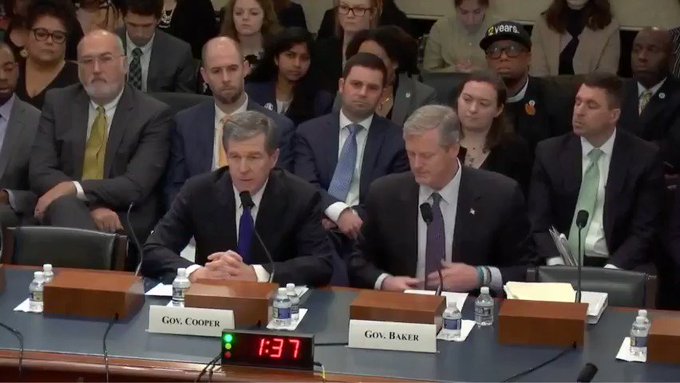
Cooper, who testified Wednesday morning on climate change before the U.S. House of Representatives Natural Resources Committee, wields far more negotiating power as a result of the 2018 election, which ended the long-held Republican super majorities in each chamber.

Embedded video
Natural Resources ✔@NRDems .@NC_Governor: “We can’t afford not to take urgent action to fight climate change. It is not too late, but it soon may be.”
Cooper on Oct. 29, 2018, ordered greenhouse gas reductions in operations of all state agencies and required them to build consideration of climate effects into planning and regulatory functions. But to move the needle beyond the executive branch, the governor will need the backing of the legislature, where many members remain unconvinced of the science, the need for sweeping policy changes or both.

Rep. Pat McElraft, R-Carteret, a veteran legislator who is co-chair of the House Environment Committee and the appropriations subcommittee that drafts the environmental and natural resources budget, said she remains skeptical about the cause of climate change and taking policies too far in response.

Rep. Pat McElraft

“I’m convinced that the climate changes. I’m not convinced that man has that big a part in it,” she said in a recent interview with Coastal Review Online. “I’m sure there is a small amount, but when you start looking at changing everything in America, when the Chinese haven’t changed anything, and other countries haven’t changed anything …”

McElraft said she does support preventive measures, which have helped in coastal areas, but she isn’t convinced the state needs to start elevating roads. She said the emphasis should instead be on clearing debris from waterways. The state’s beach areas fared far better in terms of rising water than inland communities, she said.

“I think we in North Carolina already have prepared and are pretty resilient. I think our issues are 30 inches of rain and river flooding and we need to do something about cleaning out the creeks and rivers. That should be our focus,” McElraft said.

For Rep. Ray Russell, a Democrat who won in a Republican-leaning district in North Carolina’s northwest mountains, the state will have to do far more.

Russell, a computer science professor at Appalachian State University and a web entrepreneur who founded a respected weather site, said climate change and effects of global warming on North Carolina is one area where most residents are ahead of the legislature.

“They’re understanding climate change now, unlike five to 10 years ago. They feel it,” Russell said. Climate change deniers continue the same “mumbo-jumbo,” he said, “but no legitimate scientist has any question about (global) warming.”

Russell said that for years he’s been advising businesses to prepare for changes, and it’s inevitable that the state will also have to start to shift.

Rep. Ray Russell

“It’s only a matter of time before it works its way to this body,” he said in a recent interview at the Legislative Building. “There are going to be fundamental changes to how we do business here, but a little bit at a time.”

The model for transportation funding, “will be turned on its head,” he said. “In 30 years, we’re not going to be able to rely on a gas tax to get that done.”

Right now, some of the biggest recurring economic effects are seen in agriculture, Russell said. In the state’s mountain regions, climate change has already shortened the growing season, and wet weather and early- to late-season temperature swings have taken a toll on berry and apple farmers.

Russell said some farmers are facing the loss of crop insurance coverage because the climate is no longer viable for orchards.

“Insurance companies are paying attention and are starting to reduce liability,” he said.

Concerns about apple orchards are also on the mind of Rep. Chuck McGrady, a Republican who is both a key House budget co-chair and an environmentalist with no qualms about the scientific consensus on climate change.

McGrady, whose district in Henderson County is in the heart of the state’s apple-growing region, said that to move forward, those pushing for policy changes will have to take a pragmatic approach. There is still a lot of wariness around the term “climate change,” McGrady said, but there is a consensus around the need for greater resiliency.

“I do think most Republicans are skeptical about climate change and you’re not going to likely see changes in how we address disaster relief by making climate change arguments,” McGrady said. “That said, I think there is more of a focus on resiliency. We have had two major storms within a short period of time, and we’re being asked to build again or fix again a range of the same things we just built or fixed.”

Rep. Chuck McGrady

There’s more of a recognition now that there are places where the state should be rebuilding, he said.

The legislature has roughly $100 million budgeted for the next round of disaster relief. That’s where McGrady and others expect the disaster avoidance initiatives to happen.

Since the storm, the legislature has been working with the governor’s office to prioritize spending, working through a menu of options. The early priorities were getting schools open and roads back in service, but now, he said, there’s an understanding that the next part of the recovery plan is building greater resiliency.

“The early priority was on fixing a range of things not on preventing future things,” he said. “Now there is a recognition that since we’ve had two of these massive events that we have to spend money on prevention and avoidance.”

McGrady said he is not discouraged that many of his colleagues do not share his views on climate change. He said late last year the legislature approved a plan advocated by Cooper for a new section of the Division of Emergency Management charged with managing resiliency and recovery efforts. Setting up the new group was an acknowledgement that the state couldn’t manage either on a storm-by-storm basis and needs longer-term programs and strategies.

McGrady said he’s also encouraged because, even though many of his colleagues are still doubtful about climate change, they are now far more willing to discuss doing something about it.

While working on legislation for recovery programs during Hurricane Matthew, McGrady said that raising resilience, prevention and avoidance issues “were more or less laughed at.” The thinking then was that it was a one-time event and the state just needed to fund the recovery.

“There’s none of that thinking now,” McGrady said.

N.C. Ferry Division to hold career fair in Hatteras March 1

0
The Hatteras-Ocracoke ferry. Photo: C. Leinbach

To catch up on Ocracoke news and more, click here

HATTERAS – The North Carolina Department of Transportation’s Ferry Division will hold a career fair from 10 a.m. to 6 p.m. on Friday, March 1, in the Hatteras Civic Center.

“We’re looking for exceptional employees in all positions,” said Ferry Division Director Harold Thomas. “Whether they want a summer job or a full-time career, we hope they’ll take the opportunity to come talk to us.”

The division will accept applications for all positions system-wide, from parking lot attendants and engineers to marine welders and captains.

Positions are also available for the dozens of part-time and temporary summer positions that are needed every season.

Career fair attendees are asked to bring a resume along with any applicable certifications.

For more information on job requirements and positions available, contact Alma Fountain at (252) 423-5125, or at afountain@ncdot.gov.

Free barbecue Saturday courtesy of Cedar Island

0
The Cedar Island community will hold a free pig pickin’ barbecue at 3 p.m. Saturday to thank Ocracoke for its help after Hurricane Florence. Photo: C. Leinbach

To catch up on Ocracoke news and much more, click here 

The Cedar Island community wants to thank Ocracoke for its help after Hurricane Florence with a free pig pickin’ barbecue Saturday starting at 3 p.m. on the Native Seafood parking lot. To read about their efforts, click here 

Farris O’Neal, owner of Native Seafood, said his commercial fishing buddies and others wanted to show their gratitude to Ocracoke islanders who helped our neighbor to the south after Florence wrought its havoc.

The massive storm Sept. 14 devastated areas south of Ocracoke, from Cedar Island to Jacksonville. Parts of Cedar Island were still without power more than a week after the storm struck.

Islanders immediately rallied to Cedar Island’s plight by gathering donated food and supplies, loading them into personal skiffs and traveling “Down East” to deliver them.

“I told them it wasn’t necessary, but they insisted on doing it,” O’Neal said about the generous gesture.

While it lasts, the free eats will include two roast pigs, baked beans, cole slaw, water and soda.

However, O’Neal said those attending will have the opportunity to donate money to the 2020 fifth-grade class trip.

Each year, the Ocracoke School fifth grade takes a week-long trip to visit various sites across the state.

“That costs $15,000,” O’Neal said. His daughter will be in that class next year.

Editor’s note: This story has been corrected. Wrong hurricane was originally named. 

Ocracoke Islanders load one of three personal boats last September to ferry supplies to Cedar Island residents cut off by Hurricane Florence. Photo: C. Leinbach

Derelict sailboat removed; disposition pending

7
The “Josna,” a derelict sailboat languishing against a private dock in Silver Lake Harbor, was pumped out and is anchored, awaiting final disposition. Photo: C. Leinbach

To read an earlier story on this boat, click here, for Ocracoke news, click here 

By Connie Leinbach

Ocracoke rallied on Saturday (Feb. 2) and dislodged a derelict sailboat from a private dock on Silver Lake Drive that had languished there since December.

Islanders Farris O’Neal, owner of Drumstick Sport Fishing, and Jeramy Guilleroy, a teacher at the school,  pumped out the “Josna,” and then anchored it alongside the fishing shack at Carolyn Jones’s property, O’Neal said.

After an early December storm, the sailboat unmoored and ended up against Marcy and Fred Zbranak’s dock across from their house on Silver Lake Drive. This boat’s fate took up the bulk of the discussion at the Jan. 28 meeting of the Ocracoke Waterways Commission where the Zbranak’s sought relief. 

Tom Pahl, Ocracoke’s county commissioner, said in that meeting that, legally, Hyde County is not responsible for removing derelict boats. He had asked the Zbranak’s if they would share the cost with the county to remove the boat, but the couple declined.

The waterways commission then decided to ask the Occupancy Tax Board for a one-time, emergency grant to pay for removal and has sent a letter to that effect to the board members, Pahl said.

In the meantime, O’Neal asked Pahl if the county would help by footing the bill for a dumpster and a backhoe for O’Neal to smash the boat and dispose of it.

“I raised that at the commissioners’ meeting (Feb. 4) and we’re looking into it,” Pahl said. “We’re very confident we can do something to get that boat out of the water, but removal may still need some money from occupancy tax.”

O’Neal, for his part, said it took about an hour to pump out the boat and haul it to its current anchorage.

“The boat is in very good shape,” he said. “I was impressed with how it looks. The mast isn’t dented.”

The inside of the 28- to 29-foot built in 1989 boat isn’t bad either, he said, noting that the hose clamps don’t have any rust.

O’Neal will continue down the disposal path unless someone wants to buy it from O’Neal, who claims he now has “salvage rights.” According to Pahl, once you abandon a boat, anyone can lay claim to it.

O’Neal said anyone interested in buying it and hauling it it away should call him at 252-588-0193, but Pahl said he doesn’t want it to stay in Silver Lake.

“I want it out of the water,” Pahl said “Nobody’s sailed that boat. It’s just been a floating motel.”

A chain of ownership over the last several years has shown just that, Pahl said.

On Saturday, after being prompted by Janille Turner, who said that C.J. Wynn was in charge of the boat, the local guys did their thing.

“I got it off there,” O’Neal said. “Freddy’s my buddy.”

Last year, the county approved an interim ordinance, based on a statute allowing for the removal of derelict vehicles, allowing for the removal of abandoned boats but not length-of-stay.

A more comprehensive ordinance, based on the one Brunswick County has, that will also address length of anchorage.

According to the North Carolina constitution, the county cannot enact any law unless it’s enabled by the General Assembly.

“The legislature has to give us enabling legislation to regulate dropping anchor in the harbor,” Pahl said.

Such an ordinance is on the top of the county attorney’s priority list, Pahl said.

He also said Joe and Henri McClees, the lobbyists hired by Hyde County, are working on it as are some legislators.

“We’ve had some direct contact with legislators,” Pahl said. “This will come together soon.”