Home Blog Page 305

Work behind the scenes deserves our thanks

2
The Ocracoke Occupancy Tax Board on April 10 reviews the nonprofit project proposals for funding for the 2018-2019 year. Photo: C. Leinbach

In Ocracoke Alive’s Deepwater Theater show, “Dingbatter’s Guide to Ocracoke,” one of the skits is “The Reappearing Local.”  It spoofs how, during their stay, visitors might see a worker in several different businesses.

This skit could equally apply to residents who serve behind the scenes, many on multiple boards—both nonprofit and government–which often intersect.

In Hyde County, the only government is the county’s Board of Commissioners. There are no incorporated municipalities in the entire county. Ocracoke’s only local elected official is our county commissioner.   County employees–the county manager, assistant manager and others in various departments–of course work on behalf of Ocracoke as well as the mainland, but it falls to islanders to handle some of the tasks done in larger communities that have larger resident pools and more paid governmental employees.

Among these important boards are the (elected) Ocracoke Sanitary District, that oversees the municipal water issues, an elected island representative to the county’s Board of Education, the appointed Mosquito Control Board (which handles those relentless pests, standing water and drainage), the Ocracoke Advisory Planning Board and the Occupancy Tax Board (OT) which divvies out money from the occupancy tax coffers to support nonprofit projects.

Last year, the county commissioners authorized two more volunteer boards: The Ocracoke Waterways Commission (which addresses critical access issues via the Hatteras Inlet and Ocracoke’s harbor) and the Tourism Development Authority (TDA).  When the commissioners last June raised the occupancy tax rate by 2 percent (for a total 5 percent tax on all lodging rooms and houses), they authorized the TDA to manage this added revenue.

While the OT board reviews, applications submitted by nonprofits seeking funding for specific projects from the 3 percent fund, it is advisory only: The county commissioners must approve their allocation plans, which, in recent memory, have always been approved.    

But the TDA is its own independent authority and can spend the 2 percent monies however it wants for tourism promotion according to its authorizing state legislation.  The TDA been developing a plan with the Ocracoke Civic & Business Association (which is tantamount to a visitor’s bureau) to spend these new funds to market the island.

Late last fall, yet another committee formed to explore how the Island Inn could be saved from possible commercial development and put into community hands.

This group accomplished its goal when the nonprofit Ocracoke Preservation Society took a big leap and agreed March 22 to purchase this iconic building and property for community use. Specifics are still to be determined, but Hyde County has agreed to purchase the vacant lot across the street on which to install a new building to house the EMS services.

Among other island nonprofits are the Ocracoke Health Center, the Ocracoke Volunteer Fire Department, the Ocracoke Youth Center, which oversees and fund raises for the island’s ball field, the Ocracoke Foundation, which owns Community Square, WOVV 90.1 FM, the island’s community radio station, and Ocracoke School Booster Club.

Ocracoke Alive produces the Ocrafolk and Latino festivals, Arts Week in the school and community theater shows. OcraCats oversees control of the island’s feral cat population.  Still other groups raise money and produce events for the island churches, school activities, the library and more.

We don’t have room to list all the island nonprofits but suffice it to say that much work goes on throughout the year to make this little island vibrant, all while retaining its non-commercial feel.

These islanders take seriously their membership on these (largely) volunteer boards. They do it out of dedication and commitment to the community, and we salute them for stepping up and for their hard work.  Through their dedication, they improve the island community and deserve both our thanks and admiration.

Ocracoke Preservation Society president, Ken DeBarth. Photo: P. Vankevich

Community Square renovation to take several more weeks; visitors urged to park in NPS lot

0
Basnight Construction workers set up orange construction fencing around the new septic field in Community Square. During construction, pedestrians have access to businesses. Photo: C. Leinbach

By Connie Leinbach

Parking on Ocracoke is always a problem and it got dicier the last several weeks as the Community Square lot has undergone renovation.

Long needed, the Ocracoke Foundation, which owns the square, in February began the project to upgrade the waste water systems for businesses in the square.

Plans were to have all the work done by Easter, which was April 1, but that deadline passed, and completion is still several weeks away.

“Nothing happens on Ocracoke the way you plan it,” said Scott Bradley, foundation president. “This has been an incredibly complicated project. It will improve water quality in Silver Lake and benefit the whole community.”

The project involved removing the old macadam and installing an underground wastewater system before repaving.  Huge backhoes and other equipment from Basnight Construction populated the square for several days in the demolition. 

“Then we had four nor’easters in four weeks,” Bradley said. 

Although the foundation had wanted concrete installed that could absorb rainwater (pervious concrete), the logistics of getting this type of concrete to the island forced a change of plans.

“When it came time for the concrete, that company backed out,” Bradley said.

So, the engineer had to redesign the paving plan, which took a few more weeks.

But Bradley said today (April 10) that Hatchell Concrete of Manteo, is scheduled to begin the repaving on Monday (April 16), which “should take two to three weeks depending on weather and other unknowns to completion, including all time required to properly cure the concrete.”

In an email, Bradley noted that the new design has standard concrete in the drive lane and the parking areas will have the water-absorbing paver stones.  When complete, the 15-foot by 60-foot septic area in the middle will be grassy, as will a few areas along the edges of the parking lot adjacent to buildings.

In the meantime, the square is torn up with piles of debris all over; the newly installed wastewater system still needs power and to be tested before it’s operational, which should be in two to three weeks.

These waste water access holes will be paved up to their edges and cars will be able to drive over the lids, said Ray Abbott, Basgnight Construction foreman. Photo: C. Leinbach

Pedestrian safety in the construction zone and lack of highly visible signage directing visitors to the NPS lot has concerned business owners.

“It’s dangerous and confusing,” said Marcy Brenner, of Coyote Music Den, which is a year-round business along with the Community Store.  The Den, where they help to promote musical and literary artists, is her and her husband, Lou Castro’s, life dream.

“It’s frustrating. Every season there’s some kind of disaster—whether a hurricane, power outage, road closure—and we already have our first disaster.”

She said she wrote a letter to the foundation board describing the impact to businesses and lack of timelines.

Basnight crews today installed orange-webbed construction fencing around the area only.

He noted that the businesses—the Community Store, Coyote Den, Trixie’s Fineries, The Fudge and Ice Cream Shop and Kitty Hawk Kites—are open and that a few parking spaces are available.

“If people want to get to the businesses, they’re getting to the businesses,” he said.

While Easter weekend was one of the best in recent memory with warm, sunny weather, rainy and raw weather has returned in the last few days. 

But it’s still the off season and “people aren’t here now,” Bradley said.

Until the work is complete, visitors to the square are urged to park at the NPS lot at the south end of the village near the ferry terminals from which they will have to walk a little farther. 

Additionally, the Ocracoke Youth Center has OKed for visitors to park behind the Village Thrift across from the square.

Overall, once complete, Community Square will lose about six parking spaces, further reducing “downtown” short-term parking.

Other nearby shop owners say their parking areas are for their staff and customers. One, who declined to be identified, noted that there have been several fender-benders and animals hit by visitors leaving their cars there all day.

Parking on the island is an educational thing, noted Tim Parker, whose business T.J. Outfitters is across from Community Square, and who constantly educates visitors about parking.

“People who don’t know the island expect to see the acres of parking like in the rest of the world,” he said.


Treasures abound for N.C. Shell Club

0
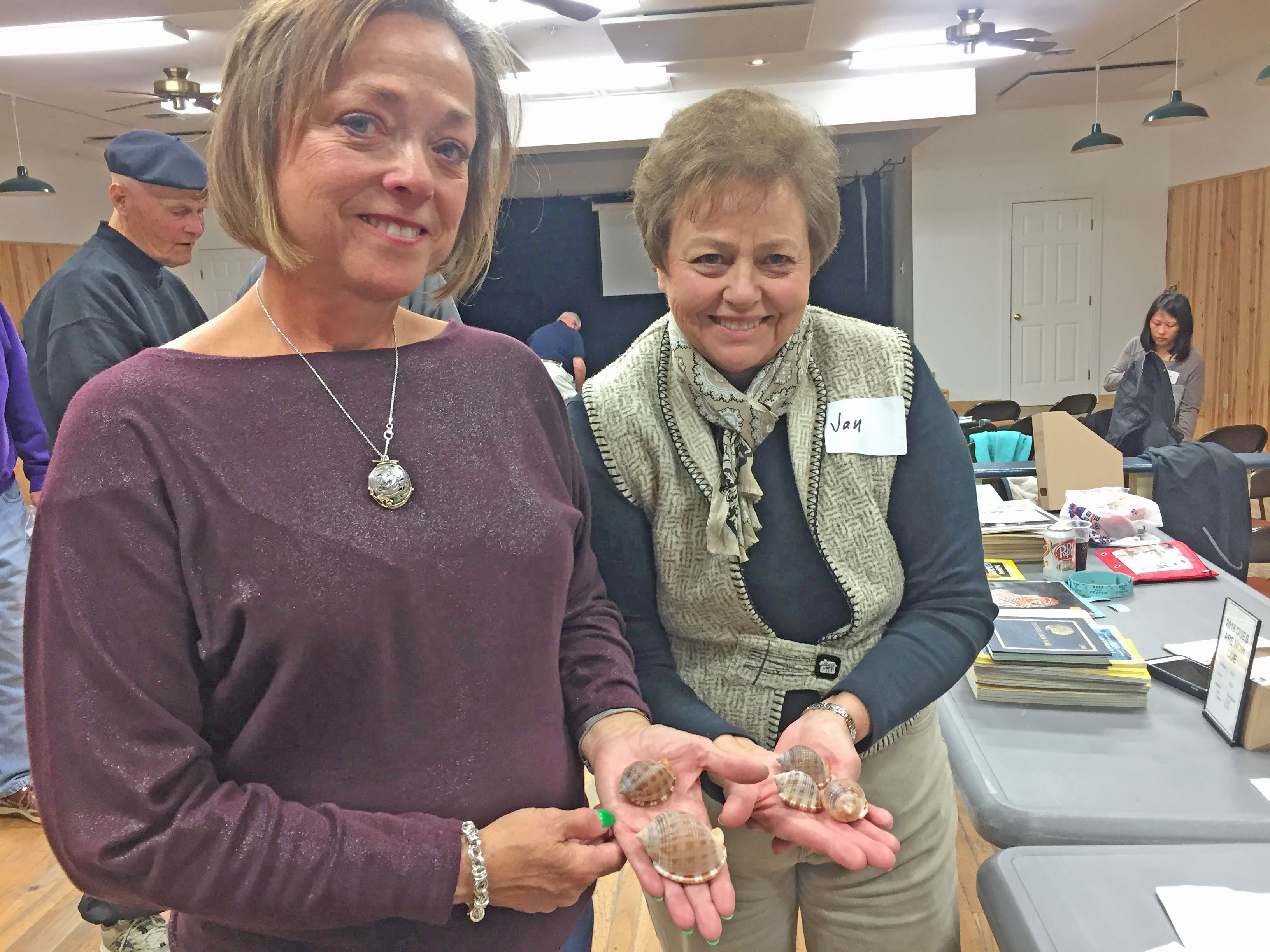
Fresh scotch bonnets are the ‘finds of the day’ which Toni Boldy and Jan Reaves, members of the N.C. Shell Club, found on Portsmouth during their yearly spring meeting on Ocracoke. Scotch bonnets are the North Carolina state shell.

Text and photos by Connie Leinbach

“You walk the beach and you find treasures,” said Jan Reaves about her avocation of shell collecting.

That about sums it up for the members of the North Carolina Shell Club, shell nerds who make a yearly two-day visit to Ocracoke at the end of March each year.

Most come for the special trip to Portsmouth Island and 34 members made the trek.  Few people, especially at this time of the year, spend time in search of interesting shells on one of the remotest islands in North Carolina. So, beachcombing can yield some of the best finds, including shells that make the record books.

That was the case for Stephanie Bain of Youngsville, whose find of a large jingle shell on Portsmouth has been deemed the largest recorded jingle shell in North Carolina at 1.96 inches.

It was Bain’s and her husband Phil’s first trip to Ocracoke and first time to a club meeting, having just joined during their visit to the island.

Stephanie Bain, left, her husband Phil and Ed Shuller, official shell club measurer, talk about her jingle shell find on Portsmouth.

“I found people who are as crazy as I am about shells,” Bain said about the group.

Official recording of the largest shells, using strict measurement criteria, is part of the shell club’s mission.

After shelling on Friday and Saturday, the group gathers in the evenings at the Community Center to display their finds, have silent auctions of shells from all over the world and listen to speakers. These meetings are open to all.

Islander Dave Frum regaled the group Friday night with stories and history gathered from his many years working for the National Park Service in maintaining Portsmouth village.  

On Saturday night, Doug Wolfe of Beaufort gave a slide presentation of the bird-watching trip he and his wife, Nancy took to Thailand.  Although this was a birding trip, he kept his eyes open for shells that he photographed and described. They also saw one of the world’s rarest birds, two Spoonbill Sandpipers.

Also on Saturday night, members of the group displayed their “finds of the day.”

Toni Boldy of Newport News, Va., and Jan Reaves, of Williamston, S.C., tied for that honor, both having found colorful specimens of the state shell—scotch bonnets—on Portsmouth.

“You can’t find these in Kill Devil Hills,” Boldy said. “I squealed a little when I found the big one.”

Boldy found two and Reaves found three whole scotch bonnets.  From their unweathered, brown-striped colors, they appeared to be fresh.

Toni Boldy and Jan Reaves with their scotch bonnets.

“These were some of the best Scotch Bonnets I have ever seen to come off either Ocracoke or Portsmouth Islands,” said Everett Long, club president. “The colors were just perfect. Fresh dead with the operculums still attached. Great finds.”

Reaves said she’s never found any scotch bonnets in South Carolina, although she has found white ones on Sanibel Island, Fla., which is another prized shelling location.

“We’re very nature oriented,” said Reaves’ husband, John, about the club. Their many forays scavenging beaches has resulted in more than 920 species of shells in their home collection.

“Our winter project is cataloging them all,” he said.

But scotch bonnets are what everyone hopes to find during their trip, said Vicky Wall of Mayodan, the club secretary, who tries to make the Ocracoke trip every year.

“I love the history and that there are still places so remote that you have to get to them by ferry,” she said.

More information on the club can be found on their website and on their Facebook page.

This jingle shell found by Stephanie Bain made a new state record for size at 1.96 inches. Photo courtesy of Stephanie Bain
Members of the N.C. Shell Club culled these barnacles on a piece of flotsam found on Portsmouth Island March 24.


Ocracoke events week of April 9 to 15

1
Springtime blooms along Lawton Lane. photo: C. Leinbach

Updated April 9; 2:27 p.m., deleting the OCBA civic affairs meeting, which has been postponed to a date TBD.

Monday, April 9
Community Center: Tourism Development Authority 3 to 5 pm; Hyde County ABC Board, 6:30 pm
Ocracoke Bar & Grille: Kate McNally, 7 pm

Tuesday, April 10
Ocracoke Community Center: Hyde County School Board, 2 p.m.; Occupancy Tax Board, 7 pm
Coyote Music Den: Music Jam, all ages & levels, 6:30 to 8:30 pm. No charge; donations appreciated.
Gaffer’s: Texas Hold ‘Em Poker, 7 pm

Wednesday, April 11
Coyote Music Den: Word Play, 7 to 8:30 pm. No charge; donations appreciated.
Ocracoke Bar & Grille: Kim France, 7 pm
Gaffer’s: Team Trivia, 7 pm

Thursday, April 12

Ocracoke Preservation Society Open House, Come see new exhibits and check out the gift shop, 49 Water Plant Rd., 4 to 5:30 pm
Ocracoke Bar & Grille: Kate McNally, 7 pm

Friday, April 13
Gaffers: Alcohol Training Class by the ABC Commission, 9 am
April 13, Ocracoke High School Prom, Community Center
Coyote Music Den: Martin Garrish & Friends “Playing Your Ocracoke Memories” with special guests. 8 pm (doors at 7:30)
Gaffer’s: Live Music TBA

Saturday, April 14
Ocracoke Oyster Co.: Martin Garrish, 6 pm
Gaffer’s: Live Music TBA

Sunday, April 15
Ocracoke Bar & Grille: Kim France, 7 pm


Oceanography expert to give talk on sea level rise

6
Reide Corbett. Photo courtesy of Institute for Coastal Science and Policy (ICSP), East Carolina university

Sea level rise is happening.  The “why” is far less important for the Ocracoke community than the “how.”

Dr. Reide Corbett, an expert on the implications of sea level rise for the Outer Banks, will talk on this subject at 7 p.m. Monday, April 16, in the Community Center.

Sponsored by the Ocracoke Civic and Business Association and the Ocracoke Waterways Commission, Corbett will address the science of sea level rise and how it is likely to impact the Outer Banks, including Ocracoke.

Corbett is program head of the Coastal Processes Program with the UNC-Coastal Studies Institute and is a professor in the Department of Geological Sciences, Institute of Coastal Science and Policy, East Carolina University.

Corbert obtained his Ph.D in chemical oceanography (geochemistry) from Florida State University. To read about his extensive resume and the studies has conducted, click here.


Ken Gordon: An unknown poet

1
Joyce and Ken Gordon loved fishing on Ocracoke, whether offshore or on the beach. Photo courtesy of Joyce Gordon

Editor’s note: The Observer posted an obituary for Ken Gordon in December (click here), but since then, the family discovered another side to their beloved husband, father and grandfather described in this profile.

By Connie Leinbach

Joyce Gordon is discovering unknown facets of her late husband.

James Kenneth Gordon was 82 when he died unexpectedly the afternoon of Dec. 28 in the couple’s home on Back Road.

It had been a typical day for Ken, as he was known. He’d visited the Fish House (Ocracoke Seafood Company) for his back-room coffee klatch, then came home. He got on his exercise bike for a bit, then went to sit in his recliner while Joyce was on the sofa.

Presently, she heard some odd sounds coming from him. When she went to check on him, he was gone.

Later that night when the couple’s four children and families arrived they discovered several poems Ken had written stashed in the drawer of the table beside his recliner.

“I never saw this side of him,” Joyce said while perusing the papers that held this other, literary side of her husband. “I have no idea when he wrote them.”

Actually, she had seen one of the five poems, but not the others—hand-written tributes to the island they both loved.

“To me, this was so different from the man I knew,” she said. “He was macho and didn’t want to show that side.”

The couple had spent all but 15 of their 82 years together having met in grammar school and then dating while both were in ninth grade in Winston-Salem. 

“We graduated high school on a Friday and got married on Sunday,” Joyce said.

Their family grew while Ken ran his dry-cleaning business, Klean Rite Cleaners in Winston-Salem, and Joyce worked as a medical assistant in a doctor’s office.

Joyce is one of those who has instantly bonded with Ocracoke.

“I loved it the minute I got here,” she said.  The family vacationed on the island, getting to know many locals.

“He was a very outgoing person,” Joyce said of Ken. “He never met a stranger. He’d go up to people and talk to them, but that’s not me.”

Ken Gordon

Ken would go to the Fish House at 5 a.m. and make coffee for the men-only gathering, said Ronnie Vann O’Neal.

“I’ve never met anyone as good natured as him,” O’Neal said, noting that the group loved to get Ken going about politics. “We liked to pick on him.”

Ken was never at a loss for words.

“If it went through his mind, it came out his mouth,” Joyce said.

In the winter, when the Fish House turned off its water, Ken would tote gallon-jugs of water for the coffee, O’Neal said, but the klatch ended with Ken’s death.

Retiring in 2003, the couple moved to the island.  Along with working in local businesses, fishing and enjoying the beach year-round were high on the couple’s priority list.

“We got to live our dream,” Joyce said.

Although Ken disdained organized religion, his poems reflect his passion for the beach as God’s handiwork.

And Joyce now cherishes these mementos.
“Man, I didn’t know you were a poet,” she said as she gazed fondly at the poems in her hands. “I read them every day.”

In addition to Joyce, Ken is survived by children Debi Servidio of Winston-Salem, Cindy, wife of Richard Carpenter, of Advance, James Kenneth Jr, of Appamattox, Va., and Lisa, wife of Steve Loos, of Winston-Salem; 10 grandchildren and 12 great-grandchildren; his sister, Jean, as well as numerous nieces and nephews.

After Ken Gordon died, Joyce discovered four hand-written poems below about the Ocracoke. The first one, which was published in the April print issue of the Observer, is Joyce’s favorite.


NPS to hold wildfire risks educational meetings

0
A wild fire on the Hyde-Dare County border in April 2016. (U.S. Fish and Wildlife Service)

The National Park Service has scheduled several public information sessions this month aimed at educating the local communities on the risks of wildfires.

The session on Ocracoke will be held from 2 to 3 p.m. Monday, April 16, in the Community Center.
At these sessions, the National Park Service (NPS), North Carolina Forest Service, North Carolina Coastal Reserve, and the Fish and Wildlife Service will discuss:

  • Risks of wildfires
  • Steps to prevent or minimize damages from wildfires
  • Advantages of maintaining fire boundaries
  • How fire boundaries are created
  • Information on becoming a “Firewise” community

Staff from each agency, including National Parks of Eastern North Carolina Superintendent David Hallac, will be available to answer questions and address any concerns.

Meeting locations elsewhere and dates are as follows:

  • Dare County Administration Building, room #238 (954 Marshall Collins Dr, Manteo) Wednesday April 18, 6 to 7:30 p.m.
  • Nags Head Town Hall, community meeting room (5401 S Croatan Hwy, Nags Head) Thursday April 19, 6 to 7:30 p.m.
  • Cape Hatteras Secondary School (48576 Hwy 12, Buxton)
    Monday April 23, 6 to 7:30 p.m.
  • Kill Devil Hills Fire Department, training room (1634 N. Croatan Hwy, Kill Devil Hills) Thursday April 26, 6 to 7:30 p.m.

The sessions are being conducted in areas where NPS has a boundary with the local community.


Pamlico Sound ferries return to normal schedules today

0
A Swan Quarter ferry on its way to Ocracoke sports a Blackbeard flag in honor of 2018 as the 300th anniversary of Blackbeard’s demise on the island. Photo: C. Leinbach

MANNS HARBOR – After a month-long dredging effort by the U.S. Army Corps of Engineers, the North Carolina Ferry System will return to its regular published schedule on the Cedar Island-Ocracoke and Swan Quarter-Ocracoke ferry routes as of 4:30 p.m. today(Thursday, April 5).  All vehicle size and weight restrictions have also been lifted.

The dredging began in March after the ferry channel in Bigfoot Slough just outside of Ocracoke’s Silver Lake Harbor became too shallow for the M/V Swan Quarter and the M/V Sea Level to pass through it. That required the Ferry Division to reduce its schedules on Pamlico Sound until dredging was complete.

“We appreciate the hard work the Army Corps of Engineers did in Bigfoot Slough under rough weather conditions,” said Ferry Division Director Harold Thomas. “We’re happy to be returning to normal operations on Pamlico Sound, and look forward to a busy summer season.”

Ocracoke middle school girls to visit Duke University Marine Lab

0
Middle school participate in last year’s GEST event. Photos courtesy of Duke University.

To read about this year’s Ocracoke School’s STEAM Fair, click here

All 17 Ocracoke middle school girls plan on heading to the Duke University Marine Laboratory in Beaufort April 13 to participate in the program Girls Exploring Science and Technology (GEST).

Now in its third year, GEST is a collaborative event to expose middle school girls to STEM (Science Technology, Engineering and Mathematics) resources, role models and activities in Eastern North Carolina. The program has grown every year and about 200 students are expected to attend.

According to Sarah Loftus, the event coordinator, last year Ocracoke was one of about 30 schools that sent students, mostly from Carteret County and Eastern North Carolina counties and also from the Raleigh area.

The students will rotate through about 12 activities with each activity representing a different STEM field. Some of the activities are Aquatic Animal Veterinary Care,  Exploring Robotics, Living Shorelines Exploration and Marine Debris Chain Reaction.

Support and volunteers for this event come from various Duke departments, including the Duke Marine Lab, Nicholas School of the Environment, Graduate and Professional Student Council, Biology Department, and Pratt School of Engineering.  Other volunteers will be from UNC Institute of Marine Sciences, NC State CMAST and NC Coastal Federation, NC Coastal Reserve and National Estuarine Research Reserve and the Girl Scouts North Carolina Coastal Pines Council.

The day will conclude with a panel discussion led by female scientists and an instructional workshop about preparing for futures in STEM.

Ocracoke is also getting financial support for the overnight trip from the 21st Century program, coordinated by Nancy Leach.

Anyone wishing to help with a financial contribution should contact Mary McKnight, the Ocracoke School counselor and assistant administrator, 252-928-3251, ext 3204 following this week’s spring break.

GEST students participate in laboratory activities.

Little support for ferry route cuts, fare hikes

1
M/V Sea Level docked in Ocracoke. Photo by Peter Vankevich

Reprinted courtesy of the Coastal Review Online

By Kirk Ross

RALEIGH — The reception to recommendations for fare increases and cuts in off-season ferry trips ranged from tepid to ice cold at a legislative hearing here last week.

Members of the joint House and Senate Program Evaluation Oversight Committee said the proposal from the legislature’s Program Evaluation Division, which would double the fares for some state-operated ferry routes and cut dozens of crossings, needs more study and could potentially treat coastal residents differently than other North Carolinians when it comes to the state’s transportation system.

Rep. Nelson Dollar, R-Wake, who chairs the House Appropriations Committee, said there’s not enough data, including passenger counts for individual trips, to make decisions on specific route cuts. He also argued against the plan on philosophical grounds, stressing that the ferry service is part of the transportation system and not a business.

Rep. Nelson Dollar

“I hope we don’t do anything as a General Assembly that will treat our folks down east, in those rural counties who have enough to struggle with, that we don’t do anything that treats them like second-class citizens,” Dollar said. “Because they’ve got to get from Point A to Point B, too, and this ferry system is their bridge system.”

Chuck Hefren, a principal program evaluator with the Program Evaluation Division who worked on the study, said there is no way the state could make the ferry system pay for itself using fares, which at present only provide 4 percent of the funds for the system. But Hefren said the state can make improvements. The cost per vehicle on off-season crossings on expensive routes can run as high as $250, he said.

“We think the reliance on state funds can be lessened and still provide great ferry service in North Carolina,” Hefren said.

The proposal reviewed by the oversight committee finds that the state could save $1.5 million by reducing the number of crossings and another $1.7 million through fare increases. The bulk of the estimated $1.5 million in savings, $953,419, would come from dropping 12 daily crossings for the Hatteras-Ocracoke route, the service’s highest-cost route. Other reductions in service to Ocracoke would include eliminating two daily crossings each from Swan Quarter and Cedar Island. The largest number of daily crossings eliminated would be 18 of the 54 crossings for the Cherry Branch-Minnesott route. Fort Fisher to Southport service would be reduced by nine crossings.

Hefren told the committee that the impact of fare increases on local residents and regular commuters would be minimal because most would take advantage of the $150 year-round pass.

North Carolina Department of Transportation officials offered a response to the report, saying the cost-saving estimates are unrealistically high and that many of the suggestions, such as targeted route reductions, are already being considered.

Dollar said the proposal was unnecessary given improvements and route adjustments already being made by NCDOT and would likely be met with heavy opposition on the coast. He recalled reaction to an effort in 2012 to start charging fares for free routes.

“Folks came out by the hundreds of thousands with their pitchforks,” he said. Pointing to the process used to settle on the upcoming fare increase for the Southport to Fort Fisher route, Dollar said the system is working.

“We need to leave these things to DOT under the structure that we’ve got and make sure that the local governments are involved and do it that way, as opposed to the General Assembly weighing in,” he said.

Rep. Becky Carney, D-Mecklenburg, agreed, saying that she’d like to see better reporting and updates on the system before taking on large-scale changes.

‘Struggling With the Math’

Some inland legislators were more receptive to the report’s recommendations.

Sen. Andy Wells, R-Catawba, said he didn’t understand why the state is providing a free commute for coastal residents. Wells said a 5-mile commute, the length of the average ferry run, costs $1,400 per year based on the current Internal Revenue Service mileage deduction rate of 54.5 cents per mile.

Sen. Andy Wells

“I’m struggling with the math on this,” Wells said. “If your commute is over the highway your cost is $1,400 a year, but if it’s over the water, it’s zero.”

Rather than move forward with the proposed fare increases and crossing reductions, the committee is reviewing potential legislation for the 2018 short session that would require NCDOT to develop a 20- to 30-year forecast of transportation demands for the coastal region and look at possible alternatives for transporting vehicles and passengers via ferries. The plan would include a review of routes, pricing structures for fares and all ferry operations. The report would be due Dec. 1, 2019.

Rep. Pat McElraft

The committee is scheduled to review the proposed legislation at its April 9 meeting and decide whether to forward it to the General Assembly for consideration during the session, which opens May 16.

Rep. Pat McElraft, R-Carteret, said she agrees there needs to be more information before considering major changes.

“I think the long-term study is the right decision,” she said Tuesday in a text response to Coastal Review Online. “There are many moving pieces to this issue. We need to consider tourism that generates billions of dollars to the economy. A modest fee increase for cars on ferries where there is an alternative road might be appropriate but there needs to be stakeholders involved in the final plan for any changes.”

Partnerships Pushed

While there was plenty of pushback on parts of the ferry service evaluation, a proposal to encourage more public-private partnerships was generally applauded.

A plan under consideration would revive the idea of a network of passenger ferries to boost tourism in the state’s Inner Banks, a marketing term that describes the inland areas of the coastal plain, particularly in the Albemarle Sound region.

Nick Didow, a marketing professor at the Kenan-Flagler Business School at the University of North Carolina Chapel Hill, told the committee that a new study by a new Inner Banks collaboration, showed that a public-private partnership model could be used to launch a new ferry passenger as part of an economic revitalizations for Albemarle communities. The concept draws on an idea proposed in 1993 by former Roper mayor Bunny Sanders, Phil McMullan and Peter Thompson.

The network of ferries, Didow told the committee, would benefit locals by connecting communities as well as the tourism economy. It also would expand eco-tourism in the region.

The study, conducted for a coalition dubbed the Harbor Town Project, looked at adding passenger ferry service between Elizabeth City, Edenton, Hertford, Plymouth, Columbia and Kitty Hawk. One proposed route would be an express service between Kitty Hawk and Edenton.

In the study, the infrastructure, including docks and vessels for the system, would be provided with public funds, with an initial investment estimated at $22 million. The service would be operated by a commercial ferry service.

The study estimates that 107,000 passengers would use the service during the first year and 170,000 per year after that and increase as routes increase.

According to the study, tourists and visitors would enjoy visiting historic towns and sites, seeing nature and exploring the inner banks region by ferry. Image: UNC