Home Blog Page 319

The Blacklands: Farming in Hyde County  

2
Vine-clad silos in Hyde County farmland. Photo by Pat Garber

For Ocracoke news, click here.

By Pat Garber

Following  N.C. Route 45 through mainland Hyde County, one passes swamps, canals and fields, but it is only by veering off the main highways that one can appreciate the extent of agriculture in this large coastal county.

These are “the Blacklands,” reminders of early, old-fashioned farms and modern mega-agricultural businesses that have been and continue to be an important part of county history and economy.

During the early 1700s, colonists from Virginia and farther north began moving to the Albemarle-Pamlico Peninsula in eastern North Carolina, of which Hyde County is part.

They found themselves in a vast inland wetland, which the Mouzan Map of 1775 called the Great Alligator Dismal Swamp.

Settlers built houses and cultivated land for agriculture, but before long they learned that much of the land would have to be drained. Canals and ditches were soon in the works with convict and slave labor used to build the drainage canals.

The soil in the drained swamplands was a rich black color, deriving its tone from accumulated organic matter, and the farmlands soon came to be known as the Blacklands.

A new book, “North Carolina’s Blacklands Treasure,” by Philip S. McMullan Jr. (2016), describes in text and photographs the history of farming on the mainland.

Among the most significant of the drainage projects, the book says, was at Lake Mattamuskeet.

Edmund Ruffin wrote that there were 32,000 acres in and around Mattamuskeet in 1839.  While the 1882 Kerr-Cain map shows five canals draining the lake, farming the drained land was only marginally successful and draining was later abandoned.

Despite the drainage failure, farming continued to grow in importance in Hyde County during the 19th century.

Near the beginning of the Civil War, Confederate Gen. Daniel Harvey wrote in a report that “Hyde is the richest county in North Carolina in agricultural products.”

Abundant as the crops might have been, the majority of people growing them were not reaping the rewards.

In an 1888 report submitted to the N.C. Bureau of Labor Statistics, 75 percent of Hyde County’s labor force was farmers, many of them tenants working on lands owned by others.

The report presented a revealing look at their lives, which meant hard labor from sunup to sundown.

Farm laborers in the 1880s made between $.75 and $1.25 a day. They typically bought store items on time, paying up to 40 percent more than cash value. According to a report by a landlord listed only as G.H.W., “the tenants and laborers are interested in education and are trying to send their children to school; the landlords are not caring much about it; they want work done and have no interest in anything further…”

Around 1950, large-scale farm developers moved in and flourished through the 1980s.  Many of the landowners were from other countries–Germany, Italy, Japan and China—and the Church of the Latter Day Saints also acquired large tracts.

Farmers today hail from North Dakota, the Midwest, West Virginia and other parts of North Carolina, as well as Hyde County.

Blackland soils are still considered to be some of the best in the country, according to McMullan, but to be productive require lime, pesticides and nutrients.  Most local farmers lease the land, although some own their own farms. Wheat, corn, soybeans, and cotton are the main crops, but produce such as potatoes, cabbage and onions are on the increase.

Bill Rich, Hyde County manager and former manager of a 35,000 acre mega-farm, said that most of the big agri-businesses are no longer raising food crops.

Of the farm he managed only 7,000 acres are now planted in crops and 28,000 acres have been converted into wildland for conservation and hunting, notably the increasing number of black bears.

Bear are abundant on mainland Hyde. Photo courtesy of Dare to Hyde Outdoor Adventures

The same has happened with the other large farms.

Today, according to Rich, many farms are from 2,000 to 6,000 acres. Of the foreign-owned farms only an Italian one remains and it is 55,000 acres in Carteret County.

Hyde County Commissioner Benjamin Simmons III owns and leases the largest amount of working farmland in Hyde with row-crops of corn, soybeans, potatoes and green beans.

Of the farms Rich calls “the big boys,” there are about six with 5,000+-acre tracts, big houses and airplanes or helicopters. They farm for wildlife, he said, raising grains for quail and turkeys, and then flooding the fields for geese and ducks.

Among those, Benjamin “Jamin” Simmons, father of Benjamin Simmons III, is in charge of about 50,000 acres that serves as habitat for hunting deer, quail and bear with Dare to Hyde Outdoor Adventures.


Alligator River Bridge on U.S. 64 to close for repairs Jan. 10 through 16

0
This graphic shows the area on Route 64 that will close Jan. 10 to 16 for repairs. The detour is highlighted in a lighter color.

For Ocracoke news, click here.

RALEIGH – Islanders and visitors wishing to access Ocracoke and the Outer Banks should beware of the closure on a section of Route 64 requiring a detour Jan. 10 to 16.

The North Carolina Dept. of Transportation will close the Alligator River Bridge between Tyrrell and Dare counties to all vehicle traffic and boat navigation from 12:01 a.m. Wednesday, Jan. 10, through Tuesday, Jan. 16, to allow crews to perform major renovation work on the bridge’s swing-span drawbridge.

Workers will repair and replace electrical and mechanical components located beneath the bridge’s swing span.

During the closure, NCDOT will have detour signage and variable message signs in place to guide motorists through the following detour routes:

  • Motorists traveling east from Columbia should use N.C. 94 South to U.S. 264 East to U.S. 64.
  • Motorists traveling west from Dare County to Columbia should use U.S. 264 West to N.C. 94 North to U.S. 64.
  • Motorists traveling to the Outer Banks from areas west of Williamston should use U.S. 17 North to U.S. 158 East.
  • Motorists traveling from the Outer Banks to points west of Williamston should use U.S. 158 West to U.S. 17 South to U.S. 64 West.

The project will require another week-long closure for the bridge in March 2018. The dates for that closure have not been determined at this time.

The work is part of an extensive renovation project designed to extend the life of the 58-year-old bridge. The $16.7 million contract was awarded to Flatiron Constructors of Morrisville, NC, in March 2017.

For real-time travel information, visit DriveNC.gov.

The Alligator River Bridge on N.C. Route 64 will close Jan. 10 to 16 for repairs. Photo: C. Leinbach

Merry Christmas from Ocracoke

3

The Ocracoke Observer extends warm wishes to all for a Merry Christmas and Happy New Year.

Below are some shots of holiday lights on Ocracoke Island this year.  To see winners in the Island Celebration, see story here

Brian and Sara Warren’s home along Back Road. Photo by Richard Taylor
Darren Burrus’s yard on Middle Road. Photo: C. Leinbach
A decorated bush at Hyde County Manager Bill Rich’s house by day. Photo: C. Leinbach
The same tree at Bill Rich’s house has a different look at night. Photo: C. Leinbach
Ocracoke Christmas 2017
‘Surf’s Up’ is the theme at this home on Loop Road. Photo: C. Leinbach
The display at Trudy Austin’s home on Lighthouse Road. Photo: C. Leinbach
The Ocracoke Variety Store’s light display. Photo by Richard Taylor


Ocracoke events week of Dec. 25 to 31

0

For Ocracoke news, click here.

Monday, Dec. 25. Christmas
Ocracoke Bar & Grille: Aaron Caswell & Jackie Willis, 8 pm

Tuesday, Dec. 26
Gaffer’s: Texas Hold ‘Em Poker, 7 pm

Thursday, Dec. 28
Ocracoke Bar and Grille: Kate McNally, 7 pm
Zillie’s Island Pantry: Holiday Wine Tasting. 6 pm. For details and reservations on all events, visit zillies.com, or call 252-928-9036.

Friday, Dec. 29
Zillie’s Island Pantry: Special Wine Dinner at the Berkley Manor. 6 pm. For details and reservations on all events, visit zillies.com, or call 252-928-9036.
Ocracoke Bar & Grille: Aaron Caswell & Friends, 8 pm
Gaffer’s: Cosmic Super Heroes and Psylo Joe, 8 pm

Saturday, Dec. 30

The 12th Annual OWWA Ocracoke Oyster Roast will be from 2 to 5 p.m. Dec. 30. Photo by Janille Turner


Canceled:  
Portsmouth Island: Christmas Bird Count. To participate, contact Peter Vankevich, 202 468-287, or email: petevankevich@gmail.com.

Date changed from Sunday to Saturday: Ocracoke Island: Christmas Bird Count. To participate, contact Peter Vankevich, 202 468-287, or email: petevankevich@gmail.com.
Ocracoke Seafood Co.: Ocracoke Working Watermen Assoc. Annual Oyster Roast, 2 to 5 pm, followed by potluck desserts in OWWA exhibit, Community Square.
Ocracoke Oyster Co.: Martin Garrish and Lou Castro, 6 pm
Ocracoke Bar & Grille: Aaron Caswell & Friends, 8 pm
Gaffer’s: Cosmic Super Heroes plus Psylo Joe, 8 pm

Sunday, Dec. 31. New Year’s Eve
Ocracoke Oyster Co.: Bryan Mayer Band New Year’s Eve party
Gaffer’s: Cosmic Super Heroes plus Psylo Joe; Great Gatsby- theme New Year’s Eve party, 8 pm
Ocracoke Bar & Grille: New Year’s Eve Bash. Aaron Caswell Band, 8 pm to midnight. Cash prize for Best Hat at midnight.

Loud and clear: New tower, antenna return WOVV to full strength

0
Adam Wright and John Barrett of The Tower Guys install a new antenna atop a new tower. Photo by Richard Taylor

For Ocracoke news, click here.

By Richard Taylor

More than a year after Hurricane Matthew’s high winds toppled WOVV’s transmitting tower, Ocracoke’s community radio station has resumed broadcasting at 650 watts thanks to a new 70-foot tower and antenna installation completed in November.

The station’s FCC-licensed 90.1 FM signal now reaches all the way to the Hatteras Inlet thanks to The Tower Guys Inc., from Mecklenburg County. For the past year, the station had broadcast at reduced power via a small, borrowed omni-directional antenna. That temporary signal reliably reached only as far as the NPS Pony Pasture.

The new installation involved weeks of excavation on Ocracoke School property, concrete work for a new foundation for the new tower topped by a custom-built directional antenna and a five-foot lightning rod.

Even during the month-long period when over-the-air broadcasting was lost following Matthew’s destruction on Oct. 9, 2016, WOVV never stopped streaming its eclectic music programming and emergency updates over the internet, thanks to the back-up generator.

Former station manager and engineer Clayton Gaskill remembers that Sunday morning well.

“When the winds woke me up around 4 a.m., we were still on the air, thanks to the generator,” he said.

But by 5:20 that morning, Matthew’s 84-mph peak gusts had toppled the tower, and the station’s transmitter shut down. Gaskill’s fears had come true.

“I had to wait until mid-morning for the water to recede enough to slog down to the station,” Gaskill recalled.

Station founder Robert Raborn helped complete the necessary FCC paperwork, round up volunteer labor and temporary gear and get WOVV back on the air within a month.

Over the next 13 months, Station Manager Manager Debbie Wells, Board President Tommy Hutcherson and

Galen Brown excavates the ground line trench. Photo by Richard Taylor

Former station manager Clayton Gaskill arranged all of the various administrative, technical, legal and financial details to pull off the complicated replacement project.

Wells and Hutcherson worked with Hyde County Schools to find insurance and FEMA resources to fund the tower replacement.

“Hyde County was incredible with their help,” Wells said.

Tower Guys foreman Earl Lake said his crew enjoyed both of their week-long visits here, explaining that his team usually erects, maintains and paints much taller radio and TV towers, some soaring 1,000 feet or higher. This little island job was almost like a vacation for them.

“We loved coming here,” Lake said. “Everyone was so nice and friendly. I liked the whole Ocracoke vibe. It’s nothing like Charlotte. I can see why people come here. We’d certainly like to come back again.”

“It was a long and grueling process,” Hutcherson said. “We’re just glad it’s over.”

WOVV streams online at http://www.wovv.org.

A crane lifts the upper tower sections into place. Photo by Richard Taylor
Gary Mitchell and the Ocracoke School shop class watch the tower installation. Photo by Richard Taylor
Clayton Gaskill adjusts the transmitter as John Barrett and Earl Lake look on. Photo by Richard Taylor
John Barrett, Clayton Gaskill, Earl Lake, Adam Wright and Alex Torres finish installation of the new WOVV transmitting tower. Photo by Richard Taylor

Waterways Commission tackles Silver Lake Harbor regulation

0
Boats in Ocracoke’s Silver Lake Harbor. Photo: C. Leinbach

For Ocracoke news, click here.

By Connie Leinbach

The Ocracoke Waterways Commission is working on better regulation of boats at anchor in Ocracoke’s Silver Lake Harbor.

The group, at its meeting Dec. 18, agreed to read over an ordinance from Brunswick County, supplied by Hyde County Manager Bill Rich, and use it as a starting point for a new county ordinance regulating these boats.

“We only have so much space,” said Chairman David Hilton, “but can we create some kind of organization of these boats that doesn’t mean mooring balls.”

The issue of monitoring the anchored boats has been a thorny issue for several years, and the biggest concerns are that some don’t have adequate anchors for when major storms or hurricanes occur.

The island got a taste of this in October when, during a high-wind storm, two unattended boats became unmoored and blew into the Anchorage Marina docks. Anchorage personnel captured the wayward boats and tied them up at NPS dock slips. One subsequently sank and both remain unmoved.

Above is one of the unattended boats that became unanchored in October. Photo: C. Leinbach

Loose boats could also slam into transient boats and other private docks around the harbor.

“Just two weeks ago, a poorly anchored boat slammed into a private dock during a hard blow out of the north, damaged the dock and then sank,” explained Tom Pahl, Ocracoke’s county commissioner. “That makes two boats currently on the bottom in Silver Lake Harbor.”

Hilton stressed that once something is in place, enforcement could involve preliminary greeting of newcomers to find out how many are on board (in case of emergencies), give them a copy of the regulations and make sure they have adequate insurance. 

Hyde County Public Information Officer Donnie Shumate suggested that a “please check in” sign could also be installed at the harbor entrance.

The commission wants to ensure that those folks living on boats in the harbor adhere to the regulations (such as having adequate lights on masts and proper waste disposal) while having enough room for the transient boating community.

Both the (federal) Coast Guard and the state Fish and Wildlife Commission have their own sets of boating regulations.

The boat about a month later had sunk. Photo: C. Leinbach

The Brunswick county ordinance authorizes the county sheriff to enforce the ordinance, which includes impounding offending boats and getting rid of them. For Hyde County to do this more money would have to be budgeted, and a site on the island would be needed as an impoundment area, Rich said.

But he added that “there’s money out there” in state coffers for this purpose, and Allen Moran, the new member of the state Board of Transportation in the district that covers Ocracoke, is looking into it, too.

“We need to address these problems in a way that forces boat owners to take responsibility before the boats become a cost to the county,” Pahl said.  

Rich said before the county commissioners approve any ordinance, the state General Assembly has to sanction it.

“It can be tacked onto a bill,” Rich said.

He will work with the county’s lobbyists, Joe and Henri McClees of Oriental.

All of this will be further explored at both the February and March meetings with the hope of having an ordinance in place in April.

In other action, the group changed the January meeting (typically at 5:30 p.m. on the third Monday, which this year is the Martin Luther King holiday) to Jan. 29.

It will focus on the Hatteras Inlet ferry route, which was further discussed at their November meeting.

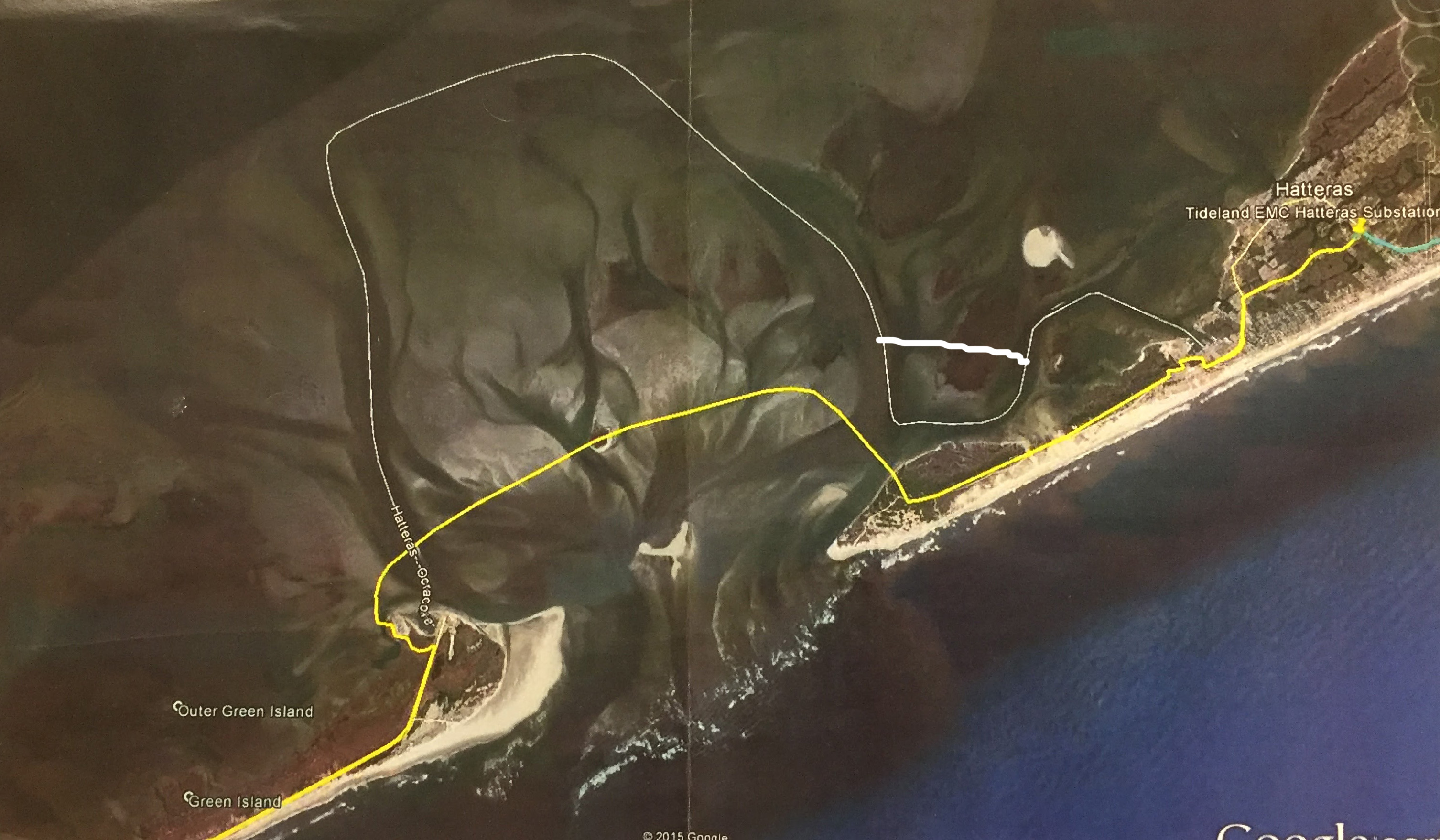
Lance Winslow, environmental supervisor for the NCDOT, said the “horse shoe,” which is the current long route, has been surveyed but the data has not yet been compiled, though information should be available by the Jan. 29 meeting.

The group is hoping a section near the 90-degree turn at the end of Hatteras Island can be dredged enough to cut off about 15 minutes from the one-hour time the ride takes now, but Winslow said that area is now too shallow to get their survey boat into it.

“Harold Thomas (N.C. Ferry Division director) is gung-ho to find a shorter route,” Hilton said.

The group agreed to ask the Hyde County commissioners to ask the NCDOT to do a full study of the entire inlet and the current route the ferries use “to find an alternative to the long route that’s permanent and sustainable.”

“The best alternative to the long route is shortening it up,” said commission member Rudy Austin.

This approval will be on the Jan. 8 Hyde Commissioners meeting agenda at 6 p.m. Jan. 8. 

In this image of Hatteras Inlet supplied by Tideland EMC, the yellow line shows the main power line to Ocracoke. The broken white line shows the current long ferry route. The thicker white line shows the approximate area that could potentially be dredged to shave the crossing time.

NC Ferry Division releases 2018 schedules

0
A ferry pulls into the ‘south dock’ at the north end of Ocracoke Island. Photo: C. Leinbach

For Ocracoke news, click here.

MANNS HARBOR – The N.C. Department of Transportation’s Ferry Division has released the 2018 route schedules here.

While similar to the 2017 schedules in terms of level of service, the Division was able to eliminate a limited number of low-ridership departures, saving taxpayers a total of $100,000 in reduced fuel costs.

The changes are as follows:

  • Elimination of four runs on the Hatteras-Ocracoke route during January and February
  • Elimination of the final daily run on the Currituck-Knotts Island route

In addition, the Currituck-Knotts Island route will close between June 7 and Aug. 6 next year only in order to perform needed renovations on ferry docks and terminals.

“Every year, we assemble our schedules after careful analysis of ridership levels and consultation with local stakeholders,” said Ferry Division Director Harold Thomas. “These new schedules manage to give us some cost savings and make the Ferry Division more efficient, while maintaining the levels of service that residents and visitors have come to rely on.”

The system-wide 2018 North Carolina Ferry Schedule can be viewed and downloaded on the Ferry Division website.

They’re Back! Snowy Owls return to North Carolina

2
This Snowy Owl was seen near the Pea Island Visitors Center on Dec. 15. Photo by Jeff Lewis

For Ocracoke news, click here 
For more information on Snowy Owls, click here 

By Peter Vankevich

“Ahoy! Hast thou seen the great white owl?”

So cried the ancient man, holding a pair of vintage 1970s green armour-coated 7×35 Leitz binoculars. Returning to scanning the Outer Banks dunes, cane laying on the same, he caught the young man off-guard as he stood next to his Zeiss 20×60 zoom-spotting scope attached to a Manfrotto tripod nonchalantly eating a sandwich.

Okay, so a Snowy Owl is not a Moby Dick – but for some it is close, and a reliable sighting may cause birders to quickly change plans and head out in hope of a glimpse and some photos of one of the most sought-after birds in the Carolinas.

Mostly sedentary, Snowy Owls are not often seen in flight. This photo was taken by Jeff Lewis in 2014.

And yes, Snowy Owls have returned to North Carolina with several reports already, including at the Pea Island National Wildlife Refuge.

Pundits in the birding world a few months ago starting making bold predictions that this winter would be an another banner year for seeing Snowy Owls in the United States in numbers similar to the winter of 2013-14 when hundreds descended and at least 15 owls were seen throughout the state.

Daily reports throughout large parts of the northern United States are confirming this prediction. When such incursions occur, they are referred to as “irruption,” or “invasion” years.

The potential nesting areas for Snowy Owls in the great north are so dauntingly large that finding nests can be overwhelming, making predictions difficult. One indicator that may help predict a large number of owls descending is when lemmings, small arctic rodents, have a highly productive breeding year. Lemmings are the Snowy’s preferred food source, and when they are in large numbers, more young owls will successfully fledge and disperse widely, including to points far south.

This summer, reports on the Project Snowstorm  website indicated that a lot of Snowy Owls were seen in the Ungava region of northern Quebec and many may make their way to the south.

Young Snowy Owl blends into the dunes. Photographed on Ocracoke Jan. 12, 2014 by Peter Vankevich

An excellent source for both North and South Carolina for tracking information on Snowy owls as well as lots of other species is the Carolinabirds Listserv.

The first Snowy report of the season on it was Nov. 17 when Nathan Gatto, owner of the Wright’s Birding Center in Winston-Salem, posted that he received a call at the store that a Snowy Owl was seen and photographed off Stratford Road in Winston-Salem. He confirmed that it was indeed a Snowy Owl.

The intrigue and excitement moved east. The Pea Island National Wildlife Refuge Visitors Center has a clipboard by the door where people can write in the names of interesting birds and the date they had seen them.

On Nov. 20, Steve Shultz of Apex, writing about a King Eider that had been seen in the Oregon Inlet areas, added to his post: “Also noted on the clipboard of sightings at PINWR (Pea Island NWR) the tantalizing suggestion of a Snowy Owl report of one seen in the general PINWR area on, I believe Friday (Nov. 17).  So you might want to keep a look out for that as well, should the notation be accurate and repeatable.”

Things really heated up on the listserv last Friday (Dec. 15) when Jacob Farmer posted: “Nathan and Sarah Gatto asked me to pass along that they found a Snowy Owl on the dunes just north of the New Inlet (Split Pea) bridge on Highway 12. It has since flown from the dunes and landed on beach in the same general area.”

Nathan, along with his wife Sarah, are regular birding visitors to the Outer Banks. He described how he discovered it: “(We) spotted the Snowy Owl while driving back from Avon. It was sitting on the dunes and looked very similar to a trash bag. After turning around a few times, we decided that it was likely a Snowy Owl. We parked at the north end of New Inlet and confirmed it.”

Jeff Lewis, the Outer Banks’s top birder and photographer, posted that evening that “the Snowy Owl was seen by many this afternoon as it worked its way north. It was almost to the north end of north pond at dusk.”

The next day brought some disappointment as Jim Gould of Southern Shores reported,  “At least five people, in separate search parties, have been scouring Pea Island National Wildlife Refuge for the Snowy Owl that was seen the last two days.  No luck so far, after having looked from Coquina Beach near Bodie Island Lighthouse all the way to the northern end of Rodanthe.”  There have been no sighting reports on the Outer Banks since. 

Moving back west, on the Greensboro Christmas Bird Count held Saturday, Dec. 16, part of the report included “a Snowy Owl, found near a runway at the Piedmont Triad International Airport in count week, and later picked up by a Fish & Wildlife officer and taken to the Carolina Raptor Center in Charlotte, where it was found to be underweight and infested with mites but otherwise in good health.”

Michele Miller Houck, associate executive director for the center, confirmed that this bird was doing well, and they have plans to release it farther north, possibly in Minnesota. A few days earlier, another Snowy was found in the Pee Dee Wildlife Refuge that appeared to be sick, was captured and transported to the raptor center.

“It was emaciated and suffering from a lung infection and did not  survive,” she said.

“This is amazing,” Houck said. “In our 40 years of existence, we never had to rehab a Snowy Owl.  This  year we have already received two.”

Another report was from Myrtle Beach  where a Snowy Owl that appeared to have medical issues was captured and transported to the Center for Birds of Prey located in Awendaw, S.C.

Jim Elliott, its executive director, confirmed that the bird when brought in was laced with parasites but otherwise in good condition and was doing well. He said they are working with the Project Snowstorm group on securing its release farther north. This was also the first time that a Snowy Owl appeared at the center.

Snowy Owl mania on the Outer Banks kicked off  in mid-November of 2013 when one was seen at Cape Point on Hatteras Island. Hundreds made the trek to see the bird, which hung around until a little beyond mid-December.  Then on Dec. 27 at South Point on Ocracoke, one was seen and photographed perched on a dune and was seen regularly afterwards. 

As sunset approached on Dec. 30, the day of the Ocracoke Christmas Bird Count, several observers were looking at a distant Snowy on the South Point flats when a second owl landed next to it, confirming there were two Snowy Owls on Ocracoke. The owls hung on all winter and were seen by  several hundred observers and photographers. The last sighting was March 8.

Venturing into the United States is entering dangerous territory for owls.  More than 100 years ago, these owls were routinely shot and often taken to taxidermists. Gaining protection via federal Migratory Bird Treaty Act in 1918 did not mean the end of dangers. Electric wires, moving vehicles and poison by pesticides are some of the biggest threats, as they are to other birds of prey.

A word about birding etiquette.  Snowy Owls may appear to tolerate human presence –perhaps because we do not look like an arctic fox. Like all birds, they should not be harassed. Even though they are reasonably tolerant of disturbances (they favor noisy airports where prey is readily available), one should not get too close as they will flee. A flushed owl is vulnerable to being struck by a vehicle, crashing into a hot power line and even attacked by a Bald Eagle or Peregrine Falcon lurking in the area. Flushing a resting owl is not good for it and will deprive others from seeing it. They can be enjoyed from a safe distance.

If you notice a bird that appears to be hurt, you may contact the Carolina Raptor Center at (704) 875-6521, ext. 111. Information on rescuing an injured raptor can be found here.


Snowy Owl on Ocracoke, photographed Jan. 2, 2014, by Peter Vankevich

Early Gifts

1

By Pat Garber

Christmas has not yet arrived, but already this month I have received three gifts of inestimable value.

The first came when, passing by my front stoop at my Ocracoke cottage Marsh Haven, I glimpsed under the deck a sight that made me stare first in shock, then wonder, and finally delight. Let me back up a few months. In early fall, before I left my summer home in the Adirondack Mountains, I attended “Fungusfest,” an all day festival on mushrooms held  at Paul Smith’s College. Among the workshops I

The salt marsh near Pat Garber’s home. Photo: C. Leinbach

took was one on growing oyster mushrooms. The participants mixed together hemp, a special kind of kitty litter, and soil in a plastic bag and injected it with oyster mushroom spore. We took the bags home with us, along with instructions on what to do next: keep the bag tightly closed in a dark, cool space for three weeks, then bring it into moderate light and warmth and pull back the plastic. After a week or so mushrooms should sprout, after which they should be lightly watered until large enough to savor in gourmet recipes.

I followed the directions but saw no signs of mushroom life. So I closed up the bag and hauled it down first  to Virginia and later North Carolina. With all the traveling and jostling and temperature changes, I didn’t figure there was much chance of success, but I kept trying. Finally, however, I gave up. Last week I decided to get rid of it. Hurricane Mathew had ripped apart my porch the year before, leaving a gaping hole where the post had been. I decided to use the lump of failed mushroom garden (about a foot and a half square) as fill. I dumped it out of the plastic into the hole, replaced the chalice woodwork and forgot about it.

Until, that is, that moment of revelation when I realized that my supposed failure had sprouted into a plethora of gorgeous white fungi, some as big as my hand. In excitement I called my friends to come see what was growing under my house, shared some of them, and then prepared myself a mushroom feast. 

Sometimes gifts can be happy accidents.

The second gift arrived just three days ago, Dec. 11, in the form of a winged visitor. Since returning to Ocracoke over a month ago I have been trying to tidy up my somewhat neglected yard and ready it for winter. I have been cutting back all the plants which had died or gone to seed. Some young sprigs of goldenrod still had blossoms, and I left them, in spite of how messy they looked growing in the middle of the lawn. I told them I was allowing them to stay in case any late pollinators showed up.

I was by the front fence, stripping yaupon leaves from branches I had collected to make tea, when I saw a flutter of motion pass nearby.

Monarch butterfly. Photo by Peter Vankevich

Bright shades of orange and black hovered before my face.   A monarch butterfly! My first reaction was “Oh, no! You’re too late. You should be far south of here by now!” As I watched, it flitted over to one of the goldenrod plants and began feeding; then to another. My old dog, Bruce, who is almost blind but can detect motion, followed it around the yard, and I followed Bruce, pulling him away and saying, “Let it eat! Don’t scare it away!”

For about 20 minutes the monarch feasted on goldenrod nectar. It rested for a bit and then, in what my imaginative mind fancied as gratitude, danced a sort of circle around me. Then it fluttered away in a flight pattern which seemed whimsical and slow, but which I knew could project it about ten miles an hour. South, I hoped, to its winter destination, maybe Mexico.

How, I wonder did it find the little sprigs of goldenrod bloom in my yard.  There were almost none in the rest of the village. I prayed that it could find enough nectar along the way to sustain its flight, and that the temps would not dip too low before it made it.

The goldenrod was my gift to the monarch butterfly, and its visit to my yard was its gift to me.

The third gift has roots that go back eight years, when a tiny yellow tabby kitten was born and then abandoned at Ocracoke’s convenience site, otherwise known as The Dump. The attendant watched as the mama kitty moved three of her kittens, but did not come back for the last one. He waited till it was time to close. The kitten was still alone, crying, so he took her home, where she was bottle-raised and grew into a sweet loving cat.

Fast-forward to a week ago. I was working at my part-time job at the Community Store when an island woman I had known for many years came in looking for me.

The yellow tabby that is now reunited with its owner. Photo by Pat Garber

“I’ve been feeding a stray cat,” she said, “and it has an awful place on its neck. I wonder if you can help catch it and get it to the vet.”   I couldn’t say no. The other request was that I not return the cat to her house, as she goes away a lot and has no one to feed it when she is gone. That part was not so easy.  What do you do with a homeless cat?

After a couple failed tries at catching this yellow tabby, an excited call from the woman informed me that the cat was in the trap. I called the local veterinarian and we met at the house.

It soon became obvious that she was not feral.  She was quite tame, and she purred as we gave her three injections and shaved and cleaned the wound on her neck.   I put the cat in a large dog crate on my screened porch, adding kitty litter, a bed, water and food. I called my Ocracats friends, and before long we had the kitty’s photograph and story on Facebook. I couldn’t sleep that night, wondering what I would do if we did not find a home. I couldn’t keep her (my 20-pound male tabby hates other cats), and I couldn’t take her with me during Christmas. We were having a cold, windy snap, and I felt terrible leaving her on the porch, even wrapped in blankets as she was. I had been asking around for someone who might foster her but had found no one so far…

The call came at midnight. The person who called had seen the picture on Facebook and said it looked a lot like her cat, who had disappeared months before.  Her teenage daughter came over the next day and recognized her. She showed me a picture of her from years back, held in a hand and being bottle-fed. Before long the cat—her name is “Baby-kitty”—was on her way home.

We may never know how she ended up so far away from her home, but now she is back. I was filled with relief and joy.

Many gifts this time: To the woman who so kindly fed the cat but now is relieved of the responsibility; to the mother and daughter who got their beloved kitty back; to the kitty who is back in a warm loving home; and to me, who is happy for all of them.

All these lovely gifts and it’s not even Christmas yet!

Pat Garber. Photo: Peter Vankevich

Pat Garber is an island author, whose books can be found in stores all over the island.  Born and raised near Richmond, Va., she has a background in anthropology, history and education, with a master’s degree from Northern Arizona University in cultural anthropology.  

Dolphins valiant efforts fall short in Holiday Scholarship Tournament; Camden girl awarded scholarship

0
Cailey Byrum of the Camden County team, receives the tournament scholarship. With her are parents Gene, left, and Lisa. Photo by Richard Taylor

For Ocracoke news, click here 

By Richard Taylor

The addition of a scholarship added a deeper dimension to the 7th Annual Holiday Basketball Scholarship Tournament over the weekend that the First Flight Nighthawks won in both the boys and girls matches.

Cailey Byrum of the Camden County Bruins captured the $2,000 prize.  

The Ocracoke School Boosters and SmacNally’s Restaurant each donated $1,000 for which each of the eight teams selected one senior to compete. To be eligible, each athlete had to have a 3.1 unweighted GPA, write an essay on a topic selected by the scholarship committee, submit a resume and two letters of recommendation, play in the tournament and interview with the scholarship committee Friday afternoon.

In her essay, Byrum wrote about her extra-curricular school activities.

“I have really big aspirations for myself,” she said after her win. “So I think that played a part in my drive for writing my essay and creating my portfolio. I’m very proud of myself.”

Byrum said she plans to major in psychology at East Carolina next fall, studying to become a child-life and pediatric oncology specialist.

Lupita Martinez (11) tips off against Lilly Cartwright Camden of Camden County. Photo by Casey Robertson

“She works very hard; she does homework between games; she does volunteer work,” said Lisa Byrum, Cailey’s mother. “I can’t ask for a better daughter. I’m so excited she won.”

Cailey’s father, Gene Byrum, was equally proud of his daughter’s accomplishments.

“She’s amazing,” he said. “She does much better than I could ever do.”

Ingrid Contreras and Liam Caswell were nominated for Ocracoke.­­

“The scholarship committee was blown away by the athletic talent, academic achievement, community involvement and personal dedication of these young men and women,” said Ocracoke School Assistant Principal Mary McKnight in announcing the recipient Saturday afternoon.

Dolphins Coach David Allewalt had said in a prior interview that tournament organizers earlier this year added the scholarship to emphasize that academics are as important as sports achievements.

This was the Byrum family’s first trip to Ocracoke.

“It’s like a Hallmark movie,” Lisa said about the island. “It’s so beautiful. Everybody was so wonderful.  It takes you back and it lets you get away from time.”

In game action, the Ocracoke teams managed only one win, but easily won the hearts and respect of locals and visitors alike with their drive, enthusiasm and sportsmanship over the four-game contest.

Friday evening, the Lady Dolphins lost to the Gateway Christian Crusaders (4-8) from Virginia Beach 70-21. Ingrid Contreras led the team with 7 points, followed by Taylor Fuller with 6 and Hannah Belch with 3. Vanessa Lora and Iris Trejo each scored 2 points, followed by Lupita Martinez with 1.  Stats for Gateway were unavailable.

The girls First Flight Nighthawks (5-4) defeated Camden County (2-8) 37-21 in the first round and won the tournament on Saturday beating Gateway 58-31. The boys First Flight team (8-1) beat the Camden County Bruins 80-65 in the first round going on to win the tournament Saturday with their victory over Ocracoke.

The Dolphins boys won Friday’s nightcap 58-31 over Gateway (4-8). Both teams started slow concluding the first quarter in a 6-6 tie. The Dolphins began to heat up in the second, ending the first half with a 23-14 lead and outscored the Crusaders 37-17 in the second half.

Junior Colby Austin led the Dolphins with 15 points, including three 3-pointers. Liam Caswell scored 11 points, Kalai Samick and Mason Fuller had 10 each, Cole Gilbert and Sam Evans had 4 each, Darvin Contreras scored 3 and Perry Austin had 1. The Dolphins shot 49 percent from the floor with six 3-pointers.

In Saturday morning’s consolation game, the Dolphins girls lost to the Camden County Bruins, 53-30. Ingrid Contreras scored 15 points, followed by Vanessa Lora, 11 and Taylor Fuller, 4. Hannah Ferebee was high scorer for the Bruins with 12 points.

In the afternoon championship game, poor 3-point shooting and erratic defense doomed the Dolphin boys against 2A powerhouse the First Flight Nighthawks of Kitty Hawk, who won 86-54.  Ocracoke is in the lower 1A Atlantic Six conference.

It seemed like First Flight point guard Dylan Blake could not miss from beyond the arch, as the superstar nailed four 3-pointers, three in the first half.  Even though they showed valiant hustle and drive, the Dolphins could not keep pace with the Nighthawks’ larger, more experienced team, especially from 3-point land and from under the basket.

First Flight scored 42 points from beyond the arch; the Dolphins had 24 in eight out of 21 attempts. Blake, just a sophomore, was their high scorer with 23 points and picked up tournament Most Valuable Player (MVP) honors.

The Nighthawks are 8-1 and their only loss this season was to undefeated Division 3-A Northside-Jacksonville.

Both First Flight teams carried winning trophies home to Kitty Hawk, as the Lady Nighthawks beat Gateway 58-31 in the girl’s championship. Lady Dolphin Ingrid Contreras made the all-tournament team.

Perry Austin battles for rebound in Dolphins championship loss to First Flight. Photo by Richard Taylor

Senior Liam Caswell led the Dolphins in scoring in the championship game with 28 points. Darvin Contreras, Reese Gaskins and Mason Fuller each had 5, and Colby Austin had 3 points. 

Despite game losses, Allewalt said it was a good tournament.

“They (the Nighthawks) scored 27 points off 25 rebounds,” he said about the final game. “You can’t have that.”

Allewalt said the team missed Kalai Samick, who was out for the last game with a bum knee and is the second leading scorer after Caswell.

WOVV radio play-by-play announcer Bill Cole said the Lady Dolphins are a work-in-progress.

“A lot of the players are new to the team this year and new to a higher level of competition,” he said, “but they keep fighting and they keep working hard. We’ll look to see them improve, which is what you want from high school athletes.”

As for the Dolphins, Cole said they had some shining but also some sloppy moments in the final game.

“But they never quit and they never gave up,” Cole said. “They fought to get in this one. I look for a lot of big things out of that team this year. They are not going to play a (Division 2) team like First Flight from outside our conference week-in and week-out.”

The Dolphin boys next play in the Perquimans Holiday Tournament against the Currituck County Knights in Barco at 4 p.m. Thursday, Dec 28.

The Lady Dolphins will take on the Pamlico County Hurricanes (Bayboro) in the Crystal Coast Christmas Classic Tournament in Morehead City at 4 p.m. Dec 21.

Camden’s Brock Colson (5) drives. Photo by Casey Robertson
The victorious First Flight Nighthawks team. Photo: C. Leinbach
Perry Austin, right, shoots for Ocracoke. Tournament MVP Dylan Blake, no. 4 for First Flight, is center. Darvin Contreras is second from right. Photo: C. Leinbach