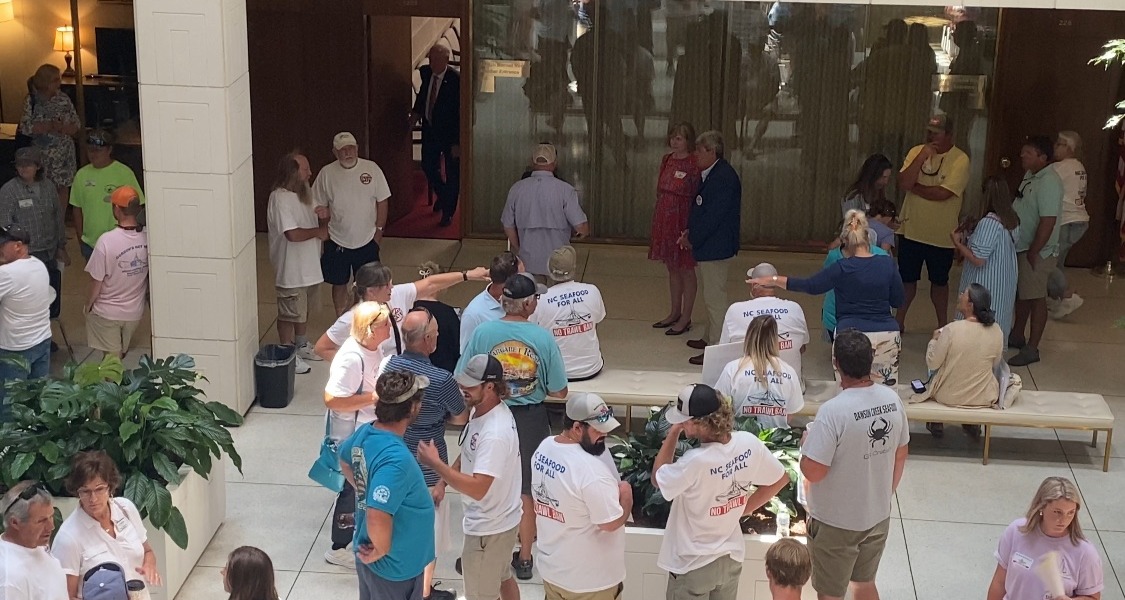
Shrimp-ban protesters continue to work the North Carolina Legislature in Raleigh on June 25. Photo by Bob Phillips
By Connie Leinbach
A cheer went up in the hallways of the N.C. State Legislative Building in Raleigh when members of the House Rules Committee emerged around 3 p.m. this afternoon from their caucus on the shrimp trawling ban in HB 442 and announced they would not move the bill.
Bob Phillips, executive director of Common Cause North Carolina, who was at the capitol building bird-dogging the situation, confirmed the news and the cheering.
“The announcement was simply, the house caucus has decided that it will not take up the bill this session,” he said. While the bill is still there, when bills go to the Rules Committee it’s typically a death knell.
The announcement followed yesterday’s intense lobbying of the legislature by hundreds of shrimpers, seafood workers and others, who descended on the capital to protest this bill that could have drastically reduced, if not ended, the North Carolina shrimp industry.
“I’ve never seen anything like yesterday,” Phillips said about the raucous truckers. Many of the protesters on Wednesday continued to mill around the Legislative Building.
Islander Susie O’Neal, manager of Ocracoke Seafood Company, made the trip to Raleigh on Tuesday and was among the protesters.
“Thank goodness!” she said on Wednesday after hearing the news of the bill’s dormancy. “But they won’t stop trying,” she said about the groups wishing to ban shrimp trawling. “We have to stay vigilant and keep the information (about these efforts) out there.”
House Bill 442 originally sought to expand the commercial and recreational fishing season for flounder and red snapper, which was widely praised.
In the Senate, an amendment to prohibit shrimp trawling within a half mile of North Carolina’s coast was tacked on before the June 17 committee vote.
Facing limited opposition in the Senate, the revised bill passed and which, if it had been put to a vote in the House would possibly have ended the shrimping industry.
But Phillips said on Wednesday that a number of House Republicans came out against the bill, ensuring that it wouldn’t move forward.
Protesters like this returned to the Legislative Building in Raleigh on Wednesday, June 25. Photo by Bob Phillips
Susie O’Neal, manager of the Ocracoke Seafood Company, was at the State Legislative Building in Raleigh on Tuesday along with hundreds of North Carolinian shrimpers, sea food workers and concerned citizens about the possible end of the shrimping industry. Capture of a video by Bob Phillips
By Connie Leinbach
Hundreds of men and women who make their livelihood in commercial fishing converged on the North Carolina General Assembly Tuesday to protest House Bill 442, which would ban shrimp trawling.
“Shrimp Day” or “Shrimpgate” at the legislature included a truck caravan that continuously circled the legislative complex with horns loudly blaring for lawmakers to hear.
“As a longtime Raleigh resident, I can say I’ve never seen anything quite like it,” said Bob Phillips, executive director of Common Cause North Carolina, who was at the capitol building.
He said that the Legislature is expected to recess by the end of this month but what happens next to this bill is unknown.
Phillips said the latest information is that HB442 does not have support by the majority of House Republicans and a hearing on it likely will not happen before the Legislature goes on summer break at the end of June and may never see the light of day.
Susie O’Neal, left, visits lawmakers. Photo by Bob Phillips
“Of course, we take nothing for granted in the capital city,” he said. “They may decide to vote on it Friday and be done with it.”
Ocracoke Seafood Company Manager Susie O’Neal was among those from Hyde County who traveled to Raleigh and Phillips interviewed her.
“I think they’re getting the point across,” O’Neal told Phillips about the truckers. “The idea that by ending shrimping you’re going to increase the number of fish for recreational fishermen is not true. They tried it in Florida, and it hasn’t worked.”
Eliminating shrimp trawling would be doing away with an industry that feeds people, she said.
“We are trying to feed people local sustainable protein that’s not chemically treated,” she said. “You can’t do better.”
House Bill 442 originally sought to expand the commercial and recreational fishing season for flounder and red snapper, which was widely praised.
But an amendment to prohibit shrimp trawling within a half mile of North Carolina’s coast was tacked on before the June 17 committee vote. Facing limited opposition in the Senate, the revised bill passed and which, if passed by the House would greatly curtail, if not put an end to the shrimping industry.
One lawmaker speaking at a Tuesday morning press conference in the Legislative Building said there are 294 shrimpers in the state, down from around 1,000 in the 1990s.
Some of the opponents to the shrimp bam bill at the State Legislative Building. Photo by Bob Phillips
Several noted that shrimping is already heavily regulated and that about 85% of the delicate estuarian areas where fish breed have been closed off to shrimping.
John Mallette of the Southern Breeze Seafood Market in Jacksonville said North Carolina can’t be compared to other states.
“South Carolina has more mud flats and they can shrimp off the beach,” he said. “All we have (off the shore) here is rocks.”
Senator Bobby Hanig, who represents Currituck County, said “this crazy amendment came out of left field.”
He proposed several amendments to the bill but was shut down “by my own party,” he said.
“The Coastal Conservation Association and N.C. Wildlife Federation have been pushing against (shrimp trawling) for years,” he said. “Last week I was ashamed to be a member of North Carolina Legislature.”
Truckers circle the Legislative Building. Photo by Bob Phillips
The Coastal Conservation Association is a nonprofit organization made up of saltwater anglers and conservationists. They and the Wildlife Federation claim there’s overfishing and that trawling nets with rough, heavy chains that drag along to seafloor, causing damage and uprooting marine life.
But Ocracoke Island Fisherman Morty Gaskill has pointed out that as mandated by state law, multiple by-catch reduction devices, along with a turtle excluder device, are required on each shrimp trawl.
These measures alone have been shown to reduce by-catch by 40 to 70%.
“Additionally, a lot of the shrimpers I know have also stopped dragging at night and are towing smaller nets in order to further minimize bycatch.,” he said. “No shrimper wants to have to deal with bycatch as it slows them down and decreases their catch.”
Why the rush to add this amendment?
The General Assembly commissioned the North Carolina Collaboratory in 2022 to complete a report on the environmental impacts of coastal shrimp trawling, he said, which is expected to be released June 30 and that “the truth is going to come out.”
Further proposed legislation, HB 441, would pay shrimpers impacted by the trawling ban through Oct. 1, 2028.
Rep. Keith Kidwell of Chocowinity, who represents Hyde County, decried that notion.
“These people don’t want to live on welfare from the government,” he said. “They want to work.”
Shrimp fishing proponents watch the N.C. Legislature. Photo by Bob Phillips
Fowler and Chloe O’Neal. Photo courtesy of the family.
Chloe Ann O’Neal, 88, of Ocracoke passed away peacefully at home on June 21, 2025, surrounded by her family.
Born April 4, 1937, on Ocracoke, she was a daughter of the late Uriah W. Garrish, Jr. and Maude T. Garrish of Ocracoke.
A devoted mother, grandmother, great-grandmother and friend, Chloe lived a life full of love, grace and kindness.
She loved cooking traditional island dishes and feeding her family and a countless number of friends.
Young Ocracoke Island woman Chloe O’Neal. Photo courtesy of the family.
She will be remembered for her warm heart, gentle spirit and her devotion to her late husband Robert “Fowler” O’Neal Sr.
She is survived by her brother Robert “Bobby” C. Garrish of Ocracoke and her three children Robert “Bobby” Fowler O’Neal Jr. and Joan “Joanie” Ann O’Neal of Ocracoke, and Gloria “Sissy” O’Neal Nash of Newport News, Virginia.
Chloe had 10 grandchildren who affectionately called her Granny “Coco.”
Her grandchildren include Robert “Billy” W. O’Neal of Santa Maria, California, Mark O’Neal, Chloe O’Neal and Jackson Strange of Ocracoke; William “Will” Stevens, Neal Stevens, and Caroline Minns all of Newport News, Virginia; Tressa Kane of Smithfield, Virginia; Leeanna Lanciault of Williamsburg, Virginia; and Aurora Schraffenberger of Anchorage, Alaska.
She is also survived by 11 great-grandchildren across the country. She is preceded in death by her parents and her three sisters Maude Ballance and Grace Gaskill of Ocracoke and Helen “Tink” Helpenstill of Eagle, Alaska.
A date for a graveside service is still being determined.
In lieu of flowers, the family asks that donations be made in Chloe’s memory to Ocracoke Volunteer Fire Department care of the Ocracoke Fire Protection Association (OFPA) and mail it to OFPA, P.O. Box 332, Ocracoke, NC 27960, or Ocracoke United Methodist Church, P.O. Box 278, Ocracoke, NC 27960
OPS Porch Talks: Jeff Reaser & Walt Wolfram’s new book “Language and Life on Ocracoke,” 1 pm
Ocracoke Oyster Company: Bryan Mayer, 7:30 pm
DAJIO: Beatles & Bossa Novas, 8-10 pm
Wednesday, June 25: Ocracoke Community Library: Special guest Jon Sundell for a bilingual musical program, “Our Colorful World of Stories, Songs, People, Crafts, and Nature.” 10 am and 1 pm.
MiniBar at Ocracoke Coffee: Karaoke, 6 pm
Ocracoke Oyster Company: Jeff McCargish, 7:30 pm
Deepwater Theater: Ocrafolk Opry, 8 pm
DAJIO: Barefoot Wade, 7:30 pm
Thursday, June 26: OPS Porch Talks: Seashells of Ocracoke Island, Charlie DeCarlo, 1 pm
Ocracoke Volunteer Fire Department meeting, New volunteers always welcome. 822 Irvin Garrish Hwy. 6 pm
MiniBar at Ocracoke Coffee: Brooke & Nick, 6-8 pm
Ocracoke Oyster Company: Caldwell Grey, 7:30 pm
DAJIO: Beatles & Bossa Novas, 8-10 pm
Friday, June 27: Ocracoke Community Library: Used book sale at the Ocracoke Library.
What’s Happening on Ocracoke, guest Philip Howard discussing his new book. 11:30 am. 90.1 FM on the island and wovv.org.
MiniBar at Ocracoke Coffee: Kate McNally, 6 to 8 pm
1718 Brewing Ocracoke: Raygun Ruby, 7 pm
Ocracoke Oyster Company: Ray Murray, 8 pm
Saturday, June 28: MiniBar at Ocracoke Coffee: musical artist TBD
Ocracoke Oyster Company: Ocracoke Rockers, 8 pm
1718 Brewing Ocracoke: Whiskey Business
DAJIO: Ray McAllister Band, 7:30 pm
Sunday, June 29: Church services: Ocracoke United Methodist Church, 11 am Ocracoke Life Saving Church, 11 am Stella Maris Chapel: Sunday afternoon Mass time varies. Go to Masstimes.org and type in the zip code: 27960
National Park Service programs:
The following free programs run from June 16 to Aug. 28. Banker Ponies at the Ocracoke Pony Pen: Every Monday and Wednesday, 8:30 am — 9 am Ocracoke Lighthouse: Every Monday, Tuesday, Wednesday and Thursday, 11 am — 11:30 am Life on a Barrier Island: Every Monday, Tuesday, Wednesday, Thursday, 2 to 2:30 pm. Outside the Discovery Center. MorningBird Walk: Every Tuesday from 8:30 to 9:30 am. Meet at NPS campground parking lot.
The NPS meeting area at the Visitors Center is where programs are held. Photo: C. Leinbach
A weather pattern known as a “heat dome” is setting up over a large portion of the continental United States, and will bring dangerously hot conditions to the Outer Banks and northeastern North Carolina this week.
A Heat Advisory has been issued for nearly the entire area for Monday, excluding Hatteras and Ocracoke islands, as high temperatures are forecast to reach 94° with a heat index of 105°.
An Extreme Heat Watch in also in effect for all of eastern North Carolina for Tuesday and Wednesday, as highs both days are expected to top 95° and the heat index will exceed 110°.
This is the first summer where new terminology is being used by the National Weather Service for high heat watches and warnings.
“A heat dome occurs when a persistent region of high-pressure traps heat over a particular area, and it can linger for days to weeks,” according to NOAA. “Heat domes are typically linked to the behavior of the jet stream, which is a band of fast-moving winds high in the atmosphere that move in meandering wavelike patterns.
“When the jet stream meanders north, it moves slower and can sink, which lowers humidity. This allows the sun to create progressively hotter conditions on the ground,” NOAA said.
According to National Weather Service Newport office forecasters, well above normal temperatures each night will lead to less relief, even after sunset, adding to the impact of the heat this week.
“Make sure those that must be outside this upcoming week are aware of the signs of heat illnesses and to stay hydrated,” the NWS said.
Heat is the number one weather-related killed in the United States, according to NWS statistics. More information about staying safe in the heat can be found at https://www.weather.gov/safety/heat
Along with the high air temperatures, the sand and pavement will be dangerously hot and appropriate footwear will be required when walking on area beaches and roads.
Pets should not be brought out on the street or the beach during the day, as the hot surfaces will burn the pads of their feet.
The heat wave will likely last through the week with heat indices of greater than 105° likely on Thursday and Friday. And there are little to no rain chances through Friday.
Here is a link to the NWS Heat Safety webpage which has multiple tools and resources.
If HB422 in the N.C. Legislature passes on Tuesday, the Ocracoke fish house will no longer have locally harvested shrimp. Photo: C. Leinbach/Ocracoke Observer
By Morty Gaskill
As many of the readers of this publication are aware, there is currently a bill before the NC House of Representatives, HB442, that would ban shrimp trawling in all inshore waters out to half a mile from the beach.
Considering that the vast majority of shrimp in North Carolina are harvested within these areas, if passed, this bill will all but end shrimping within North Carolina waters.
In this letter, I intend to explore how and why this bill has made it this far, along with why the logic behind the bill is faulty and as such should not be made into law.
HB 442 originally concerned only restoring access to flounder and red snapper. After this bill was passed in March, it moved to the NC Senate for consideration.
It was only on Monday last week that an amendment to this bill was added on, which would prohibit all shrimp trawling in the sounds and ocean out to half a mile.
This bill was somehow shepherded out of both the Ag Committee and Rules Committee in less than a day and half before being brought before the full Senate for a vote on Thursday.
There was very little opportunity for public input on this bill before it was passed.
Of 17 people who showed up to Raleigh on Wednesday, only four were allowed to speak about their opinions of the bill before it was voted on.
Within the North Carolina Department of Environmental Quality, the Division of Marine Fisheries is tasked with managing the marine resources of the state of North Carolina. This agency is governed in accordance with the Fisheries Reform Act of 1997, which mandates setting policies that achieve sustainable harvest while ending overfishing.
To achieve this, the Marine Fisheries Commission is a nine-member board appointed by the governor to set and maintain rules governing the marine fisheries of the state.
This board consists of three representatives of commercial fishing interests, three representatives of recreational fishing interests, a member of the scientific community, and two at-large members.
In the last few years, these bodies have established increasingly stringent regulations governing what can be harvested, when it can be harvested, how much can be harvested, what gear can be used to harvest, etc.
Now I am going to attempt to address why, at the eleventh hour, some members of the legislature have decided to bypass the entire state regulatory process in order to attempt to ban trawling.
They say that shrimping is taking place in some wild outlaw realm with neither regulations nor regard for the natural environment. These claims are simply not rooted in facts.
HB 442 is not the first attempt to end trawling and other forms of net fishing within state waters, but all previous attempts were denied both by the state regulatory agencies and in court when the state has been sued over the matter.
Within my relatively short commercial fishing career, I can recall at least four or five instances where advocacy groups have petitioned either the Division of Marine Fisheries or the Marine Fisheries Commission to further restrict or even outright ban trawling in various waters of the state.
These attempts have largely been spearheaded by well-funded sportfishing/”environmental” groups that claim that shrimp trawling is destroying both habitat and fish stocks.
On every occasion to date, the state has found no scientific basis to do away with shrimp trawling. Now these groups are claiming that the Legislature has to ban shrimp trawling because the state regulatory agencies are inherently biased in favor of commercial fishing interests. This is absurd as just in the last five years the state has severely restricted commercial access to several important fish species such as southern flounder, striped mullet, and spotted sea trout even in the face of declining commercial effort.
The groups advocating for the elimination of shrimp trawling paint this picture of shrimp trawling as destructive to critical habitat while also being incredibly wasteful in terms of bycatch.
They say that shrimping is taking place in some wild outlaw realm with neither regulations nor regard for the natural environment. These claims are simply not rooted in facts.
No one who is trawling for shrimp would do so over submerged aquatic vegetation or live bottom as doing so would clog or damage their nets.
Approximately 50 percent of the state’s waters are already permanently closed to trawling to protect critical habitat. As mandated by state law, multiple
by-catch reduction devices, along with a turtle excluder device, are required on each shrimp trawl.
These measures alone have been shown to reduce bycatch by 40-70%, including upwards of 90% reductions in bycatch of key species such as flounder, spot, croaker, and weakfish; according to the state’s own data.
Additionally, a lot of the shrimpers I know have also stopped dragging at night and are towing smaller nets in order to further minimize bycatch.
No shrimper wants to have to deal with bycatch as it slows them down and decreases their catch.
Some fishermen have also switched to skimmer trawls, which are even less disruptive to the bottom and can be emptied while still being actively fished, allowing bycatch a greater chance of survival. However, that gear would also be outlawed by HB 442.
Where this all hits home is that the commercial fishing industry in this state has been struggling for years due to a confluence of several factors: Regulations, fuel prices, changing market dynamics, hurricanes and climate change.
What the fishermen get paid for their shrimp has remained relatively flat since the 1980s before even accounting for inflation, largely due to foreign imports depressing the prices.
As my predecessors in commercial fishing have aged out or left for better paying and more reliable jobs, the commercial fishing ranks in have thinned considerably as few people in my generation have opted for this career.
North Carolina-caught jumbo brown shrimp would be a thing of the past if HB442 passes the N.C. House. Photo courtesy of Davis Seafood
All over the state, places where fishermen once docked or spread their nets have been replaced with condominiums and rental homes.
Ocracoke has dwindled from having multiple fish houses and almost 50 fishermen when I was young to one fish house and barely a dozen fishermen.
Fewer commercial fishermen are fishing in this state than ever before, yet somehow we have been given the brunt of the blame for why fish stocks are not where they need to be.
The people pushing the ban on shrimp trawling claim to be doing so largely out of some concern for the environment. Yet these same people were largely silent as the state legislature has rolled back environmental protections for the same wetlands and estuaries that they claim to be saving by banning shrimp trawling.
The fact is that if HB 442 is adopted into law, it will probably decrease most shrimpers’ landings in the realm of 90%.
This will create an even bigger market void that will be filled largely with imported shrimp from parts of the world with even fewer environmental and food safety standards.
Restaurants are not going to stop serving shrimp and people are not going to stop eating shrimp; they’re just going to be supporting even worse environmental and human rights degradations by relying on imported shrimp.
By supporting the commercial fishing industry in this state, you are ensuring a stable supply of healthy and responsibly harvested seafood for everyone in this state.
Instead of focusing on the fact that only 300 people are still shrimping, focus on the fact that these 300 people are providing millions of pounds of shrimp for all 11 million people and visitors in the state of North Carolina.
Every pound of shrimp harvested in this state supports more than just the shrimper. It also supports the workers at the fish house, the people who sell the fuel for the boats, the mechanics who repair the boats, the people who make the nets for the shrimper, the truck driver who transports the shrimp to market, the people working in markets and restaurants serving the shrimp to consumers, and many others.
HB442 is scheduled to come before the legislature on Tuesday (June 24).
In summation, I am asking the readers to contact their local representatives as soon as possible and urge them to vote against HB 442 if it contains the amendment banning shrimp trawling.
For the reasons I have outlined above, banning shrimp trawling would be devastating to the coastal economies of eastern North Carolina, while showing little tangible benefits.
Although I am concerned at the speed that this bill is moving — as I am writing this barely 48 hours before it will probably come up for a vote in the House — I am hopeful that with enough public support and outcry the worst parts of this bill can be averted.
The bill with the inclusion of the shrimp trawling ban can be read here. Members of the N.C. House can be found here.
Morty Gaskill is a commercial fisherman and has been a board member NC. Coastal Federation for eight years. He is on the Ocracoke Waterways Commission and on the board of directors of the Ocracoke Seafood Company.
Pat Garber’s goal as a young girl was to grow up and have lots of stories to tell, and that she has accomplished both from a fascinating life she has led and the opportunity to recount them in her many diverse books.
Raised on a farm in southern Virginia with horses, this childhood led to a lifelong love of animals, both domestic and wild.
For many years, Garber lived on Ocracoke primarily as a writer, director of the Ocracoke Preservation Society and a federally licensed wildlife rehabilitator and a licensed volunteer with North Carolina’s Sea Turtle Stranding Network.
Her two most notable books from living here are “Ocracoke Wild” (1995) and “Ocracoke Odyssey” (1995), both still in print.
She has always had a fascination with the Southwest, which is the subject of her latest book, “Living the Life; ranches, rodeas and rattlesnakes.”
Her great grandparents, Don Alonzo and Lou Sanford, moved to southern Arizona to homestead a ranch raising cattle and sheep, mining and even running a stagecoach stop.
They passed on to their descendants a remarkable collection of 67 diaries, lots of letters and large ledgers that offer a view of what life was like back then. Garber takes excerpts from these documents and offers her insights on their significance.
But the book is more than that. After visiting the state, she decided to move there and be a volunteer at a nature reserve.
By good fortune, became the caretaker to a 1,200-acre ranch outside of Patagonia, almost to the Mexico border, that was adjacent to that of her great-grandfather’s. She writes about ranch life today with its calf-season roundups.
The book shifts between the past and her present, connecting, in her engaging writing style, her experiences and observations and how they all relate.
This is the “Wild West,” with rattlesnakes, cattle rustlers, the wild border with Mexico and rodeas (interchangeably used with rodeos in the diaries), a term used for the demanding work of rounding up livestock on horseback.
There’s also the threat of rattlesnakes and mountain lions while riding through difficult rocky terrain and the desert in search of the cattle and horses.
Not only does she recount how they were managed in the late 19th century, but she had the opportunity to participate in a “rodea” herself.
She recounts her life while living in Patagonia (close to the Mexican border) and making friends with colorful characters that could match those on Ocracoke.
One character, who simply went by Penny, was “a lovely, slender woman who reminded me of a back-to-nature, flower child from the Sixties, and loved to dance and hike,” Garber writes. Penny was obsessed with a diet consisting of vegan, organic raw foods and odd-colored smoothies consisting of organic fruits and veggies.
Only later, as they became close friends, did Garber learn that Penny’s body was consumed with cancer which she was treating with diet rather than chemo and radiation.
Garber’s love of animals is apparent throughout the book. She befriends a cow simply known as “76” and a wild horse named Brown who earns her trust through familiarity and with carrots.
The cow 76 was slowly dying from failing eyesight but managed to get pregnant and Garber provided support to her as she gave birth to her foal, before dying.
The book is a tribute to her ancestors and has many photographs of them along with historical and contemporary images.
This and other of Garber’s books are available in the Ocracoke Preservation Society gift shop, 49 Water Plant Road.
Pat Garber is a prolific writer, author of “Ocracoke Wild; A Naturalist’s Year on an Outer Banks Island,” “Ocracoke Odyssey; A Naturalist’s Reflections on her Home by the Sea” and many other books and articles. She is a long-time contributor to the Ocracoke Observer.
A shrimp boat off Springer’s Point, Ocracoke. Photo: P. Vankevich/Ocracoke Observer
By Connie Leinbach
The N.C. Senate on Thursday, after a third reading, passed House Bill 442 that includes an amendment to ban shrimp trawling in the Pamlico Sound.
The measure then went to the N.C. House.
If the House concurs with the Senate’s changes and it is signed by Gov. Josh Stein, fresh shrimp from the Pamlico Sound would be a thing of the past.
Hyde County Manager Kris Noble told members of the OCBA board June 17 about this amendment that bans shrimp trawling in all inshore waters and a half mile off the beach.
“This new restriction would essentially wipe out the North Carolina shrimp industry,” Noble said.
The original bill would expand recreational fishing for flounder from four days to at least six weeks, with a limit of one fish per person per day. It would also allow a year-round red snapper season, with a limit of two fish per person per day and a 20-inch minimum size limit in state waters.
According to reporting by the Raleigh News & Observer, earlier this week, Sen. David Craven, a Republican from Randolph County, introduced an amendment that would prohibit shrimp trawling indefinitely in inshore waters, including sounds, and within a half mile of the ocean shore starting Dec. 1.
Craven said the ban would align North Carolina’s trawling regulations with those of Virginia and South Carolina and reduce bycatch.
Thomas Newman, a full-time commercial fisherman who works with the North Carolina Fisheries Association, predicted that the ban would put some shrimpers out of business.
Many boats used by North Carolina’s commercial shrimpers are not large enough to work in the Atlantic Ocean, he said.
Preventing commercial shrimpers from working in the sounds and inshore waters would result in a 75% decrease in the total shrimp catch each year, he added.
There were fewer than 300 commercial shrimpers in North Carolina in 2023, according to a 2024 report from the N.C. Division of Marine Fisheries.
In 2023, more than 2.3 million pounds of brown shrimp alone was caught just in the Pamlico Sound, the Division of Marine Fisheries report shows. That’s in addition to the 287,000 pounds of brown shrimp caught in other sounds, rivers and inland waterways, and doesn’t include the amount of white or pink shrimp caught.
As for what happens next, the House might wait until next week to debate the bill again, Noble said about the process, as told to her by Hyde County lobbyist Bob Steinberg, a former N.C. senator.
If the House debates the bill, they cannot further amend it.
Or they might delay voting on the measure until they come back into session in September after summer recess in the hopes that the two studies commissioned by the General Assembly on the impacts of shrimping are complete and reviewed, Noble said.
The NC General Assembly is expected to recess before July 4.
Over the summer, House members will still be checking their email, Noble said, and she encouraged those interested to voice their concerns to House members.
According to Noble, the N.C. House will have two options:
To concur, which would mean approval of HB442 as amended, at which point it will go to Gov. Stein. The only chance for a veto from the governor is if Democrats have supported it or have concurred.
Not to concur, which would be a no vote for HB442. This would require 61 votes. At that point the bill will go to conference. Conferees would be selected by the Speaker of the House and the Senate Pro Tempore.
Once in conference, if the Senate and House can come to an agreement, it will go to vote in both chambers. With approval by both chambers it will then subsequently go to the Governor. If the Senate and the House do not come to an agreement, the bill dies.
Noble and the Hyde County Board of Commissioners on Tuesday whipped up a resolution against the bill and sent it to Senator Phil Berger, president pro tempore of the Senate. She said commissioners from Pamlico, Carteret and Dare counties sent resolutions.
She said hundreds of commercial fishermen and even Blue Crab representatives went to Raleigh on Wednesday, but to no avail.
The Senate vote on Wednesday was 41 to 4 in favor and on Thursday, it passed 39 to 2.
“Red Snapper and Flounder bill is a good bill, and the recreational and commercial fishing industries worked together on it,” Noble told the waterways members. “The Senate tacked on a shrimp trawl ban.”
In her email to Berger, Noble said Hyde’s economy would be greatly harmed.
“The shrimp trawling industry coupled with farming are the two main industries in Hyde County and this bill would devastate us economically and socially,” she wrote.
Noble further said that the amendment was endorsed by inaccurate statements on the harms of shrimp trawling to the recreational catching of Red Snapper and Flounder.
“North Carolina has highly regulated fisheries and our stocks are healthy,” she said. “The Pamlico Sound is a vibrant estuary filled with abundant stocks. These claims against trawling are unsupported by science and, in my opinion as a lifetime resident of Hyde County, are a mechanism to commandeer resources that belong to the people of this great state, not one user group.” The resolution urges the General Assembly to reject this amendment and “engage with fishermen, scientists, and coastal leaders before advancing any measure that would cripple a historic and sustainable fishery.”
Accusations of underwater landscape damage by shrimping are being made by the Coastal Conservation Association, a non-profit organization dedicated to marine conservation, particularly focused on recreational anglers’ interests, and the N.C. Wildlife Federation.
Editor’s note: Ocracoke Islanders Tom and Carol Pahl are on a trek around the United States (following 70-degree weather) and will report back from time to time their reflections. This is their seventh dispatch.
Text and photos by Tom Pahl
One of the questions we heard often from friends before we started this year-long adventure was whether we had really considered what life would be like with the three of us (Carol, me and our dog Napolean) living together in a 156-square foot space. That is a pretty small area, but as we had hoped, we’re doing fine.
Over the years, we’ve developed a healthy regard for each other’s independence, and seven months into this adventure, we have tested a theory that independence is a state of mind, not of proximity. So far, the theory is holding up to very close scrutiny. It helps that we have millions of acres of wilderness right outside our door with biking trails and hiking trails, incredible views, and time for reading. And regularly, we pour a little something to celebrate the end of another day, which also helps.
As we travel the country, we often find ourselves making gross generalizations about the apparent character of the folks living in America’s different regions. Down South you can walk into a convenience store and walk out believing that the clerk is your new best friend. In New England that same transaction is likely to take place with the clerk barely looking up and quite possibly without exchanging a word.
After all, the amount you owe shows on the register, so why complicate things with useless palaver? On the other hand, the New Englander’s reticence also comes without judgment, where you must wonder, when you leave that WaWa in Macon, if your new best friend wasn’t thinking, “Bless his little heart!”
Carol Pahl in Winslow, Arizona.
Now that we’ve spent several months in the Western states, we have concluded that the classic “well, howdy” friendliness out here is much like that of their counterparts in the South, minus the sideways blessing. Westerners are just plain friendly people. And I would add: They respect the letter “R,” which I appreciate very much, having lived in places such as eastern Connecticut and Rhode Island where the letter “R” is treated like a case of appendicitis.
Even though I’m a Montana boy by birth, I have spent enough time in New England that I tend toward the laissez-faire side of the human interaction spectrum. I have, therefore, not made any extraordinary efforts to try to cultivate a lot of new friendships as we’ve traveled around, though the opportunity is always there.
Back in February, we were camping along the Texas gulf coast in a county campground with campsites right on the water. I had been fishing off and on for almost a week and had caught some fish, but mostly I had been putting shrimp back where they came from, albeit less lively than when they came out. As every piece of water has its own learning curve, fishermen have developed an unwritten code that says you should share the basics of the learning curve with other fishermen, but you’re not required to share the details.
Roosevelt Lake, Arizona.
With that in mind, I strolled over to where a neighboring camper had set up to start fishing. He had just arrived, and I thought I might be helpful.
“Catchin’ anything,” I asked. The standard fisherman greeting.
“Nope,” he answered.
I asked what he was using for bait. Again, pretty much standard fisherman-ese.
His reply: “You know, there’s a difference between you and I.”
He threw out the bait and, being curious, I took it, “And what would that be,” I asked, not adding that one of us knows the difference between the objective and the subjective first-person singular.
Antelope Canyon, Arizona.
He looked me square in the eye and said, “I would never enter another person’s campsite without being invited.”
I gave a kind of halfhearted two-finger salute and wished him luck as I backed away. Whereupon I learned that the human interaction spectrum extends way past me in both directions. It happened we were leaving the next day, so we didn’t have to feel the discomfort of his neighborly chill for long, but on the way out, I silently put a fisherman’s curse upon his bait and his gear. “May your bait rot in your Yeti cooler so that the stink lingers forever and may your rigs twist up into tight knots and catch everything but fish!”
All together we ended up spending four months (February through May) in the southwest desert. We spent a good amount of time in the border areas of Texas, New Mexico and Arizona. We came to love the remoteness and the desolate beauty of the dry lands.
From the border, we went up to Tucson, where we stayed just outside of the Saguaro National Park for almost two weeks. Our stay there coincided with a Bernie Sanders/AOC rally which we attended, and which has buoyed our spirits somewhat, as we doom-scroll through the news most mornings.
From Tucson, we made a quick stop in Phoenix to visit old friend Sari, then on to Winslow. Yes, that Winslow: “Standin’ on a corner in Winslow Arizona….” In Winslow, we caught up with the cold weather we’d been trying to avoid.
The dry Southwest.
When we woke up to snow one morning, we cut our visit there short and headed back southward, just enough to find beautiful weather and a wonderful campground on Roosevelt Lake, south of the Tonto National Forest. Ten days later we ventured north again, passing through the Coconino Plateau and the Painted Desert to the Grand Canyon. On the way, we went through some of the most inhospitable land imaginable.
What wasn’t dry arroyo or rocky gorge was red sand so infertile that nothing grows there except a rare tumbleweed, and a creosote bush too mean to die.
The only living critters we saw and apparently, the only fauna that can survive in that environment are lizards that have evolved to live with just the moisture they can suck from their diet of red ants and grasshoppers. The entire southwest is four years into a severe drought and even the slightest gust of wind will raise a cloud of red dust that regularly spins up into a dust devil that will rise 40 or 50 feet into the dry air.
As we traveled through Texas, New Mexico, Arizona and into Utah, we learned to watch for Reservation Land — tribal land that is the historic legacy of Westward Expansion, white supremacy, and genocide.
Zion Canyon, Zion National Park.
Invariably, it is this dry land, the most inhospitable, the least arable, the least valuable, that was designated as Reservation Land. And, even then, as times and technology changed, some of the Navajo Tribal Lands, at first thought to be worthless, were discovered to contain great stores of highly valuable uranium ore.
As a matter of course, newly found value quickly became a new way to screw over the Indians. Between the 1940s and the 1980s more than 4 million tons of uranium ore was mined from Navajo land. During that time, the attraction of paying work put Navajo men and their families, by proximity, at risk for uranium poisoning, resulting in increased incidences of various forms of cancer ranging from 250 to 1,500%, depending on the type of cancer.
Though the hazard was known, little if anything was done to make the danger known to the Navajo workforce and it wasn’t until the 1990 Radiation Exposure Compensation Act was signed by President George H.W. Bush that any significant effort was made to rectify the harm.
Bighorn sheep in Zion National Park.
In New Mexico, in 1979, a neglected uranium mine tailings pond in the Church Rock region of the Navajo Nation broke its dam, releasing more than 1,000 tons of radioactive mill waste and 93 million gallons of radioactive water. Downstream notification was slow and was delivered in English-only format. Residents were sickened, sheep and cattle died en masse. Multiple requests for a state of emergency were denied. Government and industry response took years to clean up the disaster, considered to be the largest radioactive accident in US history.
After just one day at Grand Canyon, we went to Zion National Park where we luckily snagged a two-week spot at the campground just inside the park. Zion is breathtaking at every turn. There is not a view or angle, not a sunset or sunrise that doesn’t just take your heart and wring it out like a wet rag. We hiked up challenging trails rising a thousand feet and some easy trails alike, all with the same impossibly stunning views.
And I biked the Pa’rus Trail along the Virgin River into Zion Canyon. For anyone who loves to ride a bicycle, all I can say is, “Don’t miss this ride!” For some reason, perhaps it’s just the magic of the place, it seems like a mostly downhill ride for six miles out, but then it’s all downhill coming back. I can’t explain it.
We were told that if we were lucky, we might see Big Horn Sheep on the east side of the park. So, with hope as our guide, we took an excursion out there one day searching ridgelines and along canyons, up and down rocky ledges until the day waned and we turned back. And then the magic happened and there they were, a small herd, bucks, ewes, and lambs all within a few hundred yards of us. They posed and stood still for our photos like they were on duty.
Valley of the Gods, Utah.
There is majesty out in this wild world, and the concentration of it at Zion National Park will affect you for a lifetime.
From Zion, we followed the San Juan River into the 1.35-million-acre Bears Ears National Monument. This area is so barren and dry and desolate and magnificent, it has a kind of beauty you feel more than see. There is one section known as Valley of the Gods. The buttes, and canyons, and mesas, red as a rising sun, are most certainly grand enough and spread out far enough for the gods to inhabit.
The sandstone formations are 250 million years old, formed when calcium carbonate (from ancient seashells) mixed with layer upon layer of red sand in great dunes along the shores of an ancient sea. When the sea was emptied by the collision of continents, the remaining dunes hardened into rock and were then sculpted by millions of years of wind and rain, creating this landscape that defies description. Monoliths thousands of feet high were revered by the ancients as god-sculpted tributes to their ancestors. Who’s to argue.
In Bears Ears, there are over 100,000 known archeological sites, many unexplored. Some are ancient, going back 10,000 years or more and some, not so ancient, are sites of Aboriginal inhabitants, mostly ancestors of today’s Dine’ (Navajo) community. We stayed almost two weeks in a modest little town called Bluff, in southern Utah.
There, we learned about the settlement of Morman pioneers into the area in the 1880s. Latecomers by archeological standards, but their efforts were rewarded by a permanent, though sparce settlement that established a relatively peaceable relationship with the Native inhabitants, and which happens to have, today, a little treasure of a restaurant called Comb Ridge Eat and Drink.
As if all of that weren’t enough to overload our senses and to remind us every day how lucky we are, we departed Bluff in the beginning of May for the magnificence of the New Mexico highlands.
I will leave off here, to pick up the narrative next time of our last weeks in the desert.
But first, I’ll invite you to join a game we invented one day while we were driving in the super arid climate of the southwest. Mind you, we’re talking humidity levels around 15%, week after week after week.
The game is called, “It’s as dry as ___.” Here are some of our favorites: It’s as dry as a fairground parking lot. It’s as dry as a sinner’s throat on judgment day. It’s as dry as a snakeskin in a dust devil. It’s as dry as scorpion spit. It’s as dry as dinosaur dandruff. OK, go!
A shrimp boat in the Pamlico Sound. Photo: C. Leinbach/Ocracoke Observer
Editor’s note: This story was corrected to say that shrimp trawling could be banned if N.C. House Bill 442 is passed. It would have to pass both houses and be signed by the governor. We will post a follow-up story soon.
By Connie Leinbach
If N.C. House Bill 442 passes with a shrimp trawling ban amendment, fresh, local shrimp could be a thing of the past.
Hyde County Manager Kris Noble told members of the OCBA board Tuesday night about this effort to ban inshore shrimping in the Pamlico Sound.
The amendment bans shrimp trawling in all inshore waters and a half mile off the beach.
“This new restriction would essentially wipe out the North Carolina shrimp industry,” said Sara Teaster of the Ocracoke Seafood Company.
The bill and its amendment could pass as early as 4 p.m. this afternoon.
Noble and the Hyde County Board of Commissioners this morning sent a resolution (see below) to Senator Phil Berger, president pro tempore of the Senate, urging the General Assembly to eliminate the Trawl Ban provisions in House Bill 442.
“Our county and its citizens will be greatly harmed if this bill passes,” Noble said in her email to Berger. “The shrimp trawling industry coupled with farming are the two main industries in Hyde County and this bill would devastate us economically and socially.”
Noble further said that the amendment was endorsed by inaccurate statements on the harms of shrimp trawling.
“North Carolina has highly regulated fisheries and our stocks are healthy,” she said. “The Pamlico Sound is a vibrant estuary filled with abundant stocks. These claims against trawling are unsupported by science and, in my opinion as a lifetime resident of Hyde County, are a mechanism to commandeer resources that belong to the people of this great state, not one user group.
The resolution urges the General Assembly to reject this amendment and “engage with fishermen, scientists, and coastal leaders before advancing any measure that would cripple a historic and sustainable fishery.”
More information on this bill can be found on the Coastal Review Online website here.
In addition to Berger, Noble urged residents to send emails to legislators before 4 p.m. today to House Speaker Destin Hall (destin.hall@ncleg.gov) and all Hyde County legislative delegates.