At the Ocracoke Civic and Business Association (OCBA) meeting on July 16, tourism director Sundae Horn briefed everyone on the impact of Hurricane Arthur on the island’s July Fourth activities–all canceled except for the flag-raising at the school on July 5. Horn was in favor of still having the fig cake competition to be held the Community Square in mid-August. Out of that a lively discussion ensued. Why stop there? Let’s see if the island’s pizza makers would make available a special fig/goat cheese pizza by the slice. Islanders could sell their preserves and saplings. Restaurants could offer special fig dishes that week. Within a short period of time, the Ocracoke Fig Festival started to sprout.
Ocracoke and fig trees have a long history. About 14 types of figs are grown on the island and many islanders have one or more trees in their yards and make preserves. Ocracokers often socialize by having potluck get-togethers, when we bring a dish to share. Seeing a fig cake on the dessert table is always a plus. Having a Fig Festival village wide that would include music, square dancing, and, of course the Fig-cake Bake-off could greatly benefit the Ocracoke economy and, even more importantly, be a lot of fun. With proper publicity, it has the potential of drawing a lot of visitors to the island, many perhaps for the first time. While this year, the celebration will be mid-August, when the livin’ is easy, fish are jumpin’ and the figs are ripe, in the future perhaps this event could occur a bit later when the post-summer season could use a boost. Let’s go for it. Food festivals are very popular nationwide and in time this could be a must-do on many people’s calendars.
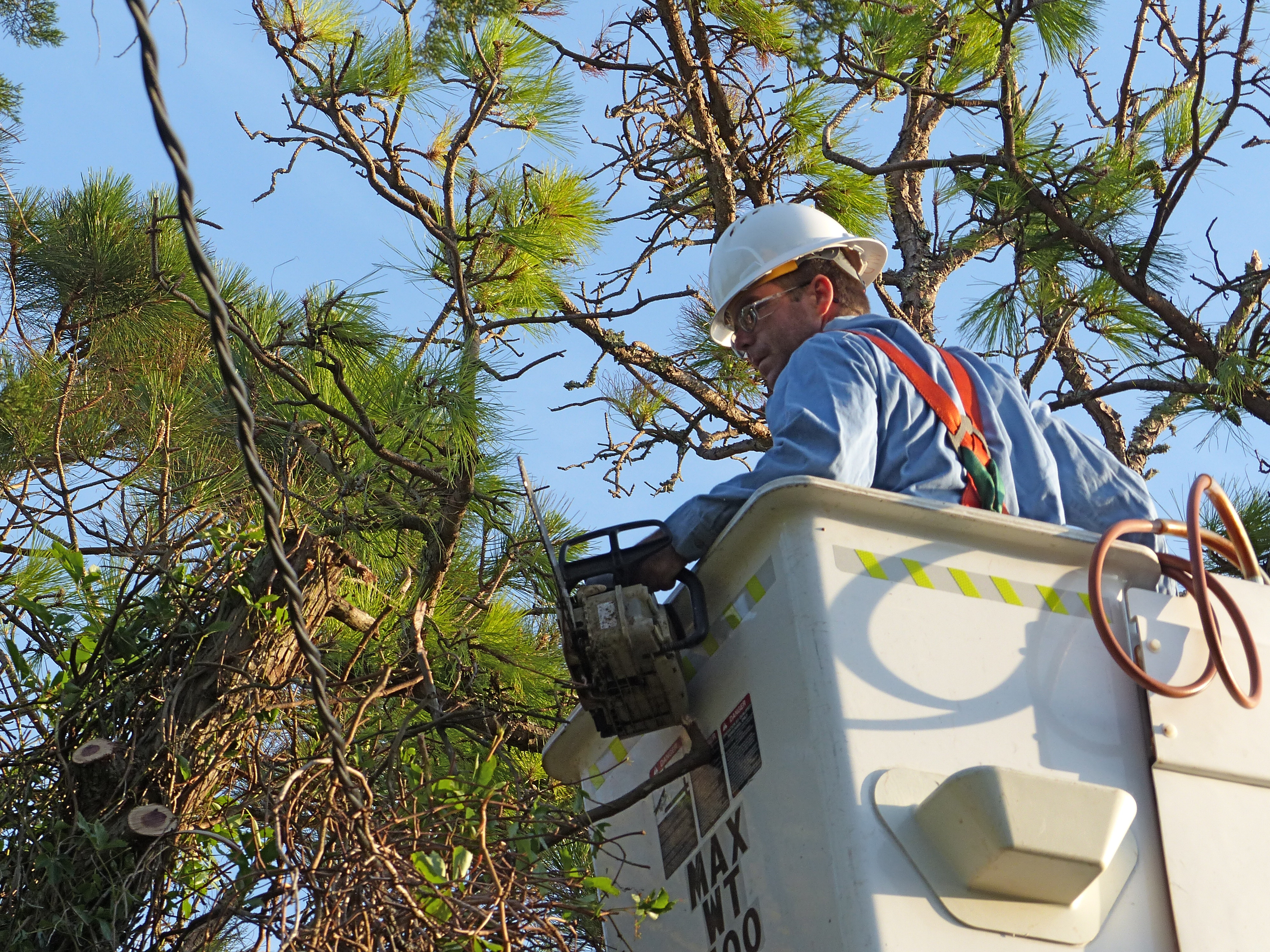
Islander Matt DeVan, a Tideland employee, removes broken tree limbs after Hurricane Arthur.
Hurricane Arthur, which went over Ocracoke Island in the early morning hours of Friday, July 4, canceled holiday festivities except the flag-raising ceremony the next day. The Hyde County commissioners had declared a state of emergency and voluntary evacuation Wednesday afternoon while Dare County declared a mandatory evacuation to begin the next day. The Ocracoke Deputy Control Group, an advisory group made up of emergency officials and some business persons, met for the first time Thursday morning and scrambled to prepare for Arthur, which, according to the National Weather Service, was classified as a tropical storm on Tuesday, July 1, but had intensified to a Category 2 hurricane and was headed for the island. Among the concerns of the Control Group were loss of electric power, over wash at the north end and the streets flooding as with Hurricane Alex in 2004. In anticipation, Justin Gibbs, Hyde County Emergency Services Director, via conference call, agreed to order pallets of bottled water and meals-ready-to-eat (MREs), and alert a cadre of medical professionals—just in case. Hurricane-force winds hit around midnight. Soon after that, the power went out. By morning, islanders were amazed to see the streets relatively clear of water although the highway north of the Pony Pens was closed due sand and water over wash.
According to Heidi Smith, Tideland EMC spokesperson, 41 electric poles were broken on Ocracoke—in the village and along Highway 12, and five were broken on Hatteras. Tideland was on the job immediately, including bringing in a special worker to fire up their generator on the island. But since it can handle only a limited load, the Control Group asked everyone on the island to turn off everything but fans and refrigerators. Power rolled around the island grids until power was fully restored Saturday evening. Many locals were concerned that a mandatory evacuation had not been ordered and suggested that any time there’s a named storm, evacuation should be mandatory. “When you’re dealing with the public, safety is the primary concern,” noted Jim Kelley, an island property owner. “Especially on this island, a mandatory evacuation is paramount.” Bob Oakes, owner of Ocracoke Island Realty (OIR), encouraged the Hyde County commissioners at their July 7 meeting, to make all evacuations mandatory. “If you’re going to evacuate people, make it mandatory,” Oaks said. “Ocracoke in a hurricane is not for visitors. Storms are unpredictable.” Visitors don’t know the effects of tropical storms, he said, and mandatory evacuation allows travelers to get their money back from insurance companies. Voluntary evacuation is too ambiguous, said Jack Whitehead, Ocracoke Island Realty general manager. “People don’t know what to do,” he said. “We’ve gotten a lot of feedback that it was very confusing.”
John Fletcher, the Hyde County commissioner who represents Ocracoke, explained in an interview that “things were in a rush on Wednesday morning” when the commissioners met with Gibbs and Bill Rich, Hyde County manager. “No one had time to mess with the (Ocracoke) Control Group. They’re just advisory and (Gibbs) met with them.” Although the notice of this meeting and the minutes of it are on the Hyde County website, this meeting was not publicized on Ocracoke. Fletcher said notices of it were posted in three places on the mainland, but since Hyde County does not have a daily or weekly newspaper, the rules of public notification differ. Sarah Johnson, Hyde County information officer, said the notice had been put on Hyde County’s website, but not posted in the Ocracoke post office or on http://www.ocracokecurrent.com. While Dare County had ordered the mandatory evacuation at 5 a.m. Thursday the same for Ocracoke would have been too late, Fletcher said. “If it’s a short time to evacuate, you have to consider where they’re getting off,” Fletcher said. “The ferries were already full carrying lots of people off.”
More visitors also left Thursday after rental companies talked further with them and about 70 percent of visitors left by Thursday night, Rich said in a recap meeting July 25 of the Control Group. Gibbs explained that after Wednesday’s decision, the forecast changed throwing a monkey wrench into things. “It’s tough being out there by ourselves,” he said. “We have to make a decision before anyone else.”
Both Tommy Hutcherson, owner of the Variety Store, and Darlene Styron, owner of the Sweet Tooth, stressed that the group needs to meet earlier—at least three or four days out. Since Ocracoke is on the leading edge of storms headed toward the Outer Banks, “we need to set the precedent as to what Dare does,” Styron said. Hutcherson noted that information was the hardest thing to get and that visitors have look in or call different places for information about the island. He suggested the county get an 800 number as a central source for all information—ferries, road closures, storm situations. Visitors would do best to call the local ferry offices for current information: 252-928-1165, Ocracoke; 252-986-2353, Hatteras.
Re-entry after a mandatory evacuation is always problematic, Fletcher noted. He said he’s looking into allowing people who own businesses to be able to sign a waiver to come back to the island to tend to their businesses after evacuations. Because of the state-of-emergency called, the rental insurance company Ocracoke Island Realty uses is honoring the policies and refunding the money of those who left, said Jack Whitehead, general manager. Jennifer Esham, owner of Blue Heron Realty, said the company they use is making decisions on a case-by-case basis. Fortunately Ocracoke did not get the flooding Arthur was supposed to bring, and infrastructure personnel were on the clean-up job early July 4.
“When the island is at risk for severe weather including ice storms or hurricanes, we try to evaluate if ferry service will be interrupted and for how long,” said Tideland CEO Paul Spruill in a prepared statement.
Rich is working on better preparation for the next storm as well as timely removal of the tree debris and getting the Ocracoke Convenience Site (the dump) back to pre-storm conditions. Bob Chestnut, owner of Ride the Wind Surf Shop, noted that this is the second time the island has been hit with major storms early in the season with the first one on Easter weekend. “It’s happened twice when nobody had any cash,” he said. Whitehead expressed sentiments of many islanders. “We’re lucky it worked out and the island got back into business so quickly,” he said. “After the storm, everybody did a terrific job.”
Lou Castro may seem like a quiet one, but get him talking about music and he’s a ball of energy as the joy of talking about his profession flows in a cascade of musical references and past and contemporary musicians.
Castro, 48, is a fixture in the music scene on Ocracoke. The number of bands he’s in changes often.“Music is like my religion,” he says. “It helps me to be a better human being. I try to learn any kind of music.” In one band, the Ocracoke Jazz Society, jazz is a new form he has been learning the last few years.
Sometimes he might have difficulty communicating with the group’s founder, Serge Gracovetsky, who is from Montreal and speaks better French than English.
“I can’t always talk to Serge (in his language), but I can through music,” Castro says. And that’s what Castro finds so wonderful about his profession: music helps people communicate and it brings diverse people together. Most nights, one is likely to see Lou in a band somewhere on the island.
Among the bands he plays in are Molasses Creek (a contemporary folk band, which is his main gig), Raygun Ruby, an 80s band, Lightning Lou and the Blackouts, which is his jazz-rock band, Martin and Lou, his gig with popular island guitarist Martin Garrish, the Ocracoke Rockers and the Aaron Caswell Band.
There’s the Ocrafolk Opry Wednesday nights, and he also plays at various venues on Hatteras. On stage he has an array of instruments. Not just the electric, acoustic, slide or steel guitar, but the electric bass There’s also the duo, Coyote, with his wife, Marcy Brenner, who also is a member of Molasses Creek.
Ocrafolk Festival 2013 photo by P. Vankevich
It all started when he was in the third grade in the Abington Friends School and growing up in the northeast Philadelphia area. He tried the violin, the recorder and piano.
His mother, who is Filipino, and father, who is Colombian, exposed him to all kinds of music. “Then I heard the Beatles and I wanted a guitar,” he says smiling his infectious grin. The iconic group from England still is his favorite band.“I discovered them after they had broken up,” he says about the Fab Four. “They showed us that our own music was cool and brought in harmonies from their parents’ era and different rhythms including Latin beats.” As the guitar gripped his imagination playing in bands was what he wanted to do. “I just always liked the idea of being in a band,” he says. “I don’t like solo playing. I just choke. I like playing off other people.” As he shows a visitor his music room that includes a baby grand piano, bookshelves full of music, computer equipment and instruments all over, he says he’s not sure how many guitars he has.
“I think 30,” he says, picking up an electric bass. “I love the guitar. It can do so many sounds.” While he loves to play covers from the classic rock and metal era, he also writes songs with Marcy, a skill he honed at Berklee College of Music, Boston, from which he graduated.
He and Marcy met in 2000 while he was living in Duck and working in the Duck Deli. “I wanted her to sing Aerosmith and she wanted me to learn Joni Mitchell,” he says about their musical confluence. “I was classically trained, but then was playing Led Zeppelin,” Marcy chimes in.
“We had rock in common,” Lou continues. “I wanted her to sing because I have no range. So, I was stuck singing Metallica, which sounds like static.” But, a few times during a set, Lou will sing at least one song, often a Beatles song. Despite his limited singing, Lou’s rendition of “It’s a Sin to Tell A Lie,” a classic swing song, made it into the top 40 of folk songs in March 2012 when Molasses Creek’s CD “An Island Out of Time,” released nationally, became the fifth most played album in folk radio.
In his spare time, Lou teaches guitar and is pleased about the progress so far of one of his former pupils, Jason Daniels, the deputy sergeant on the island. Aaron Caswell, who performs frequently at island venues, is one of Lou’s more visible students. “He’s an awesome teacher,” Caswell says. “And now he’s learning from me.”
CDs of Castro’s music in various bands can be found in many island shops. See the Entertainment Calendar, for Lou’s gigs.
Lou, second from right, jams at the 2014 Ocrafolk Festival with Serge Grakovetsky, Fuzz Sangiovani of the Caravan of Thieves, and Rob Sharer of Craicdown. Photo by C. Leinbach
Young Brown Pelicans on Beacon Island after Hurricane Arthur. Photo taken with long lens from a boat by Peter Vankevich
It’s summertime and Ocracoke is in full swing. There is a frenetic energy about the island as visitors flock to paradise and residents work hard to welcome them. This energy is mirrored on many of the smaller islands throughout the Pamlico Sound. Nesting season, from March through October, is a busy time for waterbirds.
These islands, some no more than shell mounds, are chock-full of several species of nesting birds. Black skimmers, three species of terns, American oystercatchers, brown pelicans, three species of gulls, a variety of herons and egrets, and others all nest here. Some prefer building elevated nests in vegetation. Others prefer to nest directly on the ground.
Like Ocracoke Village, winter on Beacon, Shell Castle, and North Rock islands, is a quieter time, but as springtime rolls in birds begin vying for prime nesting spots. Oystercatchers, specifically, meet up with their life-long mate and usually return to the same territory that they’ve established year after year. They will defend their turf quite aggressively from other pairs looking for a piece of the territorial pie. With territory established, parent birds begin the challenging task of raising their young.
Larger predatory birds, like black-crowned night herons and great black-backed gulls, are also nesting, requiring extra vigilance from non-predatory nesters. Yet even when surrounded by avian predators, they can defend and successfully raise chicks. The oystercatchers will fly fast and hard at a predatory bird that is attempting to steal an egg or chick. Common terns, though not large, also aggressively defend their nests and can pack quite a punch when they dive and strike with their beaks.
Weather and loss of habitat due to erosion are other variables that can determine the fate of nests. The early arrival of Hurricane Arthur took its toll on many of the ground nesters this year. Ground nests on these low-lying islands are simply no match for high winds and waves. Oystercatchers, terns, and black skimmers took the biggest hit while brown pelicans, whose nesting numbers were up from the 2011 census, lost chicks but fared better than other species.
In addition to these challenges, human encroachment during nesting season can have regrettable impacts for several reasons. The natural camouflage of eggs and chicks protects them from predators, but can make them vulnerable to footsteps. Data collecting is calculated and methodical to keep disturbance to an absolute minimum. Keeping a safe distance from the islands allows the bustling nesting season to continue undisturbed. When an adult is forced to fly away from its nest or chicks, there is a window of opportunity for predators to swoop in and make a meal of the unprotected young. Exposure to the elements is another hazard for the eggs and chicks when adults are forced to flee from humans or dogs. Some adults are quicker to fly away than others, but regardless of species, their attention is often focused on the approaching human or predator. In these instances, feeding and caring for the young is interrupted, also leaving them vulnerable. Signs on the islands remind people that these areas are closed to humans and dogs during the sensitive nesting season.
Chicks that successfully fledge from these and other nesting habitats contribute to the state bird population. Many of these species will fly far and afield on their annual migrations. For instance, banding data shows common terns have traveled as far as Brazil. Brown pelicans typically winter in the southeast U.S., but some have been recorded in Cuba. As adults, this year’s fledglings will find their own nesting grounds to begin another generation.
Maria Logan has worked for Audubon North Carolina as a biological science technician on Beacon, Shell Castle and North Rock Islands for the past four years.
Most every evening, visitors and locals alike gather at the end of the NPS parking lot by the Sound to watch the sunset.
We hope you enjoy your visit to our beautiful island. As you will see, it’s different from most shore points. Here are some tips to make your visit safe and enjoyable:
The speed limitis 20 mph. “Village-wide” means ALL streets. Please drive slowly at all times.
The village streets are narrow and shared with animals, pedestrians, bicycles, skateboarders and golf carts, all of which may suddenly lurch to avoid a puddle.
If you are walking in the dark, take a flashlight so you can see and be seen.
If you ride a bicycleat night, use a bright light. Drivers: Be aware. Many bicyclists do not ride with a night light and can, unfortunately, be difficult to see. Being without streetlights, the village is darker than most places at night.
Walk left; bike right.
Never, ever pass anyone or anything on the right.
Learn and heed the traffic laws for golf carts.
Know your street name and house number if you are staying at a cottage and should need emergency assistance.
Please pick up after your animals. Hyde County has an animal feces removal ordinance. While there is no leash law, there is an ordinance against “vicious” dogs.
Please DO NOT FEED THE WILD DUCKS. Ocracoke is trying to control them, and when humans feed them, they will not disperse to forage naturally.
Ocracoke cares about how the island looks and we recycle. Glass and metal recyclables (separated) can be taken to the Hyde County Convenience Site beside the post office.
Driving on the beach and dirt roads within the National Seashore requires a permit that can be purchased at the NPS Visitor Center.
Public restrooms are at the NPS Visitor Center and the lifeguard beach. There also is a porta-potty in Community Square. Some shops have restrooms for customers.
Please remember to tip your servers. Our restaurant workers have about six months to earn a living.
Fireworks of any kind are prohibited on Ocracoke.
Want to see more of the Milky Way? Please turn out unnecessary outside lights at night.
An official Lost-&-Found Box is now at the Hyde County Sheriff’s Dept. on Hwy. 12.
If you are staying at a cottage, know your street name and house number should you need emergency assistance.
Rip currents (not sharks) are the most dangerous thing at the beach. To view a NOAA video about them, click here.
When a community borders on the potential for a disaster, criticism of how things were handled is inevitable. Regarding Hurricane Arthur July 4, the Observer received many such comments before, In the case of how Hyde County handled the vagaries of Arthur, there certainly is some needed critical analysis of what went right, what went wrong and how to improve communication on evacuation and safety procedures, especially for our visitors. Ocracoke is not Asheville. Ocracoke is smack in the middle of Hurricane Alley. Through the centuries, the people here have experienced a hurricane or two. Based on their experience, islanders know that hurricanes can quickly shift direction and wind speed. This is exactly what happened with Arthur, when a day before its arrival it was upgraded to a Category 2 and its approach shifted to arrive from the sound–both major causes for concern.
While the county has the means to get island feedback from the Ocracoke Deputy Control Group prior to an evacuation decision, as per the Hyde County Emergency Operations Plan, the group wasn’t consulted. In an emergency meeting of the commissioners and county manager County Commissioner John Fletcher, who represents Ocracoke, advocated for voluntary evacuation while the storm was still listed as “tropical,” to which the other commissioners agreed. The local Control Group rallied on its own and admirably planned for a major hit. Hyde County updated its emergency plan a few years ago. It is a protocol that can provide continuity. You can read the 2004 version here: http://coastal.geology.ecu. edu/NCCOHAZ/county_HMP/ EOP_Hyde.pdf The newer version is not online, according to Darlene Styron, who was the Ocracoke commissioner when the latest version was done. Many islanders have told us that evacuation should be mandatory with named hurricanes since the primary concern with these unpredictable storms is public safety first, and we have to agree. But one should not just criticize. When good work is done under trying circumstances, it should be acknowledged. A huge thank-you goes to our local infrastructure workers with NCDOT, the Ferry Division, Belhaven Cable, Hyde County and Tideland EMC.
Tideland was truly amazing in restoring full power in such a short amount of time (a little over two days). Their expert work included fixing or repairing 41 poles along Highway 12 and the village and removing branches dangerously hanging onto wires.
Fortunately, the emergency generator on rolling power was not overloaded, with so many visitors still here. Special thanks to Paul Flythe, who is employed by North Carolina Electric Membership Corporation which owns the Ocracoke generator, and who came to Ocracoke to operate it. Many Tideland employees and subcontractors helped quell this emergency. According to Heidi Smith, Tideland spokesperson, the following helped: six Cape Hatteras Electric Cooperative linemen, who worked on our five broken poles south of the Graveyard of the Atlantic Museum; 31 Lee Electrical crew members (five of whom were already on the island before the storm hit; the other 26 arrived July 5). We commend the company’s prescient management, who staged the crews and got replacement poles on the island before the storm.
There are many Tideland employees who helped resolve this emergency whose names we do not have. We do, however, have the names of the island staff. Month”: Bobby O’Neal, Justin Boor, Matt DeVan, Joe Smith and Rachel O’Neal.
Hurricane season is far from over and it is comforting to know the dedication of those on the front line. Thanks, again,
Tony McGowan, left, turned over the reins of the Down Creek Gallery to new owner Marissa Gross, right. Opening receptions featuring local artists will continue under Gross’s ownership. Photo by C. Leinbach
Down Creek Gallery, 260 Irvin Garrish Highway, in the heart of the village next to Community Square has a new owner. Islander Marissa Gross purchased the gallery in July and plans to continue the successes of previous owner Tony McGowan, who had it for nine years.
“I feel that (my purchasing this gallery) is one of the few times in my life that I’m in the right place at the right time,” Gross said before one of the Thursday evening artists’ reception she plans to continue.
A photographer with a bachelor’s degree in fine arts from the University of Arizona, Gross has worked in gallery management, as a visual merchandiser with J. Crew and, most recently, as a massage therapist.
She is also an avid daily runner having competed in seven marathons and countless 10K events, including the Ocracoke race held in April.
Down Creek will continue the tradition of showcasing local artists work in November with a final season “Expose Yourself to Art” opening from 5 to 8 p.m. Thursday, Nov. 26, featuring the photographer of islander Melinda Fodrie Sutton.
These openings are open to all and feature refreshments and live music.
What’s it like to run a bed and breakfast? This is a thought that many have fantasized over. Ann Ehringhaus provides the insider’s view of her place called Oscar’s House Bed and Breakfast, built in 1940 by Capt. Joe Burrus.
If this was a book about running a B&B in a location like, say, Boone, this would be an interesting read. That the B&B is on Ocracoke and the book covers a period of more than 30 years and written by an extraordinary person who first arrived on the island as a 22-year-old grad from Chapel Hill to teach at the school makes this an essential book about gaining a perspective of a part of the cultural life on Ocracoke.
Ten Thousand Breakfasts chronicles the evolution from a traditional B&B to one that also serves as an informal kind of retreat house where both creative conversations and silence are equally respected.
As one can gather from the title (which derives from Tao Te Ching where “ten thousand” things is a term referring to all of phenomenal reality, i.e., everything physical in the world) breakfast is the magic of the B&B experience.
This is the time when everyone gathers for a great meal and strangers get to know each other. Advertising that Oscar’s House will accommodate special diets including macrobiotic and vegetarian has its benefits, and she devotes a chapter that includes several of the house recipes many of which were passed on by her guests.
Ehringhaus is a professional photographer, a practitioner of Chinese acupressure and Rosen Method Body Work, a Reiki master teacher and has a doctorate in ministry. Clearly she has long been fascinated with the spiritual/mystical side of life.
This comes out in many ways in the book, starting early on with her discovery of Reiki from a guest visiting the island for a Japanese cooking class. Reiki, which means Universal Life Force Energy, helped her create a peaceful energy for herself and the B&B.
The book includes poetry by Michele Maria Surat, a writer and teacher from Richmond and long-time visitor to the island, and Adam Schonbrun, a prolific writer who spends time in Brooklyn and Tel Aviv.
It is loaded with photographs and brief quotes gleaned from guests made over the years relating to the theme of each chapter.
I found myself surprisingly captivated by the acknowledgements of those who took the photos, many by Ann, and others by her guests. I particularly loved the image on page 45 by David Crosby from Appalachian State University of a white Persian cat in the kitchen with the door open and light filling a rectangle on the floor.
This is far more than an insider’s view of running a B&B. It is also a reflective memoir of an extraordinary person who wishes to pass along the wisdom she has gained on a long spiritual journey. It is a book written with a little help from her guests. Make that a little help from her friends.
The book is available on the island at Books to be Red, the Variety Store and the museum gift shop of the Ocracoke Preservation Society.
More information about Oscar’s House Bed & Breakfast can be obtained by calling 252 928-1311 or http://www.oscarsbb.com.
The musical play “A Tale of Blackbeard” is revived on Ocracoke after a 20-year hiatus. Above, the cast in the rollicking finale. Photo by Brenda Kremser
June 2014
By Connie Leinbach
The revival of the play “A Tale of Blackbeard” after a 20-year hiatus is the talk of Ocracoke.
An original musical by former islander Julie Howard, the show had four preview performances in May and will begin its summer run Monday nights at 8 p.m. June 9 through Aug. 11 in the Community Center. “I’m having a blast,” noted Trish Davis, who never acted before and who plays Euphemia, one of the female leads. That’s the general feeling of all the cast members.
Matt Tolson, the head daytime chef at the Flying Melon Café, is Blackbeard and also a first-time thespian, and is having a great time stretching himself. “I wrote on the audition sheet ‘not a singer,’ and, five minutes later I was Blackbeard,” he said. “I grabbed it with both horns. I have big shoes to fill, following the legendary Dave Frum, Gary Mitchell and David Senseney.” “He was it,” noted co-director/ choreographer Desiree Ricker about Tolson’s appearance—tall and commanding, with a dark beard to boot. Part of Tolson’s costume is a necklace of dolphin teeth he calls a “mystical trinket” that Senseney and Philip Howard had crafted. Tolson was 12 when he found the necklace in 1993 on the Southpoint beach. Since the community knew that Senseney had lost it, Tolson returned the necklace and forgot about it.
“Opening night, there’s a package from David and a two-page letter,” Tolson said. The letter related how Senseney had lost it. “And you found it,” Senseney wrote in the letter. “Please wear it on stage.” “The hairs on the back of my neck stood up when I read that,” Tolson said. “It gave me the chills.” Opening night of the May previews was great, Tolson said. “It kind of set the bar.” “It was the best opening night I’ve ever had from a cast,” added director Charles Temple.
The crafting of the show is kind of mystical itself in that author-composer Julie Howard, though an English major and music minor in college, had never composed much of anything before or after this work.
“It was all because of Danny Garrish,” said Howard, who was married to islander Philip Howard in the 1970s when the play began. “The PTA was doing little skits and variety shows and at one of the cast parties, Danny said, ‘What we need is a play about Blackbeard,’ ” she explained recently.
The late Garrish ran the Community Store and was an Ocracoke icon, she said. There were 500 people living on the island and a nascenttourist industry.
Matt Tolson is Blackbeard
“He was a great singer and had a good stage presence,” she said. Garrish played Blackbeard’s cook, Ezekiel, played this time by Bill Cole. Katy Mitchell plays the boarding house cook.
“I worked on it in the fall and winter of 1973 and ’74,” she said about creating the piece. At night, while she lay in bed before falling asleep, the music and lyrics would come to her and she’d write it down the next day. The well-crafted songs are catchy and clever—the kind of songs one can easily pick up and hum along, and the dialog links the songs. She still works from handwritten music on the electronic keyboard she uses for accompaniment as musical director.
The only nonfiction characters in the play are Blackbeard, who was killed off Ocracoke Nov. 22, 1718, by Lt. Robert Maynard, and Euphemia Curtis, who really had a boarding house on Ocracoke but about two centuries after Blackbeard.
“It’s total fantasy,” Howard said. In 1715, there was no village here but the colonial legislature recognized the island as Pilot Town, and some ship pilots were housed in the Springer’s Point area.
Waylon Underwood is Richard
The show has a conflicted Blackbeard the night before his date with destiny, scruffy sailors growling “Arrghh!” who are interested in the charms of the “village girls” at the boarding house, two young ingénue roles, a bickering husband and wife and comic-relief in the two cooks. There’s a William Howard character “because I had to have a Howard in the show,” Julie said. History says there was a William Howard on Blackbeard’s crew, but Philip cannot verify if he and all the other Howards on the island are descendants.
The 12 to 14 songs and characters have changed over the years depending on who’s in the cast.
“I wrote the part of Katherine for Amy because she wanted to be in the play,” she said about her daughter Amy Howard, who is the OPS administrator. Many of the cast members have family who were in it before. Joanie O’Neal, who is a village girl, is the only one who was in the cast before. The costumes are newly designed and built by Linda Ward and Heather Johnson, who also is one of the village girls. Several of the costumes from earlier plays are on view in the Ocracoke Preservation Society. Philip Howard, co-producer with Julie for many years, who also has played Quartermaster William Howard, attended opening night and praised this revival.
“It’s wonderful to do it again,” he said. “It’s the same play as before but it’s been reinvigorated with Charles and Desiree.” “I just loved it,” said islander Cindy Fiore. “It’s great to have some theater on the island.” Julie Howard says the show is pure community theater. “The cast is so enthusiastic,” she said. “In 40 years I don’t think we’ve had a cast with this much energy.”
Ocracoke Alive, which is the successor nonprofit to the Ocracoke Players, produced the show. Half of the tickets for each show will be available online at http://www.ocrafolkfestival.org/blackbeard-tickets, which includes all the details. The other half will be available, first-come, first-served at the door.
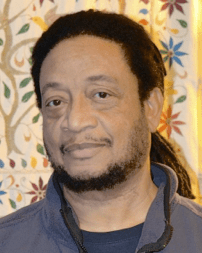
Poetry and Performance lovers, take note. Award-winning poet Phillip Shabazz of Chapel Hill is coming to Ocracoke Island to share his fire for “living words” from Aug. 7 to 8.
Shabazz, a poet, author and teaching artist, will perform from his latest collections of poems, “Flames in the Fire,” Thursday, Aug. 7, on Bob Ray’s “Rabbit Opera” from 7 to 8 p.m. on WOVV 91.0 FM.
If the cocktail hour distracts you, then at 3 p.m. Friday, Aug. 8, you can meet Shabazz for a book signing at Books to Be Red, School Road. Later that evening, Ray will host an evening to celebrate poets and performers, including Shabazz, at 7 p.m. at the Books to Be Red stage.
Shabazz, whose work expresses various points of view exploring the issues of community and culture, is a poet-in-the-schools in North Carolina and is affiliated with the N.C. Arts Council. In 1997, he became Duke University’s third artist-in-residence at the Mary Lou Williams Center for Black Culture.
Other local talents who will perform include singer/songwriter Carol Soo Lee, writers Pat Garber and Kelley Shinn, Mickey Baker, reading the poetry of Carmie Prete (unless Prete reads herself) and Ocracoke high school student, Waylon Underwood.
Ray also will perform his acclaimed “White Days Unswal¬lowed” with Kevin Hardy.
That’s the kind of Ocracoke line-up that can give you a philological hangover.
So, word up and bring seating to the Live Oak Stage at Books to Be Red. This event is open to the public and free of charge.