Home Blog Page 499

North Carolina’s Underwater Gardens: Submerged aquatic vegetation

0

August 2013

by Pat Garber

A gusty winter wind tugged at my jacket as I scrambled along the shore of Pamlico Sound, gath­ering up handfuls of dead, grayish seagrass and stuffing them into a brown paper sack. I filled four bags before turn­ing back and heading home, pleased with myself and day-dreaming about a spring gar­den. The eelgrass I carried would soon be tucked around my dormant plants, serving as mulch that would protect them and eventually break down into a nutritious fertilizer. I have been mulching my flow­ers and vegetables with sea­grass, washed up on sound-side beaches, since I moved to Ocracoke years ago. Its value as a garden-enhancer, howev­er, is only a tiny proportion of its immense importance to our coastal environment.

Looking out across the great expanse of Pamlico Sound, one may see buffleheads swim­ming and diving, least terns plummeting into the dark wa­ters, or the head of an occasion­al diamond-back terrapin pop­ping above the water’s surface. There is little indication from above, however, of the wealth of life that may lie below. Only a few feet below the surface, expansive beds of eelgrass and shoal grass form underwater gardens where life flourishes. The estuaries of coastal North Carolina have about 200,000 acres of these aquatic plants. Known as aquatic submerged vegetation (SAV), they play an important role in safeguarding the entire coastal ecosystem.

More than 150 species of fish and marine invertebrates use SAV as adults or juveniles, thirty of which are important com­mercial fisheries. SAV beds are nurseries for blue crabs, pink shrimp, and spotted sea trout, and provide habitat for juve­nile fish and small species such as mummichogs and pipefish. They form hunting grounds for larger predators such as flounders, red drum, and rays. Post- larval shellfish such as bay scallops attach to the surface of these seagrasses before reach­ing adulthood. Waterfowl such as brant and widgeons depend on eelgrass as an important food source.

Submerged aquatic vegeta­tion also enhances the health of other marine habitats by providing oxygen for coastal waters, reducing turbidity, and lessening the effects of tur­bulence. Their roots provide sediment stabilization and the grasses themselves reduce storm damage to shoreline by lessening wave action. Ac­cording to Joann Burkholder, eelgrass is a “highly efficient biological filter that removes harmful pollutants from the water.” Changes in SAV cover­age can be a sensitive indicator of water quality and overall es­tuary health, and Mark Fonse­ca, of NOAA’s Beaufort marine lab, calls them “the canaries of the estuaries.”

There are at least 50 spe­cies of seagrasses, but here in North Carolina’s estuaries the main ones are Zostera marina , or eelgrass, and to a lesser de­gree Halodule wrightii, or shoal grass. Coastal North Carolina is a unique blend, for it is on the southern-most boundary of the eelgrasses, and the northern-most boundary of shoal grass. Most beds in the state occur in waters less than six feet deep, because of their requirements for light. They are dependent on the clarity of the water column for their survival.

Seagrasses are not true grasses, being more closely re­lated to lilies. They are flower­ing plants. The flowers of eel­grass are enclosed in sheathes at the leaves’ bases, and their fruits are bladder-like and will float. Shoal grass is among the most grass-like of the differ­ent species. Sea Grasses live in a harsh environment, with their roots fixed in a bottom of sulfide-ridden sediments toxic to most plants, forming under­water meadows.

During the 1930s there was a massive die-off of eel­grass in northern Atlantic waters. Ninety percent of the beds were lost to what was called the “wasting disease,” its causes still not fully under­stood. There has been some recovery since then, but sea­grasses are still a matter for concern. Here in North Caro­lina, the more eastern beds of SAV, which have high salinity, seem to be stable (with pos­sible exceptions in southern estuaries). Beds nearer the coast, however, in the western parts of Pamlico, Albemarle, and Currituck Sounds, have been in decline since the 1970s, with losses of fifty percent or more in these low salinity ar­eas. Studies show that SAV is declining on a national and global level.

While the reasons for the decline are not fully under­stood, it is believed that run­off from the mainland, which causes nutrient and sediment overload, excessive amounts of nitrates in the water, and a reduction in light, is a primary cause. Warmer water tem­peratures are also believed to contribute, causing reduced grass shoot density, a decrease in leaf and root development, and alterations in internal carbon and nitrogen composi­tions. Disturbance by channel dredging, filling submerged bottoms, and trawling in ar­eas of grass cause further de­cline, and the effects of climate change and sea level rise are now being assessed.

According to Patricia Smith, Public Information Officer for DMF in Morehead City, the distribution, abundance, and density of SAV varies season­ally and from year to year, making it more difficult to monitor and protect. Mount­ing concern over the health and well-being of SAV beds and the life that depends on them has led to new efforts to protect them. State agencies have been mapping the beds since 1981, and recent map­ping efforts using sophisticat­ed GPS devices have identified at least 139,000 acres of SAV along 75,000 miles of coastal shoreline.

In 2006 a Memorandum of Agreement was signed by 25 state agencies, universities, and conservation groups, cre­ating the NC SAV Partnership, dedicated to promoting con­servation efforts to protect the state’s submerged grass beds.

The North Carolina Habi­tat Protection Plan, which was updated in 2010, identifies the protection of SAV as a prior­ity. It has determined that “the monetary value of the ecosys­tem services provided by SAV, such as waste management, food production, and climate regulation are very high.” The plan contains new information on the ecological understand­ing of eelgrass and shoal grass, including the light and water quality conditions needed for healthy grass beds.

Plans to protect and im­prove SAV habitat include the adoption of coastal storm-wa­ter rules by EMC, a modified SAV definition by MFC, and revised dock rules by the C R C. Certain kinds of fishing gear are prohibited in SAV, includ­ing trawlers, oyster and clam dredges, hand tongs, and clam rakes more than a foot wide. DMF does not permit shellfish leases or the seeding of oyster cultch in SAV, and CRC has rules prohibiting new dredg­ing and filling in areas with grass beds.

Seagrasses are also pro­tected by the U.S. Corps of En­gineers, which in 2012 imple­mented new regulations which forbid the disturbance of SAV beds.

With the current levels of concern and the actions be­ing taken for their protection, it is hoped that North Caro­lina’s underwater gardens of eelgrass and shoal grass will remain stable or increase, thus ensuring the many benefits they  provide.

Health and Wellness: Ways of feeding the ‘good wolf’ within

0
taichi_000
Tai chi on the Ocracoke beach.

August 2013
By TL Grace West

You may be familiar with one of my favorite stories about a conversation between a Grandfather and his Grandson that goes something like this:

Grandfather: “everyone has a good wolf and a bad wolf living inside of them”

Grandson: “I think it was the bad wolf that influenced me to misbehave”

Grandfather: “Yep, I’d say so”

Grandson: “ what do I need to do to strengthen the good wolf?”

Grandfather: “That’s easy, the wolf that is fed is the strongest”.

Exploring and becoming a teacher of Tai Chi, Qi Gong and Ai Chi are ways I have found to feed the good wolf in me. A quote from Barbara Kingsolver’s new book “Flight Behavior” helped shape my intention for this article. She says “words are just words, describing things a person can see; maybe a person has to know a thing first, to see it.”

I would like to paint a picture of what goes on in classes: Tai Chi, Qi Gong, and Ai Chi, so that you might both see and know more about these words and experiences.

Let’s start with Ai Chi. Imagine entering a warm water therapy pool (about 94 degrees), moving and being moved gently by the water, starting first with a series of arm movements, then moving the whole body. Feel the water support your balance and breathe as your ability to move smoothly and naturally increases. The simplicity of only 16 movements in all helps you remember that the sequence can be done in 10 to 15 minutes and repeated as much as you want.

This is just a snap shot of what you would see in a class but it hints at some of the things that I have learned and know.  I know that I like warm water and as I relax, my range of motion and the tight places in my body let go. I know the buoyancy of water supports my sometimes achy joints and that I feel little or no pain.

I like to learn what others have found helpful, especially when it can be done in a reasonable amount of time. I first saw a video of Ai Chi and later learned it was developed in Japan by a swim coach who adapted what he knew about tai chi and applied it to water. He believed and found it was true that as his swimmers learned better how to relax in the water their efficiency increased. As a teacher of Tai Chi, I also knew I wanted to bring the benefits of tai chi to people whose knees were not up to standing on a floor.

I was drawn to study Tai Chi back in the early 1970’s. I had seen people on TV from China doing these slow graceful movements and I was simply intrigued. I knew I liked meditation (quieting my mind, a kind of prayer) and I learned that Tai Chi is sometimes called ‘moving meditation’. I loved my first Chinese teacher who at 80 years old was as flexible and healthy as a young person! I knew I wanted to grow old like this. I liked how I felt doing the Tai Chi movements and how the feeling of peace, strength and balance lingered after I ended my practice.

While I visited Ocracoke during the 80’s I enjoyed doing Tai Chi by the ocean side and wanting to share my experience, I made the commitment to become a teacher 10 years later when I moved to Ocracoke full time. Since I combine Qi Gong into my Tai Chi classes, let’s turn to what Qi Gong is before I paint a picture of what class is like.

Tai Chi dates back to the 12th Century, while Qi Gong is often said to be its “Grandmother”. Ancient. The focus of Qi Gong on healing as well as harmony attracted me to its multi-faceted movements and sounds that weave together Chinese practices meant to enhance health. Although I’ve learned a lot about Chinese philosophy while studying Qi Gong, it is in the doing of it that resonated with what I know about the benefits of stilling my mind, being present and moving gently and feeds the ‘good wolf’ within.

Imagine walking up the steps at Angie’s Gym and hearing soft Chinese music welcoming you into Tai Chi/Qi Gong class. As you enter into the hour class, you follow me through warm ups noticing your increased ability to relax. Your mind may be interested in the information I slip in about the benefits of specific ways of moving, or you may simply enjoy “monkey see, monkey do,” following along.

As the warm ups and Qi Gong movements flow into doing the sequence of the ‘Park Form’ of Tai Chi I begin telling the story behind this form. The story begins before you are born, continues through your birth, into life’s lessons and ends with the moral of the story: to be grateful for how we are all connected. You may be surprised that only 10 minutes goes by for all three parts of this Tai Chi form.

At the end of class I observe students often smile softly with glowing eyes looking refreshed. I wonder if the “good wolf” is resting happily after such nourishment.

TL Grace West loves to both exercise and relax. After a good workout you can experience her warm water massage therapy. http://www.floatwithgrace.com  (919) 418-5472; (919) 418-5472


New wheel-chair ramps proposed for Ocracoke pedestrian beach access

0

August 2013
by Connie Leinbach

Ocracoke Islanders at­tending the public presentation July 17 of the NPS plan to renovate access points to the National Seashore overwhelmingly asked for more sound-side access.

The plan, titled “the envi­ronmental assessment (EA) for the Proposal to Facilitate Addi­tional Public Beach Access,” is for 29 projects along the Cape Hatteras National Seashore, from Bodie Island to Ocracoke. The Ocracoke projects call for handicap ramps from the decks at the Lifeguard and Pony Pen access points to the beach. About 23 attending the public presentation in the Oc­racoke School Gym all-pur­pose area.

A new ramp would be built for wheelchair accessi­bility at the north ferry dock area to the beach. Since the north end of the island has been closed to both vehicles and pedestrians since Feb­ruary of 2012 when the new ORV plan went into effect, a new ramp—59.5—would be built further south of the now-closed ramp 59.

“This new ramp is out of the bird area at the north end of the island,” said Ran­dy Swilling, the natural re­source program manager for the CHNS.

He said the plan also calls for a new ramp called Ramp 63, further south of the cur­rent Ramp 67, and another parking area would be built on the sound side of High­way 12 at Borrow Pit Road.

The presentation at Oc­racoke and at other sites along the national seashore is the first public comment period. Citizens have until Aug. 2 to make comments on this pro­posed plan that calls for four new ramps and two ramp re­locations along the seashore. The plan can be accessed and commented on online at http://parkplanning.nps.gov/ beach_access. Comments can also include which projects are most important.

Swilling said all com­ments and priority sugges­tions will be evaluated. Then the final plan will be sent to the park’s regional office in Georgia for final approval.

Although these approvals will take some time, Swilling, who is managing these proj­ects, said, “We really want to get these projects started as soon as possible. We’re hop­ing by the end of summer.”

While these projects have been six years in the making, he said it’s taken a lot longer to write the environmental assessment because the proj­ect area is so big.

“This plan in no way lim­its us as to future projects,” Swilling added about the possibility of more public access to water on the Pam­lico Sound side of the island. The difficulty in developing those would be funding and environmental compliance, according to Darrell Echols, deputy superintendent.

“But we’re not closed to the idea,” Echols said. He also said that repairs to the south side dock at the end of the NPS parking lot and the NPS dock on Silver Lake, both of which were damaged in last October’s Hurricane San­dy, are ready to go as soon as they receive new account numbers from Washington. He hopes these repairs also will begin by the end of sum­mer.

These projects that fa­cilitate visitor access to key recreational areas within the National Seashore are part of the controversial Final Rule Off-Road Vehicle Manage­ment Plan (ORVMP) that also implemented fees for beach driving and has al­lowed for more closures on the beaches for wildlife.S. Senate bill #486, which has passed out of commit­tee but has not yet passed the Senate or House, calls for loosening of some of the restrictions of the Final Rule, such as, extending the sea­sonal off-road vehicle routes, decreasing the buffer zones around turtle nests and al­lowing for the beach to open in the morning as soon as park personnel have cleared the nesting areas in “rolling” openings.


Walk about Springer’s Point

0

August 2013

By Samara Skinner

springers pt beach


Springer’s Point is a 122 acre tract of land owned by NC Coastal Land Trust located on Ocracoke Island. The area is a nature preserve focusing on the protection of the conservation values of the property, while allowing passive recreation and low impact public enjoyment of the area.

Though everyone may come to the island through different happenstances, no one forgets their first experiences on Ocracoke. From age six I remember the smell of honeysuckle on bike rides past the lighthouse, the oyster-shell driveway at the summit of Loop Road, and the sandy trail next to the camper that I played make-believe on when no one was watching. Back then – before the land trust set Springer’s Point up as a nature preserve – it was just a pretty piece of land I happened to live by, but now as I begin to wander through my adult life, I have been drawn back to that place.

Len Skinner, otherwise characterized as my father, is the caretaker. Among other things, he maintains the trail on a daily basis, creates informational signs, and manages the opening and closing of the nature preserve to the public. In addition to Len’s conservation efforts at Springer’s, he tends the historic Emma and Simon O’Neal house (built circa 1900), paints signs for local businesses as seen at Thai Moon and the Flying Melon Café, and builds constructions like the fig leaf bar area at Back Porch restaurant. Since I have walked the trail at Springer’s Point countless times, both with my father and alone, I wish to offer you the reader the same experience.

Springer Point sign

When you arrive at the entrance to the trail you can see an owl carved atop a stump. Similar tree statues created by Len can be seen around the island: two examples being the shoal of fish carved into a tree outside of the Anchorage Inn and the dolphin mascot made from mottled Ocracoke wood at the school.

As you start to walk along the Springer’s Point path, you begin to be enveloped in foliage: Wild high bush blueberries, planted mulberry and fig trees, and the original red honeysuckle that was home in this country long before the yellow variety was brought from overseas. Wooden signposts have been erected in places that mark and describe vegetation including wax myrtle, black needle rush, and yaupon. In a fenced off area on the right of the trail, the Georgia sun rose, a highly endangered flora that rarely blooms, rests in the sand among prickly island cacti.

You come to a clearing under the forest canopy where a large tree hosts a bird feeder. A raccoon is perched on a stump – another of Len’s creations – in commemoration of a raccoon who had lived nearby in a bird house intended for great horned owls who had decidedly built their nest elsewhere. A bench waits for weary travelers to sit and listen to the rush of leaves. When the wind blows, the trees seem to be interacting with one another, conversing on a telepathic level, exchanging the mysteries of life above your head while below their trunks twist at unusual angles.

The path separates into a loop, and at the point of division rests a small cemetery. Here Sam Jones, an old proprietor of the island, is buried next to his horse, Ikey D. There is a small cement statue brought in by the caretaker as a grave marker for the horse. A tombstone for Sam is also nestled within the ivy, marking where he was laid to rest, buried at an angle because he wanted to be vertically placed within the ground, a wish that couldn’t be fully achieved due to underground water residing so close to the surface.

In your first view of the sound, if you’ve chosen the left path, you can see the signs of the conservation area.  Island environmentalists have implemented a shoreline restoration project by planting marsh grass and introducing bags designed to attract oyster spat, or young, to colonize a living reef.

Then the trail deposits you on a quaint beach, wrapping the sound in a small semi-circle. A rock peninsula, the veritable “point” of Springer’s Point, juts out at one side of the sandy cove. Warm water, dogs wading in the tranquil surf, children mesmerized by crabs that scuttle across the ocean floor. The horizon is full of gentle sea and the sun making its slow descent toward the earth.

Please remember, there is no accessible parking at Springer’s Point. Bikes may be left at the designated area at the trailhead. The path is only available for foot traffic and the wandering soul, so this is not the place to bring an expanse of coolers, beach chairs, or other incumbent seaside gear. Springer’s Point is a meditation of island life, a reflection of serenity. Bring your sandals, your senses, your canine companion if you wish, and walk into nature.


Regarding the Park Service Public Hearing

0

Sept 2013

Ocracoke, NC

July 17, 2013

I am J.S. Fletcher II, sev­enty-five years of age.

When first on the Outer Banks, I remem­ber black or dark green shades that were pulled down at dark before the curtains were drawn. At all steps entering the cot­tage were bottles of kero­sene and rags. Rages were used to scrub the oil and tar from your feet. Believe it or not, the environment survived all the oil and tar without a massive clean up. We were fighting a war.

When the National Seashore came it was funded to a great extent by grants from the Paul Mellon Foundation. As “a park for the people” it was not a nature pre­serve. Wildlife should be considered, but people should come first in this area. There are wildlife preserves.

Now we are paying a fee to take a vehicle on the beach. Next we will pay to park and to walk on the beach. The money raised, I understand, is to be used to improve ramps, build walks to the shore, and increase park­ing. If you could drive on the beach, more parking may not be needed. Hard improvements on the beach are just something else for storms to destroy. In driving 59 years on the banks, the only place I have had trouble park­ing is on Hwy 12 between the Wahab Cottage and the bank. We drove on the beach before there were any ramps. The Park Service does not need more to look after. It cannot keep up with what it has. The firebreak at the northeast end of Ocracoke Village has been grown over 3 or more years. If the village were to burn as it may from a fire started on the Plains, the county of Hyde would lose 60% of its income not to mention the loss of lives. Does the park service have the time and money to send employees driving up and down the beach while the safety of the people on Ocracoke is at risk of fire? Yes!

When the park service came to Ocracoke, I have been told by many older residents who appeared to be of sound mind, that the citizens were prom­ised before they sold their land that they could use the beach as accustomed including the removal of sand from the beach. Who forgot?

The closing of the beach at night and early mornings has caused surf fishermen to abandon Oc­racoke in favor of places where there are private beaches that are open 24 hours a day. Hyde Coun­ty is the only county in the nation, that I know of, where 100% of the coun­ty’s oceanfront is owned by the Federal Govern­ment. Are we blessed? Should not Hyde County have some beach open 24 hours?

Thank you for your time,

J.S. Fletcher, II

County Commissioner for Ocracoke Township

(I do not speak for the Board of Commissioners)

PO Box 1479

Ocracoke NC 27960

CC: Copies various Federal
and State Officials and
Publications

Henry’s Kitchen: Fresh tuna

0

August 2013
By Henry  Schliff

For many years tuna has been second only to shrimp as America’s favorite seafood but most people bought it in a can to make tuna salads and casseroles. That has all dramatically changed now and fresh tuna is wildly popular, so much so, that Ocracoke Seafood is having a hard time keeping it in stock this summer. Almost to prove this point, just a few days ago when tuna was out of stock, a woman rejected the wide array of choices in the case (pristine fish along with shrimp, scallops, and oysters) and walked out saying “I guess I’m just a tuna girl.”

I too have come to love fresh tuna. I like it marinated and grilled, seared or blackened, wrapped in a sushi roll, or made into fresh tuna burgers. When cooked rare to medium-rare it rivals the best filet mignon for tenderness and taste and is well suited for the most delicate of French sauces. When grilled it can be marinated in assertive Asian flavorings and is delicious served with pickled ginger and Japanese horseradish (wasabi). On a toasted roll it makes a burger that rivals the best that ground beef can offer. 

Tuna Facts:

  • Tuna inhabit the upper and middle layers of ocean water but can be found at a depth of 1,600 feet or more depending on size and species. Tuna are found in all of the oceans of the world (except in the Artic) and roam continuously over long distances north – south and across oceans.
  • Tuna has a unique circulatory and respiratory system that gives them an internal  temperature that is higher than the surrounding water. This higher internal temperature combined with their oxygen-rich blood (which results from the continuous movement of water over their gills) permits tuna to swim at high rates of speed (yellow-fin tuna can swim up to 50 mph for short distances).
  • Tuna feed indiscriminately on a large variety of crustaceans (shrimp, lobster, crabs), cephalopods (octopus and squid), and fish. They use their keen eyesight and swift swimming ability to compete with other large predators.
  • Yellow-fin tuna (called Ahi in Hawaii) is the most common species of tuna found in North Carolina waters. Yellow-fins grow rapidly upwards to 6 feet in length, can weigh up to 400 pounds or more, and live for up to 8 years.
  • A 3 oz. serving around of yellow-fin tuna has only 110 calories, 24 to 25 grams of protein and very little fat. It provides beneficial amounts of choline, vitamin A, vitamin B12, riboflavin, thiamin, Vitamin B6 and niacin along with several beneficial minerals (magnesium, potassium, phosphorus, selenium, and iron).

Purchasing and cooking fresh tuna
Always buy fresh tuna from a market that you know you can trust (preferably sushi-grade and domestic) and never pre-wrapped in a supermarket. The flesh of fresh tuna should always be very moist, have a shiny deep red color, and a fresh salty aroma (never a pungent smell). Tuna is more prone than other fish to bacterial development because of its high internal temperature and should always be kept on ice until it is cooked, preferably on the same day it is purchased. It can also be tightly wrapped and frozen immediately and used within a month but should always be defrosted slowly under refrigeration and cooked immediately.

Since tuna has very little fat it can get dry and chewy if overcooked and should always be cooked either rare, medium rare or at least pink inside. If you prefer your fish well done I recommend that you buy another fish that has a higher fat content or one that is served with a sauce that has a high fat content (butter or cream).

Tuna Burgers in Paradise
1 lb. fresh tuna
4 Tbs. olive oil
1/3 cup minced sweet onion
2 medium-size cloves garlic, peeled and finely minced
1 jalapeno, seeds and veins removed, finely minced
½ cup fresh bread crumbs
2 tsp. low salt, naturally brewed, soy sauce
¼ tsp. black pepper
¼ tsp. thyme
Cut the tuna into small pieces and coarsely chop it in a food processor or finely chop the tuna by hand using a sharp knife. Place the tuna in a bowl. In a small skillet cook the onion in olive oil until it becomes soft and translucent. Stir in the garlic and cook briefly until it softens. Add the onion and garlic to the tuna along with the remaining ingredients. Form the tuna into 4 patties, place on a plate, and refrigerate until cooking. Heat the remaining olive oil in a large skillet and add the tuna burgers leaving enough space in between them for turning. For rare tuna burgers cook over high heat until seared underneath (firm and lightly browned – about 2-3 minutes). Turn and sear the burgers on the second side. Remove the burgers from the skillet and place them on a serving dish (for burgers that are more well done adjust the cooking time accordingly). 

Serving the Tuna Burgers
4 toasted rolls or 8 toasted slices of French or Italian bread
Ginger-wasabi mayonnaise (see recipe below)
1-2 fresh tomatoes, thinly sliced
½ large sweet onion, thinly sliced
½ bunch romaine lettuce leaves, washed and dried
Sriracha hot chili Sauce (available at Thai Moon)

 Spread an ample amount of the ginger-wasabi mayonnaise on the bottom half each roll or on 4 of the bread slices. Place the burgers on top of the mayonnaise and then layer with slices of tomato, sweet onion, and lettuce leaves. Cover with the tops of the rolls or the 4 remaining bread slices. Serve with Sriracha sauce (or your favorite hot sauce) to be used as desired. 

Ginger-Wasabi Mayonnaise
½ cup mayonnaise
2 packed teaspoons of peeled and grated fresh ginger
2 tsp. wasabi powder (available at Ocracoke Seafood and Zillie’s Island Pantry)

Place the mayonnaise into a small bowl and whisk in the ginger and wasabi.

Note: to make fresh breadcrumbs: Place slices of fresh bread into the bowl of a food processor and chop them into coarse crumbs. If no processor is available cut thick slices of crusty French or Italian bread (soft bread doesn’t work) and grate it by hand using the large holes of a hand grater.

Henry Schliff has been the chef of a French, Italian and Mexican restaurant, and was most recently the owner of the Orange Blossom Bakery in Buxton. He is the author of two cookbooks.


The Flying Melon has a Brand New Building and Location

0

July 2013
by Connie Leinbach

A test of a business’s value to its customers is when it’s not open, everyone hankers for it. That happened over the winter and spring as The Flying Melon restaurant, which had been along Highway 12 since 2006, decamped for the winter while a new building was built on Back Road.

“When is the Melon open­ing up?” was a refrain heard frequently in the spring as islanders watched the prog­ress on the first new restau­rant building in decades took shape.

June 13, it finally reopened, and “we’ve been busy ever since,” said Paula Schramel, who with her husband Mi­chael, owns the res­taurant, designed by Garick Kalna and built by Junior Perez. Inside, the design with several rooms and nooks makes it look larger although the total number of seats is the same. “The flow is better,” noted veteran server Lori Masaitis.

The new interior features a wooden spiral stairs that leads to an upstairs lounge where din­ers can have drinks or dessert. Although it is new, the spiral stairs were aged to comple­ment the reclaimed maple floor throughout the building, Paula said. Islander Len Skin­ner did the “aging” work on the stairs and also crafted the new signs for the outside of the building.

Paula, who has an interest in antiques, scoured the In­ternet for old sinks and light fixtures such as chandeliers and sconces, all of which add to an old-world, yet hip, new ambiance. She is proud of the backlighted fleurs-de-lis em­blems on the new bar in the entrance area. “Michael had to have fleurs-de-lis, which are the emblems of New Orleans,” she said about the theme of the restaurant and whence the Schramels hail. The menu and prices are the same, but the Schramels have added mixed drinks to the alcohol offerings.

While the soft green walls include the cut-out rooster partitions from their previous building, Paula is waiting to add art to the walls. “I have to think about that,” she said.

Outside there is a riot of plantings hugging the build­ing and a watermelon patch/ front lawn, which Paula said will be great for re­ceptions.

“Isn’t it beautiful?” gushed Joanne Keeler of Manteo, who waited with her husband Andy to be seated. “The interior is gor­geous. I just love the lighting choices.”

Keith Beau­mont of West Ches­ter, Pa., who is a sometime contrac­tor, admired the ar­chitectural details of the cypress-clad building. “Inside upstairs there’s a little window that lets you see down into the dining area,” he said while out­side the building looking over the details. He also noticed the copper in the outside railing which differs from the typical steel. Although the building is new, “it looks like it’s been here,” Beaumont said.

But the food from Chef Michael is what draws the crowds. “I missed this place,” noted Sunday brunch diner Catherine Farley. “The Fly­ing Melon is always good. I’ve never had anything I didn’t like here.”

The Flying Melon serves a full brunch menu 9 a.m. to 2 p.m. Tuesday through Sunday, and dinner from 5:30 to 9:30 p.m., Tuesday through Satur­day. They also offer catering services.

Congratulations Ocracoke Graduates

0
Grads 2-13 DSC00516
2013 Grads Zackery Jordan “Jordy” Jenkins, Casey Tolson, Diana Perez and Miguel Monter

Ocracoke School launched four seniors during graduation cer­emonies in the school gym.

Valedictorian was Zackery Jordan “Jordy” Jenkins, who is a commercial fisherman and will attend the College of the Albe­marle in the fall. He received $4,562 in scholarships.

Casey Camden Tolson was the salutatorian and begins work immediately with the NC Ferry Division as well as com­mercial fishing. He received the National Career Readiness Certificate, an industry-based honor from the governor that certifies workplace skills for students immediately entering the workplace.

Diana Perez will attend East Carolina University in the fall and will pursue a ca­reer in the medical field. She received $16,162 in scholar­ships, including the $10,000 People Helping People State Employment Credit Union scholarship.

Miguel Monter will work in the kitchen at Gaffer’s.

“He’s going to be a won­derful chef someday,” said Laura Kelly, school princi­pal in an interview Monday about the four-member class and added that Perez is con­sidering becoming a doctor.

Kelly recently announced her resignation at the end of June and will return to Frank­lin County to work in the school system there and be closer to her extended family.

“They’re all really won­derful,” Kelly said about the seniors and the Ocracoke school children she has got­ten to know this school year.

“This is an awesome place and it holds a special place in my heart,” she said, “but there’s a two-year-old grandson who’s calling my name.”

Kelly noted that while the Class of 2013 had only four stu­dents, classes behind them are growing, such as pre-K, which will have 18 students in the fall, among the largest classes ever for Ocracoke. There were 19 stu­dents in eighth grade this year, which would have been the larg­est class ever, but that dropped down to 18 during the year. Both first and ninth grades will have 17 children.

The elementary building be­hind the main school building has classrooms large enough for all these students, “but we’re go­ing to need to grow,” Kelly said.

One of those options will probably be the building owned by the Hyde County School District that currently houses the Ocracoke Volunteer Fire Department, which will move into new quarters being built along Highway 12.

Walter Padgett, the school principal for two years before Kelly, was the commencement speaker and Kelly and Dr. Ran­dolph Latimore, superinten­dent of Hyde County schools, awarded the diplomas.

The Howard Bennink, a teacher at Ocracoke School received the Community Ser­vice Award, a tradition by Oc­racoke seniors conferred on a community member.

Diana Perez created the slide show of class memories

Spotted on Ocracoke: A Snapping Turtle

0

July 2013
Text and Photo by Peter Vankevich

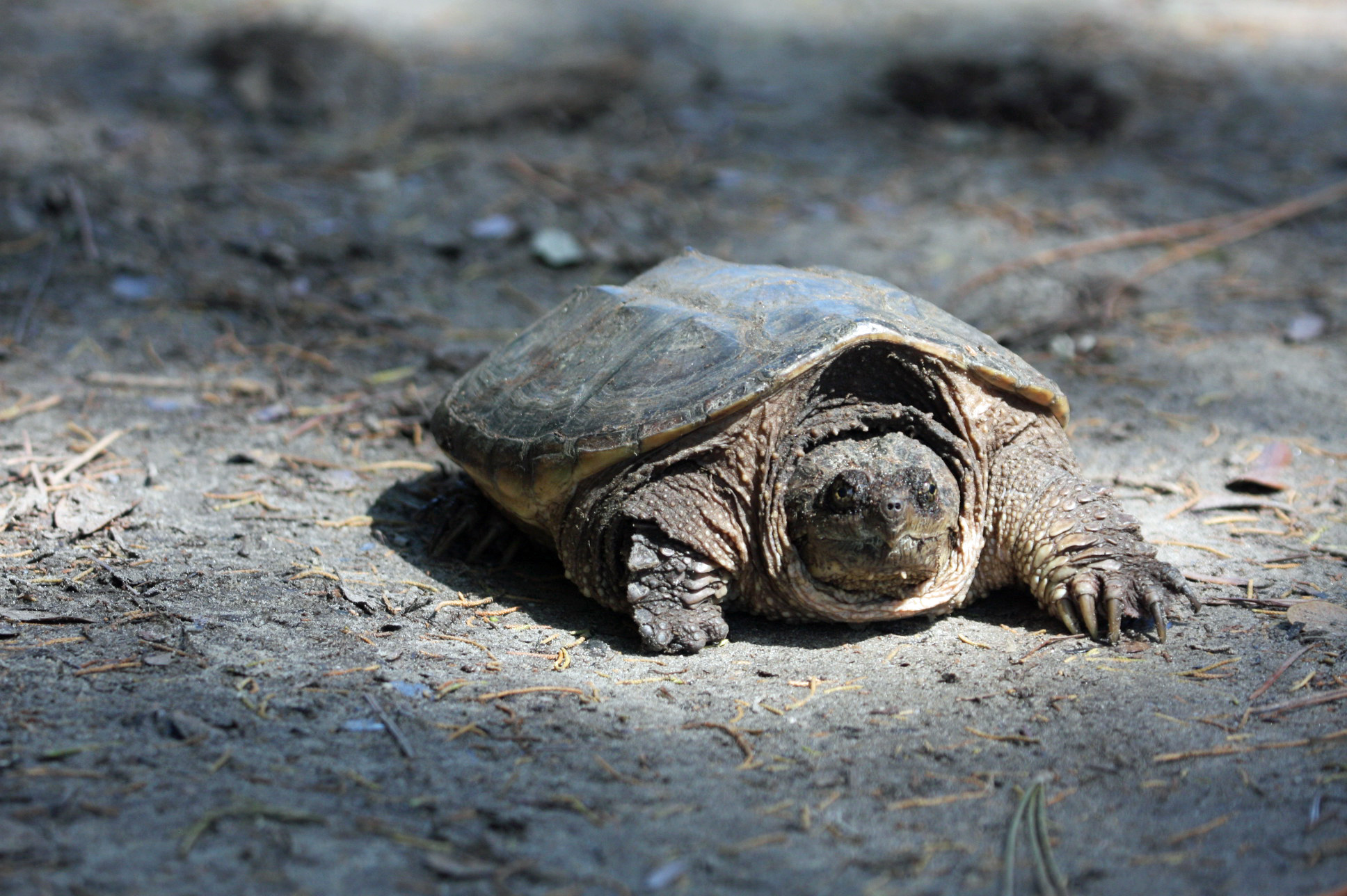
snapping turtle PS IMG_2660

There are several turtle species that can be observed on Ocracoke. In the spring, one of them which you may come upon when you least expect it (as I did recently) is the common snapping turtle (Chelydra serpentine). During this time of the year the females will leave the water in search of a suitable location to lay their eggs. Others will leave their habitats in search of better ones.  I have seen several snapping turtles on land this May and June (2013) in on the village. One of them, much larger than this guy, spent a morning in my neighbor’s yard digging a hole to lay her eggs. Such a clutch can be between 20 and 40 eggs and sometimes more. If all goes well, they will hatch in about three months from the time they were laid.

As its name implies, the common snapping turtle can be found throughout the state of North Carolina and indeed throughout most of North America beginning in Southern Canada. They favor shallow fresh water ponds and streams that have abundant subaquatic vegetation though they can also be found in brackish waters including the mosquito canals that are found in the village. Omnivores, their diet consists of plant life as well as live and dead fish, amphibians, and just about anything of suitable size that may be unfortunate to find itself within its striking range.

 Unlike the aesthetically handsome and terrestrial Carolina box turtle that can be seen sometimes in the denser vegetation areas the village, these turtles convey a very rugged, even brutish and ancient look about them. They have three defined ridges on their upper shell (called the carapace), a large head and a long serpent-looking mobile neck.

With longevity of up to 30 years in the wild, they can grow up to be quite large. The heaviest individual found in the wild weighed abrrout 75 pounds though most weigh between ten and thirty-five pounds. Larger specimens are sometimes confused with the alligator snapping turtle which is not found in North Carolina but resides in states further south

If you see one walking on land, just think of their name and do not try to pick it up. Snapping turtles are more vulnerable to predation on land than in the water and will be far quicker to defend themselves. They do not attack, but if you get too close, they will give a warning hissing sound. Their long, flexible neck, powerful jaws and quick reactions, makes it unwise to hold them. You do not need to help them find water.

In the past few years, snapping turtles have been showing up in ponds in Italy. This is probably due to someone releasing their no longer wanted pets into the wild. A problem apparently that exists not just in United States.

If you have an interest in this subject, a book you may want to pick up is Amphibians & Reptiles of the Carolinas and Virginia published by the University of North Carolina Press. It has great photographs, distribution maps and succinct text. Using it, I was able to ascertain that the glass lizard I found recently in my backyard was a subadult. It is available in at the Ocracoke Community Library.

The negative press sticks longer

0

July 2013
By BJ Oelschlegel

I was scooping ice cream for a family (my other job) and as they proceeded to pay, the dad made a com­ment about the incred­ibly long amount of time the ferry took to get over to the island. “It took for­ever to get down here.”

I ventured that the ferry ride had been a 40-minute route and now, with the new channel, it was a 60-minute trip. “The difference is only 20 minutes, sir.”

“Wow! Really?” was his response. When I re­framed the time span, he countered with amazement.

I took from what he was saying that this day trip was a yearly event during their Nags Head vacation. He was familiar with the two-hour travel time but that last 20 minutes really col­ored the entire excursion for him. If he had traveled the route as many times as we each have, he would have been familiar with this minor shift in travel time. I think he had an ex­pectation that this was go­ing to be a rough ride and sure enough, it unfolded as he had anticipated.

It seems apparent that the amount of press about the various hurdles we have had to traverse is taking its toll. The media has had sooooo much to write about; if it wasn’t the ocean washing over the “S” curve, it was the channel filling in, the long wait to come over or the wind picking up to stop a ferry run. The residual ef­fect of so many reports is lingering longer than real­ity calls for.

It’s easy for the negative press to hang around. Our island environment lends itself to exaggerated im­ages. One has to live here to know the truth. We all have family members call­ing with the first mention of a storm on the Weath­er Channel.  The words “hurricane on The Outer Banks” automatically con­ger up, for the land lub­ber, adjectives like “blown away,” “cut off,” “demol­ished,” “stranded.”

So of­ten these pictures are far from the truth. I tell my prospective buyers that the island sits in a much better position because the water washes in, over and out. The hardest part is the prepping and then the waiting. Experience is a great teacher and never having lived through a storm leaves a void to be filled by wild mental pictures.

It is hard to convince the general public that we are safe and sound. They might have an easier time of believing it with the press releases put out by an online newspaper.  The message gets convoluted due to an aspect out of our control. It is so darn profitable to dramatize the weather events; the livelihood of the media is based on this drama. Remember when the grocery store in Hatteras had a marquee which gave Jim Cantori an Emmy for “Best Dramatic Performance” after Hurricane Irene (2011)?

We also have the additional burden of so many events. It was like we had no re­covery period; those dam­aging waves of events just kept slamming us, one af­ter another. And yet, we are not totally out of the woods. The old channel is open again but not wide enough for two ferries to pass, therefore slowing the shuttling of cars from Hatteras to Ocracoke and back again. That channel could be seen as the gift that just keeps giving.

So, what is the solution? As with every other as­pect of village life, it looks like the burden of shift­ing the public’s percep­tion will fall on the com­munity. This society is so resourceful. For a popula­tion of less than 1,000, we pack a lot of power; there are lots of good minds and industrious people.

After speaking with the Ocracoke Civic and Busi­ness Association’s new part time Ocracoke Trav­el and Tourism Director, Sundae Horn, some ideas stand out. She is building her rapport with the point person known as the com­munications director for the DOT. Sundae spoke about a ferry which broke down canceling four out of a day’s 64 runs. The DOT website put out the story about “runs being can­celled” and the next thing she knows, the story is picked up by the Raleigh, Charlotte and Greenville newspapers talking about ferry runs being cancelled to Ocracoke; not two hours worth of runs but some­thing more general.  Imag­ine having a trip sched­uled to the island. Would your reaction be to ques­tion the DOT? Would you really grasp the nuance of four vs a day’s worth of runs?

As part of a much larger county structure, I asked our county manager, Bill Rich, if the role of the Hyde County public in­formation officer could be expanded. Keeping the county residents in­formed is very beneficial. Putting out the truth to a wider audience about these access issues could prove to be invaluable for the county. His response was very positive and it sounds like that can be done.

In researching this arti­cle, I became aware of two groups, The Civic & Busi­ness Association and The Occupancy Tax Board, which are each taking on the project of advertising the island and responding with press releases after a weather event. It makes sense to bring those groups together to con­solidate the power of the dollar and the energy of the folks involved. There should be one wheel when it comes to this topic; there is no need to reinvent anything.

We are seeing the drastic effects of the access issues plus the residual effect of not nipping the negative stuff in the bud. After speaking with representatives from each group, I am hearing that there is a consensus on the need to merge sub­committees from each or­ganization and a need to work together to muster the creative juices in the community.

We have what it takes. The path is clear and we know how to get there.

 BJ Oelschlegel is a  Broker with Ocracoke’s Lightship Realty
…..before there was a light­house, we had a lightship to light the way for mariners.