Home Blog Page 84

More than birds spotted during weekly bird walk

0

The weekly morning bird walk begins at the NPS campground. Photo by Sam Corlis

By Lynn Ingram

Why is a willet a willet?

How fast is a ghost crab?

Who eats sea turtles?

Answers to those questions, and a buffet of others, entertained and enlightened attendees of Peter Vankevich’s Tuesday morning bird walk.

The 90-minute event might well have been billed “Amazing Ocracoke 101,” as Vankevich and volunteer park ranger Michaela Davis extolled and explained the island’s natural wonders.
The Sept. 12 walk began with a description of the effects of the massive Hurricane Lee, fiercely churning way out in the Atlantic.

Despite forecasts that Lee wouldn’t hit North Carolina, she still threatened Ocracoke with severe rip currents and overwash.
Ocean safety was top-of-mind that morning not only because of Lee, but also because of three water-related deaths on the Outer Banks the previous week. (None had occurred on Ocracoke.)
Davis’s presentation was punctuated by a whoosh of wings, followed by Vankevich’s observation, “Cooper’s Hawk!”

All eyes searched a nearby treetop, where the bird, barely visible, perched.

Noting that several present did not have binoculars, Vankevich suggested that beginners might have more bird identification success if they hone identification skills not reliant on devices: Learn flight patterns and distinguishing marks, like the Carolina Wren’s white eye line.

Learn songs and calls of birds that frequent one’s viewing area. That will help to know when an unusual bird is present.

As the group meandered toward the beach, the aforementioned Carolina Wren burst into song. Birds, like people, Vankevich said, have accents.

The trilling of Ocracoke’s Carolina Wren varies somewhat from the melody sung by their inland kin, as does that of the Eastern Towhee.
The next avian attraction, a Belted Kingfisher, whizzed quickly into and out of view, stridently voicing its rattling call.

An elegant Osprey soared overhead moments later. Ospreys frequently construct enormous nests on utility poles, Vankevich said, prompting utility companies to erect poles with nesting platforms to tempt the birds away from problematic pole-nesting. (See story, page 1.)

Where there are birds, there must be bird food.

Protecting and planting native species such as wax myrtle and yaupon holly, rather than imported exotic plants, is vital, Vankevich said.

Introduced invasive flora may choke out native plants, depriving wild creatures of both food and habitat and then humans of their delightful company.

Everything on Ocracoke—flora and fauna alike—is interconnected, he said; each element lives and thrives in concert with others.

Next, Davis pointed out gaillardia, a gold and red flower, and told the legend why they are known locally as Joe Bell flowers on Ocracoke.

Then, she noted a ghost crab hole in the sand. These transparent-bodied crabs with eyes perched comically on stems above their heads can run 10 miles an hour, she said, making them chief predators of newly hatched sea turtles, along with the ubiquitous black-headed Laughing Gulls, opossums and other mammals.

This year, Davis said, 111 turtles nested on Ocracoke, primarily loggerheads, with a few green turtles and, unusually, one leatherback with 71 successful hatchlings.

Because Hurricane Lee threatened to overwash the remaining nests, rangers were excavating those in the 50- to 60-day hatch window, to release any early hatchlings so that they don’t drown in the overwash. Rangers will rebury unhatched eggs, hoping that they’ll survive the overwash and hatch later.

A party of cavorting Willets welcomed the group upon its arrival at the beach.

A tall shorebird on stilt-like legs, the Willet stalks the tideline, poking its bill into sand in search of tasty crustaceans.

Like many other birds, Vankevich noted, the Willet is named for its call: “Will-it, will-it, will-it.”

Flying Willets are also easily identified by a pronounced white wing stripe.

On cue, providing a fitting finale to the bird walk, a Willet took flight to demonstrate.

Willets along the shore. Photo by Lynn Ingram

Nest platform may attract a different kind of islander: Ospreys

4
Heather Johnson stands in front of an Osprey platform, a project she spearheaded, at NCCAT.

Text and photos by Peter Vankevich

Just off the NCCAT campus in the Pamlico Sound is a new structure.

Though it has a striking appearance, it is not a cell tower or even a modern sculpture. It is an Osprey nest platform.

Islander Heather Johnson, who works at NCCAT (North Carolina Center for the Advancement of Teaching), came up with the idea and got approval to pursue it.

Her fascination with Ospreys goes back a way.

“In my first year working at NCCAT, I watched an osprey land on the nearby rock jetty,” she said. “It was the first time that I was aware of seeing an osprey on the island. I sat there for, like, 20 minutes and just watched it because it was just gorgeous.”

NCCAT Campus Manager Regina Boor was supportive and forwarded the suggestion to Dr. Brock Womble, NCCAT’s executive director, who agreed to the proposal.

Osprey with fish.

“NCCAT is proud be a good community partner in the recent installation of the Osprey nest platform,” he wrote in an email. “It is important to our organization to help whenever we can in Ocracoke community efforts. This project is a great addition and provides a meaningful hands-on learning opportunity as well for North Carolina teachers as we continue the work of supporting teachers while impacting students and families across North Carolina.”

This is a bird with a fascinating life history and ranks near the top for education on many levels.

Ospreys and several other species began experiencing nesting failures when DDT, a synthetic pesticide used to control mosquito populations, was made available for public sale in the United States in 1945.

The dangers of the indiscriminate use of pesticides were brought to light in the 1962 best-seller “Silent Spring,” by Rachel Carson.

For about 15 years, there were no records in North Carolina of successful nesting. A DDT ban was put in place in 1972 and as the chemicals disappeared from the environment, Ospreys and other species, including Brown Pelicans and Peregrine Falcons, began an amazing comeback.

Johnson was so impressed with her sighting because ospreys are large birds of prey, exclusively fish eaters, with wingspans of nearly six feet and body lengths of 24 inches.

Whereas Ospreys historically have selected large trees, rocky cliffs or mammal–free islands to nest, in the last 70 years or so they have used artificial sites for their nests such as channel markers, bridges, tops of utility poles and communications towers.

The Osprey nesting platform

But the most common sites these days are purpose-built nesting platforms.

Electric utility companies have installed nesting platforms for Ospreys to discourage them from nesting on power line poles.

Ospreys often mate with the same partner for life and begin nesting at age 3. Adults often return each year to nest at the same site where they were born. The large nest, called an eyrie, is made of sticks, reeds, bark, sod, grasses, vines, flotsam and jetsam.

The male delivers the materials, and the female arranges it. Nests grow larger year after year as they “renovate” each spring.

Getting the platform and location approved required the cooperation of NCCAT’s neighbors — the NC Ferry Division and U.S. Coast Guard — and a permit from the Coastal Area Management Act (CAMA) program.

This was a community effort. NCCAT employee Chip Evans built the 4’x’4’ platform, which includes two perches.  Darren Burrus, Erik O’Neal and David Scott Esham assembled it to the pole and placed it in the water.

The minimal recommended depth of the pole holes for these platforms is three feet. This one has a depth of 10 feet that will help it withstand the high winds and swirling water surges of major storms.

Flashing, which will serve as a predator guard, will be added to discourage minks that are frequently seen among the rocks of the jetty from attempting to grab eggs or hatchlings.

Johnson, co-author with Ann Ehringhaus of “Ocracoke A.D.,” which chronicles the emotional toll of Hurricane Dorian, is an example of how educational interest in a fascinating species can evolve.

She now photographs and observes birds more closely. Two years ago, she started a Birds of Ocracoke Facebook page that has grown to 1,400 followers and gets several postings of photos daily.

We won’t know until spring whether an osprey couple will build a nest, but in the meantime, it will serve as a safe perch for pelicans, cormorants, gulls and one of the first birds photographed on it, the Belted Kingfisher.

To read more: Birds of Ocracoke: The Osprey

Osprey.

Government shutdown avoided for now, OBX beaches remain open

0
The beaches of the Cape Hatteras National Seashore remain open. Photo: P. Vankevich

With just hours to spare, the U.S. government avoided a shut down today that would have caused major disruptions, including shutting down the national parks, by passing a stopgap funding bill that allows the government to stay open for 45 days.

This gives the U.S. House and Senate more time to finish their funding legislation.

The House of Representatives voted 335-91 to fund the government through Nov. 17, with more Democrats than Republicans supporting it.

The Democratic-majority Senate voted 88-9 to pass the measure to avoid the federal government’s fourth partial shutdown in a decade, sending the bill to President Joe Biden, who signed it into law before the midnight deadline.

Federal agencies had already drawn up detailed plans that spelled out what services would continue and what must shut down.

OPS to hold Working Waterman’s festival Oct. 21

0
A waterman. Photo courtesy of the Ocracoke Working Watermen’s Association.

The Ocracoke Preservation Society will celebrate the island’s tradition of working on the water with the First Annual Ocracoke Working Waterman’s Festival from 9 a.m. to 4 p.m. Saturday, Oct. 21, on the grounds of the Ocracoke Preservation Society Museum.

Since the first inhabitants of the island, Ocracokers have made their living on the water, from piloting ships through the treacherous Ocracoke Inlet, to fishing, crabbing, clamming, oyster harvesting, duck hunting, and decoy carving, all of which continue today, handed down through the generations.

The festival will celebrate these traditions with booths and exhibits with the watermen themselves. Porch talks will start at 10 a.m.. A silent auction will run from 9 a.m. until 3 p.m., at which time winners will be announced (If anyone would like to donate, they can drop off items at the museum until the day of).

A raffle for a ship-in-a-bottle by Jim Goodwin will be drawn at 3:30 p.m.. There will be a traditional Ocracoke fish fry from noon to 2 p.m. or until supplies run out, as well as a baked goods sale.

Proceeds from the silent auction, raffle, and fish fry directly benefit OPS and its Island Inn & Commons Project. T-shirts and posters for the festival will also be available for purchase.

Ocracoke may see more tide incursion from coastal low

0
Low lying streets like O’Neal Drive on Sept. 28 get covered in water during coastal lows that bring high water during high tides. Photo: C. Leinbach

From our news services

The National Weather Service out of Morehead City is forecasting coastal flooding impacts expected for much of the Eastern N.C. coastline from a strengthening, and persistent, northeasterly onshore flow that will continue into Monday.

This will occur in tandem with the peak of the current king tide cycle, leading to elevated water levels for portions of coastal Eastern NC.

Confidence is increasing that water levels will reach, or slightly exceed, the levels seen over the past few days.

The greatest threats are expected to occur around Sunday morning and Monday morning high tide.

High tide will occur around 9 a.m. on Sunday and 10 a.m. on Monday.

While Ocracoke is under a coastal flood advisory from 8 p.m. Saturday (Sept. 30) to 2 p.m. Monday, the Outer Banks in Dare County are under an oceanside coastal flood warning from 7 a.m. Sunday to 2 p.m. Monday.

Drivers are advised to check road conditions before traveling and can follow N.C. Highway 12 updates via the North Carolina Department of Transportation on Facebook at www.facebook/ncdotnc12, or by visiting drivenc.gov.

A high risk of rip currents is also expected for the next several days, which means that dangerous and potentially life-threatening conditions exist, and beachgoers should stay out of the ocean.

For more information on the local forecast, visit www.weather.gov/mhx for general weather information, or the National Weather Service office in Newport/Morehead City’s Facebook page at https://www.facebook.com/NWSMoreheadCity/.

What will a shutdown mean for the Outer Banks’ most visible federal agency?

0
Closed sign at Ocracoke Visitor Center during 2019 shutdown. Photo: Ocracoke Observer

By Sam Walker, WOBX and Joy Crist, Island Free Press

As another government shutdown looms at 11:59 p.m. on Saturday, the impacts on the Outer Banks’ most visible federal agency – the National Park Service – will depend on how long the Congressional impasse lasts and whether steps are taken by The White House to limit what operations and services have to be stopped.

The timing for a shutdown couldn’t be worse for visitors and locals who enjoy the activities available at the National Park Service Outer Banks Group’s three parks: Cape Hatteras National Seashore, Wright Brothers National Memorial, and Fort Raleigh National Historic Site.

It would be the third shuttering of most federal government operations in the last decade.

National Park Service officials have not been able to comment on what their plans are if the shutdown happens starting this Sunday morning.

The Department of the Interior’s preparations for a shutdown are not available as link to a plan dating back to 2017 is dead.

A link on The White House webpage has some contingency information for other departments.

With no federal government spending plan or continuing resolution in place, parks would lack the regular funds used for daily operations, NC Newsline reports.

The National Park Service furloughed about seven out of every eight workers during shutdowns in October 2013 and December 2018-January 2019, according to a report last week from the Congressional Research Service.

Outer Banks Group sign- Fort Raleigh National Historic Site

However, the Interior Department took different approaches to visitor access in each shutdown under presidents of different parties.

In 2013, under Democratic President Barack Obama, the three park facilities were shuttered and visitors were told to leave during the partial government shutdown that lasted 16 days.

That full closure happened when the fall fishing season was in high gear and large numbers of sea turtle nests were inside their hatch windows from Coquina Beach to Ocracoke Inlet.

Concessionaires like Avon Pier and Oregon Inlet Fishing Center were initially not allowed to operate, but reopened two weeks later.

Park roads to the Cape Hatteras and Bodie Island lighthouses, beach access parking areas, and off-road vehicle ramps were blocked. The First Flight, Billy Mitchell and Ocracoke airstrips were shut down.

The closure spurred a protest in Buxton, with 100 to 150 people marching from N.C. 12 to the old Cape Hatteras Lighthouse site.

Nationally, the 16-day 2013 shutdown resulted in a loss of $2.4 million to the Outer Banks economy alone, according to a 2014 NPS report cited by the Congressional Research Service.

In 2018 and 2019, under Republican Donald Trump, most parks remained at least partially open with services reduced. In part, that approach relied on visitor fees, which an independent federal oversight agency said was likely illegal.

The gates were still closed to areas like the Wright Brothers National Memorial, but that didn’t stop visitors from trying to access the grounds in Kill Devil Hills.

Vehicles filled the entrance gate area along U.S. 158 on the first day before cones were put in place to block the driveway.

That shutdown lasted 35 days and was over December and January, when visitor levels are usually at their lowest. 7 to 10 staff members (mainly law enforcement rangers) of the Park Service’s 90 total employees in the Outer Banks Group were working intermittently, while all other personnel were furloughed.

It was marked by vandalism and trash piling up at parks across the country, as well as incidents of people illegally driving on the Cape Hatteras National Seashore beaches, illegal camping on the beach, and isolated damage to facilities.

Volunteers coordinated by the North Carolina Beach Buggy Association emptied trash cans and picked up litter in the Seashore.

Outer Banks residents, businesses, civic organizations, and local governments stepped in to help the Park Service, U.S. Coast Guard, and other federal workers who lost their primary source of income. The Town of Manteo waved late fees on utilities and other payments, and local restaurants offered free meals and food pantries extended hours.

The shutdown delayed several projects that had been planned for 2019 in the parks. But it did not slow visitation that year, which set a new record that has since been eclipsed.

N.C. Newsline reports that U.S. Sen. John Barrasso, a Wyoming Republican and ranking member of the Senate Energy and Natural Resources Committee that has jurisdiction over the Park Service, wrote to Interior Secretary Deb Haaland last week asking to use visitor fees to cover operational costs during a shutdown.

The NPS used fees collected under the Federal Lands Recreation Enhancement Act to keep parks open to visitors during the last shutdown and could do so again, he said.

“Your judicious use of FLREA fees will protect the millions of people who plan and save for trips to these special places, ensure that gateway communities that rely on park visitation for jobs and economic stabilities do not needless suffer, and sustain the dedicated National Park Service employees who rely on a regular paycheck,” Barrasso wrote.

But the Trump administration’s use of those funds was illegal, the Government Accountability Office found, as those fees were supposed to be used for other purposes.
So if Congress decides not to act before Saturday night, and at least come up with a temporary solution, there’s a good chance the chains will be up at the ramps and the doors locked on the bathrooms at the Outer Banks’ national parks when the sun rises Sunday morning.

The NC Beach Buggy Association orchestrated a beach cleanup to keep the seashore clean during the shutdown. Photo: NCBBA

Ocracoke events Sept. 25 to Oct. 1

0
A Gulf Fritillary feeds on lantana in Oyster Creek. Photo: C. Leinbach

Monday, Sept. 25
Ocracoke Community Center: Hyde County commissioners hold a special meeting about their audit. 8 am. The public is welcome to attend in person and the meeting will also be live-streamed via the county’s Facebook page: Hyde County Public Information. See story here.

Tuesday, Sept., 26
Morning bird walk: Meet at 8:30 am at the NPS Campground parking lot.

Ocracoke Oyster Company: Bryan Mayer, 7 pm

Wednesday, Sept. 27
Ocracoke Oyster Company: Bryan Mayer, 7 pm

Deepwater Theater: Ocrafolk Opry, 8 pm

The Breeze:  The Dixie Dawgs, 9 pm

Thursday, Sept. 28
Mini Bar at Ocracoke Coffee: Brooke & Nick, 6-8 pm

The Breeze: The Dixie Dawgs, 9 pm

Friday, Sept. 29
Mini Bar at Ocracoke Coffee: Kate McNally, 6-8 pm

Ocracoke Oyster Company: Ray Murray, 8 pm

The Ocracoke Community Library, 225 Back Rd., will hold a “Haunted Library” at 7 p.m. with storyteller Donnamarie Emmert for scary stories and tasty treats. This program is for kids in 4th grade and up because the stories will be creeeeepy.

The Breeze: The Jamie Pridgen Band, 9 pm

Saturday, Sept. 30
The Breeze: The Jamie Pridgen Band, 9 pm

Hyde commissioners to hold special meeting Monday

0

The Hyde County Board of Commissioners will hold a special meeting at 8 a.m. Monday, Sept. 25, in the Hyde County Government Center, Multi-Use Room, Swan Quarter, and the Ocracoke Community Center.

The public is welcome to attend in person and the meeting will also be live streamed via the County’s Facebook Live account.

An unusual attraction on Ocracoke

2
Susan Dodd’s yard art. Photo: C. Leinbach

By Patty Huston-Holm

One of the more unusual visions on Ocracoke Island is not on the main drag of restaurants and shops, along the beach or in the water. 

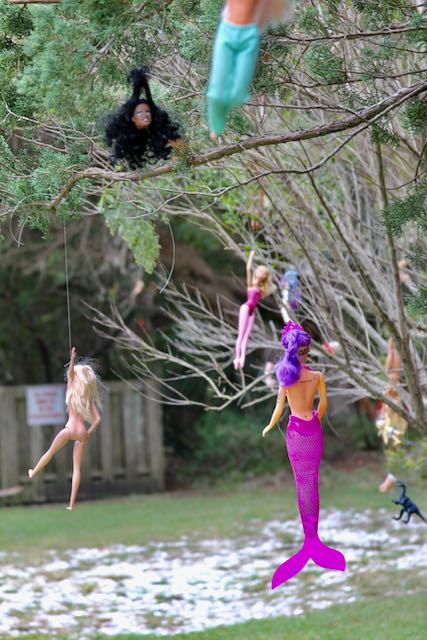
It’s on Jackson Circle within a resident’s trees that have up to 100 dolls and doll parts – clothed and bare – hanging from nearly invisible fishing line.

While not wishing to be inundated by passersby, the property owner is unabashedly delighted if her loosely artistic display can turn up the corners of a mouth.

“If I can make people smile, so much the better,” said Susan Dodd, an Ocracoke resident since 1989 and the dolls-in-trees artist for 20 years in two island locations. 

Thieves are not welcome, but photographers are.

If she’s not busy with artwork she creates inside her home, she may emerge outside with her own smile, laughter and two spaniels.  

On a recent spring day, she pointed to a favorite Barbie-like, purple mermaid. Most of the dolls come from thrift stores where she also buys many of her clothes.

Susan Dodd with her dogs. Photo by Patty Huston-Holm

Dolls and other creations inside her house tend to reflect her social justice sentiments that include America’s 2003 to 2011 Iraq war involvement.

Some figurines appear trapped behind wires and nails. Except for an occasional charity event, these are not for sale.

Dodd is more than a doll lady. She has written seven books, was once married to former U.S. Senator Chris Dodd and is a former lecturer at five universities, including Harvard.  

As an undergraduate at Georgetown University, she unsuccessfully challenged Bill Clinton for sophomore class president.

“I don’t identify as any of those things today,” Dodd said. “I came to Ocracoke because it seemed like a good place to write.  But I got tired of publishing and started to see writing as too isolating.”

Dodd also doesn’t identify as a doll expert. She doesn’t expound about the earliest documented dolls that go back to the ancient civilizations of Egypt, Greece and Rome.

Nor does she talk about doll manufacturing that has its roots in 15th century Germany.

Dodd suggested that her doll fascination might be connected to the fact that she had few dolls when growing up in the 1950s.

She pointed to her 1999 novel, The Mourners’ Bench, as perhaps the biggest inspiration, followed in 2001 by The Silent Woman.  

The “bench” book – loosely referencing a church pew once designated for people grieving or seeking salvation –uses dolls as a metaphor for a theme of broken people.  

A detail of Dodd’s yard art. Photo by Patty Huston-Holm

In The Silent Woman, based on Austrian painter Oskar Kokoschka’s love obsession with Alma Mahler, widow of a composer, a life-sized replica of Alma emerges alongside the end of the relationship in 1918.

Now in her 70s, with macular degeneration and two newly replaced hips, Dodd sees herself as simply a dabbler in art and a caregiver.

Looking after others became her untrained but willing and natural role after 9/11 when she moved in with an ex-sister-in-law, who then was a single mother fighting cancer in Kansas City, Mo.

Following the lost battle, the daughter, now age 35, became the child that Dodd never had. Likewise, in the aftermath of Hurricane Dorian in 2019, Dodd assumed the role of caseworker on a disaster relief team for Ocracoke victims of the storm.

As Dodd talked, a mismatch of bracelets, dangling from her right wrist, helps tell her story.  The bangles started with ones made by orphan girls she met during a mission trip to Honduras in 2018.

A black one signifies her two-decades-long desire to abolish the death penalty, including for around 100 Missouri, North Carolina and Texas inmates she has met personally.

These men are “not the same person” as when they committed a crime, she said.

Dodd’s experiences and novels divulge human flaws, forgiveness, mental illness and aspects of death and dying – a contrast to the lighthearted laughter of the woman still collecting dolls for her trees while planning an upcoming sacred beach fire burning of “literally hundreds” of “confidential” death row inmate letters.

Dodd believes her writing life is over, but sharing her life is not.

Reflecting on her artistic expression of dolls flying magically through trees, she said their reason might simply be for “my own delight.”

Patty Huston-Holm, an Ohio journalist, spent a month in the spring with the Observer to write a number of stories.

Ophelia bypasses Ocracoke

1
The roiling ocean at Ramp 63 around noon Sept. 23. Photo: C. Leinbach

Update: As of 8 a.m. Sunday, Hatteras Inlet ferries have resumed and all of NC 12 is passable.

Ocracoke Island was drying out Saturday as Tropical Storm Ophelia made landfall south of Ocracoke on Emerald Isle around 6 a.m. and was heading north into mainland North Carolina and northward.

The sun peaked out of scattered overhead clouds and the wind, though still strong on the beach, had been dying down since the morning. Sunday’s forecast is for sunny weather and wind speeds in the low mph teens.

According to the National Weather Service (NWS) bulletins, a storm surge warning is still in effect for Ocracoke inlet.

Ferry service remained suspended on Saturday afternoon.

Ophelia as of 2:30 pm Sept. 23

While the highest winds have passed, flooding is still a substantial threat, the NWS said on Facebook.

The easterly wind flow is expected to peak sometime in the late afternoon on Saturday, and as the storm moves north, the wind will switch to the south and southwest.

As the shift occurs, wind speed will also drop, which could lead to a quick return of sound water that was pushed west.

Should this occur, the potential for soundside flooding impacts will increase, and 2-4 feet of above-ground inundation is possible.

High tide for Ocracoke is at 2:31 p.m.

To sign up to receive alerts if water levels in your area begin to rise due to storm surge, visit www.FIMAN.NC.gov and select the flood gauge(s) located in the waterway you’d like to monitor in real-time.

On the forecast track, the center of Ophelia will move across eastern North Carolina this morning, and then move into southeastern Virginia and the Delmarva Peninsula by the end of today and into Sunday.

Maximum sustained winds have decreased to near 65 mph (105 km/h) with higher gusts. Further weakening is expected through the rest of the weekend, and Ophelia is likely to become a post-tropical cyclone tonight or Sunday morning.

A drive around Ocracoke village Friday evening before dark and Saturday showed puddles of water in locations typically seen in storms.

Ocean conditions will remain unsafe for swimming for the next several days. The public should check surf and swimming conditions before heading to the beach, and the daily beach forecast at www.weather.gov/beach/mhx includes rip current risk levels, and information about other hazards along the shoreline.

Wind gusts from Ophelia were measured as high as 72 mph at Cape Lookout Saturday morning.

More than 80,000 customers had lost power as of 8 a.m., according to PowerOutage.US, with about one half of that number in North Carolina.

There was no overwash at the hotspot on the north end of N.C. 12 around noon on Sept. 23. Photo: C. Leinbach
The Ocracoke pony herd was happily munching its lunch on Sept. 23. Photo: C. Leinbach