
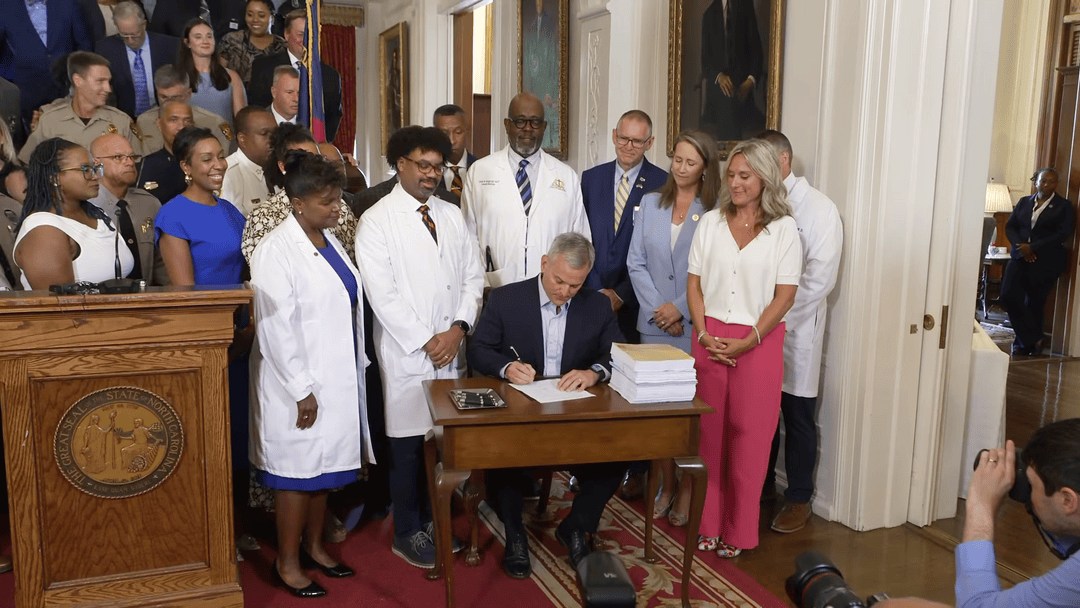
With Gov. Josh Stein having just signed Senate Bill 257 into law, Ocracoke can look forward to a toll on the Hatteras ferry next year and higher tolls on the Pamlico Sound ferries.
The governor signed North Carolina’s first comprehensive state budget in more than two years on Tuesday, praising investments in education, public safety and infrastructure while sharply criticizing a provision requiring tolls on all state-operated ferry routes beginning next year, including the Hatteras-Ocracoke and Currituck-Knotts Island ferries.
While Stein said the budget reflects bipartisan compromise, he singled out the ferry toll requirement as one of its most significant shortcomings.
“This budget has real flaws, including a requirement for the North Carolina Department of Transportation to establish tolls on all ferry routes by Jan. 1, 2027,” Stein said in a statement after signing the bill. “North Carolina’s ferries for many are not a luxury; they’re an essential part of our state’s transportation system that residents rely on for daily life. In many cases, ferries are the only practical way for families to access jobs, schools and health care.”
The $34 billion+ spending plan became law less than two weeks after Stein visited Ocracoke Island, where he rode the Ocracoke Express passenger ferry and met with local officials during an extended weekend trip to the Outer Banks.
The new law requires the N.C. Ferry Division to begin collecting tolls on every route in the state ferry system by next year, ending free passage the Hatteras-Ocracoke, Currituck-Knotts Island, Aurora-Bayview and Minnesott Beach-Cherry Point routes.
The change marks one of the most sweeping policy shifts in the history of North Carolina’s ferry system and has drawn widespread opposition in coastal communities, where ferries are viewed as extensions of the state highway system rather than optional transportation.
The Hatteras-Ocracoke ferry provides Ocracoke Island’s primary connection to the northern Outer Banks, while the Currituck-Knotts Island ferry is the only direct route linking Knotts Island with the rest of North Carolina.
Sen. Bobby Hanig, R-Currituck, emerged as one of the legislature’s strongest opponents of the toll provision, becoming one of the first Senate Republicans in more than a decade to vote against a state budget.

“I believe no North Carolina citizen should have to pay a toll to ride on a ferry. They are, by all accounts, a part of the North Carolina highway system,” Hanig said during Senate debate last week. “We’ve done an amazing job in lowering our tax rate. Now we’re proposing to tax the hardworking people of eastern North Carolina to go to work, go to school, go to doctor’s appointments.”
Hanig also criticized allowing the N.C. Ferry Division and Board of Transportation to establish toll rates rather than lawmakers.
“A non-elected agency setting a tax rate, call it a fee, but it is a tax, should scare everyone in this room,” he said.
Sen. Michael Lazzara, R-Onslow, defended the provision, arguing recurring toll revenue is needed to replace the Ferry Division’s aging fleet.
“It requires the ferry division to develop a plan for long-term vessel replacement of the division’s aging fleet, and requires tolling, which will increase recurring revenues dedicated for that essential purpose,” Lazzara said.
The budget does not establish specific toll rates. Instead, it directs the Ferry Division and the N.C. Board of Transportation to develop a tolling plan before the Jan. 1 deadline.
The legislation exempts school buses from tolls and authorizes commuter passes for coastal county residents that would waive per-trip charges.
The budget also provides approximately $15 million in nonrecurring funding for ferry operations and maintenance, including $12 million for operating costs and fuel and $3 million for maintenance and capital needs.
Additional ferry-related provisions require quarterly reports to lawmakers on dry dock spending, redirect $1.5 million previously intended for traffic-stacking lanes at Ocracoke’s South Dock terminal to rehabilitation of the terminal’s ferry ramp, and provide $1.5 million to dredge the Currituck-Knotts Island ferry channel.
The spending plan also includes 3% raises for most state employees, average teacher raises of 8% with starting teacher salaries increasing to $48,000, raises ranging from 10.1% to 17.7% for correctional officers and law enforcement personnel, accelerated reductions in the state income tax rate. Also included are investments in Medicaid, community colleges, child care, cybersecurity and drinking water infrastructure and funding for western North Carolina’s continued recovery from Hurricane Helene.
Stein acknowledged disagreements with other portions of the budget, including reductions in state positions and several policy provisions affecting executive branch authority and local governments, but said the overall package demonstrated lawmakers’ ability to work across party lines.
“North Carolinians expect their elected officials to come together across our differences to deliver for people,” Stein said. “As today’s budget proves, we can work together to get things done. I am eager to keep at it with the General Assembly to keep building on our momentum to create a North Carolina that’s safer, stronger and more prosperous with opportunity for every person.”


Folks (including myself) who are not residents should be paying a toll. Residents of Ocracoke and commercial suppliers should not be paying tolls.
Mechanical issues, unforeseen circumstances, staffing challenges; all are reasons given in Ferry Operations texts to explain amended schedules that to most off-islanders like me are minor inconveniences. Paying more into the coffers to help offset maintenance budget shortfalls is reasonable for us, not ideal but reasonable. Going to the Island is a luxury for us.
To you residents, vendors and construction workers though, having to pay at all is an insult. The Governor has criticized toll provisions, yes, but what’s the most effective way we tax-paying citizens can assist you in getting this law repealed? Not a rhetorical question.
Comments are closed.