

By Joy Crist, Island Free Press
The N.C. Department of Transportation (NCDOT) is recommending a $10 one-way toll for standard vehicles traveling between Hatteras and Ocracoke beginning Jan. 1, but the N.C. Board of Transportation voted Thursday, Oct. 8, to ask state lawmakers to delay implementation of the new ferry toll mandate to allow more time for planning and analysis.
The proposed $10 fare would apply to vehicles less than 20 feet long, while vehicles between 20 and 40 feet would pay $20, and vehicles between 40 and 65 feet would pay $30. Motorcycles, scooters, golf carts and ATVs would pay $5, while bicycles would cost $2 and pedestrians would pay $1.
The proposed rates were presented by N.C. Ferry Division Director Jed Dixon during Thursday morning’s Board of Transportation meeting, as the state prepares to implement legislation requiring tolls on all ferry routes by Jan. 1.
The rates are recommendations only and have not been formally approved. The board is scheduled to consider adopting the toll rates and rate-setting methodology at its Nov. 5 meeting.
However, following Dixon’s presentation and a lengthy discussion about the potential impacts on coastal residents, the board voted to request additional time from the N.C. General Assembly, potentially delaying implementation until at least April 1, 2027.
Board member Mike Fox, who represents Division 7, introduced the motion, saying the Ferry Division had done substantial work under an unusually tight deadline but needed more time to develop an effective and sustainable tolling system.
“One of my biggest concerns is we just didn’t have enough time, and we don’t have enough time to really do this right and do it thoroughly,” Fox said. “I would strongly encourage this board to ask the staff to go back to the legislature and ask for some more time. And I know you’ve got to continue on the path that you are now because we don’t have that approval yet, and I understand that. But I just think this is a this is too rushed a job, and again, credit to your entire staff. You have done everything you can do, but it’s just it’s too short a time period to do something like this.”
Fox initially proposed asking the legislature for a delay until at least April 1. Following discussion, he amended the motion to have the board adopt a resolution requesting additional time to study and implement the tolling system. Board member Lisa Mathis seconded the motion, which passed without opposition.
The vote does not currently change the Jan. 1 implementation deadline, which is established by state law. Any postponement would require action by the General Assembly.
Recommended toll rates
The Hatteras-Ocracoke route would have the highest base fare among the four currently free vehicle ferry routes that will become tolled under Session Law 2026-41.
NCDOT is recommending a $7 base fare for standard vehicles on the Currituck-Knotts Island, Bayview-Aurora and Cherry Branch-Minnesott Beach routes. Vehicles between 20 and 40 feet would pay $14, while vehicles between 40 and 65 feet would pay $28 on those routes.
Rates on the three currently tolled vehicle routes — Cedar Island-Ocracoke, Swan Quarter-Ocracoke and Southport-Fort Fisher — would remain unchanged on Jan. 1 under the proposal.
The legislation also establishes a $150 annual commuter pass for qualifying permanent residents of North Carolina’s coastal counties, including Dare and Hyde, and active-duty military personnel. The pass would allow eligible motorists to use the ferry system without paying an additional fare for each crossing.
A separate $150 annual vendor priority pass would remain available for qualifying commercial vehicles transporting goods and services.
Dixon said the Ferry Division is working to make commuter passes available for purchase online and in person in November. Online ticket sales are also planned for early 2027, although the division could not guarantee that capability would be available by Jan. 1.
Proposed rates fall short of vessel replacement goals
Dixon said the recommended rates are expected to generate an average of approximately $4.4 million annually, significantly less than the revenue needed to support the state’s long-term ferry vessel replacement goals.
The legislation requires ferry toll revenue to be used for vessel replacement rather than routine operating expenses.
According to the presentation, North Carolina’s ferry fleet includes 17 River- and Hatteras-class vessels and five Sound-class vessels, with an average age of approximately 28 years.
The estimated replacement cost is approximately $25 million for River- and Hatteras-class vessels and $40 million for Sound-class vessels, producing a weighted average replacement cost of $28.7 million.
An earlier vessel replacement study by HDR recommended replacing two vessels every three years. However, Dixon said the Ferry Division’s analysis determined that toll revenues could not meet the funding requirements for that schedule, even with substantially higher rates.
Replacing two vessels every three years would require approximately $19.1 million annually to fully fund vessel replacement, or $15.3 million annually if toll revenues covered 80% of the costs.
Even the least expensive scenario evaluated — replacing one vessel every four years — would require approximately $5.7 million annually in toll revenue to cover 80% of replacement costs.
Dixon said the analysis also considered how higher tolls could discourage ferry use, reducing the amount of revenue collected.
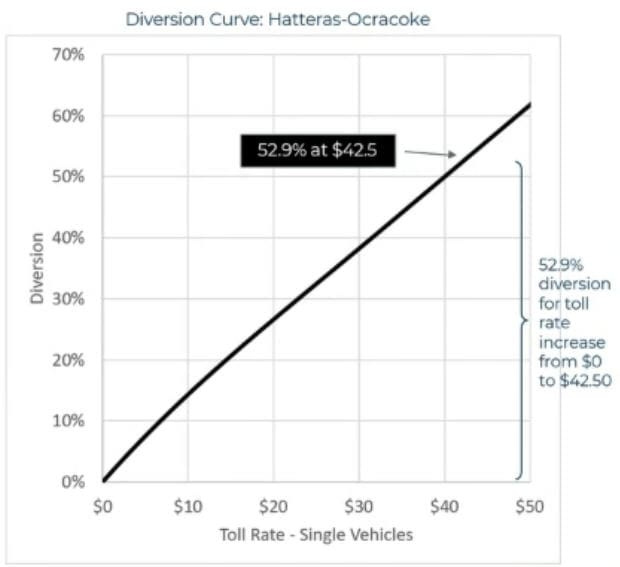
For example, the presentation estimated that a one-way Hatteras-Ocracoke toll exceeding $42 would be necessary under one vessel replacement funding scenario before accounting for changes in ridership.
However, the analysis projected that a $42.50 toll could result in approximately 52.9% of riders no longer using the ferry route, substantially reducing anticipated revenue.
The Ferry Division ultimately recommended lower initial rates, with plans to monitor ridership and revenue and return to the board in fall 2027 with recommendations for future increases.
Dixon acknowledged that the limited timeline required the division to rely on existing studies, historical ridership data, and assumptions rather than a comprehensive new economic analysis.
“We start the rates low at the bottom end of the scale, just so we can have better data to set the rates going forward,” Dixon told board members.
Ocracoke priority boarding remains a concern
Thursday’s discussion also highlighted the unresolved issue of priority boarding for Ocracoke residents, which has been a central concern since the new toll mandate was enacted this summer.
Board member Tess Judge emphasized that the Hatteras-Ocracoke ferry is not simply a transportation convenience but an essential highway for island residents.
“Ocracoke has no other way,” she said. “The waterway is the highway for the citizens that live in Ocracoke.”
Judge specifically raised concerns about residents who depend on the ferry to reach medical appointments on the Outer Banks, particularly during the busy summer months when vehicle lines can stretch for hours. Without priority boarding, she said, residents could miss essential appointments or be forced to travel the night before.
“This is not a wealthy area, ladies and gentlemen, at all,” Judge said. “These are hardworking people, [and] their grandfathers and great grandfathers and grandmothers and families have lived on Ocracoke forever.”
As previously reported by the Island Free Press, Hyde County officials and the Ocracoke Access Alliance have been working to preserve the longstanding resident priority boarding program, which county officials say has operated for approximately 40 years.
The new $150 commuter pass would address ferry costs for qualifying residents but would not provide priority boarding.
Hyde County commissioners approved a resolution in September requesting that the General Assembly formally authorize the resident priority program. Dare and Hyde counties have also joined seven other coastal counties in calling for permanent toll exemptions for locally registered vehicles.
Judge urged lawmakers to consider the unique circumstances facing Ocracoke before the new tolling system takes effect.
“It is about sustaining their everyday life as they live on Ocracoke Island,” she said.
The presentation also addressed concerns about emergency vehicle access. NCDOT legislative affairs staff said the department has requested a technical correction to state law that would authorize toll exemptions and priority boarding for law enforcement, emergency services and government officials traveling on official duty.
The department hopes lawmakers will consider the change when they return to session later this year.
Public input and next steps

NCDOT’s first public comment period, held Aug. 17 through Sept. 14, generated significant participation, including 439 attendees at five public listening sessions across eastern North Carolina.
The Ocracoke listening session attracted 173 attendees, the largest turnout of the five meetings, while 12 people attended the Hatteras session.
The online public engagement platform recorded 2,810 participants, 47,051 survey responses and 1,165 comments.
Preserving Ocracoke resident priority boarding was the most frequently mentioned issue, with 290 mentions, followed by opposition to tolling residents, with 260 mentions.
Other major concerns included access for students, ferry reliability, affordability and payment options.
NCDOT will open a second public comment period Friday, Oct. 9, continuing through Oct. 23, allowing residents to review the recommended rates and provide feedback before the board’s scheduled November decision.
Comments can be submitted online at https://publicinput.com/ferry-tolling, by email at ferry-tolling@publicinput.com, or by calling 984-205-6615 and referencing project code 10744.
In the meantime, the Ferry Division is continuing preparations for the Jan. 1 deadline, including hiring additional personnel, installing temporary toll collection infrastructure and updating its reservation and payment systems.
Dixon said the division had received 74 applications for 32 temporary administrative positions, with eight applicants approved for hire and six more being processed. Staffing gaps remain, particularly on the Hatteras-Ocracoke route.
NCDOT is also planning a longer-term modernization of its statewide ferry tolling and reservation systems, with implementation targeted for fall 2027.
The board’s next scheduled action on the proposed rates is Nov. 5, although the request for a legislative delay introduces additional uncertainty into the implementation timeline.
Unless state lawmakers change the law, toll collection on all eight state ferry routes remains scheduled to begin Jan. 1, 2027.


There’s no telling how many day trippers will not go to Ocracoke because of this toll.
And I pray the residents passes will be continued. This is a disaster in the making.