Ferry workers prepare to secure a ferry pulling into South Dock on Ocracoke. Photo: C. Leinbach
MANNS HARBOR – The North Carolina Ferry Division is teaming up with NC Works to host four career fairs to find qualified applicants to staff its ferries, terminals and shipyard.
The career fairs will be held at the following times and locations:
Jan. 26: 10 a.m. to 3:30 p.m., NC Works Career Center, 111 Jordan Plaza, Elizabeth City
Feb. 2: 10 a.m. to 3:30 p.m., NC Works Career Center, 3813 Arendell St., Morehead City
Feb. 9: 10 a.m. to 3:30 p.m., NC Works Career Center, 3101 Bismark St., Greenville
Feb. 16: 10 a.m. to 3:30 p.m. Brunswick County Career Center, 5300-7 Main St., Shallotte
Applications will be accepted for all positions at all experience levels — from entry-level parking lot attendants to experienced boat captains. Both temporary summer employment and full-time permanent positions are available.
Among the benefits of Ferry Division employment are:
Competitive salaries
Year-round, full-time permanent employment
Health insurance
Retirement benefits
Paid vacation, holidays and sick leave
People interested in attending one of the career fairs should bring resumes and supporting documents.
Representatives from the Ferry Division will be on hand to explain the various positions available and opportunities for advancement.
To see jobs currently available with the Ferry Division, visit the state jobs website and search “Ferry.”
Please continue to visit the site, as new ferry jobs are added regularly.
Twin cranes bookend a segment of the N.C. 12 bridge under construction Wednesday near Pea Island. The project is expected to be completed early this year. Photo: Kip Tabb
PEA ISLAND — Sometime soon, possibly before spring, the 2.4-mile “jug handle” bridge bypassing the troubled S-curves just north of Rodanthe will open to traffic, and after it does, folks will still be able to access the national wildlife refuge here.
The bridge, with a projected 100-year lifespan, is seen as the only practical solution to maintaining the transportation corridor connecting Ocracoke and Hatteras Island with the northern Outer Banks. It was also the result of a legal settlement in 2015 that had halted the entire Bonner Bridge replacement project because of conservationists’ concerns about protecting the Pea Island National Wildlife Refuge.
N.C. 12, the thin ribbon of highway that is the lifeline between the southern Outer Banks and the Marc C. Basnight Bridge over Oregon Inlet and Nags Head, is protected by a line of sand dunes. Where the road passes through the refuge, coastal storms regularly breach the dunes and create an impassable barrier. It typically takes two to three days before North Carolina Department of Transportation crews can reopen the road.
The S-curves are the most active area of Pea Island.
Tim Hass, communications officer for NCDOT’s Divisions 1 and 2 and the Ferry Division, told Coastal Review the bridge should open for traffic in the next two to three months.
“The target at this point is late February or early March, but that is heavily dependent on weather and equipment,” he said.
When the bridge does open, about two miles of roadway extending north from Rodanthe through Pea Island National Wildlife Refuge is to be removed, along with the sandbags that were put in place in an effort to slow the Atlantic Ocean’s encroachment.
“Pavement and sandbag removal on the S-curves will begin after (the bridge opens), and will likely take three to six months to complete,” Hass said.
Once the road is removed, the U.S. Fish and Wildlife Service, which oversees the refuge, plans to maintain continued public access to the area.
“What we’ve got planned with NCDOT, where DOT is staging their equipment at the north end of the Rodanthe bridge on the ocean side, after they remove their equipment, that’ll be paved, and we’ll have a parking lot there. The public will be able to park there and have access to south end of the beach,” Pea Island and Alligator National Wildlife Refuge Manager Scott Lanier said.
“The paving of the north end parking lot will likely begin in January,” Hass said.
Other than the parking lot, there are no plans for trails or development. But the site is to remain open to the public except during shorebird or sea turtle nesting activity.
A view of the parking lot under construction at Pea Island. Photo: Kip Tabb
“The only time that I could envision a portion of that being closed would be during bird nesting season if we had tern nesting or something like that. And that would be just like we do on the rest of the beach,” Lanier said.
Removing the road and sandbags is an important part of restoring the natural resilience of the habitat. New Inlet, about 2.5 miles north of the planned parking lot, may be a model for what will happen as natural cycles return to the S-curves.
In August 2011, Hurricane Irene breached the dunes at the New Inlet area of Pea Island. That inlet has subsequently filled in and the Capt. Richard Etheridge Bridge is located where the breach once existed. As Lanier explained, he expects that after the sandbags and road are removed, the habitat will rebound.
“We anticipate that, just like up at the Etheridge Bridge, that becoming great habitat for nesting sea turtles and colonial nesting waterbirds,” he said. “When that bridge went over that spot and that little inlet filled in after Irene — it is heavily used by those species. So we anticipate something similar there as far as habitat creation goes. That little portion of the refuge part of the island will be able to function more naturally.”
Lanier said that it’s never their intention to keep people off that refuge.
“Our visitors are an important part of what we do, but that access just may be different in the future,” he added. “In order for someone to have appreciation of that resource, they have got to be able to experience that resource. So, by no means are we looking to keep people off for refuge.”
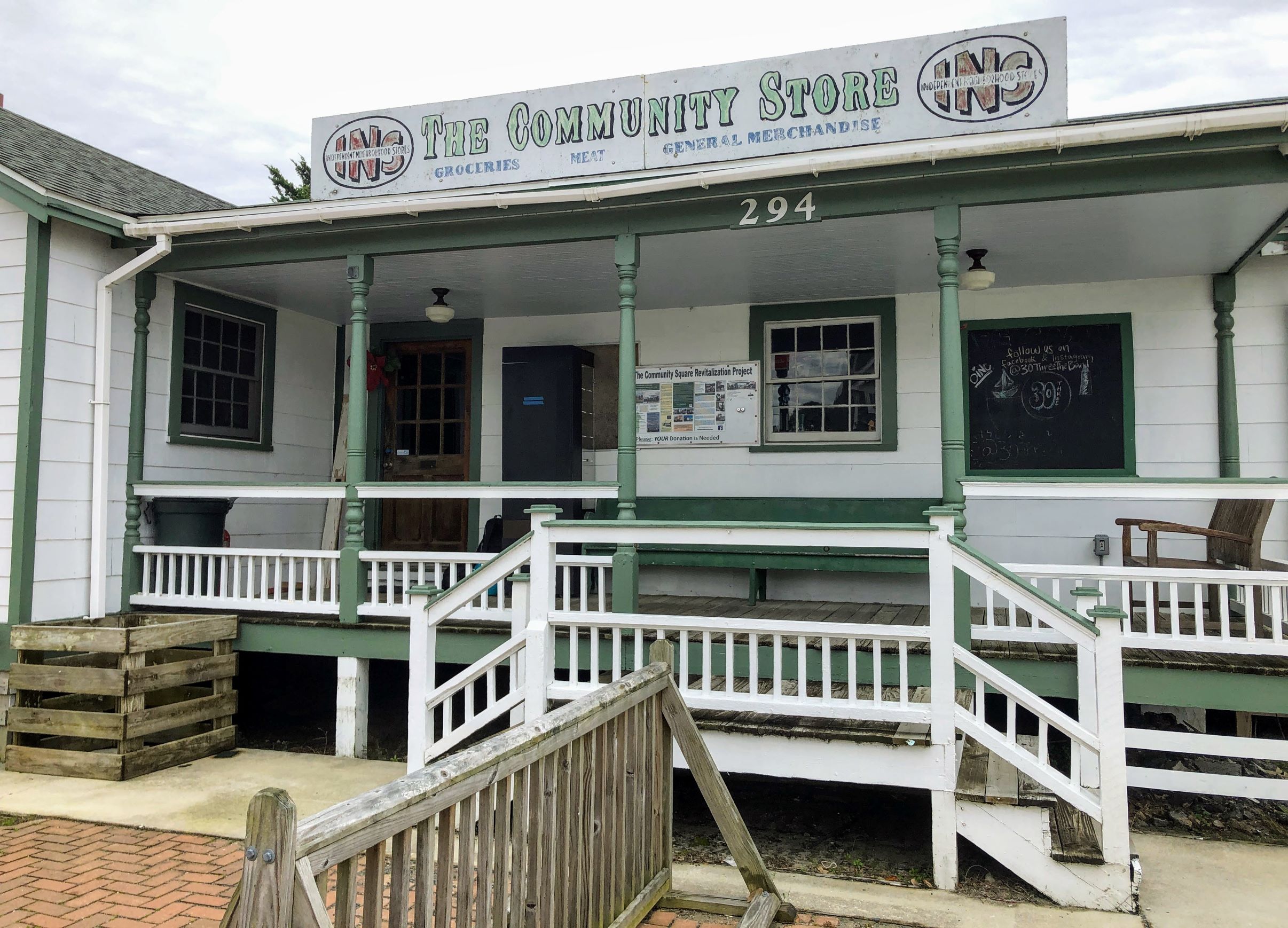
The Village Thrift has relocated to the Community Store in Community Square and is only accepting donations of items in good repair until an opening date is set. Photo: C. Leinbach
The Village Thrift, now in the old Community Store in Community Square, will be open for drop-off of donations only beginning this week from noon to 2 p.m. Tuesday, Thursday and Saturday.
These hours will also apply in the coming weeks, said Felicity Gage, one of the managers, but an opening date for shoppers has not yet been set. Donated items should be clean and in good repair, she said.
Donations can only be brought when the shop is open, she said, and islanders may not leave items on the porch as the Community Square board has asked them to keep the porch clean and clear.
Gage noted that the shop will NOT take the following items: old computer stuff (including printers), unidentified electronic cords, VCRs and tapes, cassettes, old bulky TVs, old stereo components, and anything that doesn’t work or is broken. Phone chargers are OK.
The popular shop has been closed since Sept. 6, 2019, after Hurricane Dorian flooded it in its old location across the street from Community Square.
“The two plus years of no thrift shop has made it very clear how much it’s needed and what a community service and resource it is,” Gage said. “We’re very excited to be on our way to getting Village Thrift up and running again, and big thanks for helping fill it up with ‘new,’ useful, fun stuff.”
For questions about donations, call Gage at 252-928-2799.
Proceeds from the store benefit the Ocracoke Youth Center, which operates the Ocracoke Community Ballfield.
Sandra Harris Marley, 79, died Thursday, January 6, at home on Ocracoke with family by her side.
Born March 7, 1942, she was a daughter of the late James A. Harris and Avis Sherrill Harris and grew up in Troy, NC.
She was a loving mother and grandmother. She will be deeply missed by family and friends.
Sandy loved shelling, lottery tickets and living on Ocracoke. She was always up for an adventure. She enjoyed playing cards and never met a stranger. Her grandchildren were her greatest joy.
She is survived by her daughter, Lynn Marley Gaskins (Earl) and grandchildren Amanda Lynn Gaskins (Grant Jackson) and Spencer Alan Gaskins (Grace Ward).
Sandy requested no service be held. The family will celebrate her life privately.
Please consider making a donation to the Ocracoke Volunteer Fire Department, PO Box 332, Ocracoke, NC, 27960, or to the Ocracoke United Methodist Church, P.O. Box 278, Ocracoke, NC, 27960 in her memory.
Twiford Funeral Homes, Outer Banks, is assisting the family with arrangements. Condolences and memories may be shared at http://www.TwifordFH.com.
American Oystercatcher photographed on Ocracoke Island by Peter Vankevich
By Peter Vankevich
If there were a betting popularity contest for the birds of Ocracoke, Las Vegas might place the American Oystercatcher as a 4 to 1 most likely to win top of the list.
This handsome shorebird, often seen on the beach, got its name from naturalist Mark Catesby in 1731 when he observed it using its long orange bill to pry open oysters and other bivalves for food.
More than 40 species of shorebirds have been seen on the Outer Banks but only a few, including the oystercatcher, nest in North Carolina.
Many shorebirds are difficult to identify since they closely resemble each other. Not so with the distinctive oystercatcher.
Large for a shorebird, they are 18 inches in height with a 32-inch wingspan. In addition to a long, bright orange bill, they have pinkish legs and a distinctive black and white plumage. The head and breast are black; the back dark brown and the underparts are white. In flight the large white stripe on its wings is clearly visible. The eyes are another striking feature, which are bright yellow and with an orange orbital ring. Males and females are visually indistinguishable.
Nesting
Not great architects, oystercatcher nests, barely noticeable, are shallow scrapes on sandy areas like the beach. The average clutch is two to four eggs that
American Oystercatcher nest and eggs on Ocracoke beach. Photo by Amy Thompson, NPS
are buffy gray and speckled with brown spots. One may encounter one of their eggshells on the beach as the parents remove them from nest after hatching.
In North Carolina nesting begins in early April. If the eggs are lost to predation or overwash, they will lay a new clutch. The average incubation period is slightly less than a month. Both the male and female share family responsibilities, including incubation and later assisting with feeding that lasts for several months.
In Ocracoke in 2021, 14 American Oystercatcher nests produced nine fledglings.
The chicks are precocial, meaning they are mobile within 24 hours of hatching, but it takes up to 60 days for their beaks to become strong enough to pry open bivalves. The young birds may remain with their parents for up to six months. American oystercatchers can live 10 years or longer.
Feeding
Oystercatchers forage by tactically probing the substrate with their long bills, then using them as a shovel to loosen the sand and push the prey upward.
When feeding on bivalve mollusks, including clams, limpets and mussels, they employ two techniques. One described as “stabbing,” where they quickly insert the knife-like bill into the open valves and sever the adductor muscle that holds the two valves together to get to the soft parts.
The other foraging method is described as “hammering.” The oystercatcher orients the prey item with its bill and begins hammering. Once they have broken through the shell, the soft parts are then consumed.
Oystercatchers will also prey on other marine invertebrates, such as sea urchins, starfish, mole crabs and marine worms.
Population estimates for the Atlantic Coast from Texas to New England along the Gulf Coast and the eastern Atlantic seaboard are more than 11,000 individuals.
Their numbers have increased and expanded in their northern range of eastern North America with nesting in small numbers as far north as Nova Scotia.
Historically, they may have had an even wider distribution as John James Audubon reported seeing one in Labrador in 1835.
Photo by Amy Thompson, NPS
Banding
Oystercatchers observed on Ocracoke frequently have color-coded bands. If you record the code or even a partial part of it, you can send this information to the website of the American Oystercatcher Working Group. More than 75,000 reports have been sent there relating to the more than 6,000 banded birds. You can also send your report to the Bird Banding Laboratory.
When to see: Year-round, most common in spring and summer, Far fewer in late fall and winter. Two were observed on the Ocracoke Island Christmas Bird Count on Dec. 31. On nearby Portsmouth Island, a large wintering flock can often be seen along the north flats and from the village haulover dock looking out to Casey Island.
Listen: They can be noisy during breeding season. The Macaulay Library at the Cornell Lab of Ornithology has a variety of oystercatcher recordings. Click here.
Where: On the beach, especially South Point, the rocks at Springer’s Point and around the NCCAT building, exposed sand bars and shallow low tide waters of the Pamlico Sound.
The American Oystercatcher (Haematopus palliatus palliatus) is one of the most studied birds in North Carolina covering migration, winter habitats, distribution, abundance and existing and potential threats.
They are listed as a “Species of Special Concern” by the NC Wildlife Resources Commission (NCWRC) and are listed by nearly every Atlantic coast state as threatened, endangered or special concern. In the U.S. Shorebird Conservation Plan, it is listed as a “Species of High Concern.”
Survival
A common story of many bird species, during the 18th and 19th centuries, American oystercatchers were hunted for food and their plumage. By 1918, when the Migratory Bird Treaty Act was implemented, they were close to extirpation along the Atlantic Coast. They have rebounded but face a multitude of threats.
There is concern that with rising sea levels, increased overwash will cause nesting failures. Human disturbance, mammalian and avian predators abound in their preferred nesting areas, along with ghost crabs which have been known to eat newly hatched chicks.
An Oystercatcher near the NCCAT building on Ocracoke. Photo by Peter Vankevich
Sunset at the Ocracoke lighthouse. Photo: C. Leinbach
Kermit Reed Robinson Jr., 76, died Tuesday, Jan. 4, at his home in Williston, Carteret County.
He was the husband of Carleene Robinson.
Born March 31, 1945, and raised on Ocracoke, he was a son of the late Kermit Reed Robinson Sr. and Ellen Garrish Robinson.
He worked for the NCDOT Ferry Division for more than 25 years and was a commercial fisherman. In the 1950s, he became part of the first mounted Boy Scout troop of Ocracoke.
In addition to his wife, he is survived by two daughters, Matina Lea Robinson of Ocracoke; Pam Scott of Williston; son, William David Robinson of Ocracoke; two granddaughters, Lucy O’Neal of Ocracoke; Chelsey Blondin of Holly Ridge; and grandson, Parker Scott of Beaufort.
He was preceded in death by son, George Robinson.
The family will celebrate his life privately.
Memorial donations may be made to Ocracoke Working Waterman’s Association, P.O. Box 1689, Ocracoke, NC 27960
The Noe Funeral Service, Inc. of Beaufort, is in charge of arrangements and condolences and life tributes may be sent to the family at www.noefs.net.
HATTERAS – Due to an increase in COVID-19 cases and exposures among crew and staff, the Hatteras-Ocracoke ferry route will continue its reduced schedule effective immediately through Monday, Jan. 10.
Ferry passengers are encouraged to remain in their vehicles during shorter crossings and are reminded that they must wear face coverings when inside all passenger lounges and terminals.
As COVID-19 cases and exposures continue to climb, the N.C Ferry Division asks the traveling public to monitor for schedule changes or interruptions by following your ferry route’s feed on Twitter.
Ferry operating schedules could change as weather conditions change.
For schedule updates, people should follow NCDOT on social media or call the Hatteras ferry terminal at 252-996-6000.
The North Carolina Dept of Revenue is seeking grant applicants for the NCDOR Business Recovery Grant Program, which issues one-time payments to eligible North Carolina businesses that experienced a significant economic loss due to the COVID-19 pandemic.
The application period closes Jan. 31.
Two types of grants will be available to eligible businesses that suffered an economic loss of at least 20 percent during the COVID-19 pandemic:
Hospitality grants will be available to eligible arts, entertainment, and recreation businesses, as well as eligible accommodation and food service businesses, such as hotels, restaurants and bars (NAICS codes 71 and 72).
Reimbursement grants will be available to eligible businesses not classified in NAICS Code 71 and 72 that did not receive funding from other relief programs including Paycheck Protection Program, COVID-19 Job Retention Grant and EIDL Advance.
The North Carolina Dept of Revenue is seeking grant applicants for the NCDOR Business Recovery Grant Program, which issues one-time payments to eligible North Carolina businesses that experienced a significant economic loss due to the COVID-19 pandemic.
The application period closes Jan. 31.
Two types of grants will be available to eligible businesses that suffered an economic loss of at least 20 percent during the COVID-19 pandemic:
Hospitality grants will be available to eligible arts, entertainment, and recreation businesses, as well as eligible accommodation and food service businesses, such as hotels, restaurants and bars (NAICS codes 71 and 72).
Reimbursement grants will be available to eligible businesses not classified in NAICS Code 71 and 72 that did not receive funding from other relief programs including Paycheck Protection Program, COVID-19 Job Retention Grant and EIDL Advance.
After almost four years overseeing Hyde County Schools, Superintendent Stephen Basnight will retire from public education on April 1.
In an interview Thursday, Basnight said the Hyde County Board of Education is finalizing a plan to find a replacement.
At a special meeting Monday night, he said, Board Chair Randy Etheridge resigned and Angie Todd, the Ocracoke representative, was elected board chair. Thomas Whitaker will remain as vice-chair.
Basnight began his tenure in Hyde County in the fall of 2018.
After Hurricane Dorian flooded the island and devastated all five of Ocracoke School’s buildings, he was on the ground on the island right after the storm leading a team to figure out how to resume classes and also deal with rebuilding the campus buildings.
Inundated were the gym, the main building, the first floor of the elementary building, the library building and the industrial arts building.
Twenty-two and a halfdays after Dorian, classes resumed in the NCCAT building, the second floor of the elementary building and the Ocracoke Child Care building.
Then, while working on Ocracoke’s rebuild and overseeing the mainland campuses, the COVID-19 pandemic hit in early 2020 necessitating another, multi-pronged scramble.
As to why he is leaving in the middle of the school year, Basnight said the date doesn’t matter. Superintendents work year-round.
“If the last two or three years have been an example of anything, there’s not a good time,” he said. “It’s one thing to say that the school year goes from August to June, but this job doesn’t change.”
He did say that owing to some family issues it’s time for him to return to Manteo, Dare County.
Angie Todd with Thomas Whitaker, left, and Randy Etheridge, right. Photo: P. Vankevich
“My dad’s going through some medical things and my mother-in-law’s going through some things and my daughter is in middle school and I just feel like it’s time to go home,” he said.
Concurrent to Basnight and his team figuring out how to hold classes without any buildings, Basnight, along with Randal Mathews, who was then still working for CenturyLink, figured out how to boost the internet power to the NCCAT.
Mathews is now the Hyde County commissioner for Ocracoke.
The NCCAT leadership graciously allowed the Ocracoke School to hold middle and high school classes in their building for over a year until the temporary modular units were installed on the school campus in 2020.
“They typically would have about 25 people at NCCAT at a time,” Basnight said about this resource for teacher enrichment. “And we were bringing in 91 kids and 20 staff members and the internet just wouldn’t handle it.”
So, they had to increase the internet, which emanates from the CenturyLink station on Cedar Road, down from the bank.
Laying fiber cables through Ocracoke Village was not going to happen, Mathews said in an interview.
While working inside the NCCAT tower, they could see the CenturyLink microwave tower across the harbor and landed on trying to broadcast the signal from there to NCCAT.
Basnight pushed behind the scenes with CenturyLink and worked with Rep. Bobby Hanig to get about $90,000 to pay for the work, Mathews said, while Mathews did the technical work with assistance from Tyler Gilbert to add in the wiring.
“He is just a first-class guy,” Mathews said about Basnight. “I mean, he has so much experience. He’s a people person and is really resourceful. He won’t take no for an answer.”
From that innovation, Basnight was able to boost the Internet signal in a 4.5-mile radius from the Engelhard water tower using television white space, which is signal that’s still being sent out from the old analog television system of UHF.
This extra broadband is in addition to the Starlink program that Ocracoke students have been a part of since last year. Basnight said the program expanded to 47 more units put in use in the western end of Hyde County where internet signal is weak.
“You just can’t imagine the things I’ve learned,” he said with a chuckle.
Hyde County Schools Superintendent Steve Basnight provided updates on Ocracoke School soon after Hurricane Dorian at an open meeting at the OVFD fire house, which served as the emergency command center. Photo: P. Vankevich
During the height of the pandemic when the state shut down schools from March until about mid-May in 2020, Basnight kept food service workers working.
The cafeteria on the Mattamuskeet campus would fix breakfasts and lunches for the entire student population.
“And then the bus drivers and our teacher assistants would get on the buses with all the food and they would run their normal routes,” he said. “And we added the kids that didn’t usually ride a bus to the route and we dropped off breakfast and lunch every day.”
The same was done on Ocracoke using the NCCAT food service.
“We were able to employ their staff to prepare lunches for pickup for kids on Ocracoke Island to come over to NCCAT to pick up lunches each day there as well,” he said.
He thinks about 92% of the student population was fed this way during the lockdown.
Funding for the meals was through the state Department of Public Instruction, which also got federal reimbursement.
“To be able to use all of those resources in a way that that kept our people employed and took care of our kids at the same time, it just was fantastic,” he said.
During the crisis, Hyde County students showed they could continue their course works through a new to them process called remote learning.
This was something Basnight was working on before the pandemic hit because, even though Hyde, Dare and Currituck counties rarely have snow days, they have other weather problems that force school closures.
Basnight said he’d been working on remote learning plans for that.
“So, by the time we got to the spring of 2020, before the March 13 school shutdown, we had a plan in place,” he said
Yes, everyone’s performance dropped during that time out of the traditional classroom, he said.
“But when we got our data back at the end of the last year, we actually improved,” he said. “We were No. 1 in northeast North Carolina, in math-1 performance, which is generally ninth grade.”
After increasing rigor and student performance outcomes in Hyde County Schools, Mattamuskeet Early College was recognized by the N. C. Department of Public Instruction representing Northeast North Carolina as one of only seven schools with “Promising Practices”by “Expanding Career-Ready Pathways” through their partnership with Beaufort County Community College to maximize student opportunities and offering college courses at both the high school and the college.
Basnight has spent 37 years in education, having worked in Dare and Currituck counties as a teacher, coach and principal before taking the superintendent job for Hyde.
To him, despite the separation between campuses of 23 miles of water, it’s all in service to the kids.
“Educating students is a driving force in everything we’ve done,” he said.
He said he’s comfortable with where Hyde County schools are.
“I think that we’re going in the right direction as long as we keep the kids out there first,” he said. “This isn’t about me. It’s not been about me. It’s about educating children. And that can happen whether I’m sitting in this office or anyone else is sitting here. I’m just blessed to be where I can be used.”
Ocracoke School Principal Leslie Cole said she has enjoyed working with him and is grateful for all he has done for Ocracoke and Hyde County.
“We will miss him greatly,” she said in a statement. “His steadfast leadership during Dorian and the pandemic was much appreciated and I can’t tell you how much I will miss his wisdom and advice. I wish him all the best.”
Interested applicants can see information here and also apply.
Superintendent Steve Basnight, center, who will retire April 1, is seen here in September 2018 with Ocracoke School Principal Leslie Cole, left, and PTA Chair Laura McClain, during a reception for when Basnight was chosen superintendent. Photo: C. Leinbach
Following an increase in COVID-19 infections among staff and students in the Hyde County schools, the Hyde County Board of Education on Tuesday enacted a temporary mask mandate.
“Throughout today, we have seen a dramatic increase in positive COVID cases in our staff and students at all schools,” said a notice on the board’s Facebook page. “All current indications are that this will continue through January.”
At their regular monthly meeting on Tuesday, the board voted to require face-coverings indoors for everyone — staff, students and visitors — in Hyde County Schools effective immediately for at least the next 30 days. Face coverings are still required on all public transportation including school buses.
The mandate includes all those attending indoor athletic events. All athletes will be required to wear face-coverings unless they are actively engaged in the event.
“We are committed to keeping our students, staff and visitors as safe as possible, and we appreciate your willingness to help us successfully navigate this spike in cases,” the notice said.
With cases of COVID-19 reaching record highs and hospitalizations increasing, the BOE action follows Gov. Roy Cooper’s call earlier in the day for all North Carolinians to get vaccinated and get a booster as soon as they are eligible to protect themselves from severe illness from the highly contagious Omicron variant of COVID-19.
Early studies show that boosters greatly increase someone’s immune response and provide greater protection against the Omicron variant than no vaccine, Cooper noted during a press conference. The booster is especially important for those over 65 or in other populations at higher risk for severe illness from COVID-19.
Testing and wearing a mask — especially a surgical or procedure mask, a KN95, or an N95 — are essential tools in slowing the spread of COVID-19, noted NC Department of Health and Human Services Secretary Kody H. Kinsley.
“But the bottom line is that vaccines and boosters are the number one thing you can do to protect your health,” he said.
In a Jan. 3 press release, Hyde County Health Director Luana Gibbs announced the COVID-19 cases to date in the county: 13 new cases, 25 active cases, 14 deaths, 907 recovered for a total of 946 cases since the pandemic began in early 2020.
Gibbs reminded people not to panic over testing shortages or the rise in cases.
“If you are sick, stay home and avoid exposing others to your sickness,” she said. “If you want a test, call the health department or your doctor for testing. If we do not have a test available, do NOT go to an emergency department for a test. We will schedule you once we have tests. Having a confirmed result isn’t going to take away the illness, so just practice good common sense and stay home. Testing can come later.”
However, Gibbs reinforces that should you develop trouble breathing, have persistent pressure in your chest, new confusion, inability to stay awake or discoloration of your skin, lips or nail beds, seek emergency medical care immediately.
Gibbs stressed that vaccination remains vital.
“Vaccination does not mean you will not get sick from COVID, it simply means if you get sick the illness will not be as severe, you will likely not require hospitalization, or die from the virus. Vaccination also reduces the likelihood of new variants developing.
She urged all to get fully vaccinated and boosted.
“If you fear what is in the vaccines, contact your vaccine provider to tell you the ingredients and show you the package insert,” she said. “You will be given a document that lists those ingredients when you come for your shot as well. Read for yourself. Knowledge is power and there are no excuses for not being fully informed.”
For testing or vaccination, you can call the Hyde County Health Department at 252-926-4467, or the Ocracoke Health Center at 252-928-1511.
Cooper also announced plans to extend Executive Order 224, which aims to curb COVID-19 by requiring vaccines or testing of state employees in cabinet agencies. That Order defined fully vaccinated as having two shots of the Moderna or Pfizer vaccine or one shot of the Johnson & Johnson vaccine and directed the Office of State Human Resources to issue the policy to enforce this requirement. Under the new Order, OSHR will be given the authority to include boosters in the definition of fully vaccinated when appropriate.
To date, North Carolina has administered over 14.8 million doses of the COVID-19 vaccine, with 69 percent of the adult population fully vaccinated. About 74 percent of adults have received at least one dose of the vaccine, including 95 percent of North Carolinians 65 and over. About 44 percent of eligible adults have received their booster shot.
Vaccines are available for those ages 5 and older, and boosters are available for those 16 and older.
On Monday, the Food and Drug Administration authorized boosters for children 12 through 15 years old, but the CDC must take action before they are available.
On Tuesday, the CDC accepted the FDA recommendation to shorten the time for a Pfizer booster to five months after the second shot. The CDC also recommended a third dose after 28 days for immunocompromised children ages 5 to11.
Information on testing locations, free tests and home tests is available at ncdhhs.gov/gettested. North Carolinians can learn more about the COVID-19 vaccines at myspot.nc.gov (English) or Vacunate.nc.gov (Spanish).
Use NCDHHS’ online tool Find a Vaccine Location to find a nearby vaccination site. The North Carolina Vaccine Help Center at 888-675-4567 can also help you make an appointment. It is open 7 a.m. to 7 p.m. on weekdays and 8 a.m. to 4 p.m. on weekends.