Molasses Creek, Gerald Hampton, David Tweedie, Kim France and Gary Mitchell, are the hosts of the Ocrafolk Music & Storytelling Festival, which will be June 4 to 6 on the Berkley Manor grounds. Photo: C. Leinbach
The 21st annual Ocrafolk Music & Storytelling Festival from June 4 to 6 will be different this year and in a new location.
The celebration features musicians, storytellers, artisans, and characters of Ocracoke Island and beyond.
Due to ongoing Hurricane Dorian reconstruction the festival will take place outdoors on the grounds of the Berkley Manor and adjoining properties.
This event will practice CDC guidelines as to mask wearing per COVID-19 safety measures, and with the relaxing of COVID-19 pandemic restrictions, walkup tickets will be available.
Performers include Bill and the Belles, Shana Tucker, Eric Culberson, Cane Mill Road, Lakota John, Chatham Rabbits, Donald Davis, Molasses Creek, Coyote, Violet Bell, Beleza, Mahalo Jazz, Jef the Mime, Bob and Jeanne Zentz, Craicdown, Wyldwood, Serenity Fisher & Michael Ronstadt, Adrian and Raul, Paperhand Puppets, artisans and more.
The weekend will be subdivided into four-hour performance blocks. Reserved ticketed seating will be required at the Barn and Golden stages.
To control capacities, access to gated performance areas will be restricted to those who have a reservation for the current four-hour performance block.
Ocrafolk Festival is produced by Ocracoke Alive, a community non-profit committed to enriching the Ocracoke Island community by encouraging and sponsoring cultural, artistic, educational, and environmental activities.
Proceeds from Ocrafolk Festival support student and community arts programs.
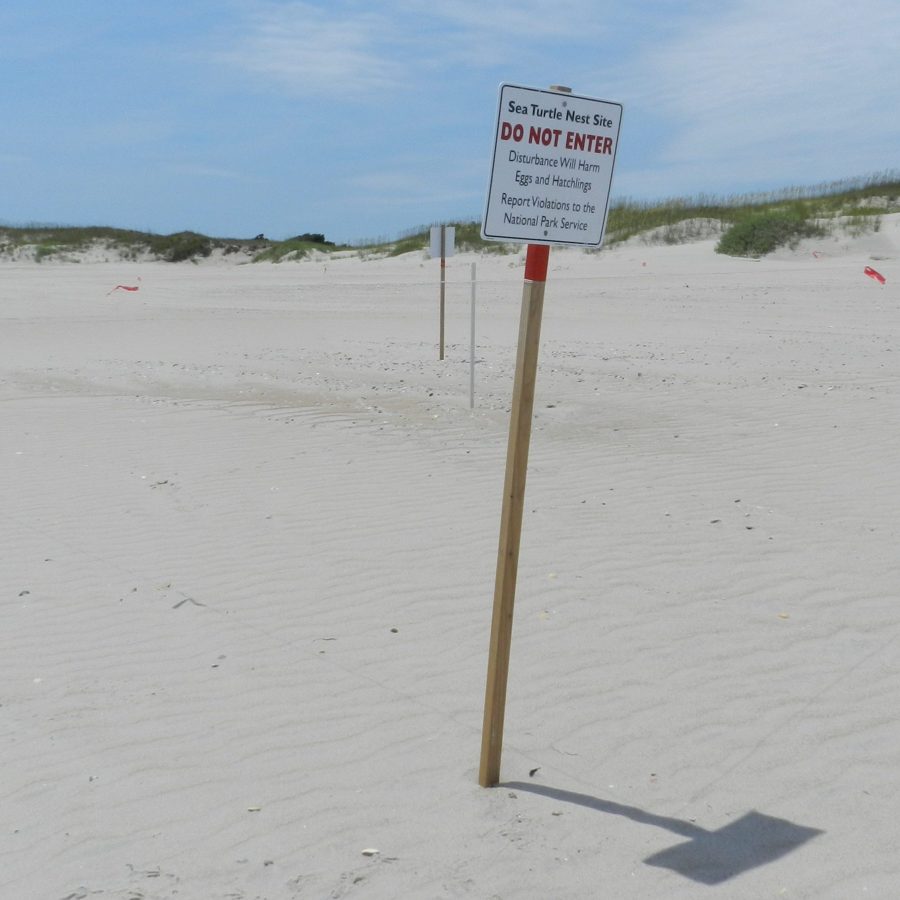
Cape Hatteras National Seashore rangers identify and cordon off sea turtle nests on the beach each year. The public can support the turtles by ‘adopting’ nests. Photo: C. Leinbach
Kill Devil Hills — Outer Banks Forever, the local nonprofit partner of the OBX national parks, has opened its annual Adopt a Sea Turtle Nest program for the 2021 sea turtle nesting season which occurs each year between May and October.
The Adopt a Sea Turtle Nest program supports projects and programs that protect and enhance Cape Hatteras National Seashore now and for future generations.
You can symbolically adopt an active sea turtle nest located on the Seashore for a minimum tax-deductible donation of $100. With your donation you receive an official 2021 adoption certificate and updates on your specific nest including sea turtle species, number of eggs, number of hatchlings and more.
There are a limited number of nests each year and they are assigned on a first come, first-served basis.
The Adopt a Sea Turtle Nest program not only helps our national park, but the foundation sends out updates to each person who adopts – particularly the number of baby sea turtles that hatch out of each nest.
“It’s a great way to feel connected to these amazing animals while also supporting Cape Hatteras National Seashore,” says Jessica Barnes Green, director of Outer Banks Forever.
Here’s how the program works:
Give — Make your tax-deductible donation online at www.obxforever.org/adoptanest or by mail to Outer Banks Forever at P.O. Box 1635, Kill Devil Hills, NC 27948, with “Adopt a Sea Turtle Nest” in the memo field.
Get your nest — You will be assigned an active sea turtle nest and receive an adoption certificate by mail along with initial information about your unique nest including general location and turtle species. Please note: As sea turtles are just starting to arrive in May, it may take 2 to 3 weeks to be assigned a nest.
Wait for your nest to hatch — When your nest hatches this summer or fall, you will receive a personalized update with detailed information about your nest including where it was located and the number of hatchlings that made their way out of your nest.
Because nature belongs to all of us, no individual or group that participates in this program may claim ownership of a sea turtle nest, eggs or hatchlings. Additionally, nature is unpredictable. If your adopted nest is lost to a weather event or damaged by some other means, Outer Banks Forever will assign you a new nest.
To learn more about the sea turtles who visit the Outer Banks each year, Outer Banks Forever’s recent Coffee with a Ranger video is available on its YouTube channel featuring sea turtle insights from Meaghan Johnson, chief of Resource Management and Science for the National Parks of Eastern North Carolina.
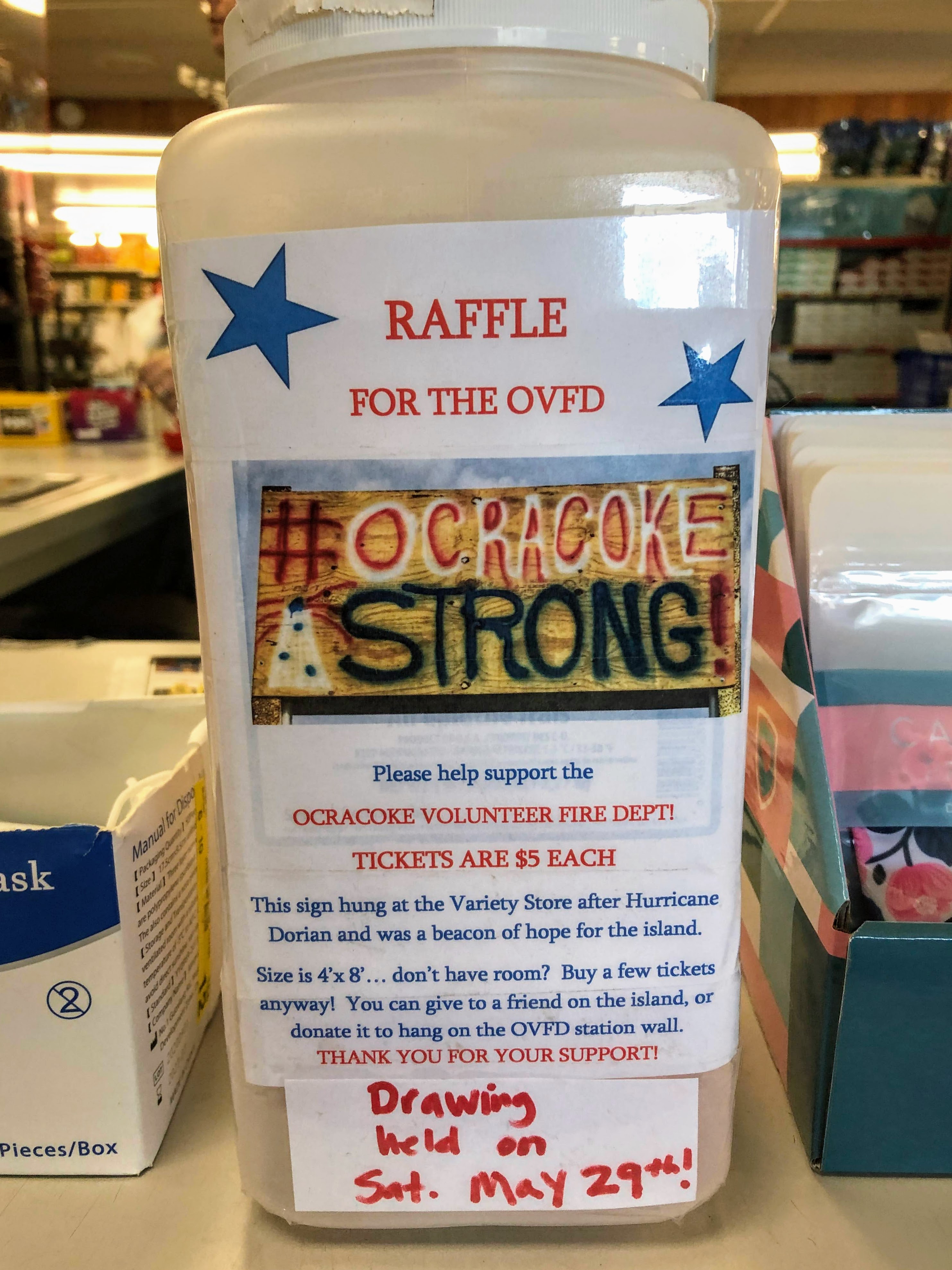
Raffle tickets to support the OVFD are at the Variety Store and online.
The Ocracoke Volunteer Fire Company issues a friendly reminder that Friday (May 28) will be the last day to purchase raffle tickets for the Ocracoke Strong sign that hung at the Variety Store after Hurricane Dorian.
This will be the main fundraiser for the OVFD this year. So please show your support by buying a few tickets or making a general donation.
Tickets are available in the Variety Store or with PayPal online at http://www.ocracokevfd.org. The Variety Store is open from 7 a.m. to 8 p.m. daily.
The OVFD thanks all who have already gotten tickets and for supporting the OVFD.
Tommy Hutcherson will contact the winner late Saturday afternoon.
Ocracoke roads are shared with vehicles, runners, walkers, animals, skateboarders and more. So it is crucial that golf cart drivers obey the traffic laws to keep everyone safe. Photo: C. Leinbach
By Connie Leinbach
Ocracoke, while indeed magical, is not a place where the traffic rules don’t apply.
It’s a vacation destination and it’s cool to be able to get around a place on a golf cart.
“The tourists love it,” said Miggy O’Neal, who with her husband Rex owns Wheelie Fun Golf Carts. “It’s easier for them to get around the village and park.”
Golf carts are an attraction that most people living back in the world don’t get a chance to enjoy.
But golf carts are not amusement park toys, say the Hyde County Sheriff deputies on Ocracoke, but after some customers sign their rental contracts, they seem to forget the rules of the road.
This photo, while of a special situation—the Black Lives Matter march on Ocracoke in June 2020–shows what NOT to do on golf carts. Do not stand up on golf carts. Photo: C. Leinbach
Not all, of course.
“Ninety-five percent of the people who rent follow the rules,” O’Neal said. “And 95 percent of us make our money off tourists and we want to make them happy so that they’ll come back.”
The cart rental companies explain the rules and Island Golf Carts even places stickers with the rules across their cart windshields.
Still, the attitude with some drivers is, “Whatever,” said Jay Neal, a Hyde County deputy. “It’s just Ocracoke; it’s just a golf cart.”
But just like cars, North Carolina law says you have to be 16 to drive a golf cart. However, Island Golf Carts has gone a step further and upped the driving age to 18. This is their insurance requirement.
The following are just SOME of the rules of the road that golf cart drivers need to follow:
Make full stops at stop signs (these aren’t “yield” signs).
It’s illegal for children under the age of 16 (and in some cases 18) to drive golf carts and those under age 16 cannot sit on an adult’s lap and drive.
Use hand signals for turning.
Do not drink and drive.
Children less than eight, or less than 80 pounds, must be in the proper child restraint.
Car seats must be buckled in.
All headlights and rear lights must work.
Everyone on the cart has to sit. No one can stand.
That’s how people can fall off and bump their heads, Neal said about the last item. “We’ve had two fatalities on golf carts,” he said. “Do you want to be number three?”
The island has been lucky there haven’t been more serious accidents with golf carts.
“But we don’t want to be unlucky this year,” Neal said.
NOAA’s Climate Prediction Center is predicting another above-normal Atlantic hurricane season.
In a May 20 press release, forecasters predict a 60% chance of an above-normal season, a 30% chance of a near-normal season, and a 10% chance of a below-normal season. The Atlantic hurricane season extends from June 1 through Nov. 30.
It should be noted, however, that experts do not anticipate the historic level of storm activity seen in 2020.
For 2021, a likely range of 13 to 20 named storms (winds of 39 mph or higher), of which 6 to 10 could become hurricanes (winds of 74 mph or higher), including 3 to 5 major hurricanes (category 3, 4 or 5; with winds of 111 mph or higher) is expected.
NOAA provides these ranges with a 70% confidence.
“Now is the time for communities along the coastline as well as inland to get prepared for the dangers that hurricanes can bring,” said U.S. Secretary of Commerce Gina Raimondo. “The experts at NOAA are poised to deliver life-saving early warnings and forecasts to communities, which will also help minimize the economic impacts of storms.”
Last month, NOAA updated the statistics used to determine when hurricane seasons are above-near-, or below-average relative to the latest climate record.
Based on this update, an average hurricane season produces 14 named storms, of which seven become hurricanes, including three major hurricanes.
El Nino Southern Oscillation (ENSO) conditions are currently in the neutral phase, with the possibility of the return of La Nina later in the hurricane season.
“ENSO-neutral and La Nina support the conditions associated with the ongoing high-activity era,” said Matthew Rosencrans, lead seasonal hurricane forecaster at NOAA’s Climate Prediction Center. “Predicted warmer-than-average sea surface temperatures in the tropical Atlantic Ocean and Caribbean Sea, weaker tropical Atlantic trade winds, and an enhanced west African monsoon will likely be factors in this year’s overall activity.” Scientists at NOAA also continue to study how climate change is impacting the strength and frequency of tropical cyclones.
“Although NOAA scientists don’t expect this season to be as busy as last year, it only takes one storm to devastate a community,” said Ben Friedman, acting NOAA administrator. “The forecasters at the National Hurricane Center are well-prepared with significant upgrades to our computer models, emerging observation techniques, and the expertise to deliver the life-saving forecasts that we all depend on during this, and every, hurricane season.”
The Marc Basnight Bridge over the Oregon Inlet in Dare County. Part of the old Bonner bridge is to the left. Photo: C. Leinbach
This story is updated a second time from the previously published version.
NAGS HEAD – The N.C. Department of Transportation has scheduled demolition work on the old Herbert C. Bonner Bridge that will require a 15-minute road closure on the Marc Basnight Bridge between noon and 4 p.m. Thursday.
High winds and rough sea conditions in the Oregon Inlet prompted officials to move the demolition work and temporary closure of the bridge from Tuesday until Wednesday and now on Thursday.
Prior to work starting tomorrow, flaggers and advance warning signs will be in place to stop traffic at both ends of the work zone on Basnight Bridge. In addition, message boards at Whalebone Junction and Rodanthe will display messages alerting motorists to the road closure. The Basnight Bridge carries N.C. 12 over Oregon Inlet on North Carolina’s Outer Banks.
Boaters in the area should also be aware, because during the demolition work NCDOT and PCL will be helping enforce the U.S. Coast Guard rules to prevent vessels from coming within a 1,500-foot radius of the old Bonner Bridge.
If weather conditions are not good for the work to take place Tuesday, the work and the temporary bridge closure will be moved until sometime between noon and 4 p.m. Wednesday.
This photo taken at the north end of Ocracoke shows the extent of erosion and damage to the stacking lanes at South Dock. The white wall along the upper edge of the land is the bulkhead that protects the ferry basin where the dock is located. Photo: C. Leinbach
By Connie Leinbach
A Sediment Management Framework signed in May by the Cape Hatteras National Seashore will help speed beach repair work along the 70 plus miles from Pea Island to Ocracoke.
Dave Hallac, National Parks of Eastern North Carolina superintendent, said in a recent press briefing that this plan will help in future emergencies—when the islands encounter severe, storm-related breeches, such as overwash at the north end of N.C. 12 by Hurricane Dorian in 2019 and, more recently, Hurricane Teddy last September.
Although it was well offshore, Teddy created wave swells that breached N.C. 12 on Ocracoke and Hatteras and stranded dozens of island visitors on Hatteras for days.
“The sea level is rising at more than five millimeters per year in Oregon inlet,” he said, “and the best available science that we have indicates that that rapid rate of change will increase over time, thereby making erosion and a lot of other stresses caused by the ocean much more severe, and potentially in need of certain mitigation measures like beach nourishment.”
In the past, when the National Park Service (NPS) has received a request for special use permits to alter the Seashore beaches, that process typically took 12 to 18 months.
“Historically, whether there were island breeches from storms like Hurricane Irene, or requests from Dare County like the Buxton beach nourishment project, approving these projects took time,” Hallac said. “But our partners (need) to protect critical areas of the park, such as Highway 12, or the water line, or we may be working with CHEC and they’ll need to protect the transmission corridor. Now we have a checklist instead of a (lengthy) permit process.”
The NPS’s Sediment Management plan will help speed the deployment of such dune shoring measures as these sandbags along the north end of N.C. 12 on Ocracoke. Photo: C. Leinbach
This new plan, which will be in place for 20 years, is proactive: It has done all the studies and gives the NPS the ability to rapidly provide permission for beach nourishment, implementation of habitat restoration projects, dune restoration, or emergency bridge repairs, and often within days.
Over the last two decades, erosion has dramatically changed the shorelines of Ocracoke and Hatteras, and these changes can severely damage essential infrastructure such as roads, bridges, electrical transmission facilities, etc.
“We know the beaches (here) are eroding quite quickly,” Hallac said. “We have rates of erosion that are 10 to 20 feet per year.”
About 13 miles of Hatteras and Ocracoke are omitted from the plan, such as the area from Ramp 72 to South Point, because there are no roads or infrastructure in these areas.
Hallac said bolstering the southern end of Hatteras Island because of climate change and sea level rise is crucial.
Erosion at the end of Hatteras. NPS photo
So, the Park Service is talking with the Army Corps of Engineers about potentially using beneficial dredged material from dredging areas around Hatteras Inlet and placing it in areas around the southern end of Hatteras. This would provide habitat for nesting shorebirds, sea turtles and other wildlife.
“The purpose of this plan is not just to allow (beach repair) activities to occur,” Hallac said. “It’s really to protect your National Seashore, that when (beach repair) occurs it protects cultural resources–everything from shipwrecks to submerged archaeological resources, to protect human health and safety, and to ensure that the new beaches that might be created as a result of sediment management are done in a way that those new habitats are useful and appropriate for wildlife and for human enjoyment.”
Michael Lydick captures a selfie before tossing back his red drum that was over the legal limit to keep.
To catch up on Ocracoke news and much more, click here
Text and photos by Michael Lydick
It’s 10:30 at night, and I’m standing up to my waist in the high tide of the tip of South Point. Directly offshore to my left is a violent thunderstorm, whose clouds tower miles upwards into the night sky. Its lightning spawns and spreads across the eastern sky, illuminating the half dozen sullen men to my left whose bait and lines lie adjacent to my own. We silently stand in yellow-white lightening light, praying to our respective gods that our lines go tight.
It is the spring Red Drum run.
I’ve made the pilgrimage to this place for eight years. Once in the fall when these magnificent fish travel south; back in the spring when they return to spawn at the bases of rivers feeding into the Pamlico Sound.
What was once a casual curiosity has become a fundamental faith of sorts for me, driving the six and a half hours east to the Mecca of these migrating monsters.
I blame the photos. Yellowed historic prints of locals standing next to drum as tall as them. Photos from Facebook. Smiling people with citation-sized fish (40 plus inches.)
Studying them, I’m struck with jealousy and angst. I want to know what they all knew. Stand where they stood and see the swirls in the surf above my own hook.
I am learning. I interrogate Alan Sutton, Kristin Chatham and Ken DeBarth at Tradewinds Tackle, quickly gleaning what I can. I try to make sense of it when Alan tells me to “fish where there are no people.” I nod and pretend to understand.
RODS UP! Lydick prepares for the hunt.
I do know new things. The differences between triangle, satellite and frog’s tongue sinkers; how to tie my shock leader to my monofilament with a modified Albright knot.
I know to keep my hands free from soapy scents. What Alan means when he says, “fishy people catch fish.” There is so much to learn. It’s hard.
I go out at low tide and study the shoreline. I have a napkin scribble sketch from Alan, as I scan left and right and out eastwards into the bars and breaker for structure. I’m starting to see “it.” Not like the people in the photos, yet. It’s coming, though.
I stalk the drum up and down the beach at Ramps 63, 65, 70 and 72. I’ve put hopeful lines into each of their waters.
I’m rewarded with a spiny dog fish, a large skate, and a small shark, and hours of quiet meditation and inside conversations. It was my 50th birthday last week.
I return to the Point on my last night. I take my 12-foot Penn Battalion rod and walk out into the same lightning water I was baptized in on night one.
Out on the bar, up to my ankles, my calves, my thighs, my hips. The birds are grey, sky diving 100 yards out in the frothy chop, and I see “it.” Know.
Lydick’s shark.
I heave my oily cut mullet out to the boiling water. My rod bows over, and my drag is pulling out and a smile spreads unconstrained left to right across my face. A tight line. He is strong and angry.
And he is beautiful. Not quite a citation, but he’s very heavy in my tired arms.
Covered in Jurassic scales the size of nickels, golden and spotted with a bright blue tail, here in the holy waters of this church, I take my photo and give him back to the sea.
As he leaves, I warn him I am learning and will be waiting in the fall when he returns, each of us a little wiser.
The passenger ferry between Hatteras and Ocracoke may not start on Tuesday, May 25. Photo: C. Leinbach
By Connie Leinbach
Passenger ferry service between Ocracoke and Hatteras might be delayed while an appropriation bill to pay for it goes through the legislative process in Raleigh.
Service by the walk-on ferry is set to begin Tuesday (May 25) and continue until Sept. 9, according to previous information from officials. Because the legislative process has yet to be finalized, officials could not say if service would begin on May 25.
According to the N.C. Legislature’s website, House Bill 165, for state highway needs and which includes an amendment with funding for the passenger ferry service, was approved May 6 and is in the Rules Committee.
The amendment, proposed by Rep. Bobby Hanig (R-Currituck), includes an appropriation of $943,000 from the Highway Fund to the Department of Transportation for leasing a passenger ferry for Ocracoke through no later than Sept. 12. Although a start date is not included in the bill, the start date would be when the bill becomes law, Jamie Kritzer, Assistant Director of Communications for the NCDOT, said on Friday.
The General Assembly was not in session Friday. It reconvenes Monday, but the Rules Committee doesn’t meet until Tuesday, according to the legislative calendar. The bill would have to pass Rules, then the Senate and then Gov. Roy Cooper would have to sign it for it to become law.
“The governor has 10 days to sign the bill after it’s adopted, Kritzer, said.
He also said that reservation service for the passenger ferry has not yet opened.
The amendment also includes $62,917 to reimburse Carteret County for having provided this amount last fall to Hyde County to fulfill the local match requirements for grant funds to dredge the Big Foot Slough channel which both the Cedar Island and Swan Quarter ferries must use in their respective routes.
The amendment also awards $362,000 to be used for North Carolina coastal dredging. Though specific areas are not identified, Ocracoke’s county commissioner Randal Mathews said this will be used as a local match for the U.S. Army Corps of Engineers to dredge Barney Slough in the channel used by the Hatteras-Ocracoke ferry.
The ‘Ocracoke Express’ passenger ferry heads to Silver Lake Harbor. Photo: C. Leinbach
From our news services
Rumors went around Ocracoke today (May 20) that the passenger ferry this year was scrubbed, but a North Carolina Ferry Division spokesman said the division is working to secure the service.
Service by the walk-on ferry between Hatteras and Ocracoke is set to begin Tuesday (May 25) and continue until Sept. 9, according to previous information from officials.
Jamie Kritzer, assistant director of communications for the NCDOT, today said in an email that the new boat builder, Waterline Systems in Hubert, is nearing completion on the new passenger ferry.
“We do not have a timeline for when the vessel will be ready,” Kritzer wrote. “At the same time, the General Assembly is considering a bill that would provide funding to lease a passenger ferry.”
He did not provide a timeline as to the legislature’s approval but said the Ferry Division will keep the public updated on any new developments. Ferry service information is located here.
Tim Hass, N.C. Ferry Division spokesman, said in an interview April 15 that for now the passenger ferry will be leased again from Seastreak out of New Jersey. This is the same company that the Ferry Division has used since 2019 when the passenger ferry under construction was sidelined because of numerous faulty welds.
Last year, owing to the impacts of COVID-19, the N.C. Department of Transportation canceled its contract for the Ocracoke Express passenger ferry, but in late June, the N.C. Legislature passed legislation that funded the service for $1.47 million.
Meanwhile, the free tram service has begun on the island and runs daily from 10 a.m. to 8 p.m.
Jennifer Rich drives one of the trams around Ocracoke Village. Photo: C. Leinbach