The live auction at the 2024 Seafood Fest to benefit the Ocracoke Health Center. Photo: C. Leinbach/Ocracoke Observer
The Ocracoke Health Center will hold its fourth Seafood Festival fundraising benefit from 3 to 10 p.m. Saturday, Aug. 30, at the Berkley Barn.
To go with the local seafood there will be live music and silent and live auctions. Proceeds will benefit the Ocracoke Health Center.
Activities begin at 3 p.m. with a silent auction.
Food will be served starting at 4p.m. A live auction will begin at 6 p.m. followed by music by the Ray McAllister Band.
A barbeque chicken dinner will precede Saturday’s events on Friday, Aug. 29, also at the Berkley Barn. Plates are $15 and will begin selling at 5:30 p.m.
The Ocracoke Health Center is a community owned and operated private non-profit with 501(c)3 designation.
In order to survive, it merged several years ago with the Engelhard Clinic on the mainland and became a Federally Qualified Health Center. Two years ago, it merged with the Manteo Community Health Center.
While that union allowed both centers to receive federal funding, it does not cover all of the health center’s expenses, which also may be in peril owing to recent cuts to the federal budget.
If you are interested in donating items for the silent or live auction or being a sponsor, please contact the Health Center: noneal@ocracokehealthcenter.org or send a text message to 252-588-2246.
Those who can’t attend the festival and wish to help can send donations by mail to P.O. Box 543, Ocracoke, NC 27960 or via the website ocracokeseafoodfestival.org.
The 2024 Seafood Festival. Photo: C. Leinbach/Ocracoke Observer
The Hyde County Board of Commissioners enacted a State of Emergency for Ocracoke Island effective at 8 p.m. on Sunday, Aug. 17, due to the anticipated flooding impacts from Hurricane Erin and potential impacts to Hwy 12.
Additionally, a mandatory evacuation order has been issued for visitors starting at 8 p.m. on Sunday, August 17, and for residents starting at 6 a.m. on Tuesday, Aug. 19.
During evacuations, the N.C. Ferry Division typically suspends fees for the tolled ferries and it’s first-come, first-served for the ferries, but that has not yet been confirmed.
While Hurricane Erin is expected to stay well off our coast, the system will continue to increase in size and is forecast to bring life-threatening impacts to the Ocracoke coastline and render Highway 12 impassable.
A Coastal Flood Watch has already been issued for Ocracoke. Coastal flooding and ocean overwash are expected to begin as early as Tuesday and continue through Thursday. Dangerous waves, 20+ feet, will likely inundate and destroy protective dune structures along the highway.
Portions of Highway 12 on Ocracoke and Hatteras Islands will likely be impassable for several days. Life-threatening swimming and surfing conditions are expected. Rip current risks will be extremely high! Stay out of the water!
Now is the time to make final preparations, secure property, and evacuate with all personal belongings.
It is extremely likely that Hyde County EMS services will not be available in Ocracoke due to Highway 12 being inaccessible. Please take this warning seriously, especially if you have medical issues or are likely to need special care.
Hyde County Emergency Services will continue to monitor the forecast and issue advisories as appropriate. For the most current and official information, visit the latest NWS Morehead City briefing by going to http://weather.gov/media/mhx/LatestBriefing.pdf.
A Mandatory Evacuation has been issued for Hatteras Island Zone A, whichincludes all of Hatteras Island, including the unincorporated villages of Rodanthe, Waves, Salvo, Avon, Buxton, Frisco and Hatteras.
Those who are evacuating to areas north are encouraged to travel westbound on U.S. Highway 64 to Interstate 95.
Evacuating through the rural areas to the west of Dare County will help avoid traffic backups and congestion that may prolong evacuation by traveling northbound through the Hampton Roads portion of Virginia.
For more information about Dare County’s two evacuation routes, please visit www.DareNC.gov/Evacuation.
“Language and Life on Ocracoke: The Living History of the Brogue” (UNC Press 2025), a new book by Jeffrey Reaser, Walt Wolfram and islander Candy Gaskill, continues the exploration of the unique dialect and the culture of Ocracoke Island.
This book, deriving from 120 interviews, is a comprehensive sequel to “Hoi Toide on the Outer Banks,” published in 1997, which provided the first in-depth look at the Ocracoke brogue—a dialect that has captivated linguists, the island’s many visitors and writers from around the world. “Hoi Toide” is the written attempt as to how the words “high tide” are pronounced with the brogue.
The story begins in 1992 when Walt Wolfram, already well-known for his pioneering research on social and ethnic American dialects, joined the faculty at NC State University.
Unfamiliar with his new home of North Carolina, he made efforts to explore its many nooks and crannies which he was sure would shed insight into the accents and dialects of the state. You must visit Ocracoke Island, he was told, because “the people speak Elizabethan English.”
He did, and on visiting, a serendipitous combination of events led him to meet David and Jen Esham, which inspired him to conduct island field research. The next year, he had five of his graduate students use their week-long spring break to come to Ocracoke and interview the “O’Cockers,” a term that refers to residents who can trace their ancestral island lineage for centuries.
That led to “Hoi Toide on the Outer Banks: The Story of the Ocracoke Brogue” that Wolfram co-authored with Natalie Schilling, published by UNC Press.
Wolfram created a tradition of having five graduate students use their spring break to teach language and culture at the school, which continues today.
In 2003, Jeff Reaser joined the faculty of the N.C. State English department and the two professors have continued their extensive field research with the help of Gaskill. The two speak at public events, such as the summer Porch Talks sponsored by the Ocracoke Preservation Society, and interviews on WOVV, Ocracoke’s community radio station.
Both are deeply entrenched in the Language and Life Project that Wolfram founded at NC State. This is a non-profit educational and research initiative. Its primary mission is to document, study and celebrate the diversity of languages, dialects, and cultures in North Carolina and across the United States.
Gaskill, a fourth-generation islander, has been involved with researching the brogue from the beginning, having documented her interactions with visitors when she was the proprietor of the former Styron’s Store.
Well-researched, the writing is not the stuffy academic style one can sometimes see in books with language and culture as a theme. There are no footnotes and not even a bibliography. This is a book for readers of all levels, or as Reaser said at an OPS meeting, “We wanted it to be a beach read.”
To gain the perspective for the context for this book it is important to read the Acknowledgements and Preface at the beginning.
After that, what I like about this book is that each chapter is self-contained, and for a book of nearly 300 pages, one could start on page 44 with the chapter “Is the Brogue Pirate talk?” or page 177 with “What Did Old Timers Sound Like?”
Jeff Reaser and Candy Gaskill discuss their new book at a Porch Talk sponsored by the Ocracoke Preservation Society. Photo: P. Vankevich/Ocracoke Observer
Here is something in this book that wasn’t a glint in the eyes of Wolfram and Schilling back in 1997: This is a mixed media book as it is loaded with QR cards that will link your smart phone to recordings. Or, if you don’t like using QR cards, go to the book’s website ocracokebrogue.com and on the home page click “Access media files.”
You will see links to the audio and visual files for each chapter. For example, you can hear Essie O’Neal talk about the hurricane of 1944 described in chapter 17.
This book serves as primer for sociolinguistics, a field that explores dialects, language change, and communication patterns and how language reflects and shapes social identities and relationships.
But this book is more. It provides insights of life past and present on Ocracoke with its many illustrations and chapters such as “What Is the Worst Storm in Ocracoke’s History?” and “What Is the Ocracoke Latino Community Like?”
If this is a book that celebrates the Ocracoke brogue, it also shows how it is disappearing as demonstrated how the school’s students speak and the decreasing number of “O’Cockers.”
Books are available on the island at the Ocracoke Preservation Society, Books to be Read, the Village Craftsmen and the Variety Store. It is also online in eBook form on several book-selling websites.
Update Sunday 8:30 am: A briefing by NWS Sunday (Aug. 17) morning said expected wave heights and wind speeds have increased with tropical storm force gusts possible along the Outer Banks Wednesday night into Thursday. Erin’s track has shifted slightly west over the past 24 hours. Large, long-period ocean swells from Erin are forecast to reach the North Carolina coast beginning Tuesday, peaking Wednesday into Thursday, and lingering into late week.
Early Sunday morning, sustained winds had dropped to 125 mph, making it a Category 3 storm, located about 140 miles (225 kilometers) north of San Juan, Puerto Rico. The forecast track, the core of Erin, is expected to pass to the east of the Turks and Caicos Islands and the southeastern Bahamas tonight and Monday, according to the National Hurricane Center.
Travelers on the Outer Banks should be aware of possible disruptions next week caused by Hurricane Erin as it intensified into a Category 5 hurricane on the Saffir-Simpson Wind Scale overnight, with sustained winds of 160 miles an hour.
Erin grew from a tropical storm to Category 5 in just under 30 hours, and from a Category 3 to a Category 5 in just under six hours. It is the first Category 5 hurricane since Milton and Beryl in 2024 and one of the most rapidly intensifying storms in Atlantic history.
Currently located north of the Northern Leeward Islands, Erin is expected to bring rain, gusty winds and high surf to the Caribbean this weekend before pivoting northward and passing between Bermuda and the U.S. East Coast.
Although this mega storm will be well offshore of the Outer Banks as it heads north, the expected huge swells will, nevertheless, be significant on the Outer Banks, including coastal flooding, life-threatening rip currents, beach erosion and extremely dangerous surf.
People planning to travel during the week should be very aware that these impacts could cause disruptions along NC 12 from Ocracoke all the way up to Dare and Currituck counties.
Another threat from this major hurricane is to the sea turtle nests. As of Friday, Aug. 13, out of the 205 reported nests in the Cape Hatteras National Seashore, Bodie, Hatteras and Ocracoke islands, 119 nests were still incubating along with 17 more on Pea Island, according to Seaturtle.org and which was updated Saturday morning.
Beach erosion where the nests are located will cause their destruction as sea turtle nests are not able to survive prolonged exposure to both standing sea and fresh water due to overwash and flooding.
Typically, if sea turtle nests are exposed to standing water for more than 24 to 48 hours, the chances of hatchling survival decrease significantly. To protect sea turtle nests from flooding, conservation efforts often include relocating nests or creating barriers in areas prone to flooding.
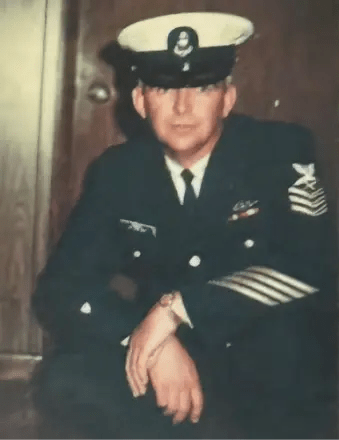
Edward Carlson O’Neal, Jr., 85, passed away on Aug. 13, 2025.
He was the husband of Stella Spencer O’Neal.
Born on June 13, 1940, in Morehead City, he lived a life marked by dedication to his family, community and country.
Edward was a proud graduate of Ocracoke High School. He went on to serve his nation with distinction as a chief petty officer in the U.S. Coast Guard, retiring after a long and honorable career.
Following his service, he embraced the life of a commercial fisherman, a testament to his love for the coastal community he called home. His replica of the Ocracoke style “pound net” can be found on display at the Working Waterman’s Museum.
A man of faith, Edward was a member of the Ocracoke United Methodist Church. He was also a proud member of the Ocracoke famous Mounted Boy Scout Troop 290.
Edward was preceded in death by his beloved parents Edward Carlson O’Neal, Sr. and Edna Styron O’Neal, his sister Betsy O’Neal Midgette and his beloved daughter-in-law Teresa Coffey-O’Neal.
In addition to his wife, he is survived by their four children, Edward Carlson O’Neal III (Pam), Andy Horne O’Neal (Cathy), Stephanie Jane O’Neal and Albert Reid O’Neal.
He is also survived by two grandchildren, Chad Sommers O’Neal (Erin) and Jaquelyn Nicole O’Neal (Juan); his great-grandchildren, Carter Sommers O’Neal, Kyler Diego Luna, Amaya Jane Luna and Johnny Cole Flores; nephew, Bradford Earl Midgette Jr., who was more like a son, as well as several other nieces and nephews.
The O’Neal family would like to extend gratitude to Mary Jane Cougan R.N. for her compassionate care and kindness during his time in hospice.
A memorial service to honor Edward’s life will be held at the Ocracoke United Methodist Church at 1 p.m. Saturday, Sept. 6.
In lieu of flowers, the family kindly requests that contributions be made to the Ocracoke Volunteer Fire Department, P.O. Box 332, Ocracoke, NC 27960, where his son Albert proudly has been fire chief for more than 20 years.
Twiford Funeral Homes, Outer Banks is assisting the family with arrangements. Condolences and memories may be shared at www.TwifordFH.com.
Edward O’Neal repairs his nets. Photo courtesy of the family.
The famous Mounted Boy Scout troop roster. Photo courtesy of Ocracoke Preservation Society.
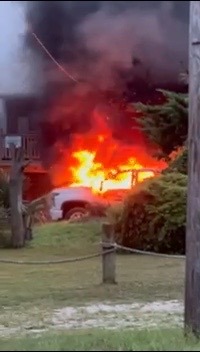
A frame of a video of the truck fire by Jerry Newsome.
By Connie Leinbach
An early morning vehicle fire today was quickly contained by the Ocracoke Volunteer Fire Department.
Assistant Fire Chief Ernest Doshier said that the call came in around 6:30 a.m. and that a truck at a rental house at the end of Pamlico Shores Drive was fully involved when the fire trucks arrived within about four minutes.
“The truck was kind of under a tree and right beside the house,” he said. “We hit the tree first, because it was up against the house — to protect the house — and then, once we were assured the house wasn’t going to be on fire, we went ahead and put the truck out.”
While photos show flames billowing out of the cab, Doshier said the fire was confined to the cab area and did not reach the diesel fuel compartment or the house.
Nevertheless, it took longer than expected to contain.
“It was pretty tough to put out,” he said about the fire. “We probably put 1,200 gallons on that thing.”
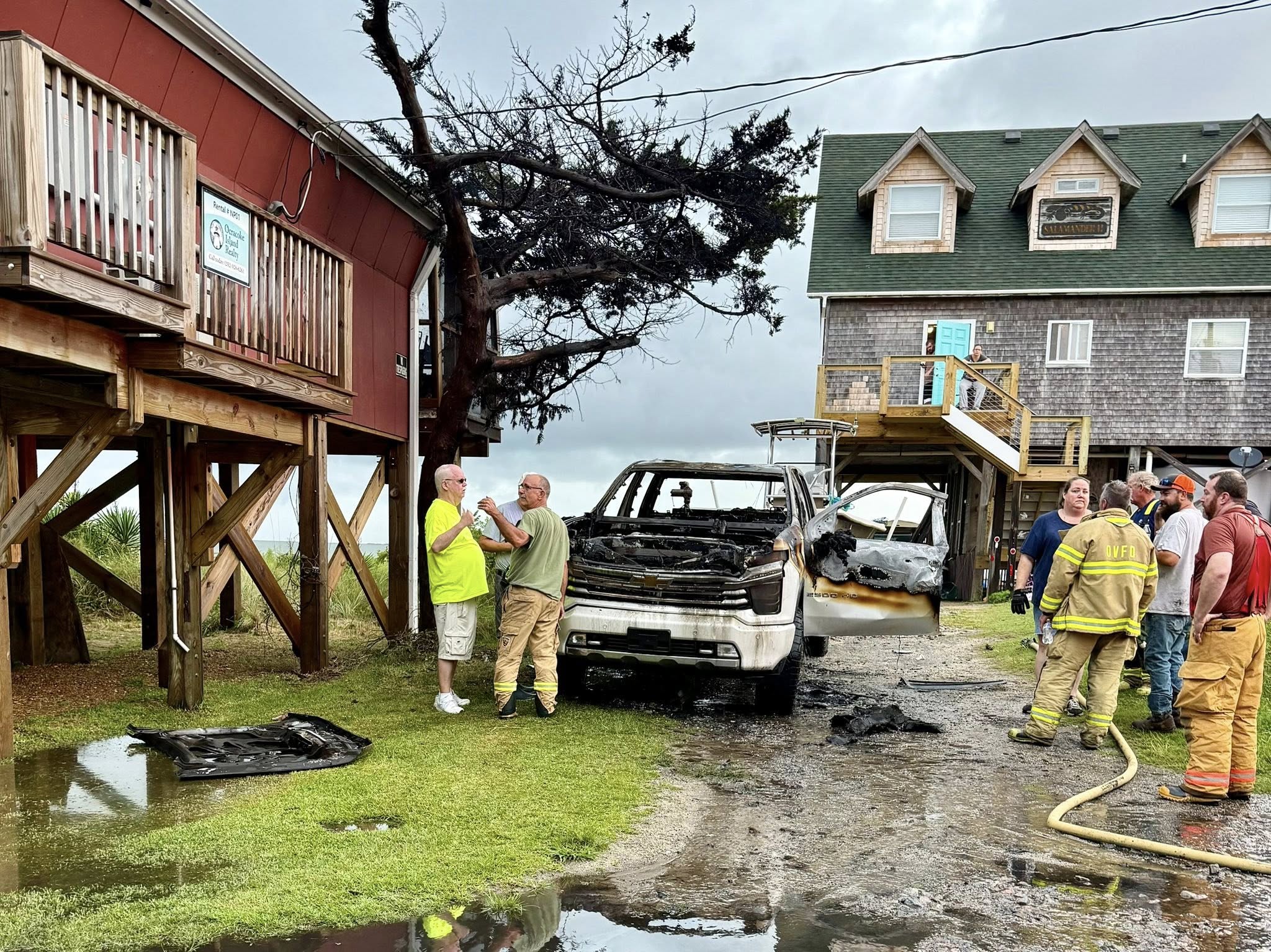
After the fire was contained, the volunteers spent time under the truck’s hood and in the cab making sure all hot spots were wetted down to prevent anything from reigniting.
Ocracoke Volunteer Fire Department volunteers at the scene of an early morning truck fire June 15 along Pamlico Shores Road. Photo by Kelley Shinn
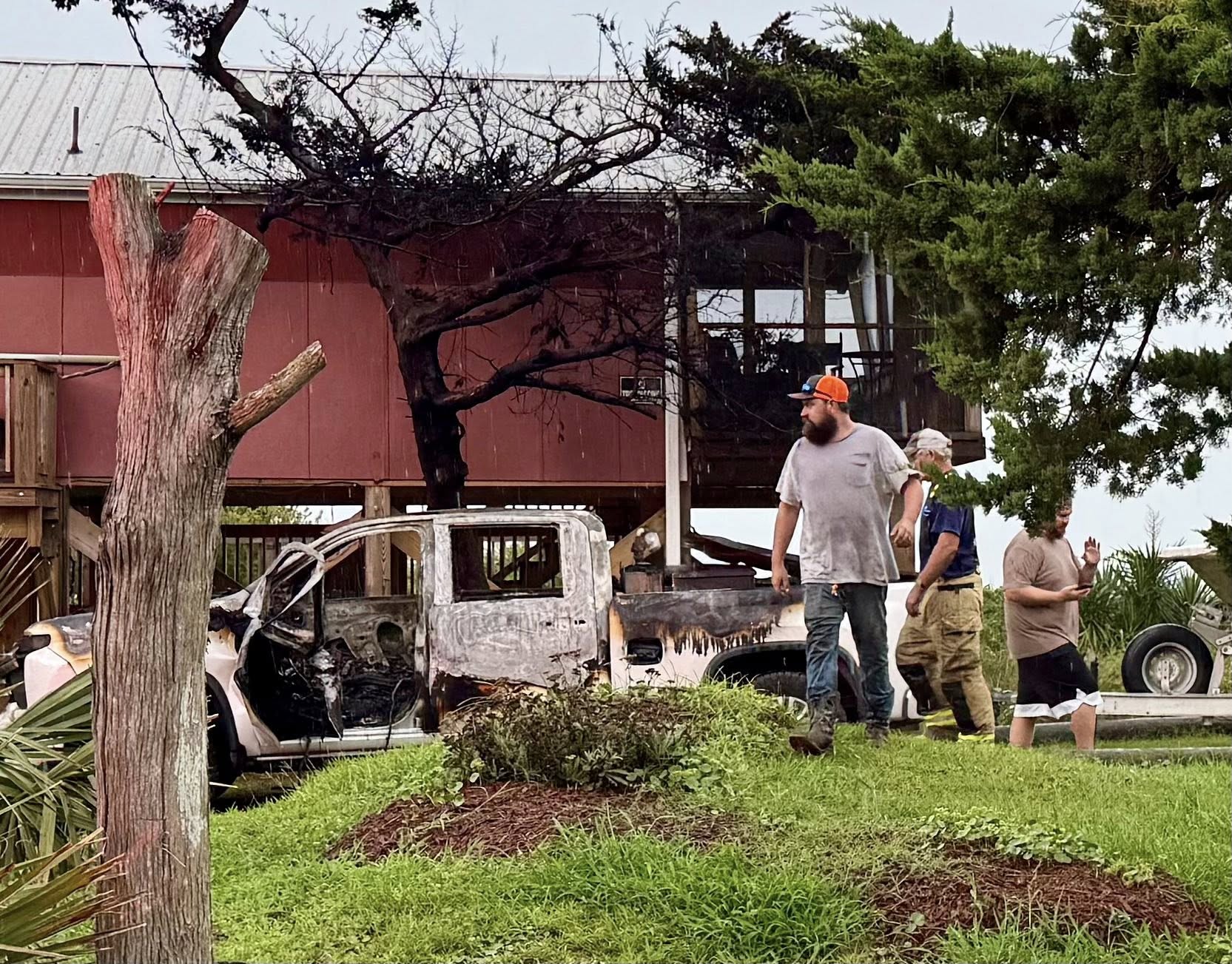
No one was injured, and the house was undamaged, an attached boat was OK, he said, but the tree was singed.
Neighbor Jerry Newsome said he was up early and while looking out the kitchen window saw black smoke and went over to the scene. He went over to the scene and called 911 but someone already had done so.
While thunderstorms were in the vicinity, a lightning strike did not cause the fire, Doshier said, and he does not know what started it.
Another view of the damaged truck. Photo by Kelley Shinn
“It wasn’t even thundering when we got called up,” he said, nor was it raining. “All that stuff was out there in the sound.”
He said about a dozen volunteers responded, along with Hyde County Sheriff deputies, NPS law enforcement officers, EMS personnel and others.
The scene at the early morning June 15 truck fire. Photo by Kelley Shinn
While it is still too early to know the exact path of what is expected to be the season’s first hurricane, the Outer Banks will likely experience rip currents, some ocean overwash and beach erosion next week from Erin.
The fifth tropical cyclone of 2025 formed off the west coast of Africa on Monday but has been battling dry air and cooler water temperatures over the last 48 hours.
Forecasters at the National Hurricane Center said Wednesday evening that Erin is starting to move into a more favorable environment and are calling for it to reach hurricane status sometime on Friday.
Erin is expected to reach major status of category 3 or higher over the weekend, with maximum sustained winds forecast to reach 120 mph in the core by Monday.
However, the track of the storm is much less certain beyond the next five days.
“(T)here is a greater than normal uncertainty about what impacts Erin may bring to portions of the Bahamas, the east coast of the United States, and Bermuda,” NHC said in their forecast discussion Wednesday evening.
But the hurricane center said there is increasing confidence that the risk of dangerous surf and rip currents along the Outer Banks and the rest of the coast is increasing.
A juvenile coyote at Cape Hatteras National Seashore. NPS photo
Editor’s note: Cape Hatteras National Seashore‘s workshop on coyotes previously scheduled for Aug. 27 has been rescheduled for 12:30 to 1:30 p.m. Tuesday, Sept. 23, in the Ocracoke Community Center.
By Connie Leinbach
Cape Hatteras National Seashore and the N.C. Wildlife Resources Commission will co-host public workshop on Ocracoke Island covering the behavior and biology of coyotes, from 12:30 to 1:30 p.m. on Wednesday, Aug. 27, in the Ocracoke Community Center.
Workshop attendees will also learn laws and regulations regarding coyotes and practical methods to prevent or reduce conflicts with them.
Evidence of coyotes has been seen on the Ocracoke beach, and, along with the destruction of sea-turtle and bird nests, islanders have been concerned about the possibility of the animals venturing into the village and attacking island pets, community cats and chickens.
A group of island volunteers met in July with Cape Hatteras National Seashore Superintendent Dave Hallac and Meaghan Johnson, chief of resource management and science, to voice concern for their own safety as well as the village, and they take issue with the stance that “we’ve just got to live with coyotes.”
These volunteers, many of whom also helped rescue sea turtles stunned by cold weather this winter, monitor the turtle nests in the early evening hours when the nests are close to hatching.
Cape Hatteras National Seashore Superintendent Dave Hallac. Photo: P. Vankevich/Ocracoke Observer
During the July meeting, Hallac said that starting Aug. 5 officials from the U.S. Department of Agriculture Wildlife Services would be on Ocracoke for two weeks to better understand the situation and possibly do some trapping.
After the USDA group finishes, from that information, the turtle group and the Park Service, with input from Hyde County, can develop a plan and a community meeting would be scheduled.
“Coyote predation on sea turtle nests is not uncommon, not only at Cape Hatteras National Seashore, but along many of the sea turtle nesting beaches in the southeast U.S.,” Hallac said. Several nests were impacted by coyotes in the northern areas of the Seashore this year.
Just to the south, Cape Lookout National Seashore, which includes Portsmouth Island, is also experiencing coyote predation.
“Over the last couple of years, we have had between 13 and 24 nests impacted annually,” he said.
NPS programs are centered on nest protection but not so much on predator control, he said, although they have removed coyotes from other areas with a surgical approach.
But the Ocracoke group pushed back.
“We feel we have a problem predator,” said James Aiken, speaking on behalf of the group.
One of the Park Service’s edicts is to protect endangered species, such as sea turtles, Aiken said.
“That’s put at risk by these additional coyotes,” he said.
Aiken cited Sanibel Island, Florida, where the coyote population mushroomed from one in 2011 to 27 in 2017.
“So, it’s a progression (of growth) and I see us at the beginning of that progression,” he said. “If we follow the advice that we just have to live with them and adapt because we don’t have the money to spay and neuter them, we’re going to no longer be the sanctuary for turtle nests or for birds.”
Susan Aiken added that they also live in Atlanta, Georgia, where coyotes have made inroads and can be heard howling at night.
“If we don’t deal with it now, in a few years they’re going to adapt to this very unique environment that we have here and wipe it out,” she said.
Ruth Fordon said that she hopes the village, be they businesses or the Ocracoke Civic & Business Association, can participate in this effort.
“The village is going to be concerned if this increases,” she said about coyotes. “We don’t want to be overwhelmed.”
Rita Thiel said that island residents cannot legally go on Park Service land to control coyotes from venturing to the village.
“So, it is your responsibility to stop a top predator from entering the village – and he is the top predator here — that could do decimating damage,” she said.
Hallac responded that the Park Service is not responsible for coyotes and cannot guarantee to remove every coyote from the island.
Coyotes are a wild canine species native throughout North America and, by extension, the Outer Banks, he said.
He also said multiple studies have confirmed that attempts to eradicate coyotes from selected areas have not been successful, in fact, resulted in more coyotes than before.
As to how they have shown up in the last couple of years, Johnson said that scat analysis from samples taken on Portsmouth and Ocracoke have revealed that some are swimming across Ocracoke Inlet.
Aiken said he worries about the slow mechanics of government and asked that whatever plan is devised, they should act quickly.
“Seeing a coyote at night, particularly in a developed area, is not abnormal behavior,” Hallac said. “If they’re approaching humans, in almost every case they’re doing that because there is a human food source that should not be there that’s attracting them.”
As for islanders’ concerns about the village, Hallac reiterated that “the best things they can do are to keep their pets inside and to eliminate any overnight pet or wildlife feeding outside. If you’re feeding pets outside, you’re going to likely have a problem.”
Late afternoon on Ocracoke Island. Photo: P. Vankevich/Ocracoke Observer
Monday, Aug. 11 Ocracoke Community Library: Used Book Sale continues during public hours: M-F, 3-7 pm; Saturday 9 am to 1 pm.
Ocracoke Oyster Company: That Guy Shane, 7:30 pm
Tuesday, Aug. 12 MiniBar at Ocracoke Coffee: Family game night. 6-8 pm
1718 Brewing Ocracoke: Barefoot Wade, 7 pm
Wednesday, Aug. 13 MiniBar at Ocracoke Coffee, 6-8 pm: Island Trivia (Corrected from a previous version.)
Deepwater Theater: Ocrafolk Opry, 8 pm
Ocracoke Oyster Company: Barefoot Wade 7:30 pm
Thursday, Aug. 14 Ocracoke Preservation Society Porch Talk: Amy & Julie Howard: Shells of Ocracoke, 1 pm
MiniBar at Ocracoke Coffee, 6-8 pm: Brooke & Nick
Ocracoke Oyster Company: Ray Murray, 7:30 pm
Friday, Aug. 15 What’s Happening on Ocracoke 11:30 am, 90.1 FM on the island and wovv.org
MiniBar at Ocracoke Coffee, 6-8 pm: Kate McNally
DAJIO: Allegra, 8 pm
1718 Brewing Ocracoke: Brooke & Nick, 7 pm
Ocracoke Oyster Company: Raygun Ruby, 7:30 pm
Saturday, Aug. 16 Fundraiser Fish Fry and bake sale for Clifton Garrish: Cook shack behind Ocracoke Volunteer Fire Department, 4 pm. $20 per plate. See flyer below Postponed to Aug. 23.
Sunday, Aug. 17 Church services: Ocracoke United Methodist Church, 11 am Ocracoke Life Saving Church, 11 am Stella Maris Chapel: Sunday afternoon Mass time varies. Go to Masstimes.org and type in the zip code: 27960
DAJIO: Allegra, 8 pm
1718 Brewing Ocracoke: Open mic, 7 pm National Park Service programs:
The following free programs run from June 16 to Aug. 28. Banker Ponies at the Ocracoke Pony Pen: Every Monday and Wednesday, 8:30 am — 9 am Ocracoke Lighthouse: Every Monday, Tuesday, Wednesday and Thursday, 11 am to 11:30 am Life on a Barrier Island: Every Monday, Tuesday, Wednesday, Thursday, 2 to 2:30 pm. Outside the Discovery Center. MorningBird Walk: Every Tuesday from 8:30 to 9:30 am. Meet at NPS campground parking lot.
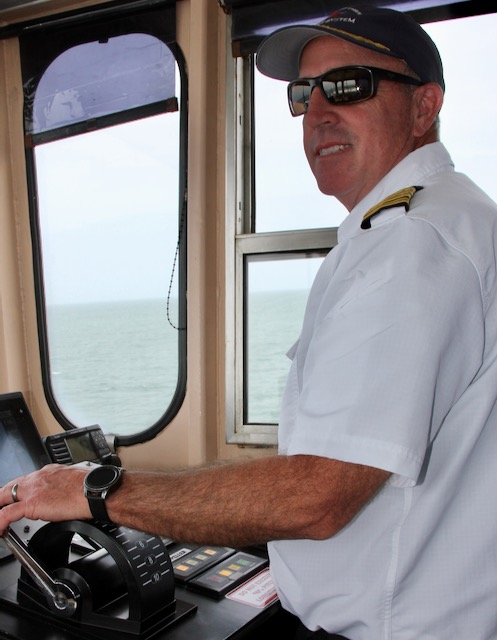
Hatteras Ferry Captain Anthony Gavetti at the helm during a recent transport to Ocracoke Island
Text and photos by Patty Huston-Holm
Hatteras Ferry Captain Anthony Gavetti ruined my vacation last year. This year, after meeting him and learning about his work, I’m glad he did.
As a captain of the ferry traveling Hatteras-to-Ocracoke and back, Gavetti is one of 45 captains in the North Carolina Ferry Division.
We’re not 100% sure he was calling the shots in March 2024 as my husband, Mike, and I tried desperately but unsuccessfully to get from Hatteras Island to Ocracoke Island for our off-the-social-media dream trip with our granddaughter. But if he didn’t, he would have.
In the name of safety, Gavetti calls the “go” or “no-go” shots for all the ferries traveling from Hatteras to the NC Highway 12 connection on the north end of Ocracoke Island.
Sometimes, the boats are suspended due to mechanical problems.
But usually, it’s inclement weather, including high wind. Gusts of 35 to 40 mph and shifting sand can make water unsafe for all boats.
Sand, wind and unpredictable water levels within the Pamlico Sound, Hatteras Inlet and Atlantic Ocean were issues during the unseasonably cold temperatures in that last week of March in 2024.
“Don’t get me wrong; I care about tourists,” Gavetti said. “But my focus is more on the people who live on the island and need to get home and the delivery trucks with food or maybe somebody’s prescription medicine. I need for it to be safe for everybody.”
Gavetti is a captain of the 22-year-old M/V Croatoan, named after a small Native American group living on what is now Hatteras Island back in the 1500s when Europeans first landed there.
I knew the Hatteras-to-Ocracoke route is the busiest of the seven routes. I have been among the estimated 1 million passengers per year using the ferry there. More than once, I was an impatient, cranky one.
I also knew the North Carolina ferry system to be the second largest in the country behind Washington state.
I shadowed Captain Gavetti, 50, on April 4. For six hours that day I posed incessant questions to him and his older and semi-retired captain back-up partner, Ricky Jones.
The average ferry passenger wants to know how long the trip will take and if the boat is going in the right direction. The average passenger hears the horn upon takeoff, absent-mindedly taking in the message to do what the captain tells you “in case of emergency.”
I wanted to know more. Gavetti patiently complied, sharing his background, credentials, stories and why the banana I ate was bad luck.
Ferry service began across the Hatteras Inlet to Ocracoke 72 years ago, in 1953. This is Gavetti’s 28th year.
Most of my conversation with Gavetti was in the wheelhouse up two flights of stairs where often it’s only the radiator and music that break the quiet.
Shortly after 8 a.m. the Croatoan pulled away from South Dock (as the north end dock is called) into the Hatteras Inlet and then into the Pamlico Sound. A sound is a body of water, typically a long, wide inlet or channel, connecting two larger bodies of water, in this case the Atlantic Ocean.
The two share in “guiding,” or directing a 275-ton, 150-feet-long, 42-feet-wide vessel between buoys and around often-changing piles of sand making up a shoal or sandbar.
The water needs to be deep enough. The depth a ferry sits in the water, also known as its “draft,” varies greatly, depending on the size and type of ferry, but generally ranges from around 3 to 15 feet (1 to 4.5 meters).
Alongside Jones, his teammate of 16 years, Gavetti works 12-hour shifts, 7 a.m. to 7 p.m., seven days a week (Tuesday to Monday) with seven days off after that.
Under the captain are chief engineer, oiler/assistant to engineer, senior AB (able body), AB and ordinary seaman. Two people must be in the captain quarters at all times.
To be captain, a minimum requirement is at least 360 days working on a vessel of 100 tons or greater.
“Able-bodied is probably the most important qualification for all of us,” Gavetti, a native of Carteret County, said. “I had to take a test to do this job, but my physical condition is what is monitored.”
The captain has the job of steering the boat and directing vehicle placement based on boat weight balance. The rest of the crew maintains order, safety and cleanliness with backup for each role.
“Sometimes, they fix me breakfast,” Gavetti. As I finished my banana, he added, “But no bananas.”
He then relayed legends of African ships disappearing under the Atlantic Ocean with “only bananas floating on top” and of deadly spiders hitching a banana ride. Thus, the yellow fruit has taken the blame for death and destruction.
“It’s just a tale, I suppose, but we all know about it,” he said. “Nobody in the crew eats bananas on the boat.”
To passengers who on this day made the boat less than half of its 30-to-40 vehicle capacity, the work of the captain might seem seamless.
Hatteras Ferry Captain Anthony Gavetti directs cars onto the boat.
Passengers exit their cars, trucks and vans to use the bathroom, feel the ocean air on their faces, get a closer view of the gulls gliding above the rear wake and peel their eyes for dolphins. On this day, a half dozen dolphins were diving in and out, “getting food that we stir up,” Jones said.
Research revealed that the Roanoke Sound, which includes Hatteras Inlet, is home to an estimated 400 to 800 dolphins.
“It might seem very monotonous, and it is,” Gavetti said, noting that on a ferry sometimes the front (bow) becomes the back (stern) and vice versa. “But you need to be ready. You have to be able to detect something different.”
Brewing storms are always on a captain’s radar.
The worst of them, hurricanes, suspend water travel, with the last one having been Isaias in 2020, though that storm went well to the west of the Outer Banks.
What most passengers don’t know about – but all Hatteras ferry crew members do – are the problems the last two years with Sloop Channel, which the ferries encounter about a third of the way into the run from the Ocracoke side.
This channel had bulged out to skirt shoals but could not accommodate two ferries, causing time delays while one ferry waited for the other to pass through. Last year, Hyde County and the Ferry Division received an emergency permit to cut off that bulge, shortening the run time.
“This was the section that aged us all by 10 years,” Gavetti said of that bulge. “We were always struggling to get through that without incident.” Creation of the channel that is used today required research by archeologists to determine that dredging wouldn’t destroy something (an old, buried ship, etc.) as well as engineering study. “We called this ‘the gauntlet,’” he said of that route “that kept getting further and further out” before the emergency cut was dredged. “There were so many agencies involved in making that better that when it was finally opened as a big slough, we saluted it.”
From the Hatteras dock, Gavetti can see his house. He has a wife who teaches kindergarten and four children, ages 25, 17 (twins) and 15.
Gavetti and Jones, who hails from Frisco, go home at night while other crew members from farther away stay in dormitories.
Gavetti’s father was a fisherman and a ferry boat captain. Also, once a commercial fisherman, Gavetti gravitates to the water even when on vacation. Marathon City in the Florida Keys is a favorite spot.
Gavetti’s first ride on a ferry was in seventh grade when his basketball team was coming over to compete against the Ocracoke Dolphins. He recalls always being fascinated with boats – tugboats, dredging spider barges, cruise ships and, of course, ferries. “Village councils and businesses are talking about us – the ferries – all the time,” the captain said. “Businesses get ticked off because the tourists can’t get over, and then they’re not making money. But when they realize it’s about safety, they calm down.”
This image of the Hatteras Inlet shows the route the ferries take and the recent cut-through at the bulge area.