Mild New Year’s Day weather today (Jan. 1) will give way on Sunday to a strong, multi-threat coastal low that is expected to impact eastern North Carolina through Monday (Jan. 3).
Weather Underground has issued a small craft advisory from today at 3 until Sunday at 5 p.m. and a gale watch from Monday at 4 a.m. until 5 p.m.
Impacts to be aware of:
Widespread heavy rain
Gusty winds across coastal communities
Minor to locally moderate soundside coastal flooding and minor ocean overwash possible
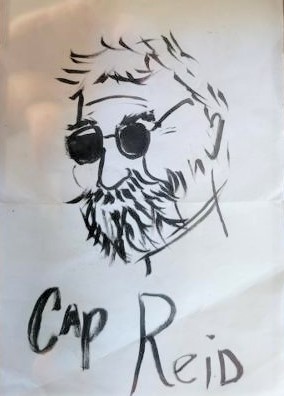
Reid Robinson, captainofthecharterboat“The Devereaux,” died in October.
Drawing of Reid Robinson by Emily Kozlowski.
Editor:
Ocracoke Island lost a colorful soul this past year, who gave us some great memories and friendship for the many years we came down and vacationed on your beautiful island.
We met Captain Reid Robinson in the early ‘90s when my family and friends first visited Ocracoke. Our kids were much younger then and Reid gave them great fun on his small (relatively) boat. He was especially fond of our daughter Emily (who drew the sketch at left) and when we were out at sea, he made all the kids laugh and made sure they caught something.
Our friends’ daughter turned 16 a while back when we were visiting the island and we charted Reid to take us out to celebrate one beautiful evening that remains one of the best times we had on Ocracoke. He was the best.
Over the years we tried to stay in contact with Reid and those of you who knew him also know he fell on some hard times. Some of you really tried to help and it was out of kindness and island solidarity you did that.
We all have our faults and Reid was no exception, but the good times and his colorful ways outweigh the bad. I saw him for the last time in August of 2020 and knew his time was fleeting. It was difficult saying goodbye and I wish there was more we could have done. He will always be part of the spirit of the island, and we will never forget Captain Reid Robinson. He will be missed.
The late Irene Nolan, co-founder and editor of the Island Free Press, left, with co-founder and business partner Donna Barnett. Photo courtesy of Donna Barnett
Ocracoke students wishing to study English or a related subject in college may apply for scholarship help from The Irene Nolan Memorial Scholarship Fund at the Outer Banks Community Foundation.
The late Nolan was co-founder and editor of the Island Free Press, the first online newspaper for the Hatteras and Ocracoke communities.
Nolan’s long-time business partner and Island Free Press co-founder, Donna Barnett recently established this fund. Renewable college scholarships will be awarded in Nolan’s name to students on Hatteras and Ocracoke islands, with preference given for students pursuing English-related degrees.
As with most other Community Foundation scholarship funds, this fund will offer up to four years of scholarship funding to each student recipient. Also, the fund is endowed, meaning that the bulk of its assets will remain invested and only 5% of its earnings will be spent each year. In this way, the fund will be a perpetual source of scholarships for students on Hatteras and Ocracoke islands.
Irene Nolan was a force for good for nearly two decades on our Outer Banks. She was an accomplished journalist and newspaper editor, an early board member for Hatteras Island Cancer Foundation, an enthusiastic volunteer for other causes, and a friend to many island residents.
Nolan moved to Hatteras in 1991 after a successful career at the Louisville, Kentucky, Courier-Journal. She married C.A. Boxley of Frisco and she became editor of the Island Breeze, a southern Outer Banks publication. Noland and Barnett in 2007 launched the Island Free Press (IFP), the first and only online newspaper to cover the southern Outer Banks. That publication quickly became an important community resource for visitors and residents.
“This has been a dream of mine since Irene’s untimely death in 2017,” said Barnett. “Irene was many things to me. A second mother, a mentor, a friend and an icon. She was also a lot of things to this community and was considered the voice of our islands. It was only fitting to start a scholarship in her name. I am so excited about this scholarship coming to fruition and look forward to watching it grow and help more and more students through the coming years.”
“As one of many writers who were lucky to work with Irene at the Island Breeze and the Island Free Press, I can’t think of a better tribute to her legacy than to help the next wave of Outer Banks writers pursue their own love of journalism,” said Joy Crist, current editor of the Island Free Press. “Irene remains the soul and backbone of the IFP, and I’m beyond grateful to Donna and the Community Foundation for finding a beautiful way to shine a spotlight on an incredible journalist, editor, and friend.”
Anyone may contribute to the Irene Nolan Memorial Scholarship Fund by sending a check to the Community Foundation with the fund name in the memo line, or by contributing online at obcf.org/donate-now, and selecting the fund from the searchable funds list.
All donations to the Outer Banks Community Foundation, a 501(c)3 charitable nonprofit based in Southern Shores, Dare County, are tax deductible.
The Hatteras-Ocracoke ferry route is one of two ferry routes that will run a reduced schedule this week due to some staff exposures to COVID-19.
In a press release today, the N.C. Ferry Division said that at Hatteras, four employees have tested positive for the virus and three are under quarantine due to exposure, while the Currituck-Knotts Island route has one employee under quarantine.
“This latest wave of the pandemic has affected travel services nationwide, and, unfortunately, we’re no exception,” said Ferry Division Director Harold Thomas. “We apologize for any inconvenience to our passengers, but health and safety have to come first.”
The Hatteras-Ocracoke route will run the following schedule today (Dec. 28) until Monday, Jan. 3:
The Currituck-Knotts Island route is closed today (Dec. 28) but will reopen as soon as a full crew can staff the route.
Ferry passengers are encouraged to remain in their vehicles during shorter crossings and are reminded that they must wear face coverings when inside all passenger lounges and terminals.
Ferry operating schedules could change as weather conditions change.
For schedule updates, people should follow NCDOT on social media or call the Hatteras ferry terminal at 252-996-6000.
Mike Lydick with a wild salmon caught in Washington. Photo courtesy of Mike Lydick
5:36 a.m., Seattle time. I’m sitting three feet from the guide, who is staring intently at the digital silhouettes of King Salmon dancing 30 feet below our small boat. I’m staring at the tip of my pole, whose barbless hook is covered with pink roe below us in the glacial lake’s black depths. The migrating fish find solace in the deeper cool waters here as they travel north up the Columbia River to spawn.
At least 50 other boats filled with anglers float above them on the surface. Fish and fishermen together at the appointed time. As the half-full October moon falls below the Olympic Mountains, I see my breath crisply rise.
I see the sky exploding — oranges, purples and pinks to the east.
I see my pole tip bounce ever so softly down to the giants below and I whip the pole up and reel. “REEL, REEL, REEL!” yells the guide and we pray and our hearts race as the net descends and captures and raises the dripping fish, dropping it into my waiting arms.
8:50 p.m., Ocracoke time. My Xterra is 25 feet from the Atlantic Ocean. Now 3,000 miles to the east of Seattle, under full hunter’s moon.
A mile behind me, the Red Drum are schooling on the reef in the sound, gorging on the thick black schools of mullet that saturate the waters and the waves before me. The bulls — massive 40- and 50-inch fish — have been spawning in the sound and are about to turn from South Point into the ocean.
Hundreds of fishermen gather with me along the shore in their own trucks. Making the same quiet bargains with God. Praying for a bent pole and a good hook set.
Above me, Venus and Jupiter shine through the bright sky down to the illuminated sand. I am empty, focused entirely on the Penn Prevail 12-foot rod in my hands. Some 80 yards out, a live finger mullet is bound to my hook just behind its dorsal fin.
Bump. Bump. Bump. BUMP, BUMP, BUMP.
Under a hunter’s moon on Ocracoke, Mike Lydick’s rod with a fluorescent chemical glow stick on the on the tip, awaits the prized red drum. Photo by Mike Lydick
I reel, reel, reel, watching the drag pull out from the Penn Squall reel.
I rise from my chair, reeling, reeling; tip up tension; keep tension reel down; pull up; don’t jerk it; let the fish get tired and come when it’s ready. When it’s ready, tip up, reel down!
Headlamp on as I reel and thousands of mullet dance in the waves around the fish as I pull him over the bar into the surf.
The mullets shine like diamonds, reflecting the moonlight and the flashlight and the starlight as I pull my prize onto dry sand.
It is fall and I am here, and it is a perfect moment.
It is a deep and special thing, this autumnal homecoming.
To meet up with these monsters out in — and in front of — the deep dark waters. I am a part of it all. A tradition that transcends the masters of my modernity.
In the dead of winter, under the summer sun, I am dreaming of cast nets and migrating mullet and moons. Cold fronts and warm waders. Ready to return, with no desire to leave.
Mike Lydick is an avid fisherman and occasional contributor to the Ocracoke Observer.
Skinvy products are Fountain Shower Oil, Selkie and Vivarium. Photo by Carol Bullard
By Connie Leinbach
Necessity is the mother of invention, and Katy Mitchell has found success with a product she created especially for herself.
Her “Skinvy” line of skin-care products helped her so much with her skin problems that she felt compelled to share them.
“My skin was terrible,” she said. “And it didn’t matter what I used. Anything that was supposed to treat oily-combination skin just made it worse.”
Mitchell, who owns the Magic Bean Coffee Bazaar on School Road, spent thousands of dollars on both cheap and fancy stuff and French and Korean products.
“And just nothing worked,” she said about issues of oily skin, large pores, blemishes and uneven skin tone.
“When you’re in your 20s you just want to be beautiful and you don’t get a lot of time to really just be beautiful,” she said. “When you’re constantly struggling, it’s a pain.”
So, in 2019 she decided to take the esthetics class in the Workforce Development Program at Lenoir Community College to learn more about skin care to figure out how to help herself and maybe other people.
But what she learned shocked her: The process was to push chemical peels and drying agents, then moisturizers.
“The professionals are creating the skin issues their customers were coming to them to solve,” she said.
She decided this was not what she wanted and began her own research on homeopathic substances and what they actually do to the skin.
Feeling like a mad chemist, for over two years she did a lot of experimentation and found ingredients that acted perfectly together.
“Pomegranate seed oil is one of the most miraculous things I’ve ever found,” she said.
This oil help cells retain nutrients, she said.
“It basically creates a little capsulized cushion so your body can actually take in stuff that normally would just kind of stay on top of the skin or get washed away,” she said.
This and red raspberry seed oil are the main ingredients in her Fountain serum, she said. Both oils repel carcinogens and contain natural SPF to protect skin from sun damage.
Fountain also has pure vitamin A, an anti-aging retinol that when used topically helps stimulate collagen production and reduce wrinkles.
“Hence, the fountain of youth!” she said.
Fountain was the first product she made for herself – to minimize pores and fight bacterial infections.
“I’ve had amazing feedback – not just my own skin,” she said.
Katy Mitchell. Photo: C. Leinbach
Maybe that’s why the tag line for her products is “Hello, Gorgeous!”
Margo Babb, who lives in Greenville and Ocracoke, testifies to the products. She had a skin graft on her nose and began using Mitchell’s face mask and Fountain.
“It smoothed (the graft) out,” Babb said in an interview. “When I look in the mirror, I can’t notice it.”
Some sun-damaged spots on her legs have faded after application of Fountain.
For a face cleanser, Mitchell recommends Milk Street Soap, another company that began on Ocracoke out of necessity.
Formed by Kim Meacham, who a few years ago moved her successful company to Kitty Hawk area, Meacham decided to develop her own soap to help her children with their skin issues. Meacham’s soap products can be found in shops all over the island.
Another island manufacturer, Kate McNally, sells her Live Oak Tea & Botanicals, which address inside-the-body issues, out of her space in the Ocracoke Wellness Collection in the pool house of the Castle B&B.
“Skinvy,” a play on “skin envy,” is the name of Mitchell’s product line and is the name of her after-shower body oil.
None of her products have the mysterious chemicals of unknown pronunciation that one sees on the labels of commercial lotions.
Mitchell also offers “Selkie,” a Dead Sea salt body scrub, good for eczema-type skin problems. “Vivarium” is a green tea face mask for rosacea and any kind of blemishes or redness.
“Quench Me” is a hydrating face spray, and “Shoo Fly” is a natural mosquito repellent.
Because of the cost of the ingredients, Mitchell makes them in small batches in her mother’s art studio, Kitty Mitchell Studio, across from Community Square, where she also sells the products.
Because the products lack chemical preservatives, after opening, each product must be refrigerated after one month and then kept no longer than three months.
A diamondback terrapin attempted to nest in the middle of South Point Road, Ocracoke Island. Photo: P. Vankevich
By Peter Vankevich
The diamondback terrapin, an estuarine turtle seen throughout much of the Outer Banks, has a special niche in the Atlantic coastal ecosystem, being the only turtle in the world that inhabits exclusively the brackish waters of estuaries, tidal creeks and salt marshes.
But islands such as Ocracoke may not be as welcoming to them as in the past due to a highly aggressive and invasive exotic plant that is eliminating much of their nesting habitat and putting their future at risk.
There may be a way to fend off this threat and help ensure long-term survival for this handsome turtle (Malaclemys terrapin) with its spotted face, striking colors and variable patterns on its shell, but action will be needed.
Terrapins have faced many obstacles to their existence over the centuries. In one case, it took a constitutional amendment to save them from extirpation.
In the latter decades of the 19th century, terrapin “turtle soup” became a popular and trendy gourmet item on menus at high-end restaurants, private clubs and even at the White House.
The demand for this perceived delicacy led to excessive harvesting, and nearly caused the species’ demise by 1920.
In a quirky twist of society’s mores, the 18th Amendment to the Constitution that banned the consumption of alcohol during the prohibition era, benefitted the terrapin.
How could teetotaling have had such an impact? The key ingredient in a decent terrapin soup or stew was sherry, which became a banned substance under the 18th Amendment, ratified in January 1919.
With restaurants unable to use this Spanish fortified wine in the recipe, the soup lost its pizzazz and disappeared from the menus. This ended the terrapin soup craze and harvesting became nearly nonexistent, allowing their drastically dwindled numbers to begin to increase. By the time the Amendment was repealed, culinary fads had moved on to other delicacies.
Diamondback terrapins in a tidal creek on Ocracoke Island. Photo: P. Vankevich
Although massive commercial harvesting is long gone, both legal and illegal wildlife trade as pets and food remain a problem and the terrapin has not fully recovered. It is listed both federally and in North Carolina and several other states as a species of Special Concern. The North Carolina Wildlife Action Plan considers it a priority species.
These days, in addition to trafficking, by-catch mortality from commercial and recreational crab pots, road crossing fatalities, pollution, sea level rise affecting coastal marshes and loss of habitat are the main causes of their premature deaths.
Unlike sea turtles, such as the loggerhead and the green turtle that spend their lives in the high seas with females only coming to land to lay eggs, terrapins stay close to shore in narrow Atlantic coastal estuarine habitats of tidal creeks and marshes.
Their range is from Cape Cod in the north, down to the coasts of Florida and along the Gulf Coast to Texas. Bermuda also has a terrapin population. With philopatric tendencies to remain in the same areas from where they hatched, terrapins do not make long-distance migrations. Females can lay two to three clutches of four to 24 eggs in late spring. The eggs usually hatch in 60 to 85 days, with hatchlings emerging from the nest in August and September. Sometimes hatchlings overwinter in the nest and emerge the following spring. During the cold winter months, they hibernate buried in the mud at the bottom of tidal creeks and marshes.
The bad guy: Phragmites in North America
Of the more than 5,000 invasive plant species embedded in North America’s ecosystems, Phragmites (Phragmites australis) is considered to be the most dominant and destructive. Also known as the Common Reed, it is highly aggressive and has many adverse effects on aquatic ecosystems, impacting native flora and fauna species. It is now found throughout the world, except for the continent of Antarctica.
The non-native Phragmites first appeared in North America in the late 18th or early 19th century, most likely brought over in ships from Europe, and has spread in wetlands throughout much of the continent.
Although there is a widely distributed but not very common North American native subspecies of Phragmites (americanus), it does not occur in the Southeast, which includes North Carolina. It is not the native subspecies but the invasive subspecies (australis) that is the problem for terrapins and which is found in abundance on Ocracoke.
Cassandra Cook cited many examples of this plant’s harmful effects in her College of William and Mary master’s thesis, “Impacts of Invasive Phragmitesaustralis on Diamondback Terrapin Nesting.” Her research focused on Fisherman Island National Wildlife Refuge in Virginia.
Cook noted that Phragmites reduces marsh habitat quality for terrapins. Its presence has been linked to decreases in the abundance of smooth cordgrass (Spartina alterniflora), the aquatic plant found in brackish tidal marshes which hosts the marsh periwinkle (Littorina irrorata), a staple in the diamondback terrapin diet. Less cordgrass means fewer periwinkles for the terrapins to eat, thus making their foraging even more difficult.
Thick stands of Phragmites create an additional problem by lowering surrounding soil temperatures that can also jeopardize terrapins. The reason is that, like many turtle species, terrapins have temperature-dependent sex determination, meaning that the sex of hatchlings is the result of incubation temperatures. Cook found that a Phragmites cover of greater than 50% causes a decrease in incubation temperatures of terrapin nests sufficient to produce predominantly male hatchlings. Fewer females mean fewer hatchings.
Non-native Phragmites australis, now in abundance on South Point Road, Ocracoke Island. can be impenetrable for a diamondback terrapin to find a suitable nest site. Photo: P. Vankevich
It is easy to identify Phragmites by its height, which can be up to 15 feet. It has long, thin, green leaves and a large purple-brown flower head that turn silver in the fall. Despite its striking appearance, the scary part is subterranean.
Its rhizome stem system creates a root structure that can grow up to 60 feet in length at a depth of more than six feet. It spreads very efficiently, with new stalks growing off the roots. New locations can be infected through wind dispersal of its seeds.
In the spring, female terrapins look for sparsely vegetated sandy areas above the tide line to lay their eggs. When Phragmites invades these open areas and takes root, the nest site is no longer viable. The plant also spreads rapidly right up to the waterline. This high density creates an impenetrable hedge that prevents terrapins from easily finding a suitable nesting site.
As their habitat diminishes, terrapins must travel longer distances to find a site to lay their eggs. Early one morning a few years ago, I saw one attempting to lay her eggs in the middle of the sandy, busy Southpoint Road on Ocracoke.
The longer terrapins search for a suitable nesting site on land, the more vulnerable they are to predation. Later, an even worse danger occurs for the hatchlings which are exposed for much longer periods on their long, dangerous maiden trek to a marsh or tidal creek. This makes them easy pickings for ghost crabs, gulls, crows, raccoons, and other predators.
Not to be confused with Phragmites, sea oats (Uniola paniculata), a tall subtropical grass, is an important component of coastal sand dune and beach plant communities in the southeastern United States. Photo: P. Vankevich
What can be done
Large-scale Phragmites removal can be a bottomless money pit and, once the plant is firmly rooted almost impossible to completely eradicate. It is much easier to remove, or at least control, when detected in its early stages.
One feasible solution is a selective small-scale Phragmites eradication process in areas where terrapins would most likely nest near water.
Cook agreed that a Phragmites eradication effort could be effective. “Open it up and they will find it,” she said, noting that terrapins have nested on clear, sparsely vegetated dredge spoil islands.
Ron Emens also thinks this is doable. “I’ve been pushing for more Phragmites management, just in general in North Carolina because I’ve seen what it does in states like Maryland, New Jersey and Virginia,” he said in an interview.
Emens, the Aquatic Weed Program manager with the state’s Division of Water Resources in the N.C. Department of Environmental Quality, assists local governments and other stakeholders with the removal of aquatic weed infestations.
Two herbicides, glyphosate and imazapyr, can control Phragmites effectively when used individually or in combination. Careful use of these chemicals is vital to protect nearby native plants. Controlled burning and mechanical plant removal using small mowers, weed whips and brush hogs can be combined with these chemical applications.
By the time Phragmites has been removed or greatly diminished, the chemicals are long gone, Emens said.
Unlike sea turtles, the National Park Service and the U.S. Fish and Wildlife Service currently do not track diamondback terrapins, according to their officials. These two federal services, in partnership with many federal and state agencies, nongovernmental organizations, and hundreds of volunteers, have made remarkable progress increasing the number of nesting sea turtles, especially loggerheads, on the Outer Banks in the past 15 years.
Fortunately, there is one ongoing terrapin research project in the state.
For the last seven years in May, volunteers (mostly in kayaks and canoes), have participated in a citizen science project, known as Terrapin Tally, to collect data to better understand terrapin distribution and density.
The North Carolina Division of Coastal Management’s North Carolina Coastal Reserve, partnering with the N.C. Wildlife Resources Commission, N.C. State Parks, Bald Head Island Conservancy, N.C. Audubon, N.C. Aquariums, and National Park Service, has spearheaded this important project.
So far, these surveys have taken place in the southeastern part of the state where Phragmites does not have the densities of the northeastern region. Sarah Finn, a coastal wildlife diversity biologist with N.C. Wildlife Resources Commission, said there are plans to extend the range of these surveys to areas farther north and could include Ocracoke if volunteers can be found. Expanding these surveys into areas where Phragmites is present or appears to be increasing can help biologists understand the regional populations and determine if loss of habitat is a factor in decreased numbers.
The North Carolina Coastal Federation hosted a workshop a few years ago to discuss the development of a coastwide management plan addressing the spread of Phragmites. Any plan should include the needs of the diamondback terrapin.
Losing nesting habitat to Phragmites can be threatening to their long term survival like turtle soup that appeared on menus more than 100 years ago.
Taking effective measures now can go a long way toward avoiding having the diamondback terrapin placed on the endangered species list.
We have a chance to take on the Phragmites threat to terrapins in North Carolina and nip it in the bud, to use a terrible floral cliché. If we don’t take action, the consequences could be far worse than groaning at a bad pun.
Phragmites, like these at the Swan Quarter ferry terminal, can be seen all over North Carolina and the East Coast. Photo: C. Leinbach
The following is from the Hyde County Health Department
The news keeps us flooded with COVID-19 information, but this press release is specific to Hyde County with information as of Dec. 20.
Since the COVID-19 pandemic began, Hyde County has had a total of 879 cases, 13 deaths, 13 active cases, 31 cases that were post-vaccination and 853 recoveries. Though our recovery rate is high, there should be no deaths and Luana Gibbs, Hyde County health director, continues to extend heartfelt condolences to those who have lost loved ones.
“As we embark upon another holiday season of love and family, please let me stress the importance of remaining as safe as possible against the COVID virus,” Gibbs said.
Here are the recommendations:
Get vaccinated
Boost your vaccinations as soon as eligible
Test if you are going to be indoors with people whom you do not live, and
Mask when indoors in public, even if you are vaccinated.
As North Carolina experiences an uptick in COVID-19 cases and braces for the impact of the highly contagious Omicron variant, Governor Roy Cooper and other state officials, during a Dec. 20 press briefing, urged residents to get booster shots and to get vaccinated if they have not done so until now.
“If you are eligible for a booster, get one right away,” Cooper said. He said the dominant variant in the state remains the Delta variant, but added that the Omicron variant is only weeks and maybe days away from taking hold in North Carolina.
People should know and understand by now that COVID-19 is with us to stay, Gibbs noted. “We must think of COVID-19 as we think of influenza, a virus that is potentially lethal though not always and can be prevented or at least severely lessened by vaccination,” she said. “Please use common sense, and take care of yourselves and others.”
For testing or vaccination, call the Hyde County Health Department at 252-926-4467.
Both the Hyde County Health Department and the Ocracoke Health Center are open Monday through Friday but both will be closed Dec. 23 to 27 in observance of Christmas.
The Ocracoke Health Center notes that booster shots have been approved for 16- and 17-year-olds if their second dose of the vaccine was at least six months ago.
“We encourage all children to be vaccinated,” the health center said in a Facebook post. Pfizer vaccine for ages 5 and up will also be available.
Appointments for all shots are available by calling 252-928-1511. The next Pfizer clinic for ages 5+ will be Jan. 6 and 7.
Trudy Austin’s house at Loop and Lighthouse roads is Best of Show. Photo by Richard Taylor
By Richard Taylor
Ocracoke Island’s Holiday Lights Celebration returned to the village this season with prizes awarded in five categories to new entrants as well as longtime decorators.
At least 14 homes along Lighthouse Road displayed varying degrees of splendor, including two celebration winners. Sundae Horn and Sara Teaster organized the event for the Ocracoke Civic & Business Association.
The Best of Show grand prize went to Trudy Austin and John Simpson for their big splash at Trudy’s home on the corner of Lighthouse and Loop roads.
Previous Best of Show winners Bobby and Allison O’Neal in Oyster Creek were runners-up.
“We only used about 80 percent of the decorations we had available,” Austin said later. “I was just trying to continue what my parents started in the ‘60s.”
Simpson also hosted his annual Christmas music show Saturday night on WOVV, 90.1 FM. The two also won best traditional fig cake at the Ocracoke Fig Festival Cake Bake-off in August.
“It was hard for the judges to choose a Best of Show,” Horn said. “They wanted to give lots of prizes.” “They really liked the Rudolph character and the sea creatures around the side.”
Across Lighthouse Road from Austin, Heather and Fletcher O’Neal reeled in the Best Theme prize for their fishing motif. The O’Neals operate Ocracoke Mariculture, an oyster farm.
Horn recruited village resident Rodney Lapp and visitor Jeremy Ross at Zillie’s to judge the festive event.
Horn said the judges never wavered from their delight with the O’Neal’s commercial fishing theme, and therefore did not award a runner-up in that category.
The Village Craftsmen captured Best Business honors. Photo by Richard Taylor
Other winners were as follows, for photos, see slideshow at bottom:
Most Traditional — Susan Barksdale house at the Corner of Sara Ellen and Silver Lake roads, for simple red candles inside the windows of this traditional two-story frame house. ”The judges loved the simplicity of this historic island home,” Horn posted on Facebook. “It’s visible from across the harbor.”
Most Traditional runners-up — Sue and Vince O’Neal house at the end of Cedar Road.
Most Original — Mickey and George Roberson’s house at Sunset Drive and Cemetery Road. “The judges admired the carriage full of gifts as unexpected and different,” Horn wrote.
Most Original runner-up — Helen and Richard Waldrop’s home in Jackson Circle. “We all loved the crab pot tree on the roof,” Horn posted.
Best of Show Business — Village Craftsmen on Howard Street. Horn posted that their winning elements were the real Christmas tree on the porch and a mantel hung with stockings. “The judges appreciated that Village Craftsmen made the effort to decorate, even though they are closed for the season.”
Best of Show Business runner-up — Zillie’s on Back Road.
A special honorable mention went to “Moostletoe the Moose,” who migrated from the Lighthouse to Ocracoke School, before finally mooving to the residence of Martha and Ronnie Van O’Neal on Back Road.
Howard Street resident Thurston Sumner created “Moostletoe” last year and it became Yuletide favorite in the village.
“Our judges were very thoughtful,” Horn said. “They made notes and took a lot of time with it.”
Some people, who have lights every year, didn’t have lights. So the competition was different this year.
“There were still a lot of lights this year,” Horn said. “I thought everybody did a great job. I appreciate it when anyone puts up even just a few lights. It makes the island more festive.”
Best Theme, Heather and Fletcher O’Neal, Lighthouse Road. Photo by Richard Taylor
Best Business runner-up, Zillie’s. Photo by Richard Taylor
Most Traditional Susan Barksdale house. Photo by Richard Taylor
Most Traditional runner-up Sue and Vince O’Neal., Cedar Road. Photo by Richard Taylor
Most Original runner-up Helen & Richard Waldrop, Jackson Circle. Photo by Richard Taylor
‘Mooseltoe the Moose’ with judges Rodney Lapp and Jeremy Ross. Photo by Sundae Horn
Honorable Mention to ‘Mooseltoe the Moose’ at the home of Martha and Ronnie Van O’Neal, Back Road. Photo by Richard Taylor
Most Original, home of George and Mickey Roberson at Cemetery Road and Sunset Drive. Photo by Sundae Horn
1718 Brewing Ocracoke has created a Christmas tree out of beer kegs. Photo: C. Leinbach
Ivey Belch, pastor of Ocracoke Life Saving Church, announces a fund raising campaign to aid victims of the recent tornadoes in the Midwest.
Observer staff report
Update Jan. 3, 2022:
Pastor Ivey Belch of the Ocracoke Life Saving Church announced on Dec. 28 that the church received a generous donation enabling it to reach its $7,000 goal of donations from the community to aid victims of the devastating tornadoes recently the Midwest.
Belch said the church received $7,050, which means $14,050 will be sent to help those affected by recent tornados in the Midwest leaving destruction and lost lives in their wake.
“We are excited and ecstatic that we can send these funds to help someone else in need as we have been helped in our community so much in need,” he said in a Facebook broadcast. “This is a blessing and I know it will be a blessing to many as we send these funds on. Any funds that continue to be received for tornado victims will be sent as well.”
Belch had announced Dec. 19 night that the church will contribute $7,000 to be given to two organizations that have helped Ocracoke and which have already responded to the tornado disasters.
Those organizations are the Christian Aid Ministry (CAM) and the Convoy of Hope, both of which helped or continue to help Ocracoke following the Sept. 6, 2019, flooding by Hurricane Dorian.
CAM volunteers returned to the island in November to resume building and rebuilding island homes following their initial posting to the island last year.
“We know what it’s like to be affected by a devastating storm,” Belch said in a Facebook address and asked individuals and businesses on Ocracoke to match or exceed the “seed” that the church has planted.
Belch is the chair of the Ocracoke Interfaith Relief & Recovery Team, which was organized in the aftermath of Dorian (Sept. 6, 2019) as the local entity to continue the work of distributing goods and rebuilding homes on Ocracoke.
“We’ve been given so much,” he said about the money, food and supplies that poured into Ocracoke two years ago. “Let’s give some back and let us give sacrificially, as others gave to us.”
He said the amount raised will go wherever CAM and Convoy of Hope deem is most needed in the six affected states: Arkansas, Illinois, Kentucky, Missouri, Mississippi, and Tennessee.
“Convoy of Hope brought the first three tractor trailer loads of food and supplies the day after Dorian,” Belch said. “They’ve been there since day one in these areas affected by the tornadoes here at Christmas. So many lives have been affected.”
Those interested in giving can go to any First National Bank and request to deposit to the Ocracoke Assembly of God general fund. Those donations will be transferred into the tornado relief fund.
Checks can be sent to: Life Saving Church, PO Box 68, Ocracoke, NC 27960, with Tornado Relief in the memo line.
Donations can also be made via credit card in the “Giving” link on the Life Saving Church’s website lifesaving.church.
Belch said the church will cover the credit card fees so that 100% of gifts will go to aiding the victims.
The campaign will go to the end of December and if goal hasn’t been met by then, it go to the end of January.
In related action, Pastor Logan Jackson of the Ocracoke United Methodist Church also announced that he has contacted multiple churches in states affected by the Dec. 11 tornado.
“We have not heard back from any of those communities we have reached out to partner with just yet,” he said, “but we will be collecting love offerings and donations until the end of the year or later to help an affected community.”
Jackson said he will relay that information, when he knows more and what community the donations will go to.
Donations can be made in person at OUMC services or through the church’s Facebook page @OcracokeUnitedMethodistChurch or by email at ocracokenccumc@gmail.com. Jackson asks donors to write “Tornado Relief” in the memo line.
The North Carolina United Methodist Church Disaster Response team set up an extended camp on Ocracoke right after Dorian and helped with disaster relief until departing in January. UMCOR also came to the island after Hurricane Matthew in 2016.