By Connie Leinbach
The N.C. Ferry Division will hold a meeting in Ocracoke School gym at 6 p.m. Wednesday, Sept. 9, to discuss the Jan. 1 start for tolling the Hatteras ferry and the pending discontinuance of residential priority passes.
Ocracoke Access Alliance (OAA), Ocracoke’s lobbying group, is seeking to delay that start due to many questions about implementation.
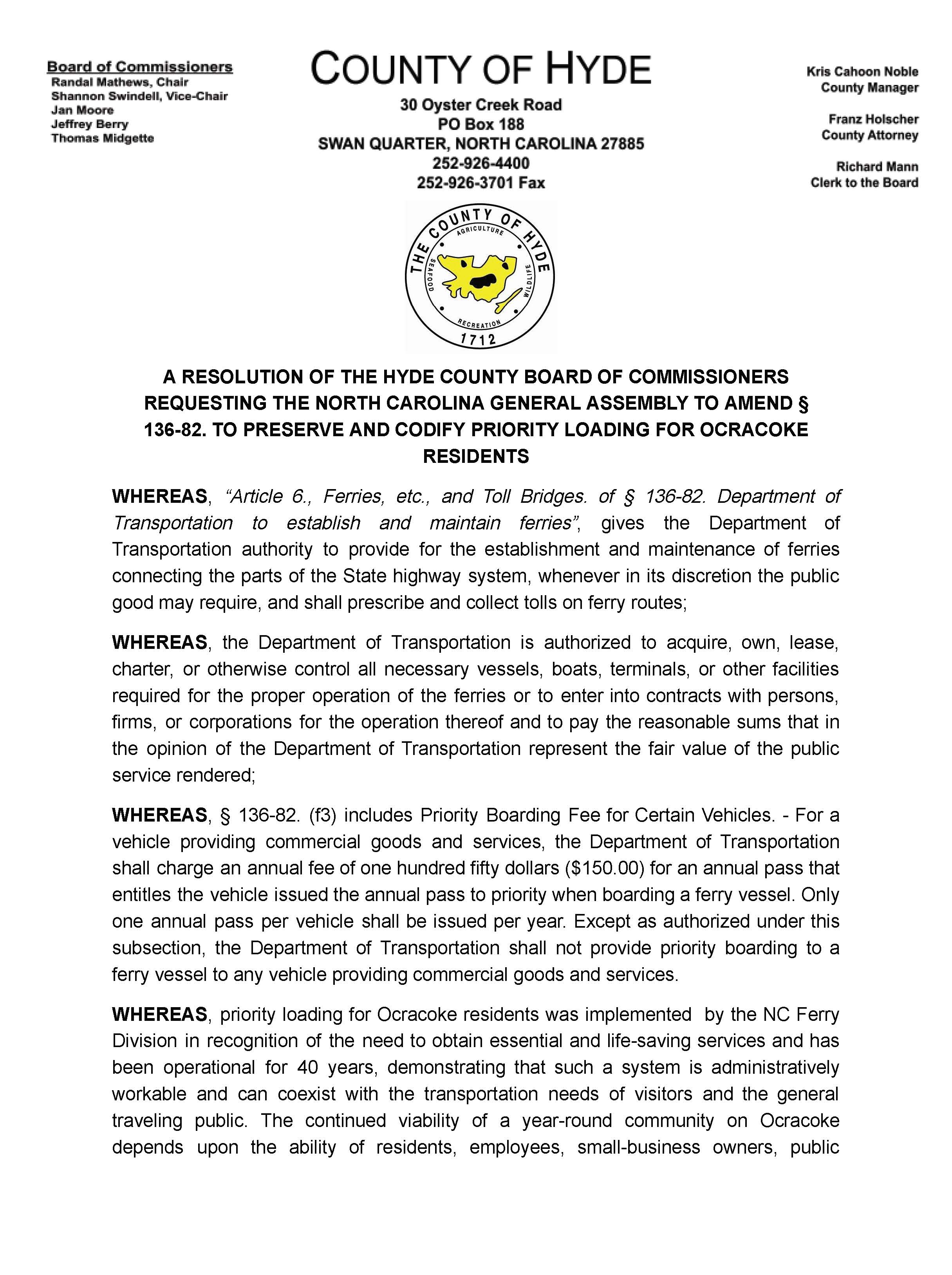
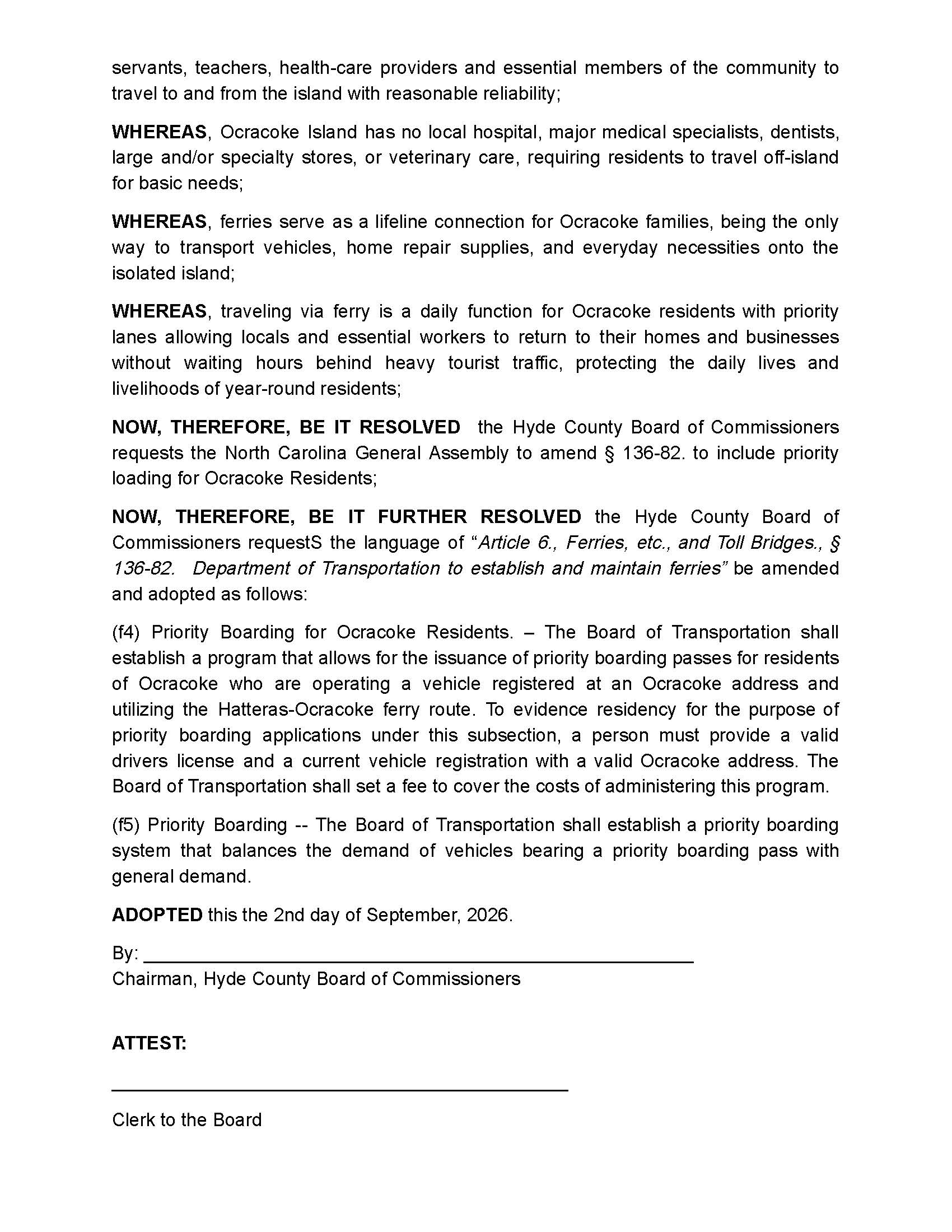
Prior to that meeting, the Hyde County Board of Commissioners at their Wednesday (Sept. 2) meeting at 1 p.m. will approve a resolution calling for the North Carolina Legislature to amend legislation to include priority ferry loading for Ocracoke residents.
A second joint resolution among Beaufort, Brunswick, Carteret, Craven, Currituck, Dare, Hyde, New Hanover and Pamlico counties requests Gov. Josh Stein and the NCDOT to waive all tolls on the N.C. Ferry System for residents in counties with ferry terminals. Both resolutions are below.
The tolling of the Hatteras ferry and other routes that heretofore have not been tolled was approved in late June when the N.C. General Assembly passed the budget, which included the new tolls.
Because the implementation date is written directly into state law, delaying it requires the General Assembly to approve either a technical correction to the budget or separate legislation.
Legislators reconvened on July 28 to consider technical amendments to the budget but did not even consider a delay in implementation, said Justin LeBlanc, executive director of the Ocracoke Access Alliance.
The alliance is working on a one-page document listing the concerns that need to be addressed before a toll can be implemented on the Hatteras-Ocracoke route. Ocracoke residents will be able to use this when contacting legislators about the need to delay.
“This is a super important meeting,” said Bob Chestnut, president of the Ocracoke Civic & Business Association. “We need to delay this (Jan. 1 date) for a couple of reasons–so the tolling part gets done right or not at all.”
He noted that each route is different in nature and in its purpose and what kind of customer it serves.
“The state just cannot implement something of this magnitude in this short a period of time without any kind of guidelines other than to say toll it,” he said.
Also, LeBlanc told the Ocracoke Tourism Development Authority (TDA) on Aug. 21 that residential priority passes will no longer be valid as of Jan. 1 because they aren’t permitted under the new law.
“As currently enacted, the budget bill does not provide the Department of Transportation with the authority to issue resident priority passes,” Ferry Division spokesman Tim Hass said in an Aug. 27 email. “As a result, the Ocracoke resident priority pass program cannot continue beyond Jan. 1, 2027.”
Hyde County Manager Kris Noble said that NCDOT hosted a virtual Local Officials’ Informational Meeting Aug. 26 where she learned that vendors would be allowed to get priority boarding on the Hatteras ferry.
“While there is grave concern regarding the tolling, implementation and timeline, the most egregious change slated to become effective is ending priority passes for permanent full-time residents of the island,” she said. “While priority passes for vendors will be available, residents will no longer receive priority boarding on the Ocracoke/Hatteras Ferry. The implications of this policy change leave us all grappling with questions including how we will make scheduled trips off island for medical and dental appointments, for school sporting events and to travel up the beach for basic necessities?”
But the OAA and island residents will fight back on this. The resolutions are the first salvo.
“It’s essential that they understand we need some type of priority on the island,” Chestnut said. “Some accommodation has to be made. They’re not exploring any accommodation. If they can give special tolling to the coastal counties, they can give exempt tolling to 900 people on our island or we’ll be the only people in the state of North Carolina that have to pay to drive on a North Carolina highway.”
Under the new law, the North Carolina Board of Transportation will determine the amount for tolls on the eight ferry routes, four of which have historically been free. As of the end of August, the toll amounts for the currently free routes have not been set.
Tolls are currently collected on vehicle ferries servicing Southport-Fort Fisher, Cedar Island-Ocracoke, Swan Quarter-Ocracoke and the Ocracoke Express passenger ferry.
Starting Jan. 1, the Ferry Division will be required to charge tolls for riders on the remaining four vehicle ferry routes — Currituck-Knotts Island, Bayview-Aurora, Hatteras-Ocracoke and Cherry Branch-Minnesott Beach.
The revenue generated by the tolls and commuter passes will be used to replace vessels in the Ferry System’s aging fleet, according to the legislation.
While school buses will be exempt from paying, there’s no exemption for other public vehicles, such as ambulances, emergency vehicles and government-owned service vehicles including the NCDOT’s own vehicles.
The legislation also creates a $150 annual commuter pass for residents of 22 coastal counties, including Hyde County.
The Ferry Division has set up five public meetings in September with the Ocracoke one being the last.
LeBlanc said he will go to all of them to find out what citizens in those counties are saying.
Ferry Division staff will present the proposed tolling plan, including the methodology and recommended rates, to the N.C. Board of Transportation at its Oct. 8 meeting.
Ferry leaders will return to the board on Nov. 5 seeking approval of the tolling policy and rate structure before launching the new program.
An online survey about ferry tolls can be found at: https://www.ncdot.gov/divisions/ferry/Pages/ferry-tolls.aspx