


By Peter Vankevich
When Jimmy Creech returned to Ocracoke Island in August, he came carrying memories of a place he once called home — and the ashes of his son, Kennedy Patrick Jubal Creech.
Jubal Creech, who lived in Thailand for seven years, died March 11 in Chiang Mai.
He had asked that his ashes be scattered on Ocracoke, where he spent his early childhood. On Aug. 8, the weekend of his birthday, his father scattered the ashes in the sound and Silver Lake, places where Jubal had taken swimming lessons as a child.
“He loved Ocracoke,” Creech said during an interview on WOVV’s “What’s Happening on Ocracoke.” “This was always his home.”
A community celebration of Jubal’s life was held at Deepwater Theater, with music, memories and a potluck.

Jubal was also part of Ocracoke’s radio history, serving as one of WOVV’s early DJs focusing, though not exclusively, on reggae and Dominican bachata music.
Creech’s return also provided an opportunity to revisit his own history on the island — eight years that he describes as among the happiest of his life and that helped shape the pastor he would later become.
Creech grew up in Goldsboro and studied biblical studies at the University of North Carolina before earning a Master of Divinity degree from Duke Divinity School.
Ordained in 1970, he became an associate pastor at Edenton Street United Methodist Church in Raleigh.
He first visited Ocracoke during his final year at Duke. He and his then-wife, Merle Smith Creech, stayed at the Island Inn.
The couple quickly fell in love with the island and returned whenever they could.
Creech said he generally did not tell people he was a minister while vacationing because he wanted to experience the island without being treated differently.
That changed when Alice Rondthaler discovered his profession. When the Ocracoke United Methodist Church was searching for a new pastor, she strongly recruited Creech to take the position.
At first, he resisted.
“I did not want to turn my favorite vacation destination into my workplace,” he said. But he eventually saw the island as an ideal setting for ministry.
Creech, Merle and their newborn son moved to Ocracoke in 1973. Merle taught at the school and offered cooking classes while Creech was pastor of the United Methodist Church.
He remembers Ocracoke as a place where neighbors looked after one another and where church membership mattered less than participation in the community.
“The churches belonged to the community, and the churches served the community,” he said.
He recalled the freedom Jubal had as a child.
“The boy might take half an hour or more to walk home from school, despite living only minutes away, because there were always friends, neighbors and distractions along the way.”
After eight years, Creech decided it was time to leave. He had become, he said, “too comfortable” and wanted new challenges. He recalls sitting on the ferry beside a packed U-Haul and crying as Ocracoke disappeared behind him.
His subsequent ministry took him to churches in Warsaw and Fairmont, the North Carolina Council of Churches and eventually First United Methodist Church in Omaha, Nebraska.
In 1984, while serving in Warsaw, a respected church member confided that he was gay.
The conversation changed Creech’s understanding of homosexuality and prompted him to study biblical interpretation, psychology and church history.
Creech concluded that the church was contributing to discrimination against gays and lesbians and that his responsibility as a pastor was not simply to welcome LGBTQ people but to work to make society safer and more accepting for them.
At Fairmont United Methodist Church, he helped establish the Raleigh Religious Network for Gay and Lesbian Equality.
His advocacy produced both strong support and fierce opposition.
In 1989, after conflict within his congregation, Creech was removed from his pastoral appointment. He later joined the North Carolina Council of Churches before accepting the Omaha position.
Creech also began performing covenant ceremonies for same-sex couples–essentially marriage ceremonies without legal recognition.
In 1997, he performed a covenant ceremony for two women at First United Methodist Church in Omaha.
For that, he was charged with disobedience to the Order and Discipline of The United Methodist Church and tried before a panel of 13 clergy.
Eight voted guilty and five not guilty. Since nine guilty votes were required for conviction, he was acquitted.
But after the trial his bishop removed him from the church.
In 1999, Creech performed another covenant ceremony, this time for two men in Chapel Hill. A second church trial followed, and this time Creech was found guilty.
His ordination was revoked.
The trials attracted national and international attention. CNN covered the first trial, which Creech said was the first of its kind in the United Methodist Church.
Rather than abandon his position, Creech spent years traveling and speaking to churches, human-rights groups and civic organizations about LGBTQ rights and religious discrimination.
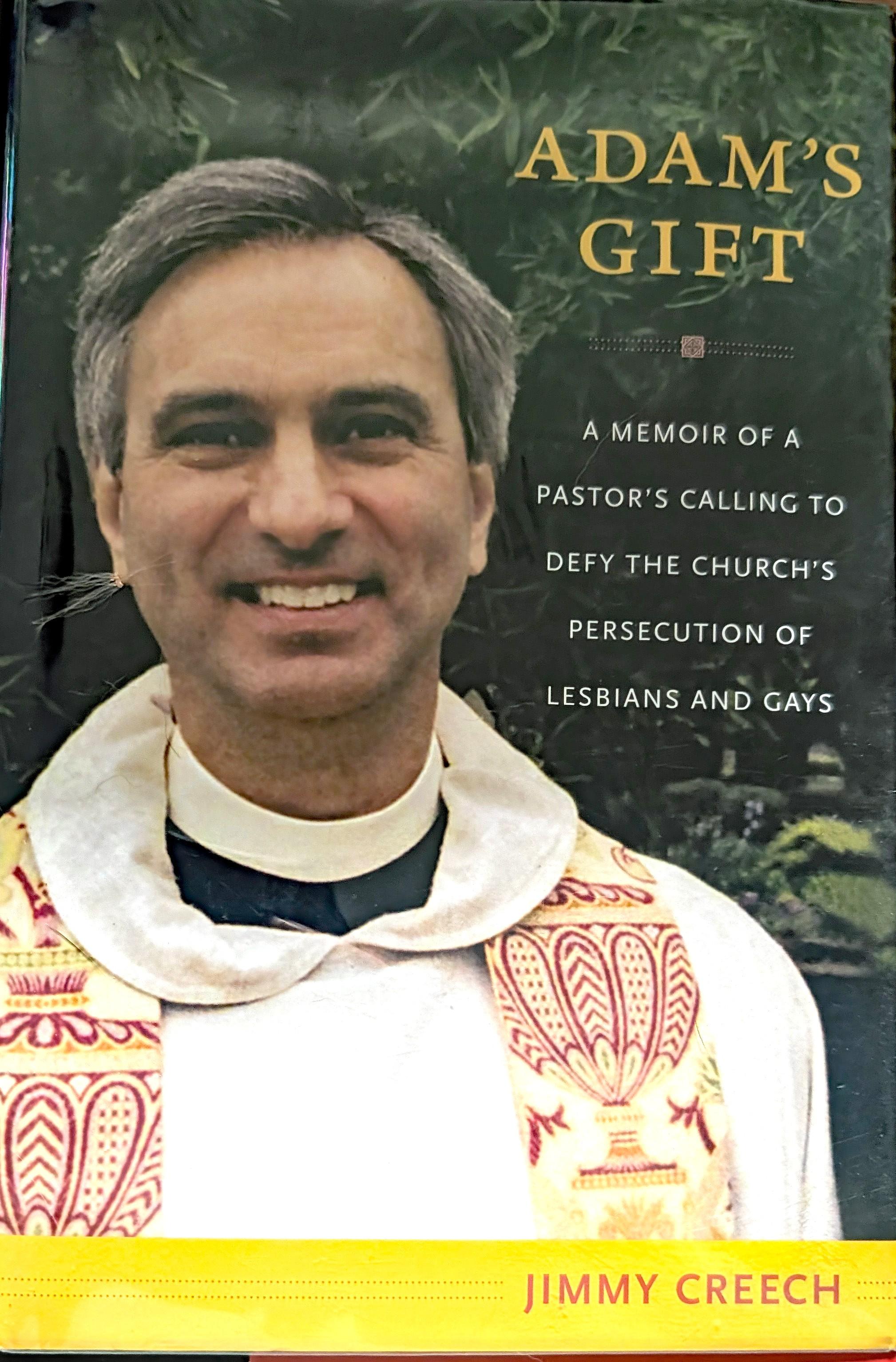
His memoir, “Adam’s Gift: A Memoir of a Pastor’s Calling to Defy the Church’s Persecution of Lesbians and Gays,” was published by Duke University Press in 2011.
The United Methodist Church has since changed its policies.
In 2024, the denomination removed prohibitions against same-sex marriage and allowed LGBTQ clergy to serve openly. While many congregations across the country—particularly in the South—opted to disaffiliate over the issue, Ocracoke’s Methodist Church did not.
Former clergy whose ordinations had been revoked were also given an opportunity to seek reinstatement.
Creech declined reinstatement.
“I consider ordination to be not just a status,” he said. “I consider it a call to ministry, and I’m no longer in a position to be in ministry.”
For Creech, the years of controversy were difficult but ultimately consistent with his conscience.
“It was extremely stressful,” he said. “But what I was doing, I was willing to see it through, no matter the cost.”
And amid the national controversy, Ocracoke remained a place of refuge and belonging.
Creech returned to the island after his son’s death not only to remember Jubal, but to bring him home, completing a circle that began more than 50 years ago when a young minister first arrived on Ocracoke and found a community he never forgot.


I am so very thankful to have read this. I will get Leslie to order several of his books for me. Also, bring him back to the island, and give us plenty notice. I’d love to have a weekend of learning with him!!’
Enjoyed this article, thank you! I met your son, Jubal, as I knew him. I am sorry for your loss. He was an exceptional human, so full of love and goodness he shared with many. I would love to read Adam’s Wish. I support your every effort, may peace be with you.
This is a wonderful article.
What a wonderful & moving story! Thanks for this.