


Editor’s note: This article tells the back story of the gold cross that’s on the Ocracoke United Methodist Church altar, about which Margaret MacKinnon wrote a poem published in the May Observer and printed below. This story also is in a frame inside the church foyer.
By Kevin Duffus
On March 14, 1942, Chris Gaskill was walking the beach on the south end of Ocracoke Island when he spotted a rectangular object washing up with the surf. He decided to investigate and discovered it was a large frame that held an official-looking certificate.
To Gaskill, it looked like other documents might have once been inside the frame, but now there was only one–a license issued by the U.S. Department of Commerce to certify the qualifications of a third mate aboard an ocean or coastwise steam vessel.
When Gaskill read the name of the person to whom the license was issued, he was at first puzzled then gravely worried.
The license belonged to his cousin, Ocracoke native son Jim Baughm Gaskill, third mate on the SS Caribsea, a 250-foot-long steam freighter operated by a New York shipping company.
Chris Gaskill hadn’t known of his cousin’s whereabouts since the war began, but finding the license washed up on the beach was an ominous sign. Gaskill promptly returned to the village and notified the family and then the Coast Guard.

Jim’s father, the late William D. “Cap’n Bill” Gaskill, had for many years owned and managed the Pamlico Inn, a popular hotel located on the edge of the Pamlico Sound and Teach’s Hole Channel south of Silver Lake.
Cap’n Bill was lost at sea while fishing in 1935, but the family continued to operate the inn. It was there, the day after Chris Gaskill found Jim’s mate certificate, that someone at the inn noticed a floating piece of wreckage that appeared to be a spar or an oar banging against the pilings of the inn’s pier.
The timber was retrieved, and a ship’s name was discovered etched on one side—SS Caribsea. By then, Jim Baughm Gaskill’s family and friends knew of his tragic fate.
Four days earlier, the SS Caribsea had been steaming past Cape Lookout on her way to Norfolk from Santiago, Cuba, with 3,600 tons of highly combustible manganese ore in her cargo holds. Believing that the greatest threat from U-boats lay 60 miles ahead, the Navy asked the Caribsea’s master to reduce speed to four knots so that the freighter would not approach Cape Hatteras until after daylight.
Third mate Jim Baughm Gaskill’s watch had ended, and he was asked by the officer relieving him if he was going to remain in the wheelhouse until they raised the Ocracoke Lighthouse off the freighter’s port bow.
Gaskill replied that he had seen the lighthouse often enough—his father’s hotel was practically next door—and that he needed some sleep.

Gaskill retired to his berth. A short time later, two torpedoes struck the ship—the first hitting #2 hold; the second exploding the ship’s boilers.
Only the seven men on deck or in the wheelhouse survived. Twenty-one men were killed instantly, including Gaskill, as the ship went down bow first in less than three minutes.
Had Gaskill waited to see his beloved Ocracoke lighthouse one more time, he might have lived. His body was never found.
Among the pieces of wreckage floating in the sea after the ship violently blew apart were Gaskill’s third-mate license and the oar marked Caribsea.
It took three days, but these two artifacts somehow floated to Ocracoke Island more than 43 miles away against great odds, heavy seas and a contrary current.
The license and the oar were the only artifacts of the Caribsea to be found.
The oar’s travels were particularly remarkable, having miraculously navigated the serpentine channel through Ocracoke Inlet and against the daily tidal outflow of Teach’s Hole Channel, avoiding sandbars and shallow bays to land at Jim Baughm Gaskill’s birthplace, his father’s Pamlico Inn.

“It was unusual for a thing like that to happen,” said 82-year-old Owen Gaskill, Jim’s cousin, in a 1997 interview. “The many people who comb the beach, it happened to be his first cousin that found his license. My brother found the big frame, and all the licenses were gone but Jim Baughm’s. His was the only license left in the big frame, and that wasn’t storm damaged at all from the water.”
Ten hours after drifting on pieces of the ship’s wreckage, two officers and five crewmen were rescued by a passing ship and were taken to Norfolk.
Gaskill’s sisters—Mary, Lillian and Nellie—traveled to Norfolk to visit the Caribsea’s survivors to learn more about their brother’s final hours.
“They went up and talked to the captain, and he told them that Jim Baughm had just been relieved from his watch, and he had just about had time to get to bed and get to sleep when the torpedo struck about directly through his berth,” Owen Gaskill said. His cousin was thought to have been killed instantly.
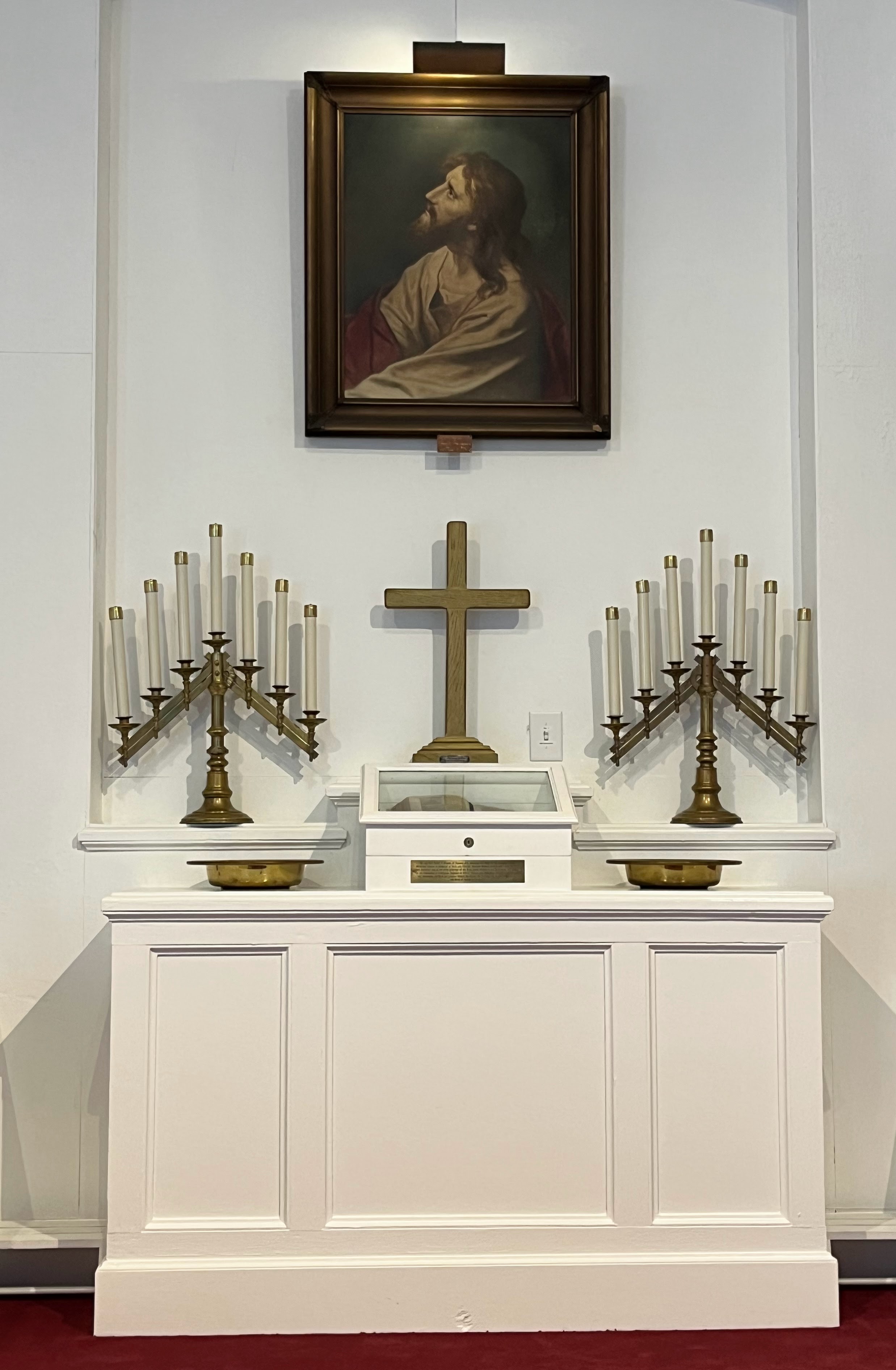
Ocracoke resident Homer Howard was given the oar so that a cross could be fashioned out of it. Ever since, the cross has stood upon the altar of Ocracoke’s Methodist Church.
For the typical visitor, and from a distance, the plain wooden cross appears unremarkable.
Not until one looks closely at the base can he see two small plates with these inscriptions: “In memory of Captain James B. Gaskill, July 2, 1919 – March 11, 1942. This cross constructed from salvage of the ship upon which Capt. Gaskill lost his life.”
Kevin Duffus is an award-winning North Carolina historian, author and filmmaker whose research focuses on the maritime and coastal history of North Carolina.
COMING BACK
In memory of Captain James B. Gaskill, 7/2/1916 to 3/11/1942. This cross constructed from salvage of the ship upon which Captain Gaskill lost his life.
–Inscription on a cross on the altar at Ocracoke United Methodist Church
By Margaret MacKinnon
It could have been a morning of old walks
and old words, mist-laid and gray, water churning
near his family’s pier—
where a piece of Jim Baugham Gaskill’s ship
came back, the mystery of chance survived—
and someone was vigilant enough to witness it.
And someone made a cross, painted it gold,
the grain still visible, though shaped by the sea and tides—
all of it in remembrance of that boy,
their shining son returned, or at least, some sign of him.
They wanted to believe a restless love
had brought him back, that time’s straight line
could bend for them—
and love was vaster than they knew.
None of this happened in the season of falling stars,
when light, for an instant, overcomes the dark—
but all of it happened on that same stretch of the Atlantic
where we got the news that my mother had died.
Our trip would be cut short. We’d be going home to mourn.
But for one sore afternoon, we drove out past
where the terns built their fragile nests, out
to that point where sand and sea and air converged—
one world joining another—
and though we didn’t see it at the time, all the photos
of those long hours show the same rosy angel-cloud,
arms outstretched, hovering above us.
Margaret Mackinnon is the author of “The Invented Child,” winner of the Gerald Cable Book Award and the 2014 Literary Award in Poetry from the Library of Virginia.


