Home Blog Page 434

Ocracoke Civic and Business Association meeting tonight, noise ordinance on agenda

0
The Ocracoke Community Center

On the OCBA agenda tonight is a revised noise ordinance has been drafted by Will Doerfer, special assistant county manager, who has researched other coastal noise ordinances.  

His suggestions are highlighted in bold and printed below. The issue will be taken up by the Hyde County commissioners in January. County Manager Bill Rich has asked for input from local businesses and individuals.

OCRACOKE CIVIC AND BUSINESS ASSOCIATION

Monthly meeting 7 p.m. Nov. 11, 2015
Ocracoke Community Center

Agenda

  1. Call to Order
  2. Approval of October minutes
  3. Treasurer’s report
  4. Travel & Tourism Director report (Sundae Horn)
  5. Discussion of proposed changes to Ocracoke Noise Ordinance. (Need the input of business owners and residents)
  1. As-needed reports:

National Park Service

County Manager (Bill Rich)

County Commissioner (John Fletcher)

  1. President’s report:
  1. New business
  2. Old Business

–Second vote on approving $1,500 sponsorship of 5K/10K/half marathon April 23.

  1. Announcements
  2. Adjourn

Note: 2015 meetings: Second Wednesdays of the month. 7 p.m. Ocracoke Community Center (unless otherwise stated).

Next meetings are:

Dec. 9, 2015 (Election of officers and board members) and Jan. 11, 2016


Proposed Revised Noise Ordinance

ARTICLE II. – NOISE

FOOTNOTE(S):

— (1) —

State Law reference— County authority to regulate noise, G.S. 153A-133; sport shooting range protection, G.S. 14-409.46. Authority to regulate mass gatherings, see G.S. § 130A-258.

Sec. 16-18. – Purpose of noise regulations.

(a) It is recognized that excessive and unnecessary noise endangers the physical and emotional health and welfare of the people, interferes with legitimate business and recreational activity, increases construction costs, depresses property values, offends the senses, creates public nuisances and inother respects reduces the quality of life.

(b) It is further recognized that a substantial body of science and technology exists by which excessive sound may be measured and substantially abated. Because the regulation of excessive and
unnecessary noise that may jeopardize human health or welfare or substantially degrade the quality of life is well within the purview of law enforcement powers, it is declared to be the purpose of this article to prevent, prohibit and provide for the regulation and abatement of excessive and unnecessary noise which may injure the physical and emotional health or welfare of its citizens or degrade the quality of life.

(c) It is further recognized that Ocracoke is a small, family oriented community with multiple residences, as well as tourist and aquaculture related businesses located in close proximity. In the absence of zoning regulations, the community, through this article, endeavors to recognize the challenges and honor the differing and often conflicting goals of the business and residential community.

(Ord. of 6-20-2011)

Editor’s note— Ord. of 6-20-2011, amended Ch. 16, Art. II., §§ 16-19—16-24 in their entirety.

For purposes of clarity, and at the editor’s discretion, Ord. of 6-20-2011, § 16-19 was included as

  • 16-18.

Sec. 16-19. – Definitions.

(a) For the purpose of [this article], the following definitions shall apply unless the context clearly indicates or requires a different meaning.

A weighted sound level. The sound pressure level in decibels as measured on a sound level meter using the A-weighting network. The level so read is designated dB(A).

Acoustic music. Music that is produced solely or primarily by instruments which produce sound through entirely acoustic means, as opposed to electric or electronic means.

Decibel (dB). A unit for describing the amplitude of sound, equal to 20 times the logarithm to the base 10 of the ratio of the pressure of the sound measured to the reference pressure, which is 20 micronewtons per square meter.

Emergency work. Any work performed for the purposes of preventing or alleviating physical trauma or property damage threatened or caused by an existing or imminent peril.

Page 2

Event. A gathering of people for the purpose of recreation, entertainment, worship, fundraising, or cultural activity outdoors on a lot or other property, where amplified sound is emitted from the property.

Nighttime. As used in this article nighttime shall mean the time period between the hours of 10:00 p.m. and the following 7:00 a.m.

Noise. Any sound which annoys or disturbs humans or which causes or tends to cause an adverse psychological or physiological effect on humans. Any sound that exceeds 70 decibels at any time except when permitted or in emergency or is specifically excepted.

Outdoor amplified sound. Any sound using sound amplifying equipment where such equipment is located outside of a residential or commercial structure or within such structures where it is obvious that the sound emitted from the amplifying equipment is intended to be transmitted to the outside through open doors or windows or other openings in the structure.

Sound. An oscillation in pressure, particle displacement, particle velocity or other physical parameter, in a medium with internal forces that causes compression, and rarefaction of that medium. The description of that sound may include any characteristic of such sound, including duration, intensity, and frequency.

Sound amplifying equipment. Any device for the amplification of the human voice, music, or any other sound, including televisions, electronic loud speakers, jukeboxes, stereos, compact disc players and radios.

Sound level meter. An instrument which includes a microphone, amplifier, IRS detector, integrator or time averages, output meter and weighting network used to measure sound pressure levels.

Unnecessary noise. Any excessive or unusually loud sound which disturbs the peace and quiet of any neighborhood or which does annoy, disturb, injure or endanger the comfort, repose, health, peace or safety of any reasonable person of ordinary sensibilities or causes damage to property.

(b) All terminology not defined in this section but used in this article shall be in conformance with applicable publications of the American National Standards Institute (ANSI) or its successor body.

(Ord. No. 106, § 1, 11-19-2001; Ord. of 6-20-2011)

Sec. 16-20. – Penalty.

Any violation of this article shall subject the offender to a civil penalty in the amount of $250.00 for the first violation, and $500.00 for the second violation. Permits will be revoked for the third violation, and the offender will lose the privilege to apply for a permit until the calendar year following the violations.

(Ord. No. 106, § 5, 11-19-2001; Ord. of 6-20-2011)

Sec. 16-21. – Prohibited noises.

(a) No person shall make, continue, or cause to be made or continued the emission of sound from any source or sources which, when measured pursuant to the procedure outlined by this article, exceeds 70 decibels.

(b) For the purposes of this article, an unreasonable loud, disturbing noise includes, but is not limited to:

(1) The sounding of any horn or signal device on any automobile, motorcycle, bus, or other vehicle, except as a danger signal, so as to create any unreasonable loud or harsh sound, or the sounding of such device for an unreasonable period of time, or the use of any gong or siren upon any vehicle, other than police, fire, or other emergency vehicle;

(2) The playing of any radio, phonograph, television, loudspeaker, amplifier, musical instrument or similar mechanical apparatus in such a manner or with such volume as to disturb the quiet,

Page 3

comfort or repose of any person in any dwelling, hotel or other type of residence, or any person attending or teaching in any school or worshiping in any church or treating or being treated in any nursing home or medical facility or any person in attendance at a funeral home;

(3) The playing of any vehicle-mounted equipment in such a manner that it may create a noise disturbance at a 50-foot distance from such device when operated on a public right-of-way, public space or on public waters;

(4) The keeping of any animal or bird which, by causing frequent or long-continued noise, shall disturb the comfort and repose of any person in the vicinity;

(5) The use of any automobile, motorcycle, or other vehicle so out of repair, so loaded or in such a manner as to create a loud grating, grinding, rattling or other noise;

(6) The blowing of any steam whistle attached to any stationary boiler, except to give notice of the time to begin or stop work or as a warning of danger;

(7) The discharge into the open air of the exhaust of any steam engine, stationary internal combustion engine, motor vehicle or motor boat engine, except through a muffler or other device which will effectively prevent loud or explosive noises therefrom;

(8) Any sound between the hours of 10:00 p.m. and 7:00 a.m. the following day such that the sound creates a sustained and/or recurring noise disturbance in excess of 43 decibels or within a noise sensitive zone, except for emergency work;

(9) The erection (including excavation), demolition, alteration or repair of any building in a residential or business district other than between the hours of 7:00 a.m. and 6:00 p.m. Monday through Saturday, except in the case of urgent necessity in the interest of public safety;

(10) The creation of any excessive noise on any street adjacent to any school, institution of learning, or court while same is in session, or within 150 feet of any hospital, which unreasonably interferes with the working of such institution; provided that conspicuous signs are displayed in such street indicating that the same is a school, court, or hospital street;

(11) The creation of any excessive noise on Sundays on any street adjacent to any church; provided that conspicuous signs are displayed in such streets adjacent to churches indicating that the same is a church street;

(12) The creation of loud and excessive noise in connection with the loading or unloading of any vehicle or the opening and destruction of bales, boxes, crates and containers;

(13) The sounding of any bell, gong, chime, siren, whistle or similar device, intended primarily for non-emergency purposes, which disturbs the quiet or repose of persons in the vicinity thereof;

(14) The sounding and crying of peddlers, barkers, hawkers, and vendors which disturb the quiet and peace of the neighborhood;

(15) The use of any drum, loudspeaker or other instrument or device for the purpose of attracting attention, by the creation of noise, to any performance, show, sale or display of merchandise;

(16) The use of any loudspeakers or amplifiers on trucks or other moving vehicles for advertising or other purposes, except where specific permit is received from the sheriff and then only under the terms and conditions set forth in such permit; and

(17) The firing or discharging of a gun, squibs, fire crackers, gunpowder or other explosive or combustible substance in the streets or elsewhere for the purpose of making a noise or causing a disturbance.

(Ord. No. 106, § 2, 11-19-2001; Ord. of 6-20-2011)

Sec. 16-22. – Exceptions.

Page 4

Exceptions to the prohibited noises listed in section 16-21 are as follows:

(1) Emergency warning devices or safety signals;

(2) Lawn care equipment, agricultural equipment and power tools used during the daytime hours;

(3) Equipment being used for construction; provided that all equipment is operated with all standard equipment, manufacturer’s mufflers and noise-reducing equipment in use in proper operating condition;

(4) Parades, fairs, circuses, festivals, other similar entertainment events, sanctioned sporting events, sporting activities taking place in areas set aside for such activities, or any activities normally associated with any of the activities previously mentioned in this subsection;

(5) Bells, chimes and similar devices, such as those on tower clocks or steeples, which operate during daytime hours for a duration of no longer than ten minutes in any given period;

(6) Emergency work;

(7) Sixty-cycle electric transformers; or

(8) All usual and ordinary noises associated with agricultural enterprises, including those made at night.

(Ord. No. 106, § 3, 11-19-2001; Ord. of 6-20-2011)

Sec. 16-23. – Permits required; contents.

The provisions of this article shall not apply for activities described in a permit issued by the sheriff;

upon a written application which states at the minimum:

(1) The date, time, place and type of activity; and

(2) A statement that a notice of the intent to apply for the permit has been given to the adjacent landowners at least 24 hours prior to application.

(Ord. No. 106, § 4, 11-19-2001; Ord. No. 112, § 4, 5-28-2002; Ord. of 6-20-2011)

Sec. 16-24. – Noise measurement standards and determinations.

(a) Sound level measurements shall be made with a sound level meter using the A-weighting scale set on low response.

(b) Sound level meters shall be at least Type II meeting the ANSI S1.4-1971 requirements and shall be operated according to the manufacturer’s standards. Person(s) using the sound level meters shall be trained in sound level measurement and the operation of sound level measurement equipment.

(c) The measurement shall be from any point which is at least 25 lineal feet from the nearest point from which the sound originates, using approved sound measuring equipment. The measurement shall not be made on the private property where the noise is being produced. At the discretion of theenforcing officer, the sound measurement may be taken on the property of the person complaining about the noise.

(d) Sound measurements shall be conducted at the time when the suspect noise or sound is being emitted.

(Ord. of 6-20-2011)

Sec. 16-25. – Enforcement.

Page 5

The county sheriff or designee shall have the authority to order those person(s) determined to be in violation of this article to cease producing the sound in excess of that authorized. Such order shall not affect other enforcement methods available for violation of this article.

(Ord. of 6-20-2011)

Secs. 16-26—16-42. – Reserved.


Proposed revivsions to the noise ordinance

0

Proposed Revised Noise Ordinance, November 2015

Changes are in bold.

ARTICLE II. – NOISE

FOOTNOTE(S):

— (1) —

State Law reference— County authority to regulate noise, G.S. 153A-133; sport shooting range protection, G.S. 14-409.46. Authority to regulate mass gatherings, see G.S. § 130A-258.

Sec. 16-18. – Purpose of noise regulations.

(a) It is recognized that excessive and unnecessary noise endangers the physical and emotional health and welfare of the people, interferes with legitimate business and recreational activity, increases construction costs, depresses property values, offends the senses, creates public nuisances and inother respects reduces the quality of life.

(b) It is further recognized that a substantial body of science and technology exists by which excessive sound may be measured and substantially abated. Because the regulation of excessive and
unnecessary noise that may jeopardize human health or welfare or substantially degrade the quality of life is well within the purview of law enforcement powers, it is declared to be the purpose of this article to prevent, prohibit and provide for the regulation and abatement of excessive and unnecessary noise which may injure the physical and emotional health or welfare of its citizens or degrade the quality of life.

(c) It is further recognized that Ocracoke is a small, family oriented community with multiple residences, as well as tourist and aquaculture related businesses located in close proximity. In the absence of zoning regulations, the community, through this article, endeavors to recognize the challenges and honor the differing and often conflicting goals of the business and residential community.

(Ord. of 6-20-2011)

Editor’s note— Ord. of 6-20-2011, amended Ch. 16, Art. II., §§ 16-19—16-24 in their entirety.

For purposes of clarity, and at the editor’s discretion, Ord. of 6-20-2011, § 16-19 was included as

  • 16-18.

Sec. 16-19. – Definitions.

(a) For the purpose of [this article], the following definitions shall apply unless the context clearly indicates or requires a different meaning.

A weighted sound level. The sound pressure level in decibels as measured on a sound level meter using the A-weighting network. The level so read is designated dB(A).

Acoustic music. Music that is produced solely or primarily by instruments which produce sound through entirely acoustic means, as opposed to electric or electronic means.

Decibel (dB). A unit for describing the amplitude of sound, equal to 20 times the logarithm to the base 10 of the ratio of the pressure of the sound measured to the reference pressure, which is 20 micronewtons per square meter.

Emergency work. Any work performed for the purposes of preventing or alleviating physical trauma or property damage threatened or caused by an existing or imminent peril.

Page 2

Event. A gathering of people for the purpose of recreation, entertainment, worship, fundraising, or cultural activity outdoors on a lot or other property, where amplified sound is emitted from the property.

Nighttime. As used in this article nighttime shall mean the time period between the hours of 10:00 p.m. and the following 7:00 a.m.

Noise. Any sound which annoys or disturbs humans or which causes or tends to cause an adverse psychological or physiological effect on humans. Any sound that exceeds 70 decibels at any time except when permitted or in emergency or is specifically excepted.

Outdoor amplified sound. Any sound using sound amplifying equipment where such equipment is located outside of a residential or commercial structure or within such structures where it is obvious that the sound emitted from the amplifying equipment is intended to be transmitted to the outside through open doors or windows or other openings in the structure.

Sound. An oscillation in pressure, particle displacement, particle velocity or other physical parameter, in a medium with internal forces that causes compression, and rarefaction of that medium. The description of that sound may include any characteristic of such sound, including duration, intensity, and frequency.

Sound amplifying equipment. Any device for the amplification of the human voice, music, or any other sound, including televisions, electronic loud speakers, jukeboxes, stereos, compact disc players and radios.

Sound level meter. An instrument which includes a microphone, amplifier, IRS detector, integrator or time averages, output meter and weighting network used to measure sound pressure levels.

Unnecessary noise. Any excessive or unusually loud sound which disturbs the peace and quiet of any neighborhood or which does annoy, disturb, injure or endanger the comfort, repose, health, peace or safety of any reasonable person of ordinary sensibilities or causes damage to property.

(b) All terminology not defined in this section but used in this article shall be in conformance with applicable publications of the American National Standards Institute (ANSI) or its successor body.

(Ord. No. 106, § 1, 11-19-2001; Ord. of 6-20-2011)

Sec. 16-20. – Penalty.

Any violation of this article shall subject the offender to a civil penalty in the amount of $250.00 for the first violation, and $500.00 for the second violation. Permits will be revoked for the third violation, and the offender will lose the privilege to apply for a permit until the calendar year following the violations.

(Ord. No. 106, § 5, 11-19-2001; Ord. of 6-20-2011)

Sec. 16-21. – Prohibited noises.

(a) No person shall make, continue, or cause to be made or continued the emission of sound from any source or sources which, when measured pursuant to the procedure outlined by this article, exceeds 70 decibels.

(b) For the purposes of this article, an unreasonable loud, disturbing noise includes, but is not limited to:

(1) The sounding of any horn or signal device on any automobile, motorcycle, bus, or other vehicle, except as a danger signal, so as to create any unreasonable loud or harsh sound, or the sounding of such device for an unreasonable period of time, or the use of any gong or siren upon any vehicle, other than police, fire, or other emergency vehicle;

(2) The playing of any radio, phonograph, television, loudspeaker, amplifier, musical instrument or similar mechanical apparatus in such a manner or with such volume as to disturb the quiet,

Page 3

comfort or repose of any person in any dwelling, hotel or other type of residence, or any person attending or teaching in any school or worshiping in any church or treating or being treated in any nursing home or medical facility or any person in attendance at a funeral home;

(3) The playing of any vehicle-mounted equipment in such a manner that it may create a noise disturbance at a 50-foot distance from such device when operated on a public right-of-way, public space or on public waters;

(4) The keeping of any animal or bird which, by causing frequent or long-continued noise, shall disturb the comfort and repose of any person in the vicinity;

(5) The use of any automobile, motorcycle, or other vehicle so out of repair, so loaded or in such a manner as to create a loud grating, grinding, rattling or other noise;

(6) The blowing of any steam whistle attached to any stationary boiler, except to give notice of the time to begin or stop work or as a warning of danger;

(7) The discharge into the open air of the exhaust of any steam engine, stationary internal combustion engine, motor vehicle or motor boat engine, except through a muffler or other device which will effectively prevent loud or explosive noises therefrom;

(8) Any sound between the hours of 10:00 p.m. and 7:00 a.m. the following day such that the sound creates asustained and/or recurring noise disturbance in excess of 43 decibels or within a noise sensitive zone, except for emergency work;

(9) The erection (including excavation), demolition, alteration or repair of any building in a residential or business district other than between the hours of 7:00 a.m. and 6:00 p.m. Monday through Saturday, except in the case of urgent necessity in the interest of public safety;

(10) The creation of any excessive noise on any street adjacent to any school, institution of learning, or court while same is in session, or within 150 feet of any hospital, which unreasonably interferes with the working of such institution; provided that conspicuous signs are displayed in such street indicating that the same is a school, court, or hospital street;

(11) The creation of any excessive noise on Sundays on any street adjacent to any church; provided that conspicuous signs are displayed in such streets adjacent to churches indicating that the same is a church street;

(12) The creation of loud and excessive noise in connection with the loading or unloading of any vehicle or the opening and destruction of bales, boxes, crates and containers;

(13) The sounding of any bell, gong, chime, siren, whistle or similar device, intended primarily for non-emergency purposes, which disturbs the quiet or repose of persons in the vicinity thereof;

(14) The sounding and crying of peddlers, barkers, hawkers, and vendors which disturb the quiet and peace of the neighborhood;

(15) The use of any drum, loudspeaker or other instrument or device for the purpose of attracting attention, by the creation of noise, to any performance, show, sale or display of merchandise;

(16) The use of any loudspeakers or amplifiers on trucks or other moving vehicles for advertising or other purposes, except where specific permit is received from the sheriff and then only under the terms and conditions set forth in such permit; and

(17) The firing or discharging of a gun, squibs, fire crackers, gunpowder or other explosive or combustible substance in the streets or elsewhere for the purpose of making a noise or causing a disturbance.

(Ord. No. 106, § 2, 11-19-2001; Ord. of 6-20-2011)

Sec. 16-22. – Exceptions.

Page 4

Exceptions to the prohibited noises listed in section 16-21 are as follows:

(1) Emergency warning devices or safety signals;

(2) Lawn care equipment, agricultural equipment and power tools used during the daytime hours;

(3) Equipment being used for construction; provided that all equipment is operated with all standard equipment, manufacturer’s mufflers and noise-reducing equipment in use in proper operating condition;

(4) Parades, fairs, circuses, festivals, other similar entertainment events, sanctioned sporting events, sporting activities taking place in areas set aside for such activities, or any activities normally associated with any of the activities previously mentioned in this subsection;

(5) Bells, chimes and similar devices, such as those on tower clocks or steeples, which operate during daytime hours for a duration of no longer than ten minutes in any given period;

(6) Emergency work;

(7) Sixty-cycle electric transformers; or

(8) All usual and ordinary noises associated with agricultural enterprises, including those made at night.

(Ord. No. 106, § 3, 11-19-2001; Ord. of 6-20-2011)

Sec. 16-23. – Permits required; contents.

The provisions of this article shall not apply for activities described in a permit issued by the sheriff;

upon a written application which states at the minimum:

(1) The date, time, place and type of activity; and

(2) A statement that a notice of the intent to apply for the permit has been given to the adjacent landowners at least 24 hours prior to application.

(Ord. No. 106, § 4, 11-19-2001; Ord. No. 112, § 4, 5-28-2002; Ord. of 6-20-2011)

Sec. 16-24. – Noise measurement standards and determinations.

(a) Sound level measurements shall be made with a sound level meter using the A-weighting scale set on low response.

(b) Sound level meters shall be at least Type II meeting the ANSI S1.4-1971 requirements and shall be operated according to the manufacturer’s standards. Person(s) using the sound level meters shall be trained in sound level measurement and the operation of sound level measurement equipment.

(c) The measurement shall be from any point which is at least 25 lineal feet from the nearest point from which the sound originates, using approved sound measuring equipment. The measurement shall not be made on the private property where the noise is being produced. At the discretion of theenforcing officer, the sound measurement may be taken on the property of the person complaining about the noise.

(d) Sound measurements shall be conducted at the time when the suspect noise or sound is being emitted.

(Ord. of 6-20-2011)

Sec. 16-25. – Enforcement.

Page 5

The county sheriff or designee shall have the authority to order those person(s) determined to be in violation of this article to cease producing the sound in excess of that authorized. Such order shall not affect other enforcement methods available for violation of this article.

(Ord. of 6-20-2011)

Secs. 16-26—16-42. – Reserved.


Marketing workshop for artisans scheduled in November

0
Local artisans and crafters are always welcome to sell their wares at the annual Ocrafolk Festival, which is always the first full weekend in June. Two marketing workshops for artisans will be held on the island Nov. 19 & 20.

Open Source Ocracoke has annouunced that Beaufort County Community College and the Hyde County Office of Economic Development will host two workshops for artisans Nov. 19 and 20 on Ocracoke.

Titled “Marketing for the Craftsperson or Artist,” both workshops will be held in the Ocracoke Community Center, 999 Irvin Garrish Hwy.

Session I will be from 2 to 5 p.m. Thursday, Nov.19, and Session II will be from 9 a.m. to noon Friday, Nov. 20.

Workshop leader, Linda Rozelle, has extensive experience in branding, marketing and advertising, and she has a love for small businesses and craft artisans specifically.

These hands-on workshops will stress creating unique advertising and marketing materials on a budget as well as effective product pricing and how to gain exposure through independent galleries or shops. Rozelle recommends attending both workshops, and she will personally provide feedback on participants’ own marketing during the second session.

**Registration is limited to a total of 40 businesses, though multiple people from one business can attend.

Cost is $25 total per person to attend both sessions. To register, contact Sarah Johnson at (252) 542-0842, or email sarah.johnson@hydecountync.gov.

Coast Guard evacuates passengers from stranded ferry

1
Cars on the grounded ferry Roanoke depart the vessel after it got to the ferry terminal. Photo by P. Vankevich
Cars on the grounded ferry Roanoke depart the vessel after it got to the ferry terminal Monday evening. Photo by P. Vankevich

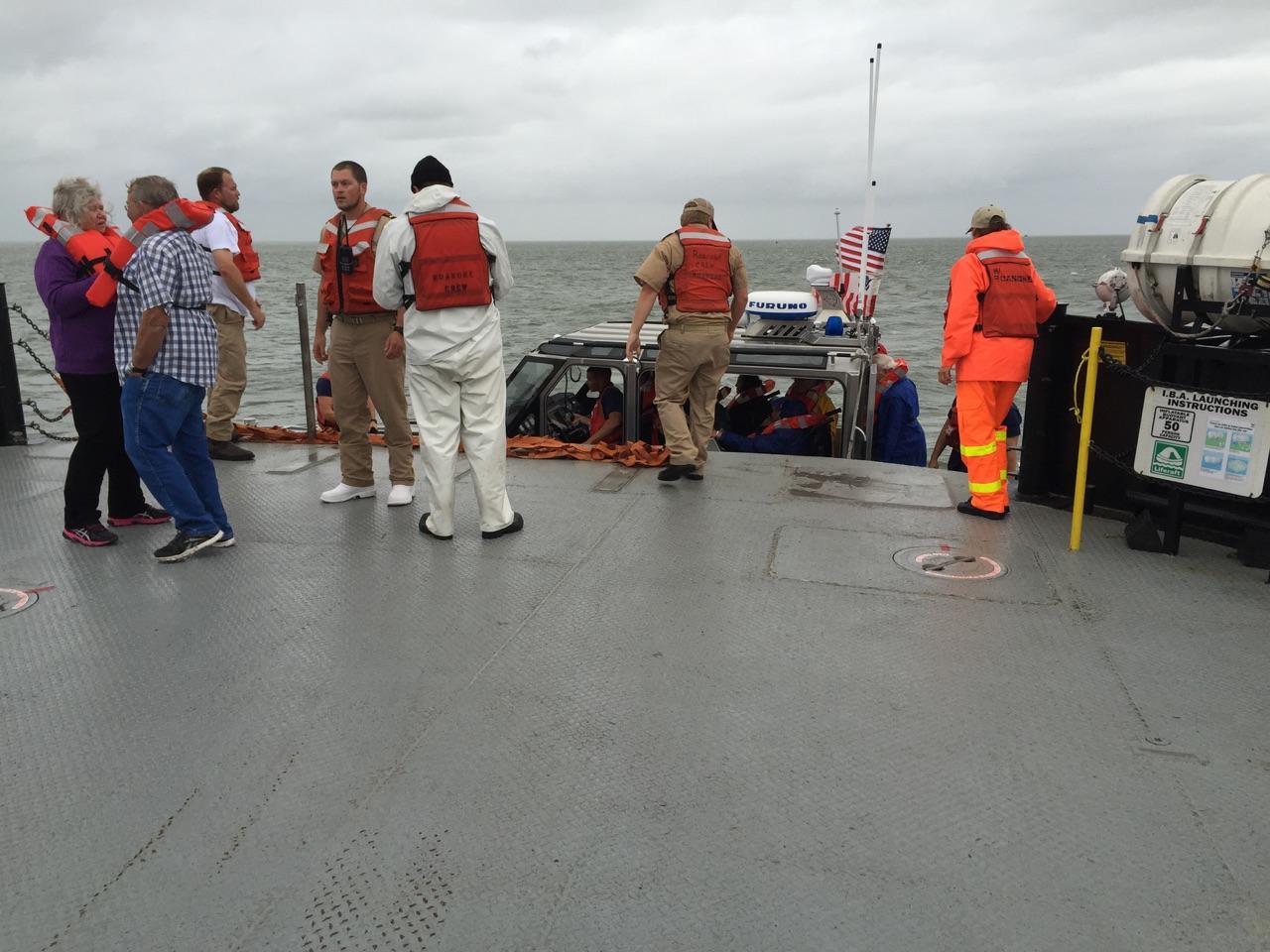
Twenty-three passengers on the 10:30 a.m. ferry from Ocracoke Monday were transferred to U.S. Coast Guard response boat after the ferry  got stuck in a shoal near Hatteras.

The North Carolina Ferry System’s ferry Roanoke ran “soft aground” around 11:30 a.m.in an ebbing tide, according to Tim Hass, Ferry Division spokesperson.

There were 16 vehicles, 23 passengers and seven crew members aboard. The Coast Guard was notified at 2:20 p.m. according to their press release.

No injuries were reported, and at no time were passengers or crew members in any danger, Hass said.

One of the division’s tug boats, the Albemarle was sent to free the Roanoke from the shoal. Once that process is complete, the Roanoke was to be towed to the Hatteras terminal to unload vehicles and be inspected for any damage.

However, ferry crews managed to free the vessel before the tug arrived.

At the time of the grounding, winds were from the southeast at 20 to 25 knots with gusts to 30.  Low tide was a little after midnight today.

Hass said the grounding occurred around channel marker #12.

“They had come through the Barney Slough (the long, natural channel) and had just made the turn toward Hatteras,” he said. “There’s a little bit of a choke point there.”

When ferries run aground, that doesn’t halt all traffic, he said, although the division did miss a couple of runs.

Hass also said that it’s not mandatory for passengers to depart a ferry when these things happen.

Plans are being developed to refloat the ferry.


The U.S. Coast Guard evacuates passengers from the ferry, M/V Roanoke, which ran aground this morning en route from Ocracoke to Hatteras. Photo by Greg Capell
The U.S. Coast Guard evacuates passengers from the ferry, M/V Roanoke, which ran aground this morning en route from Ocracoke to Hatteras.
Photo by Greg Capell


Singing twins to perform on Ocracoke, promote music in schools

0
Twins Adrian and Julian Woodrow form the band
Twins Adrian and Julian Woodrow form the duo “Take 2,” and will perform Tuesday night at 7 in the Ocracoke School gym. A portion of the proceeds will benefit the school. Photo courtesy of Take 2.

Take 2, identical-twin singer-songwriters Adrian and Julian Woodrow touring North Carolina’s Coastal schools, will perform at the Ocracoke School gym tomorrow night (Nov. 10) at 7.

Local students will perform opening acts, and parents and community members are invited to attend. Admission is $5 and a portion of the proceeds benefit the Ocracoke School.

Earlier in the day, Take 2 will do motivational talks and a mini-concert for the students.

Doors for the public concert open at 6 p.m. and attendees will receive free posters.

Their song “Friends” is popular now, said their father Gordon Woodrow.

The twins also will perform in Hatteras and in Columbia, Tyrell County, this week he said.

The 18-year twins live in Southern Vermont and graduated from high school this year.

As teenagers, they taught themselves to play the ukulele, guitar and piano. Schools started asking them to play live.

After seeing how underfunded and forgotten the local music programs were, the twins started performing at schools to inspire other students to enjoy and create music.

They toured 44 schools in the spring semester and had so much fun that they’ve decided to chase their biggest dream– to tour in every major city in the United States.

Hence, the “Dream BIG Tour” was launched last month where they give daytime concerts in schools and share their experiences in the music business with kids of all ages,  singing original tracks from their debut album and getting everyone dancing to popular cover songs,

They also share stories about how they got started singing and songwriting, and explain how they generated over 2.6 million hits on YouTube.

The duo have competed on The Voice and X-Factor and tell humorous backstage stories about what it was like to go through those competitions and perform in front of 4,000 people.

Some proceeds from every concert are used to cover travel expenses so that Take 2 can give free concerts in under-served schools where there’s often inadequate funding for arts and music programs.

School districts across the nation are dropping music and art curriculum because of budget cuts, yet our students are living in a world where creativity and innovation will drive the economic advancement of our nation.

Take 2 has partnered with PeerSpring, a youth social innovation platform, to raise money for music education.

All donations make it possible for Take 2 to offer free music programming for schools by directly supporting program expenses.  That website is https://www.peerspring.com/project/follow-your-dreams/

Visit Take 2’s website at www.take2official.com.

Singing twins Adrian and Julian Woodrow during one of their school performances. Photos courtesy of Take 2.

When and how will Hatteras ferry toll saga end?

0

Editors’ note: This is an update to an editorial printed in the November edition of the Ocracoke Observer. 

In the last couple of  weeks, Ocracoke residents and businesses have had to face the prospect once again of tolling the Hatteras car ferries.

As of now, the parties pressing for a toll to generate funds for replacement ferries have agreed to wait until after the General Assembly convenes next spring to see if these funds can be appropriated out of the NCDOT general fund. (See the story about Dare County Commissioner Warren Judge apologizing to Hyde County by clicking here.)

We will keep an eye on this situation, but for a short time recently the prospect of a toll on the still-free Hatteras ferry loomed.

Since 2011 when ferry tolls were proposed, the island (and its friends) has successfully fought off this gambit.

For the last year, NC Ferry Division officials have, in their monthly meetings on the island, focused primarily on the addition of a for-fee passenger ferry from Hatteras into Silver Lake. The state has received a $7 million federal grant to help make this happen, including the necessary infrastructure and the purchase of one ferry. This is a great plus since it is outside of the region’s shared transportation pot as you will see below. A feasibility study on this is expected to be completed before the end of this year.

Up until October, ferry tolls were not a topic in these community meetings.

So, many were surprised when County Manager Bill Rich reported at the Hyde County Commissioners’ October meeting and the following week at the Ocracoke Civic and Business Association that a ferry toll for Hatteras was back on the table. One proposal, he revealed, would allow anyone to purchase a commuter pass for Hatteras, Swan Quarter and Cedar Island for $75 per year. Visitors and islanders alike not opting in for this pass would pay a one-way or round-trip fee to be determined.

The Ferry Division is grappling with how to get much-needed money to pay for replacement ferries in their aging fleet of 22 boats. The average age of the boats is 26 years old, with two that have been in service for 52 years and one for 47 years. As you can imagine, older boats need more frequent repairs which takes them out of service for various periods of time. New car ferries cost about $16 million while a passenger ferry would cost around $2 million.

The challenge for the Ferry Division was made even greater when in 2013, Gov. Pat McCrory launched a new way to fund transportation needs statewide.  He divided the state into 10 regional transportation planning organizations allocating $32 million to each to fund all transportation needs, including road repair, bridge maintenance, snow and sand removal and new ferries.

Ocracoke is part of the Albemarle Regional Planning Organization (ARPO) which consists of 10 Eastern Carolina counties. As it stands now, it is the ARPO, not the General Assembly, that has the authority to decide whether to implement a toll for the Hatteras ferry.

After a briefing by the Ferry Division, the Dare County Commissioners, who are among the 10 counties in the ARPO, voted 6 to 1 at their October meeting to support such a Hatteras toll should this be on the quarterly ARPO meeting agenda. In the Dare meeting, no one speculated on what impact a ferry toll would have on Ocracoke’s economy. 

Hyde County officials and Rep. Paul Tine (U-Kitty Hawk) who were attending the Ocracoke monthly ferry meeting earlier that same day were unaware that ferry tolls would be on the Dare County agenda and Ferry Director Ed Goodwin say he would fight for what Ocracoke wants. So much for communication.  

Ferry tolls made the agenda for the ARPO quarterly meeting on Oct. 21, but no vote was taken.  The issue is expected to be taken up in the Jan. 21 meeting.

We don’t envy the Ferry Division’s difficult challenge of having to come up with ferry replacement money. They have to provide service and are frustrated that, although promised, no real money is currently available outside of the $32 million fund.

And certainly it is not realistic that ferry purchases should come out of this limited transportation fund to serve 10 counties.

In the General Assembly, Tine  and Rep. John Torbett (R-Gaston), who are co-chairs of the House Appropriations Committee Transportation, are strongly against tolls on any ferry. They want to get funding for ferry replacement out of the ARPO fund and are working on getting the General Assembly to take up this issue when it reconvenes in April.

Replacing a ferry is the same as replacing a dump truck, Torbett said.

The Hatteras-Ocracoke route is the most traveled ferry in the NC system, having carried 305,744 vehicles in 2014, or 34 percent of the traffic on all  seven routes, according to a presentation made by Jed Dixon, assistant ferry division director in April to the House Appropriations, Transportation, Committee.  The next most-traveled route is Cherry Branch at 238,681, and the least traveled is Currituck at 24,450.

So it’s no wonder that policymakers see dollar signs to be had here.

The Ferry Division has been requested to seek funding by obtaining sponsorship naming rights. So far, nothing has come of this.

We are concerned that not enough discussion has focused on the impact a ferry toll would have on Ocracoke’s small business economy.  How many “day-trippers” (visitors) who spend just the day, would decide not to make the trip due to this fee?  Would they take the ferry for a round-trip of $10? Would they take it for $30?

The number of visitors is already down in the past two years by 30 percent due to the extended travel time caused by shoaling. It is hard to imagine that a ferry toll would boost visitors.

We also question whether tolls would come close to covering the costs of new ferries.

Will Letchworth, an engineer with Volkert, the group conducting the passenger ferry feasibility study,  conducted a survey for the DOT in 2012. He had confirmed that his research showed the state would incur costs to build the infrastructure needed to collect tolls on untolled ferries and that there would be a decrease in ridership if tolls were raised.

The passenger ferry may increase visitors, but this would not be implemented until at least 2017 and would be limited to the tourist season

Rich is supportive of replacing some of the car ferries with passenger ferries, which would be a lot cheaper. Getting people to leave their cars for the day may take some convincing.

The free ferry has been part of the Ocracoke fabric, and to add a toll without an economic impact study could be disastrous for the island. There are those elsewhere in the state that are adamant against tolling roads or bridges in their regions as well as Interstate 95. Why? They say it would hurt local business.  

A more fundamental argument is whether it is legal (let alone fair) to charge residents to come and go to their homes on an island which is the continuation of a state highway: Highway 12 South extends from Nags Head, through Hatteras, through Ocracoke Island and then onto Cedar Island.

It is not reasonable that money be taken from the $32 million dollar transportation fund for the 10 counties to pay for ferries. We support Reps. Tine and Torbett’s efforts to procure funding outside of $32 million yearly allocation.

But time is running out.

Tine, who represents Ocracoke, recently announced that he would not seek reelection and will leave office at the end of 2016. His departure as a lawmaker will be a big blow to Ocracoke.  

We hope that he and his Republican colleague co-chair Torbett will be successful in procuring funds when the Assembly reconvenes in April, and that the Ferry Division finds sponsors that will help offset these high replacement costs.  

OPS membership meeting Tuesday night

0
Blanche Jolliff Howard, left, kin to many islanders, is a wealth of information about old-time Ocracoke. She is pictured here with cousin Amy Howard, Ocracoke Preservation Society administrator. Blanche will be honored at the OPS membership meeting and pot luck supper starting at 6 p.m. Tuesday, Nov. 10, in Deepwater Theater.

The Ocracoke Preservation Society fall membership meeting is scheduled for 6 p.m. Tuesday, Nov. 10 in the Deepwater Theater, not Nov. 9 as was reported in the print edition of the Ocracoke Observer.

Blanche Howard Jolliff will be honored with the society’s second Cultural Heritage Award. Last year the inaugural award went to Earl O’Neal Jr.


The winner of the 2015 Historic District House Award will also be announced.

Philip Howard will be the speaker on the topic of island cemeteries. He promises not to be morbid or scary.

This is a pot luck event and new members are welcome.

Deputies investigate incidents in October

0
Hyde County deputy sheriffs patrol in this golf cart.

By Connie Leinbach

Since Sept. 15, the Hyde County Sheriff deputies have logged the following incidents:

Receipt of an “air soft” toy handgun.  This was found on the ground at the south end ferry lines and turned into the ferry office, said Capt. Jason Daniels.

“This toy looks real,” he said. “If someone would point it at you, it looks like a real gun.”

Typically, toy guns have red plastic barrels so that they can be distinguished from the real thing, but these toys do not.

A breaking-and-entering of an unlocked vehicle in which some items were stolen.

“Most of these vehicles are unlocked,” he said. “If you keep your vehicle unlocked, sooner or later, it will get broken into (even on Ocracoke). So, lock your vehicles.”

An unauthorized use of a vehicle resulted in that vehicle being driven into a ditch and left. Daniels said the vehicle was retrieved and not badly damaged.

A larceny of some medications.

An out-of-state man was arrested from driving while impaired after driving wildly and “tearing up the island” around 11:30 earlier in October. There were no accidents or injuries. The man was also charged with reckless and careless driving.

One investigation of an alleged shoplifting incident.

Daniels stressed that island residents and businesses who need the deputies in such situations should call the sheriff’s office at 252-926-3171. They can send the deputies on duty right away.

While many islanders have Daniels’ and other deputies ‘cell phone numbers–and are encouraged to call them any time–when a deputy is needed immediately, his cell phone is not the number to call since they may be off duty and unable to respond.


NC Ferry Division meeting on Ocracoke canceled, upate on ferry tolls

2
2015-10-22 06.54.50
Photo by P. Vankevich

By Connie Leinbach

Editor’s note: The regular monthly meeting Nov. 9 with NC Ferry Division officials has been canceled and may be rescheduled to later in the month.

Warren Judge, a Dare County commissioner, apologized to Hyde County

Warren Judge
Warren Judge

Monday night for voting to approve the concept of tolling the Hatteras ferry.

“I own the vote,” Judge told the commissioners in person when he attended the Commissioners meeting, Nov. 2 in Swan Quarter  about the action that body took Oct. 19 unbeknownst to Hyde County officials.

The Hatteras ferry is still free, but in recent weeks there’s been movement afoot to again consider levying a toll on it.

Ed Gooddwin Bill Rich Paul Tine at Oct9 19 meeting . Photo by P. Vankevich
Ed Gooddwin Bill Rich Paul Tine at Oct. 19 meeting . Photo by P. Vankevich

“It was a mistake and if I have an opportunity to vote again, I will vote against tolls,” Judge said in an interview Thursday.

He said he is opposed to tolls and hadn’t been aware of Hyde County’s opposition to tolls when his board voted.  From the presentation by Jed Dixon, deputy ferry division director, that night, Judge thought that a toll was inevitable and hence his vote.

This vote had been taken to give the Dare representatives on the Albemarle Regional Planning Organization (ARPO) direction should this matter come up at the ARPO meeting, said Wally Overman, vice-chair of the Dare board, in an interview on Oct. 20.

Since 2013, the state tossed the matter of tolling ferries (to fund replacement boats) to local planning agencies.  Hyde County is a member of the ARPO.

Hyde County Manager Bill Rich said Thursday he is scheduled to speak at the Nov. 16 Dare County commissioners’ meeting to “respectfully request they revisit their vote and rescind it.”

Rich said the Dare commissioners sent the wrong message with their vote.

“It’s non-productive for northeast North Carolina,” he said.

Rich, who is a member of the Transportation Coordinating Committee (TCC) which advises the ARPO, had reported after last week that this group agreed to table the tolling issue and wait to see if state representatives John Torbett (R-Gaston) and Paul Tine (Unaffiliated-Kitty Hawk) could get the funding for ferry replacement out of the local pot of money.

Since all of these meetings, Rich said he wrote a letter explaining the situation and sent it to the ARPO, Gov. Pat McCrory, Tine and Torbett.

“They jumped all over it,” Rich said on Thursday. “I got responses from all of them and they were all positive.”  He also sent his letter to the Dare County commissioners.

Torbett in an interview Thursday said he met Wednesday with Ferry Division Director Ed Goodwin and Malcolm Fearing, who is the Dare representative on the DOT Board of Transportation, which oversees the DOT.

“I told them my intent to get vessel replacement out of ARPO and get it into the main transportation budget,” he said. “And they (Goodwin and Fearing) did agree with that.”

Replacing a ferry is the same as replacing a dump truck, he said.

Torbett, who is a co-chair of the House Appropriations Committee Transportation with Tine, said he and Tine will work on this scenario.

“I may have a solution ready to go when session opens in April,” he said. “Then all this talk will end,” he said about tolling. “We don’t intend to apply a hardship on North Carolinians.”

Judge also said the matter of tolling is about equity statewide.

“I don’t know how they rationalize that the ferry is any different from a bridge,” he said. “If the Legislature decides to toll roads, bridges and ferries, then I’m OK with it as long as it’s equitable.”

While NC DOT Ferry Division officials have talked the last several months during their monthly community meetings with islanders about the addition of passenger ferries to the car ferries, the subject of tolling the still-free Hatteras ferry has not come up.

Goodwin has mentioned several times how much more it is costing the ferry division to run ferries in the long route between the islands– about $2 million more a year–since heavy shoaling closed the traditional short route.  He also reiterated the need for revenue to pay for replacing aging ferries, two of which are 52 years old.

Right now, the cost of replacing car ferries (at about $15 million each) is included in the $32 million pot of money the state gives to each of 10 regional planning organizations to finance all transportation needs in the respective districts.

This new method, created by Gov. Pat McCrory in 2013, is called the Strategic Transportation Investments (STI). Prior to that, ferry replacement was funded through appropriations by the General Assembly.


November issue now available

1

Page 1 Nov Observer

The November print issue of the Ocracoke Observer hits the stands this morning. The Ocracoke Coffee shop, Variety Store, Slushy Stand, The Magic Bean, NPS Visitors Center, Ferry Division office, The Community Store, The Village Craftsmen and Howard’s Pub are some of the many locations where it is available.